For years, El Cerrito council members claimed to support its senior community. From 2010 to 2018, the City maintained a dedicated senior center. Then, without warning—and despite having just passed a Real Property Transfer Tax touted as a revenue source for the senior center—the City shut it down. Seniors were left with promises and platitudes, but no space to call their own.
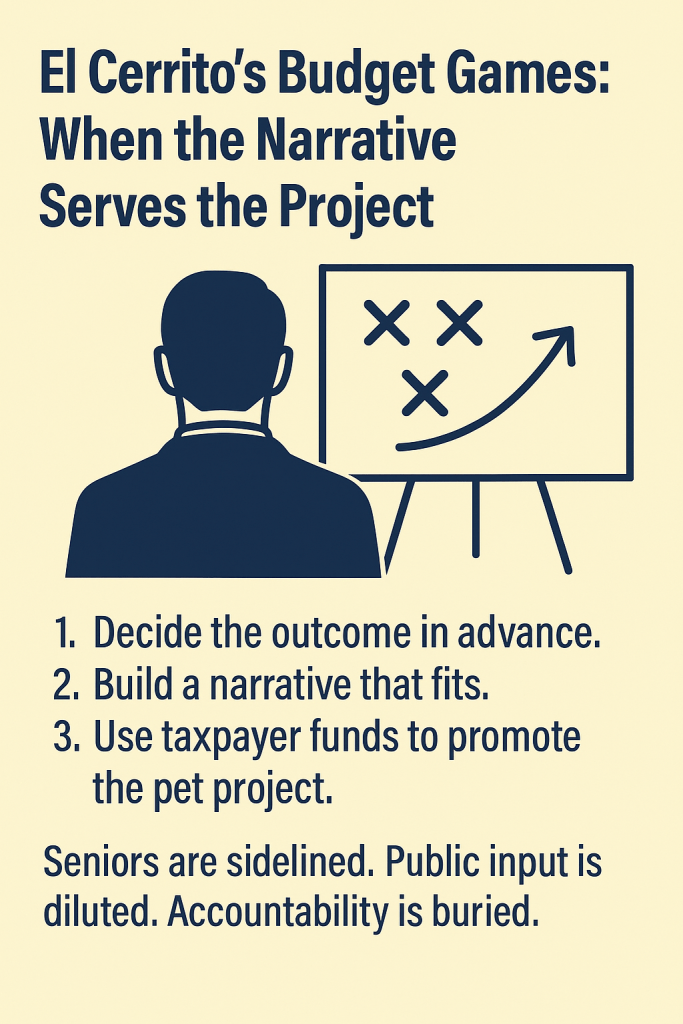
If you listened to the June 18, 2025, council meeting, it became even clearer: El Cerrito’s leadership doesn’t just let the facts drive policy—they build the story to justify the project they’ve already chosen.
Pet Projects First, Justifications Later
Councilmember Ktsanes stood alone in calling for a dedicated senior center:
2:28:24 Ktsanes: “I prioritize having a dedicated senior center return to El Cerrito.”
What followed was a coordinated pivot away from the issue—not based on need, but on political and fiscal convenience.
2:29:29 Quinto: “We already have a senior center. And that is a community center… Period… Our priority is a library… and a public safety building.”
It’s worth noting that this contradicts years of public engagement that identified three priorities: a senior center, a library, and a public safety building. Now the story has changed. The library comes first, public safety second, and the senior center? Conveniently erased.
Councilmember Motoyama went further, framing the issue not as one of community need, but as an emotional burden:
2:31 Motoyama: “I have PTSD from the Midtown Services Center. We lost $500,000… sometimes we cannot afford a senior center… That’s a staffing question.”
Mayor Wysinger also weighed in with an unfortunate framing:
2:40 Wysinger: “We can’t afford niche things, and I don’t want people in our senior community to think I am calling them a niche. But at the same time we simply cannot afford to fund something that serves only one specific group.”
The City Manager, Karen Pinkos, reinforced the position:
Pinkos: “I did let [Supervisor Gioia] know that having a senior center requires more staffing… We were not prepared to take on yet another building.”
Fiscal Austerity—Selective and Strategic
This narrative of scarcity collapses under scrutiny.
Just after this discussion, the Council approved over $900,000 for pool repairs—including $220,000 for consulting fees alone. The full repair is expected to cost more than $3 million. And plans for a new library are still advancing, with cost estimates in the tens of millions- funded on new taxes.
So let’s be clear: El Cerrito doesn’t have a resource problem—it has a priority problem and a service delivery problem.
The City declined a county offer to build a senior center. The staffing costs that supposedly block a senior center didn’t block the pool spending. And the library? Full speed ahead.
A Pattern of Manipulating Public Trust
This is how El Cerrito governs:
Decide the outcome in advance. Build a narrative that fits. Use taxpayer funds to promote the pet project.
The result? Seniors are sidelined. Public input is diluted. And accountability gets buried under a carefully crafted storyline.
If El Cerrito truly wants to lead with integrity, it must stop reverse-engineering justification for predetermined projects. It must engage in honest, community-driven budgeting—not just selective storytelling.
 El Cerrito Committee for Responsible Government (ECCRG)