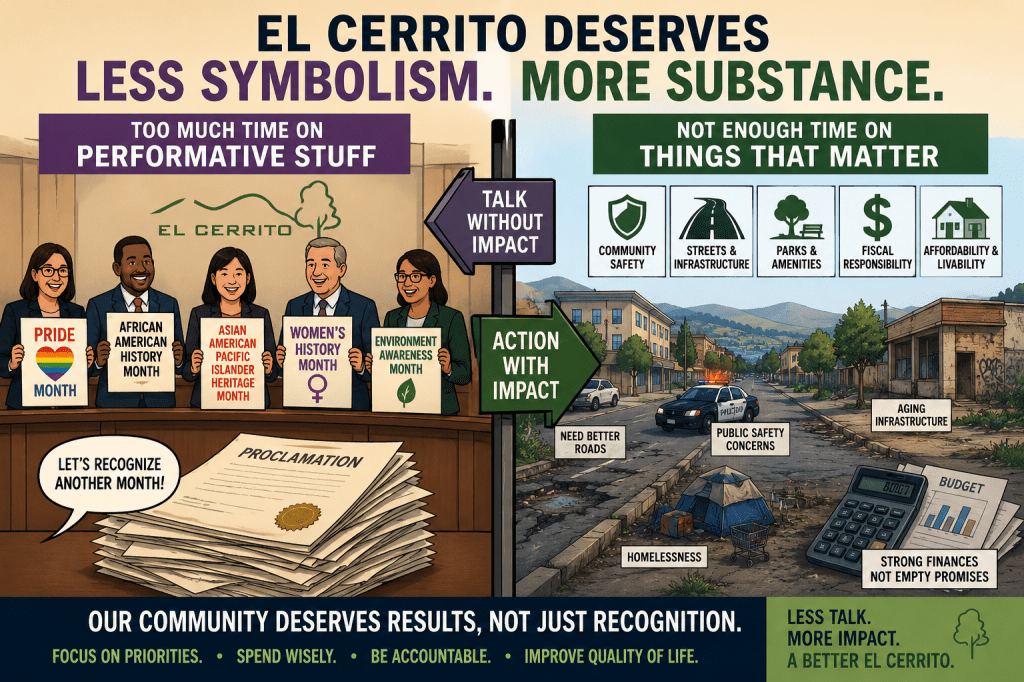
El Cerrito spends a remarkable amount of time celebrating things that would happen whether the City Council proclaimed them or not.
Every year we see proclamations, recognition months, awareness campaigns, ceremonial presentations, and symbolic gestures. Pride Month. African American History Month. Asian American and Pacific Islander Heritage Month. Women’s History Month. Environmental awareness events. Cultural celebrations. The list goes on.
There is nothing wrong with recognizing the diverse people who make up our community. Most residents support treating people with dignity and respect.
The question is whether these activities deserve the amount of attention they receive when compared to the challenges that directly affect the daily lives of El Cerrito residents.
The City’s own Strategic Plan repeatedly emphasizes quality of life, community safety, financial responsibility, infrastructure, and maintaining a high-performing organization. The plan specifically identifies community safety, infrastructure, amenities, livability, belonging, and fiscal responsibility as core priorities.
Yet many residents look around and see a different reality.
They see a city struggling with long-term financial challenges. They see roads, facilities, and infrastructure that need attention. They see concerns about crime, homelessness, traffic, pension obligations, reserve levels, and the affordability of major capital projects. These are the issues that determine whether people feel safe, whether businesses thrive, and whether families choose to stay in El Cerrito.
Residents rarely ask for another proclamation.
They ask for competent government.
They ask for transparency.
They ask for fiscal discipline.
They ask for accountability.
They ask for measurable improvements to their quality of life.
A successful city should certainly celebrate its diversity. But celebration is not a substitute for governance.
The measure of local government is not how many awareness months it recognizes. The measure is whether residents feel safer, whether parks and infrastructure improve, whether finances are sustainable, whether businesses succeed, and whether taxpayers believe their money is being managed responsibly.
Recognition has its place.
Results should come first.
The residents of El Cerrito deserve a City Council that spends less time telling us what values it supports and more time demonstrating those values through sound decisions, measurable outcomes, and a relentless focus on the issues that actually affect life in our community every day.
The most important fact in this entire discussion is also the simplest.
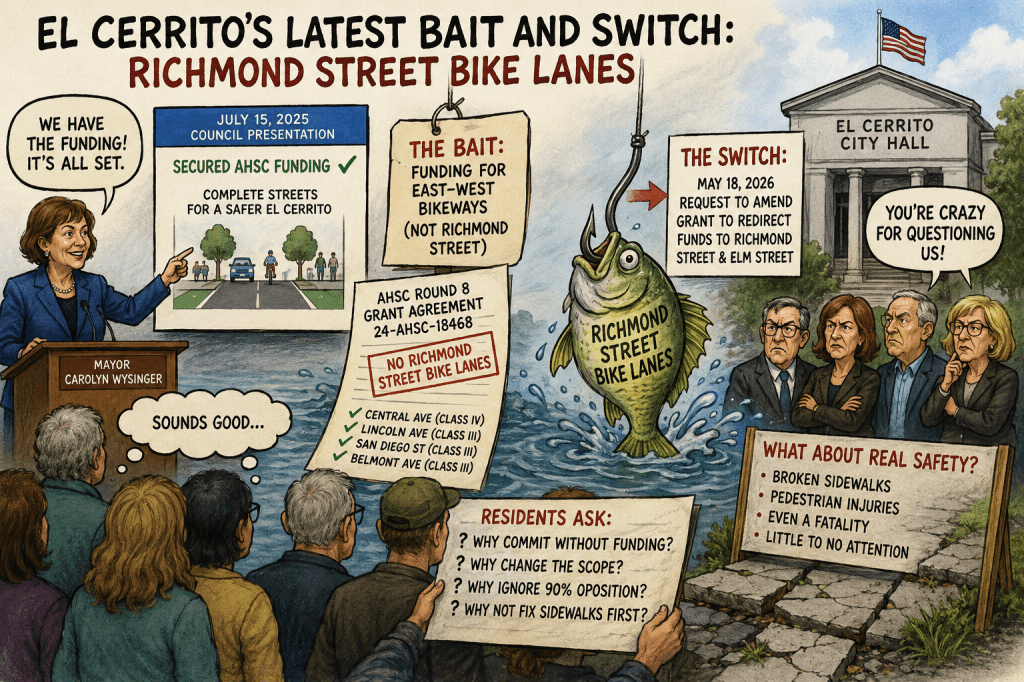
The grant that El Cerrito received did not fund Richmond Street bike lanes.
A concerned El Cerrito citizen reviewed the actual Affordable Housing and Sustainable Communities (AHSC) Round 8 grant agreement associated with the El Cerrito Plaza Transit-Oriented Development project. The grant specifically funded east-west bicycle improvements, including facilities on Central Avenue, Lincoln Avenue, San Diego Street, and Belmont Avenue.
Richmond Street was not included in the approved bicycle scope.
That is not a matter of interpretation. It is a matter of reading the grant agreement.
Yet during a July 15, 2025 City Council presentation, City staff discussed Richmond Street bike lanes as though they were the anticipated outcome of the project. Residents listening to the presentation could reasonably conclude that the proposed removal of parking on Richmond Street was part of the funded plan.
It was not.
The City had secured funding for east-west bicycle improvements. The City had not secured funding for Richmond Street bike lanes.
That distinction is critical because it changes the entire timeline.
If Richmond Street was not part of the funded project, why was the City presenting it as the expected outcome?
If funding had not been secured, what commitment had already been made?
And if the grant did not authorize Richmond Street bike lanes, why were residents who raised questions often treated as though they were misunderstanding the project?
These questions became even more important when subsequent documents revealed that the City later sought to amend the grant agreement itself. In May 2026, Public Works Director Yvetteh Ortiz requested permission from the California Department of Housing and Community Development to remove previously approved bicycle improvements and substitute the Richmond Street bike lane configuration instead.
In other words, the City first presented Richmond Street as the likely outcome and only later sought approval to redirect grant funding toward that outcome.
For many residents, that sequence of events is exactly what raises concerns about transparency and public trust.
The results of Measure C send a clear message from the residents of El Cerrito: enough is enough.
For years, four out of five members of the City Council publicly supported a plan to place a new library at the Transit-Oriented Development (TOD) site near BART. They endorsed a financing strategy that would have allowed the City to issue up to $37 million in bonds and impose a permanent parcel tax on property owners. Supporters argued it was the only way to move the project forward. Voters disagreed.
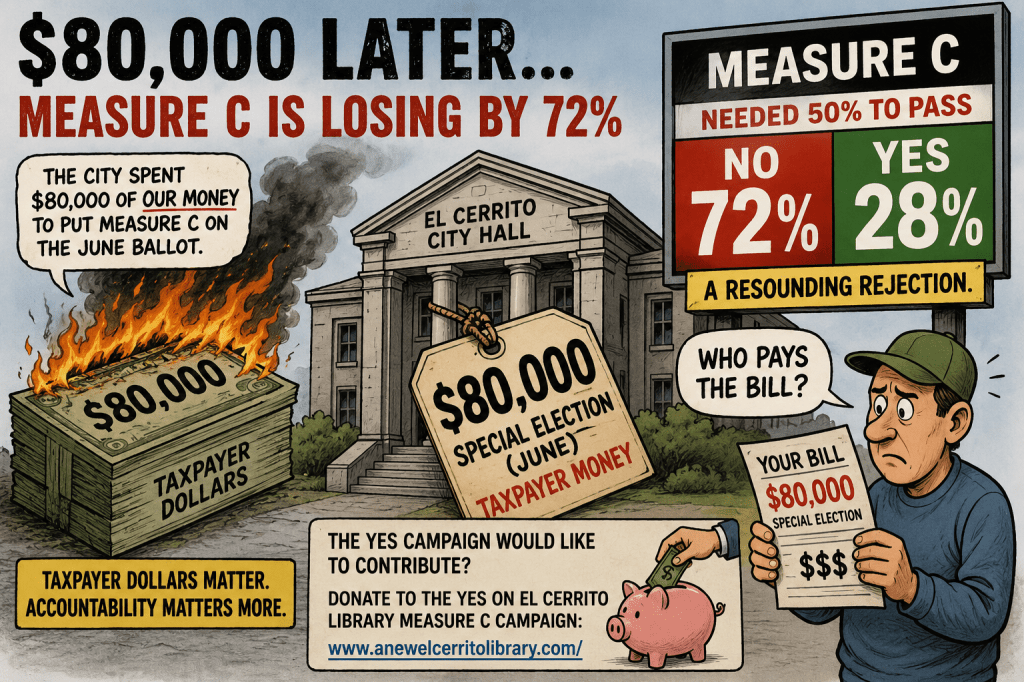
Before the election, the City spent approximately $80,000 of taxpayer money on election-related costs associated with putting Measure C before voters. Yet there was no urgency requiring the measure to be placed on this special election ballot. City leaders could have waited until November, when voter turnout would likely have been higher and election costs significantly lower.
More importantly, many residents concluded that the proposal was not fiscally sound. The measure created a permanent revenue stream while providing broad flexibility regarding how the project would ultimately be delivered. For voters already concerned about the City’s long-term financial condition, rising pension obligations, and continued reliance on reserves, that was a bridge too far.
This election was never just about a library. Most residents want a great library. The debate was about trust, priorities, and financial stewardship. Voters were asked to support a substantial long-term tax commitment while many fundamental questions remained unanswered about project costs, alternatives, and the City’s overall financial strategy.
The outcome demonstrates that residents are paying attention. They are looking beyond slogans and campaign mailers. They want transparency. They want accountability. They want realistic plans that balance community needs with fiscal responsibility.
The rejection of Measure C should not be viewed as opposition to libraries. It should be viewed as a call for better governance. The community deserves a thoughtful discussion about library needs, alternative locations, phased approaches, grant opportunities, partnerships, and projects that fit within the City’s financial means.
The voters have spoken. They overwhelmingly rejected the status quo and the approach championed by a majority of the City Council.
Now comes the important part: listening.
Rather than returning with another version of the same proposal, City leaders should take this opportunity to engage residents in a genuine public process that prioritizes capital needs.
El Cerrito deserves responsible financial leadership.
The message from voters is clear: it’s time for a change.
Voters did not narrowly reject the measure. They overwhelmingly rejected it.
That makes one question impossible to ignore:
Who should pay for the $80,000 special election?
The City of El Cerrito chose to place Measure C on the June ballot rather than wait for the November election. According to information from the Contra Costa County Clerk-Recorder’s Office, that decision cost approximately $80,000 in taxpayer funds.
Those dollars are gone.
Four of the five City Council members argued there were good reasons to hold this election in June. Some cited grant opportunities. Others pointed to project timing, inflation, or the desire to move quickly. Whatever the rationale, voters have now rendered a decisive verdict.
The measure is losing by roughly 72% to 28%.
When a proposal is rejected by nearly three-to-one, it is fair to ask whether spending $80,000 on a special election was a wise use of public resources.
The irony is hard to miss. Residents urged the City Council to wait until November, when the measure could have appeared on a regularly scheduled ballot at no additional election cost. Those requests were ignored.
Instead, taxpayers were asked to fund an $80,000 special election while also being asked to approve a permanent parcel tax.
Now the election is over, the money has been spent, and the voters have spoken. The result is not close. It is a clear and decisive rejection of both the measure and the urgency used to justify placing it on a costly June ballot.
So who should pay the bill?
Under current law, the answer is simple: the taxpayers.
But perhaps there is another option.
The campaign committee that advocated for Measure C raised money to persuade voters that this was the right path for El Cerrito. If supporters remain convinced that the special election was necessary, perhaps they would consider reimbursing the City for the cost of holding it.
At a minimum, residents deserve an honest discussion about why a special election costing $80,000 was necessary when the result was such an overwhelming rejection.
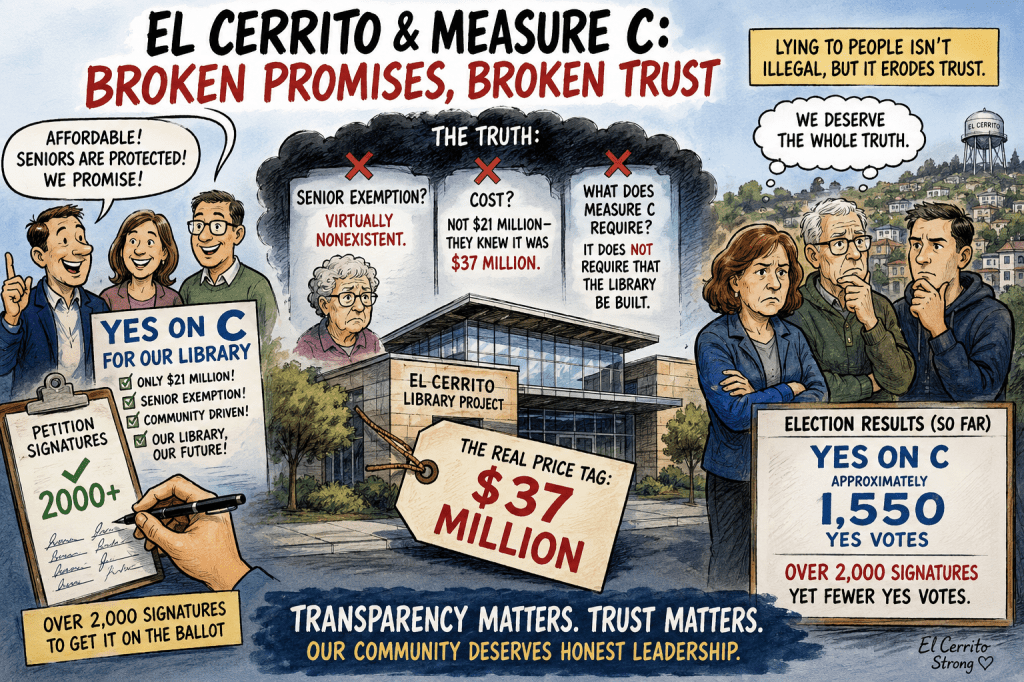
The latest election results reveal something remarkable. Measure C currently has approximately 1,550 “Yes” votes, a number that appears to be significantly lower than the more than 2,000 signatures gathered to qualify the measure as a citizen initiative.
That fact alone should give city leaders pause.
Residents were told that Measure C was a grassroots effort driven by community demand. More than 2,000 signatures were collected to place the measure on the ballot. Yet now, after months of campaigning, public outreach, mailers, consultant studies, and advocacy, the measure appears to be receiving fewer votes than the number of people who originally signed the petition.
Why?
One possible answer is that voters learned more about the details.
Throughout the campaign, residents were repeatedly told that the project would cost approximately $21 million. Yet city officials already knew the estimated cost had increased dramatically, reaching roughly $37 million. That is not a minor discrepancy. It represents millions of dollars in additional public obligations that voters deserved to understand before casting their ballots.
Residents were also told that seniors would be protected through an exemption program. In reality, the exemption is so limited that many residents have described it as virtually nonexistent. The promise sounded reassuring in campaign materials, but the practical benefit appears far smaller than many voters were led to believe.
Perhaps most importantly, many voters were never clearly informed that Measure C itself does not require construction of the proposed library project. The measure authorizes the collection of a permanent parcel tax and potentially the issuance of bonds, but it does not legally guarantee that a new library will ultimately be built. That distinction matters.
Reasonable people can disagree about taxes. Reasonable people can disagree about the best location for a library. Reasonable people can even disagree about whether El Cerrito should spend $37 million on a new facility.
What should not be controversial is the expectation that voters receive complete and accurate information before being asked to approve a permanent tax.
Lying to voters is not necessarily illegal. Omitting inconvenient facts is not necessarily illegal. Presenting only the most favorable version of a proposal is not necessarily illegal.
But it does erode trust.
Trust is one of the most valuable assets a local government possesses. Once residents begin to believe that important details are being withheld, future initiatives become harder to pass, future public engagement becomes more difficult, and confidence in local leadership declines.
Most El Cerrito residents want a great library. They want quality public services. They want a city that plans responsibly for the future.
What many residents appear unwilling to support is a process that leaves out critical facts while asking taxpayers to make a permanent financial commitment.
Whatever happens with Measure C, the lesson should be clear: transparency matters. Public trust matters. And when voters feel they have not been given the whole story, they have a way of making their voices heard at the ballot box.
What makes this election particularly noteworthy is that it may be the first time in recent El Cerrito history that a major City-backed ballot measure has faced organized and effective opposition.
For months, supporters of Measure C characterized opponents as anti-library, accused residents of spreading misinformation, and in some cases described critics as bullies. Some residents even reported concerns about being publicly targeted or doxxed for questioning the measure.
Yet the early election results suggest something different may be happening.
A vote against Measure C does not necessarily mean a vote against libraries. Many residents have repeatedly expressed support for library services while simultaneously questioning the size of the tax, the proposed financing structure, the connection to the Plaza TOD project, the potential issuance of up to $37 million in bonds, and the lack of consideration given to lower-cost alternatives.
The early returns suggest that voters may be evaluating the measure on its merits rather than accepting the narrative that opposition equals opposition to libraries. If these results hold, the election could signal a broader shift in El Cerrito politics: residents are willing to support City projects, but they are also willing to say no when they believe the proposal itself is flawed.
The message from voters may not be “we don’t want a library.”
The message may simply be: “This is a bad tax measure.”
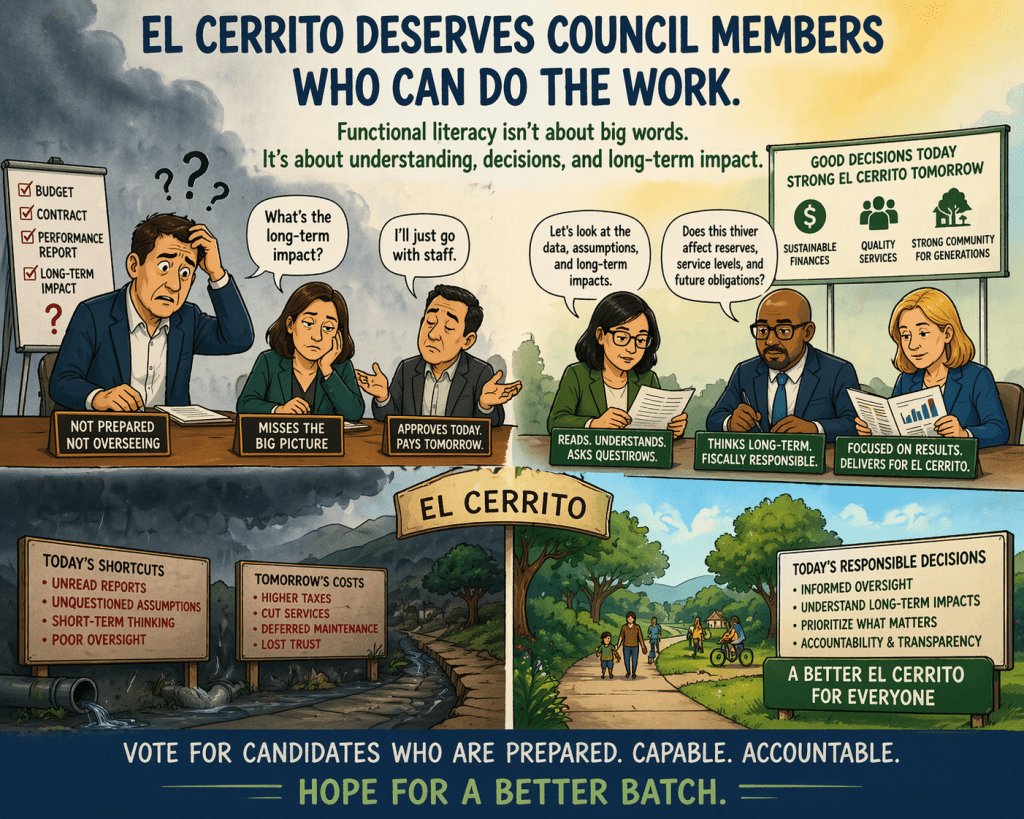
There’s a difference between being a compelling voice and being capable of governing. In El Cerrito, the stakes are too high to blur that line. The city doesn’t run on slogans or mailers. It runs on budgets, contracts, policies, and performance data. And all of that requires functional literacy in a very real, practical sense.
This isn’t about polish. It’s about whether someone can actually do the work of a council member.
What Functional Literacy Looks Like in El Cerrito
A council member in El Cerrito should be able to read a staff report and understand what is being recommended and what is not. They should be able to follow a budget document, identify where assumptions are being made, and recognize when numbers don’t align.
They need to understand the difference between one-time funding and ongoing obligations. Between capital and operating costs. Between restricted funds and discretionary dollars.
They should be able to review a contract and grasp scope, deliverables, timelines, and risk well enough to ask informed questions before approving significant public spending.
They need to interpret performance data, response times, cost per unit, service levels and connect those metrics to real outcomes for residents.
And critically, they must understand the long-term implications of decisions made today.
That means recognizing when a “small” ongoing cost compounds into a structural deficit over time. It means understanding how labor agreements, pensions, and benefit structures create future obligations. It means seeing beyond the current budget cycle to the multi-year impact on reserves, service levels, and financial stability.
That’s functional literacy in local government. It’s applied. It’s practical. And it’s non-negotiable.
Why This Matters in El Cerrito Right Now
El Cerrito has been asking residents to approve new taxes and trust that funds will be used as promised. At the same time, the city is navigating real fiscal pressure, competing priorities, and growing expectations for service delivery.
In that environment, council oversight matters more than ever.
When council members cannot fully interpret financial information or challenge it, the risk isn’t theoretical.
Budgets get approved without a clear understanding of long-term impacts. Administrative costs expand because no one is tracking how they’re allocated.
Revenue projections go unchallenged. Tradeoffs are missed because they’re not recognized.
Short-term decisions start to drive long-term consequences.
This is how structural imbalance takes hold where ongoing commitments quietly outpace sustainable revenue. The warning signs are often in the documents. But if those documents aren’t fully understood, the risks aren’t either.
Service Delivery in El Cerrito Depends on It
The same issue shows up in service delivery.
If council members cannot read and interpret operational reports, they cannot hold departments accountable for results. If they cannot connect spending to outcomes both now and over time, they cannot prioritize effectively.
That leads to misalignment.
Resources are allocated without clear performance expectations.
Programs continue without evidence of impact. Operational inefficiencies persist because they are not identified or addressed.
Over time, this compounds. Deferred maintenance grows. Service quality erodes. Costs increase without corresponding improvements.
Residents experience this as slower response times, uneven service, and a growing gap between what is promised and what is delivered.
This Is About Readiness, Not Rhetoric
Running for office in El Cerrito is a choice. Governing is a responsibility.
Functional literacy is part of being prepared to serve. It’s what allows a council member to move beyond surface-level understanding and engage with the substance of decisions that affect the entire community, not just today, but years down the line.
Without it, the role becomes reactive instead of strategic. Decisions are made based on partial understanding rather than full context.
And over time, that shows up—in the budget, in operations, and in public trust.
A Better Standard for El Cerrito
Voters in El Cerrito don’t need candidates who sound good. They need candidates who can demonstrate how they think, how they analyze, and how they account for long-term consequences.
The question is simple: can they read the material, understand it, challenge it, and make decisions that hold up over time?
The hope is just as simple: that the next group of candidates is a better batch—prepared, capable, and ready to do the work the role actually requires.
Most residents voting on Measure C likely believe they are voting for a straightforward library project.
But the reality appears far more complicated.
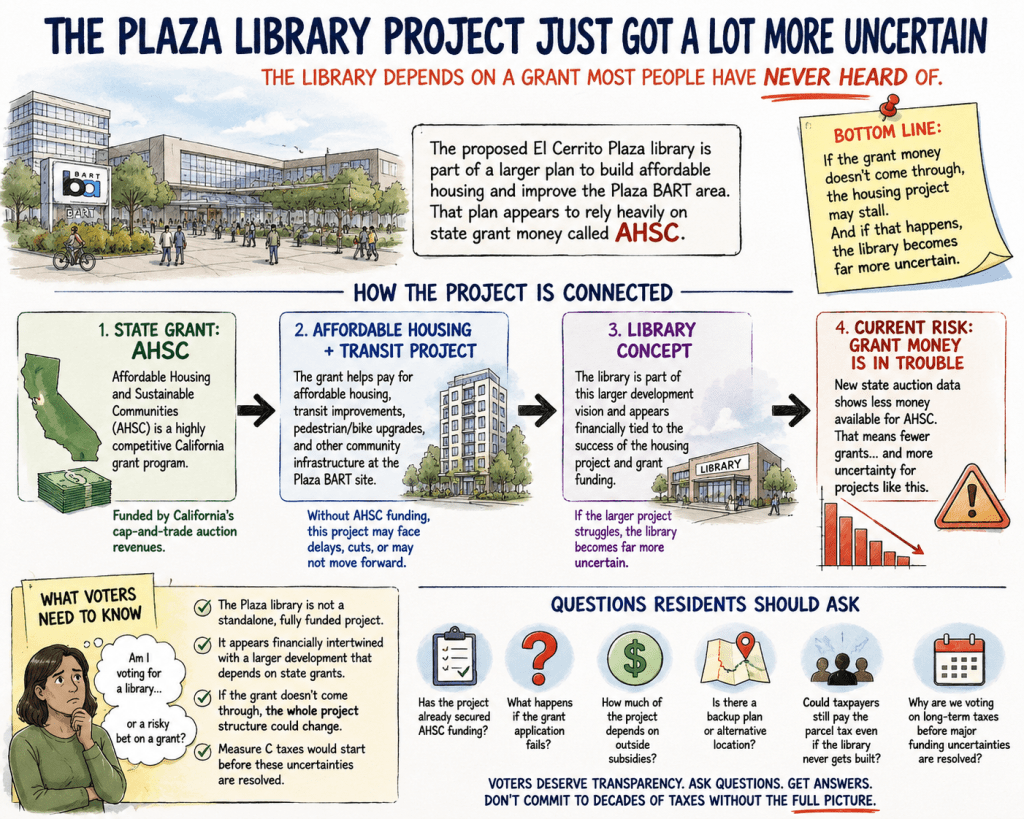
The proposed El Cerrito Plaza library concept is deeply connected to a larger transit-oriented affordable housing development planned for the BART parking lot. And that broader project appears to rely heavily on a California state grant program called Affordable Housing and Sustainable Communities — commonly known as AHSC.
Most people have never heard of AHSC.
But without it, the entire Plaza project may face serious financial uncertainty.
What Is AHSC?
AHSC is a California grant program funded primarily through the state’s cap-and-trade auction system.
The program is designed to fund projects that combine:
affordable housing
transit-oriented development
climate goals
pedestrian and bicycle infrastructure
and community-serving amenities
Projects near major transit hubs like BART are often designed specifically to compete for these grants.
That appears to be exactly what is happening with the Plaza proposal.
The affordable housing project, transit improvements, and library concept all appear financially interconnected within a larger development strategy.
Why This Suddenly Matters
This week, California released troubling new cap-and-trade auction results.
Those auction proceeds help fund AHSC grants.
When auction revenues weaken, the amount of money available for future AHSC awards can also shrink.
That creates a major problem for projects depending on those funds.
And AHSC funding is already highly competitive even in strong funding years.
If the Plaza development does not secure sufficient AHSC support, several things could happen:
the housing project could be delayed
project scope could change
financing gaps could emerge
timelines could stretch significantly
or portions of the project may need to be restructured entirely
And if the housing development struggles, the proposed Plaza library concept may also become uncertain.
The Library Is Not a Standalone Project
This is the part many voters may not fully understand.
The proposed Plaza library does not appear to operate as an isolated, fully funded civic project with all financing already secured.
Instead, it appears connected to a much larger redevelopment strategy involving:
affordable housing subsidies
state grants
transit-oriented development financing
developer participation
and future bond financing
That is a very different level of financial risk and uncertainty than many residents may realize.
Residents Deserve Full Transparency
None of this means the project cannot move forward.
But it does mean residents deserve honest conversations about:
what funding has actually been secured
what funding is still speculative
how dependent the project is on AHSC
what happens if grants are not awarded
whether alternative locations or scaled options exist
and what financial risks ultimately fall on taxpayers
Those are reasonable questions.
Especially because Measure C taxes would begin before many of these uncertainties are fully resolved.
Before Voting, Residents Should Ask
Has the project already secured AHSC funding?
If not, what happens if the application fails?
How much of the Plaza concept depends on outside subsidies?
Is there a backup plan?
Could taxpayers still pay the parcel tax even if the Plaza library never materializes?
Why are residents being asked to approve long-term taxes before major funding uncertainties are resolved?
These are not anti-library questions.
They are accountability questions.
And voters deserve clear answers before committing taxpayers to decades of new taxes tied to a project that may be far less certain than many have been led to believe.
Residents expect elected officials to make decisions and public endorsements based on what is best for the community, not on who recently contributed to a political campaign.
That is why some residents are raising questions after reviewing recent campaign finance disclosures connected to Measure C.
According to publicly available campaign filings, Alameda-owned cannabis business ECWC Partners, Inc., operating as NUG, donated $999 to the “Yes on C” campaign on May 7. The amount is notable because it falls just below the $1,000 threshold that would have triggered more immediate disclosure requirements.
The following day, on May 8, El Cerrito City Councilmember Rebecca Saltzman publicly encouraged residents to patronize the cannabis business in a social media post.
Residents can review the campaign disclosure filing themselves here:
The referenced social media post can be viewed here:
To be clear, campaign contributions are legal. Businesses, organizations, unions, developers, and advocacy groups contribute to campaigns across California every election cycle.
But legality and public perception are not always the same thing.
The issue many residents are discussing is not whether a law was technically violated. The issue is whether the sequence of events creates the appearance of political favoritism or transactional politics.
That distinction matters.
Local government depends heavily on public confidence. Residents want to believe that endorsements, public advocacy, and policy positions are grounded in independent judgment, especially when tax measures are involved.
When campaign contributions and public promotion occur within days of one another, people naturally begin asking questions:
Was this coordinated?
Was access or visibility influenced by campaign support?
Would the same public endorsement have happened without the contribution?
Even if the answer to those questions is “yes, it was coincidental,” the appearance issue still exists.
That is why transparency standards matter so much in local government. Public officials are not only expected to avoid actual conflicts of interest; they are also expected to avoid situations that reasonably undermine public confidence.
Many residents are already concerned about transparency surrounding Measure C, including evolving project costs, unclear long-term financing assumptions, questions about the project’s actual scope, and the growing role of political advocacy in what supporters describe as a community investment measure.
This latest disclosure is likely to intensify those concerns.
Ultimately, voters will decide for themselves whether this sequence of events reflects ordinary politics or something more troubling about how influence operates in local government.
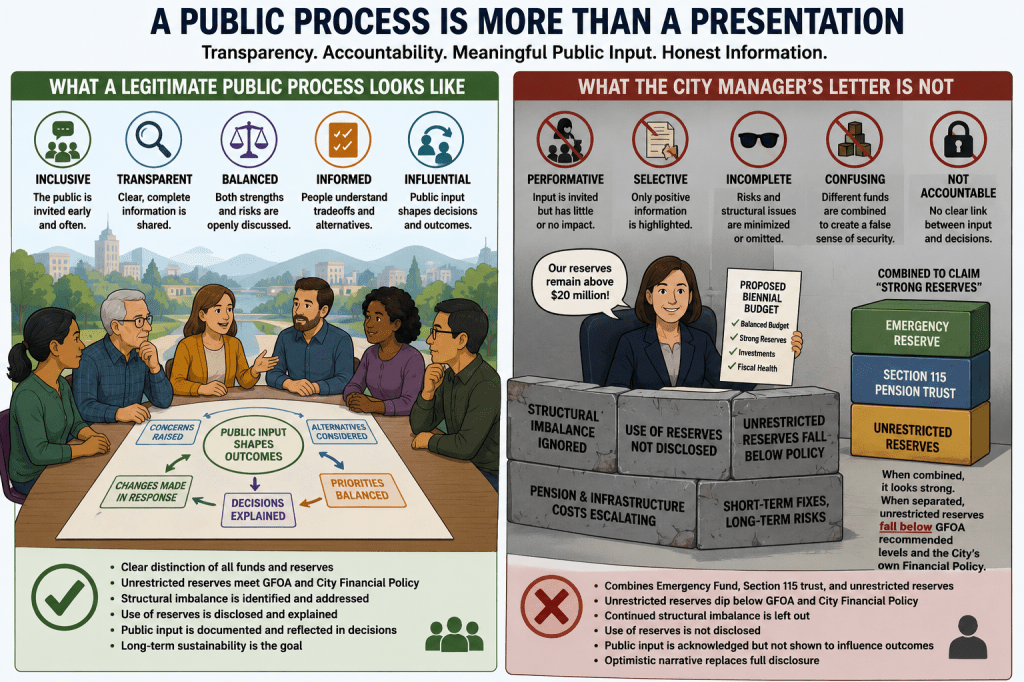
A legitimate public process is not simply a public meeting, a published agenda, or a polished budget presentation.
A legitimate public process is transparent, complete, balanced, and honest about both strengths and risks.
It gives residents enough information to understand not only what is being proposed, but also what is being deferred, understated, omitted, or shifted into the future.
Most importantly, a legitimate public process allows public input to meaningfully influence outcomes.
Public engagement is not legitimate if residents are invited to speak only after major assumptions, priorities, and financial directions have effectively already been decided behind closed doors.
It is not enough to hold workshops, accept comment cards, or allow public testimony if the outcome appears largely predetermined regardless of what the public says.
A real public process demonstrates how public feedback shaped the final recommendations.
Residents should be able to clearly identify:
what concerns were raised
what alternatives were considered
what changes were made in response to public feedback
what recommendations were rejected and why
how competing priorities were balanced
Without that connection between public participation and actual decision-making, the process becomes performative rather than collaborative.
That is why the City Manager’s budget letter deserves careful scrutiny.
The letter repeatedly frames the proposed budget as evidence of “stronger financial footing” and “long-term fiscal health.” Residents are told the budget is balanced, reserves remain above $20 million, and the City is making investments in infrastructure, facilities, and public safety equipment.
But a legitimate public process requires more than highlighting positive talking points.
It also requires openly discussing the structural concerns that continue to appear throughout the budget itself.
The City’s financial challenges did not disappear simply because the budget technically balances on paper.
The underlying structural imbalance between recurring revenues and long-term expenditure growth remains a significant concern.
That distinction matters.
Balancing a budget for the next fiscal cycle is not the same thing as resolving the City’s long-term financial trajectory.
The budget itself acknowledges escalating pension obligations, inflationary pressures, rising operating costs, infrastructure liabilities, insurance increases, and continued dependence on expenditure controls and containment measures.
Several balancing strategies appear to rely heavily on reallocations, delayed obligations, operational containment, and optimistic future assumptions rather than permanent structural solutions.
Those are not minor details.
They are central to understanding the City’s actual fiscal condition.
Equally important, the discussion surrounding reserves lacks critical distinctions that residents deserve to understand.
The City Manager references maintaining reserves above $20 million over the next five years. However, that figure combines several very different categories of funds, including:
the Emergency Disaster Relief Fund (EDRF)
the Section 115 Pension Trust
unrestricted operating reserves
other designated or committed reserve categories
Those funds are not interchangeable.
The Emergency Disaster Relief Fund exists to respond to emergencies and disasters.
The Section 115 trust is a pension stabilization vehicle intended to help offset future pension volatility and unfunded retirement liabilities.
Neither fund functions the same way as unrestricted operating reserves available to address ordinary fiscal instability or unexpected operational deficits.
That distinction matters because combining these categories into a single large reserve number can create the impression that the City’s unrestricted financial flexibility is stronger than it actually is.
The City reportedly maintains approximately $8 million in the Emergency Disaster Relief Fund and approximately $3 million in the Section 115 Pension Trust alone.
When those designated and restricted balances are separated out, the City’s unrestricted reserves appear materially weaker relative to both Government Finance Officers Association reserve recommendations and the City’s own adopted financial policy targets.
Residents deserve to clearly understand that difference.
A legitimate public process would distinguish between:
unrestricted operating reserves
emergency reserves
pension stabilization trusts
committed or designated funds
one-time resources versus recurring revenue
It would also clearly explain:
whether reserves are projected to decline over time
how sustainable current spending patterns are
what happens if revenues soften during an economic downturn
what future pension and infrastructure obligations may require
whether current balancing strategies are temporary or permanent
Instead, the public is presented with a highly optimistic narrative that emphasizes stabilization while minimizing ongoing long-term risks.
That is not transparency.
Transparency means discussing both accomplishments and vulnerabilities.
Transparency means acknowledging that expenditure containment alone does not necessarily resolve a structural imbalance when long-term expenditure growth continues to outpace sustainable recurring revenues.
Transparency means openly discussing pension escalation, deferred liabilities, infrastructure needs, insurance inflation, labor pressures, and economic uncertainty.
Transparency also means helping residents understand the difference between short-term budget balancing and long-term fiscal sustainability.
None of this means the City should not invest in services, facilities, or public safety.
None of this means staff did not work hard on the budget.
And none of this means the decisions facing the City are easy.
But public trust depends on residents receiving the full picture — not simply the most politically favorable portions of it.
Residents should not have to piece together critical fiscal realities by reading between the lines of financial tables, reserve schedules, and footnotes.
Those realities should be openly explained.
Most importantly, residents should be able to see how their participation shaped the final budget itself.
If the community raised concerns about escalating costs, reserve usage, structural imbalance, deferred obligations, or long-term sustainability, the public should be able to identify where and how those concerns influenced the final recommendations.
Otherwise, public engagement risks becoming little more than a procedural exercise.
A real public process is not measured by how many meetings occur.
It is measured by whether residents are given enough honest, complete, and transparent information to make informed judgments about the City’s future — and whether their participation genuinely matters once they do.
El Cerrito’s Proposed Budget Reveals a City Under Growing Structural Pressure
El Cerrito’s proposed biennial budget deserves credit for one important thing: it is more candid than some prior financial discussions about the pressures the City is facing.
The problem is that honesty alone does not eliminate the risks.
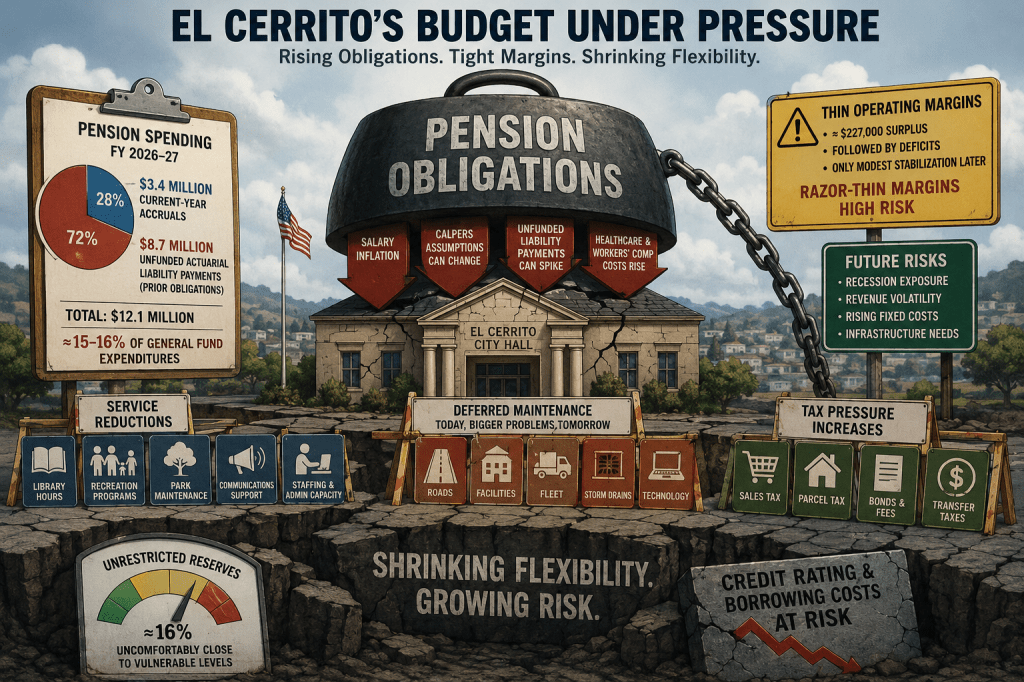
Beneath the balanced-budget presentation is a much tighter financial picture than many residents may realize, one shaped by escalating pension obligations, thin operating margins, aging infrastructure, rising labor costs, and shrinking flexibility.
This is not a fiscally comfortable budget.
It is a fiscally constrained budget attempting to stabilize itself while carrying significant long-term obligations.
Pension Costs Remain a Major Long-Term Risk
The City Manager openly acknowledges pension escalation through the early 2030s.
That section deserves scrutiny because it leans heavily on a future “PEPRA relief” narrative.
The assumptions are:
• legacy employees retire • newer employees have lower pension formulas • long-term costs eventually stabilize
That may partially happen.
But what the budget underemphasizes is that several major cost drivers continue rising simultaneously:
• Public safety staffing remains expensive • salary inflation compounds pension obligations • CalPERS investment assumptions can change • unfunded liability payments can spike during downturns • healthcare and workers’ compensation costs continue rising
The numbers themselves tell the story.
El Cerrito budgeted approximately $12.1 million in total CalPERS pension contributions for FY 2026–27. Of that:
• approximately $3.4 million is for current-year pension accruals • Approximately $8.7 million is for unfunded actuarial liability payments tied to prior obligations
That means roughly:
• 28% of pension spending funds are current employee retirement accruals • 72% goes toward pension debt from prior obligations
Even more importantly, pension costs now consume roughly 15–16% of General Fund expenditures.
That is a very large share of the operating budget for a single fixed-cost category.
And most of it is not for current services. It is debt service on prior obligations.
The budget also projects only extremely thin future operating margins:
• approximately $227,000 in surplus • followed by deficits • followed by only modest stabilization later
Those are razor-thin margins for a city simultaneously facing:
The City is projected to approach approximately 16% unrestricted reserves, uncomfortably close to levels many finance professionals would view as vulnerable for a city facing substantial fixed obligations and economic uncertainty.
A city with thin operating margins can become vulnerable very quickly during an economic downturn.
Credit Ratings and Borrowing Costs Can Be Affected
What this budget reveals is not a city in immediate fiscal crisis but appears to be heading that way.
But it does reveal a city operating with increasingly limited financial flexibility while carrying substantial structural obligations from prior decisions.
And once flexibility disappears, local governments often become reactive instead of strategic.
What I see in El Cerrito’s budget is a city trying to move toward more disciplined long-term planning while still carrying substantial long-term obligations that will continue placing pressure on services, infrastructure, reserves, and taxpayers for years to come.
But Does It Have a True Community Center or Senior Center?
A concerned resident recently raised a point that deserves more thoughtful discussion than it has received so far.
Much of the current civic conversation in El Cerrito has centered around building a new library. But some residents are asking a broader question:
What community infrastructure is actually missing in El Cerrito today?
And more specifically:
Does El Cerrito already lack the very kinds of gathering spaces that many communities consider essential?
According to the City’s own facility descriptions, the answer may be yes.
El Cerrito Already Closed the Senior Center. Now Residents Are Being Asked to Pay More for Additional Space.
Many residents assume El Cerrito already has a traditional community center and robust civic gathering infrastructure.
But the reality is more complicated.
The City’s Community Center functions largely as a rentable event facility, with significant emphasis placed on private rentals, weekend reservations, alcohol permits, kitchen use, tables, chairs, and event capacity.
And the rental costs are not minor.
For many residents, neighborhood groups, nonprofits, seniors, and community organizations, the pricing structure places the facility financially out of reach for regular use. What exists in theory as a public community space often functions in practice as a costly event venue.
That distinction matters.
A true community center is usually designed around ongoing, accessible community life:
youth activities
senior programming
neighborhood meetings
arts and music programs
workshops and mentoring
low-cost gathering spaces
daily social connection
informal civic interaction
Those spaces help reduce isolation, strengthen neighborhoods, and create a sense of belonging.
A high-cost rental hall is not necessarily the same thing.
The Senior Center Closure Changes the Conversation
What makes this debate even more significant is that El Cerrito already shuttered its Senior Center.
That decision left many older residents with fewer dedicated gathering spaces, fewer social opportunities, and fewer community-centered services specifically designed for aging populations.
Now, at the same time residents are being told the City cannot sustain certain services or facilities, they are also being asked to support additional taxes and fees for yet another major capital project.
That contradiction is difficult for some residents to reconcile.
Many cities prioritize senior centers because they provide essential daily support, including:
wellness and exercise programs
social activities and connection
nutrition assistance
technology support
caregiver resources
transportation coordination
educational workshops
health screenings
intergenerational programming
As populations age, these services become more important, not less.
Residents are increasingly asking:
Why was the Senior Center closed if the City’s broader vision is supposedly centered on community investment?
And if existing public gathering spaces are already financially inaccessible to many residents, why should taxpayers now be asked to fund even more space before those underlying accessibility issues are addressed?
This Is About Priorities
El Cerrito already has a library.
Reasonable people can disagree about whether it should be renovated, expanded, relocated, or rebuilt.
But residents are now questioning whether the City’s civic priorities have become too narrowly focused on one expensive project while other community infrastructure needs remain unresolved.
People are asking practical questions:
Why were existing community spaces allowed to diminish?
Why did the Senior Center close?
Why are affordable gathering spaces still limited?
Why are residents being asked for more taxes and fees before broader community needs are addressed?
Will ordinary residents actually be able to afford to use these facilities once they are built?
These are not anti-library questions.
They are questions about balance, accessibility, affordability, and long-term community planning.
A Community Is More Than Buildings
At its core, this debate is not simply about construction projects or square footage.
It is about what kind of civic life El Cerrito wants to support.
Libraries matter.
But so do affordable spaces where seniors gather, neighbors connect, young people participate in programs, and residents build relationships outside of expensive private venues.
Many residents increasingly feel that El Cerrito is asking taxpayers to continuously fund new projects while simultaneously reducing or limiting access to the very community-centered spaces people already depended on.
That tension deserves an honest public conversation.
Not slogans.
Not assumptions.
And not dismissing residents who are asking where all of this ultimately leads.
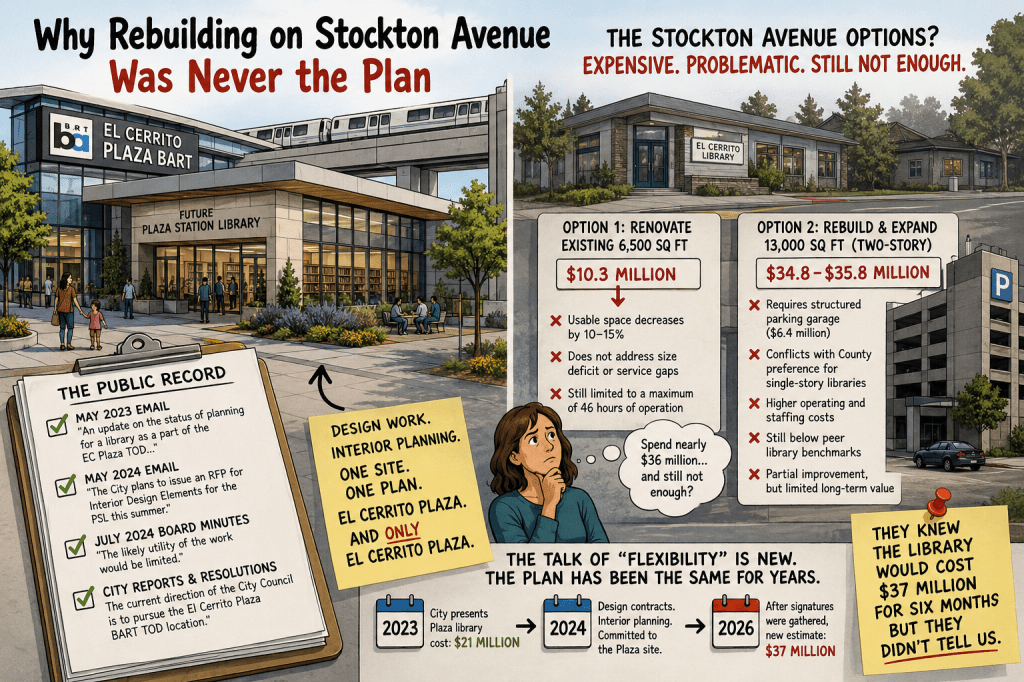
For months, supporters of Measure C have suggested that El Cerrito still has flexibility — that the city could potentially rebuild the library somewhere other than the El Cerrito Plaza BART transit-oriented development site.
But the public record tells a far more specific story.
Internal emails, board meeting minutes, city presentations, consultant reports, and official planning documents all point to the same conclusion:
The Plaza Station location was not one option among many.
It was the plan.
And city leadership appeared to move forward as though that decision had already been made long before voters were asked to approve funding.
The Private Emails Tell a Different Story
In May 2023, Community Development Director Melanie Mintz sent an invitation to library stakeholders describing the effort as:
“An update on the status of planning for a library as a part of the EC Plaza TOD and the possible upcoming measure.”
Not a future library somewhere in El Cerrito.
Not a citywide site selection process.
The EC Plaza TOD.
Then in May 2024, Assistant City Manager Will Provost wrote to a library supporter that:
“The City plans to issue an RFP for Interior Design Elements for the PSL [Plaza Station Library] this summer.”
Interior design planning.
For a specific site.
Before voters had approved a single dollar in funding.
By July 2024, Library Foundation Board minutes reflected concern about whether that design work would even be useful if Measure C failed and the city had to pursue another location. The recorded response acknowledged that:
“The likely utility of the work would be limited.”
That statement matters.
Because it confirms what many residents suspected: the work being commissioned was so tailored to the Plaza location that it would have little value elsewhere.
The Plaza site was not simply under consideration.
It was already embedded in planning assumptions.
The Stockton Avenue Alternative Was Never Presented as a Strong Solution
In public discussions, city officials and Measure C supporters sometimes suggest that rebuilding at the current Stockton Avenue location remains a viable alternative.
But the city’s own consultants and technical documents repeatedly undermine that claim.
Option One: Renovate the Existing Library
The Griffin Structures ROM report, referenced in the February 19, 2026 §9212 Impact Report, evaluated renovation of the current 6,500-square-foot facility.
The conclusion was striking.
The report found that renovation would largely be limited to:
basic code compliance
accessibility improvements
modest modernization
The city’s January 2026 presentation summarized the problem directly:
it would not solve the size deficit
it would not address service gaps
operating hours would remain constrained
Even supporters of expansion have acknowledged that renovation alone would not meet long-term needs.
Option Two: Rebuild a Larger Two-Story Library on Stockton
The second Stockton Avenue option involved constructing a larger two-story facility of roughly 13,000 square feet.
At first glance, this may sound more viable.
But again, the city’s own reports raise major concerns.
The projected cost climbed to approximately $35–36 million — nearly the same price range now associated with the Plaza Station proposal.
A major reason?
Parking.
Because the existing Stockton site lacks sufficient land, the project would require a structured parking garage costing millions of dollars on its own.
The city’s own January 2026 presentation acknowledged additional concerns:
still below peer library benchmarks
conflicts with county preference for single-story libraries
higher operating and staffing costs
limited long-term value
Contra Costa County’s own library design standards strongly favor single-story layouts because they improve:
staff efficiency
visibility
operations
security
accessibility
A two-story Stockton rebuild would conflict with those standards immediately.
Even Measure Supporters Acknowledged the Reality
The campaign’s own materials appear to reinforce the same conclusion.
The C4PSL FAQ reportedly states:
“There are no current, affordable alternatives to the El Cerrito Library at the Plaza Station.”
Meanwhile, the official §9212 Impact Report states plainly:
“The current direction of the City Council is to pursue the El Cerrito Plaza BART TOD location.”
Not explore.
Not evaluate.
Pursue.
The Public Messaging Changed After the Cost Increased
Perhaps the most troubling issue for many residents is not simply the location debate.
It is the timing of the financial disclosures.
In 2023, city leadership repeatedly promoted the Plaza Station concept using an estimated project cost of approximately $21 million, often emphasizing that the project could save the city substantial money compared with other alternatives.
But after signatures were gathered and momentum behind Measure C was already established, residents learned the estimated project cost had increased dramatically to approximately $37 million.
According to concerned residents reviewing city documents, leadership may have known about the higher estimate for roughly six months before the public was formally informed.
That raises legitimate questions residents are now asking:
Why did public messaging continue using earlier estimates?
When did city leadership fully understand the cost escalation?
Why were voters not updated sooner?
Would public support have changed if the higher number had been disclosed earlier?
Those questions are not anti-library questions.
They are governance questions.
This Debate Is Bigger Than a Building
At its core, this debate is no longer simply about whether El Cerrito deserves a modern library.
Most residents agree that it does.
The deeper issue is whether the public was given a transparent and complete understanding of:
the true costs
the true planning assumptions
the actual level of flexibility
the financial risks
and the extent to which key decisions may have already been made before voters were asked to weigh in
Because when internal planning, design work, consultant analysis, and official reports all point overwhelmingly toward one predetermined outcome, it becomes difficult to argue that all options were still genuinely on the table.
And when project costs nearly double while public messaging remains anchored to older numbers, trust inevitably becomes part of the conversation too.
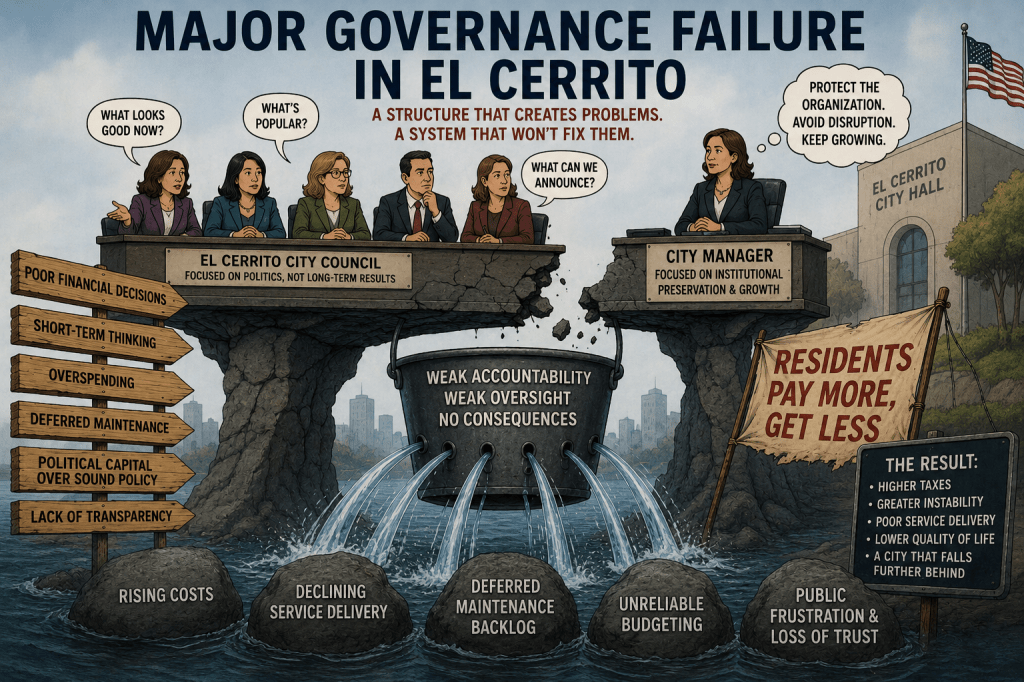
El Cerrito’s fiscal challenges did not appear overnight, and they are not simply the result of inflation, Proposition 13, passed in 1978, or a temporary economic downturn. The deeper issue is structural. The way the City is governed has created conditions where spending expands easily during good years, but meaningful correction becomes politically and operationally difficult when conditions tighten.
The way the City is governed has created conditions where spending expands easily during good years, but meaningful correction becomes politically and operationally difficult when conditions tighten.
Several residents recently raised an uncomfortable but important point: El Cerrito operates under a council-manager form of government that can weaken accountability when leadership culture becomes overly insulated from long-term consequences.
Under this structure, the City Council sets policy and hires the City Manager, while the City Manager oversees administration and operations. In theory, this model can work very well. Many cities use it successfully.
But the model only works when there is strong financial discipline, clear accountability, and elected officials willing to make difficult decisions before problems become crises.
That has not consistently happened in El Cerrito.
Over time, the City expanded staffing levels, compensation obligations, deferred maintenance exposure, and long-term financial commitments without building a sustainable revenue structure capable of supporting them indefinitely.
The result is what residents increasingly recognize today:
• Structural budget pressure • Rising costs outpacing revenue growth • Service expectations exceeding available resources • Deferred maintenance accumulating quietly over years • Increasing reliance on taxes and parcel measures • Public frustration over paying more while seeing inconsistent service delivery • Unrestricted reserves projected to fall to approximately 16%, below the City’s own reserve policy threshold
That last point matters.
Reserve policies exist for a reason. They are intended to protect cities during economic downturns, emergencies, unexpected infrastructure failures, pension volatility, and revenue instability. When a city falls below its own reserve targets, it is not simply an accounting issue. It is a warning sign that long-term financial flexibility is eroding.
What makes the problem especially difficult is that the current structure diffuses accountability.
When unpopular cuts become necessary, elected officials often avoid forcing them because the political consequences are immediate. Meanwhile, administrative leadership naturally tends toward institutional preservation. Neither side is strongly incentivized to aggressively reduce costs early enough to prevent larger problems later.
That creates a dangerous cycle.
During growth periods, spending and commitments expand. During downturns, leaders seek new revenue rather than fundamentally reevaluating operational structure, prioritization, or service delivery models.
Residents are now seeing the consequences play out across multiple issues.
The tree fee controversy became one example. Fees were dramatically increased, public backlash followed, and years later the City partially reversed course while presenting the reduction as a major accomplishment rather than acknowledging the original policy failure. Whether one agrees with the policy itself or not, the episode reflected a broader pattern: short-term political framing often replacing long-term operational thinking.
The same concerns now surround larger financial decisions, including Measure C and major capital expansion proposals.
Many residents are not opposing libraries, parks, trees, or public services. They are questioning whether City leadership has demonstrated the financial discipline and operational credibility necessary to justify asking taxpayers for tens of millions of additional long-term commitments.
That distinction matters.
A fiscally responsible city does not simply ask: “How do we fund more?”
It also asks: • What can we realistically sustain? • What services are core priorities? • What operational changes are necessary? • What projects should wait? • What obligations are already crowding out future flexibility? • Are we measuring outcomes or simply expanding spending?
Those conversations are uncomfortable because they require tradeoffs. But avoiding them does not eliminate the consequences. It merely delays them.
Some residents have also pointed to signs that parts of the finance function may be moving toward more transparent accounting practices, including better visibility around deferred maintenance and amortization obligations. If true, that is encouraging. Honest financial representation is the first step toward rebuilding trust.
But transparency alone is not enough.
El Cerrito’s challenge is ultimately cultural and structural. The City needs leadership willing to prioritize long-term sustainability over short-term political convenience. It needs elected officials willing to publicly debate alternatives instead of narrowing discussion prematurely. And it needs a governance culture where accountability is measured not by slogans or ribbon cuttings, but by whether services remain sustainable five, ten, and twenty years from now.
Because residents are increasingly recognizing something important:
As the debate over Measure C continues in El Cerrito, many residents are beginning to recognize that this conversation is no longer just about a library.
It is about trust.
It is about transparency.
And it is about whether voters were given a complete and honest picture before being asked to approve a long-term tax measure tied to one of the largest civic expenditures in the city’s history.
Political campaigns often rely on selective framing, carefully crafted messaging, and optimistic assumptions. Courts have repeatedly ruled that political speech receives broad legal protection — even when statements are misleading, incomplete, or knowingly exaggerated.
That may be legal.
But legality is not the same thing as integrity.
And when taxpayers are being asked to fund tens of millions of dollars in long-term obligations, honesty matters.
The Campaign Repeatedly Suggested The Library Could Be Anywhere
Supporters frequently claimed that Measure C was flexible and that the library could ultimately be built in various locations across the city.
But that framing became increasingly difficult to reconcile with reality.
The ballot language itself specifically references funding for a new library.
Not a renovation. Not a modernization. Not a phased expansion of the current building.
A new library.
At the same time, four out of five City Council members publicly endorsed the Transit-Oriented Development concept at El Cerrito Plaza. The City had already advanced discussions connected to that site while campaign messaging continued emphasizing “options” and flexibility.
Residents were told that no decisions had been made while political momentum clearly pointed in one direction.
That matters because voters deserve to understand whether they are being asked to support a broad civic conversation or a project path that has effectively already been selected.
The “Five Options” Talking Point Was Misleading
Supporters repeatedly claimed that the City was considering five options for the future of the library.
But the measure itself does not authorize five equal alternatives.
It authorizes funding tied to planning, construction, and furnishing of a new library.
At the same time, residents later learned that one of the supposed options involved renovating or expanding the current library at a substantially lower cost.
If a lower-cost alternative existed, residents deserved a serious public comparison before being asked to approve a permanent parcel tax associated with a dramatically more expensive project.
Instead, campaign messaging often blurred the line between “considering options” and actively advancing one preferred outcome.
The Public Was Told One Price While The Real Cost Was Growing
One of the most significant concerns surrounding Measure C has been the dramatic escalation in projected costs.
Residents were repeatedly presented with figures around $21 million.
But months before the election, internal discussions and planning documents reportedly reflected project costs approaching $37 million.
That is not a minor adjustment.
That is a massive increase that fundamentally changes the financial conversation.
Yet many residents continued hearing outdated figures long after higher estimates were already known internally.
For many voters, this became less about whether they support libraries and more about whether the public was being given timely and complete information before being asked to approve a tax measure.
The Bond Timeline Was Also Presented In A Misleading Way
Many residents were left with the impression that the “30-year” timeframe discussed during the campaign would begin immediately if Measure C passed.
That is not how bond financing works.
The 30-year clock does not begin until bonds are actually issued.
However, if Measure C passes, the City can begin collecting the tax as early as December.
That means taxpayers could begin paying long before bonds are ever issued or construction ever begins.
In addition, the measure allows funds to be used for a variety of library-related purposes.
As a practical matter, that creates little real pressure to issue bonds quickly — or potentially even at all.
The City could continue collecting revenue while planning evolves, negotiations continue, costs change, projects stall, or broader development discussions shift over time.
That distinction was not clearly communicated to many voters.
And it matters because residents deserve to understand exactly when financial obligations begin versus when actual construction obligations are triggered.
The Measure Does Not Actually Require A Library To Be Built
One of the least discussed aspects of Measure C is also one of the most important.
The measure itself does not appear to contain strict enforceable requirements guaranteeing that a new library will actually be completed within a specific timeframe.
That distinction matters enormously.
Campaign messaging frequently implied that passage of the measure would directly result in a completed library project.
But taxation and project delivery are not the same thing.
Projects stall. Construction costs escalate. Financing structures collapse. Developers walk away. Economic conditions change.
Yet taxpayers can remain obligated for years.
Residents should always ask whether enforceable accountability protections exist — not simply whether campaign language sounds reassuring.
The Senior Exemption Was Marketed More Generously Than It Operates
Supporters also heavily promoted a senior exemption.
But many residents later discovered that exemptions are not automatic and require applications, eligibility verification, deadlines, and ongoing administrative compliance.
For many seniors, campaign messaging created the impression that they broadly would not be affected by the tax.
The operational reality appears far more complicated.
Again, the issue is not whether an exemption technically exists.
The issue is whether the campaign accurately communicated how limited and procedural the exemption process actually is.
The City Had Already Begun Advancing The TOD Vision
Another concern repeatedly raised by residents involves the extent to which negotiations, planning activity, and political commitments tied to the Transit-Oriented Development project were already advancing before voters had fully weighed in.
The City had already invested substantial political capital into the TOD concept connected to El Cerrito Plaza.
Discussions involving developers, land use, financing structures, and future site concepts were already underway.
That creates understandable concern among residents who feel the public process increasingly resembled ratification rather than open evaluation.
When governments appear financially and politically committed to a project before voters approve funding, public confidence naturally erodes.
Residents Were Told The Measure Was About Libraries. But The Financial Risks Extend Far Beyond Libraries.
Many residents support libraries.
Many residents support literacy, community gathering spaces, educational access, and civic investment.
That was never the central issue.
The real concerns involved long-term fiscal exposure, escalating project costs, debt assumptions, development uncertainty, pension pressures, shrinking reserves, and whether the City was pursuing a financially sustainable path.
At the same time residents were being asked to approve Measure C, the City was already facing broader structural financial pressures, including rising pension obligations, escalating operating costs, deferred infrastructure liabilities, and narrowing budget flexibility.
Those realities matter because major capital projects do not occur in isolation.
Every major financial commitment affects future service delivery, reserves, staffing flexibility, and taxpayer exposure.
The Campaign Also Framed The Measure As Necessary To “Save” The Library
Another misleading implication throughout the campaign was the idea that failure of Measure C somehow meant the library itself was at risk of disappearing.
That was never true.
El Cerrito already has a functioning library.
A “No” vote would not close the library.
A “No” vote would not eliminate library services.
A “No” vote simply meant residents were not prepared to approve the specific tax structure and development trajectory being proposed.
There were always other options available, including modernization, phased renovation, expansion of the current facility, or more fiscally constrained alternatives.
But those possibilities often received far less attention than the narrative surrounding a large new flagship project.
Public Trust Is Hard To Restore Once It Is Lost
The deepest damage from campaigns like this often extends beyond the election itself.
When residents begin believing that elected officials, consultants, advocacy groups, and campaign leaders selectively present information, minimize risks, soften financial realities, or reshape facts to fit political objectives, trust deteriorates quickly.
And once public trust erodes, rebuilding it becomes extraordinarily difficult.
Cities function best when residents believe leaders are being candid about tradeoffs, risks, costs, and uncertainties.
Not when difficult realities are softened into slogans.
Not when major financial changes are marketed through carefully managed talking points.
And not when residents who ask legitimate fiscal questions are treated as obstacles rather than stakeholders.
Campaigns may be legally allowed to exaggerate.
But communities deserve better than technically permissible misinformation.
Because ultimately, Measure C was never just about a library.
It was about whether residents could trust the people asking them to pay for it.
Inspired by research from an informed and concerned citizen.
We keep hearing the same refrain from some local leaders and boosters: We’re not Hercules. We’re not Emeryville.
That may be true geographically. But it misses the real point entirely.
Those cities are not successful because of their names. They are successful because they made deliberate economic development choices, welcomed investment, built tax bases, and created places where businesses and residents wanted to be.
The lesson is not that El Cerrito cannot be them.
The lesson is that El Cerrito can learn from them.
What Other Cities Actually Did
Emeryville transformed former industrial land into a thriving mixed use city with shopping, housing, life sciences, offices, hotels, and major employers. It aggressively pursued redevelopment, modern land use planning, and revenue generation.
Hercules took underused land and created master planned neighborhoods, waterfront visioning, retail corridors, and business growth opportunities. It planned for expansion instead of managing decline.
Neither city sat around explaining why success was impossible.
They asked what was possible and moved accordingly.
What El Cerrito Has Going for It
El Cerrito has advantages many cities would love to have:
Two BART stations
Prime access to San Francisco and Oakland
Established neighborhoods
Strong household wealth
Regional visibility
Walkable commercial corridors
A highly educated population
Untapped redevelopment potential
That is not a city without options.
That is a city underperforming its assets.
Build a Serious Economic Development Strategy
Not slogans. Not one off projects.
A measurable strategy focused on sales tax growth, business attraction, property value enhancement, revitalized commercial districts, quality housing that strengthens revenues, and destination retail and dining.
Work With Property Owners to Create Beautiful Spaces
The city should be actively collaborating with landowners, developers, architects, and business owners to create attractive, welcoming places people want to visit and enjoy.
That means quality design, public gathering areas, landscaping, outdoor dining, activated storefronts, and projects that add pride to the community.
Beautiful places create foot traffic, investment, and value.
Make Development Easier, Faster, and More Predictable
Too many cities talk about wanting investment while making the process slow, uncertain, and frustrating.
El Cerrito should streamline approvals, modernize permitting, reduce unnecessary delays, and clearly communicate expectations so quality projects can move forward.
Good development should not feel like punishment.
Recruit Employers and Entrepreneurs
Why shouldn’t El Cerrito compete for professional offices, medical services, boutique hospitality, specialty retail, and innovation businesses?
Too often cities wait passively for interest instead of actively recruiting it.
Upgrade San Pablo and Key Corridors
Commercial corridors should look investable, vibrant, and intentional. Streetscape quality matters. Cleanliness matters. Parking management matters. Tenant mix matters.
Grow Revenue Before Raising Taxes
Residents should expect leaders to exhaust growth opportunities before returning again and again for more taxes.
Economic development is how cities create choices.
Enough With the Excuses
When leaders say we’re not Hercules or we’re not Emeryville, they may mean expectations should be lower.
Residents should reject that thinking.
El Cerrito does not need to become another city. It needs to become the best version of itself.
That starts with ambition, competence, and accountability.
Final Thought
Cities decline when they normalize excuses.
Cities improve when they pursue opportunity.
El Cerrito has the location, transit access, demographics, and assets to do far better than it has. The question is no longer whether success is possible.
The question is whether leadership is willing to demand it.
There is a difference between civic engagement and political spam.
Over the last several weeks, many contributors and residents opposed to Measure C have reported receiving unsolicited campaign emails from Greg Lyman’s Yes on C campaign despite never signing up for his mailing list. Several recipients say they never attended campaign events, never donated, and never opted into campaign communications.
Yet the emails keep arriving.
That raises reasonable questions about how contact information was gathered, how broadly campaign databases are being shared or scraped, and whether residents are being treated as participants in a civic discussion or simply as targets in a political marketing operation.
What is especially striking is the contrast between the polished tone of the message and the underlying tactics behind it.
The email is carefully consultant-crafted. It attempts to sound measured, neighborly, and thoughtful. It repeatedly invokes “community conversation,” “good faith,” and “facts.” But beneath the polished language are familiar campaign techniques: selective framing, omission of inconvenient facts, and strategic ambiguity designed to soften public skepticism.
And nowhere is that more obvious than the continued obfuscation around the library location.
The “No Final Decision” Claim Is Misleading
The email repeatedly suggests that no site decision has been made and that multiple options remain under consideration.
That is technically convenient language, but it ignores reality.
The measure clearly states the tax is for a new library.
For years, the Plaza Transit-Oriented Development site has been the clear political preference of four councilmembers and senior city leadership. The city has already invested years of planning effort, consultant work, strategic planning integration, negotiations, and public positioning around the Plaza concept.
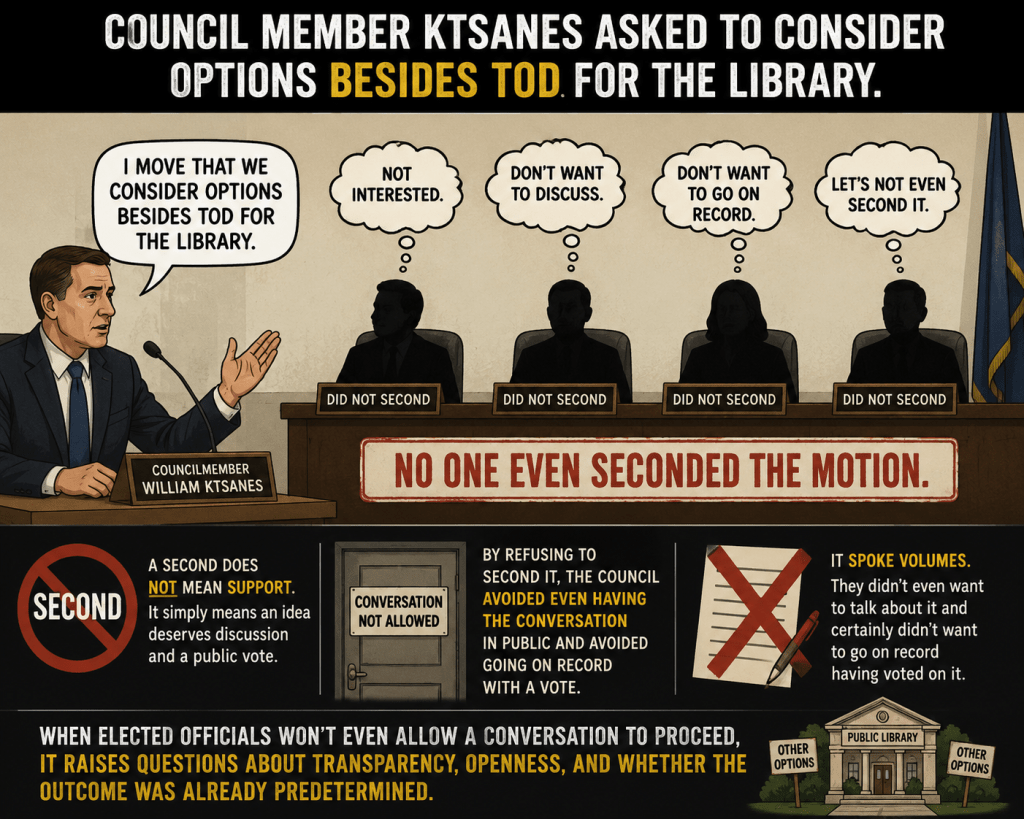
Councilmember William Ktsanes even attempted to have the Council formally discuss alternatives to the TOD library concept. His motion did not even receive a second.
A second is not approval. It simply allows public discussion and a recorded vote. The refusal to even entertain discussion spoke volumes.
Residents were told “all options are on the table,” while political behavior consistently suggested otherwise.
That matters because voters deserve transparency about what they are actually being asked to fund.
The “$1 Per Year Land Lease” Framing Leaves Out Important Details
The email presents the BART land arrangement almost like a gift:
“We would get use of the land for a total of $1 per year for 99 years.”
That sounds wonderful until residents realize the city would not own the land.
A 99-year ground lease is not the same as public ownership. Future generations of taxpayers would still be funding a major public asset built on land controlled by another entity.
The email also avoids discussing the broader costs associated with the TOD scenario, including parking impacts, infrastructure integration, construction complexity, and the realities of building within a dense transit-oriented development.
Instead, the arrangement is framed almost romantically, as though the land issue has been magically solved.
It has not.
The “Financial Recovery” Narrative Deserves More Context
The email strongly suggests the city has solved its financial problems because reserves improved after a State Auditor review.
That is incomplete.
Yes, the city improved certain reserve metrics after scrutiny from the California State Auditor. But reserve recovery alone does not eliminate long-term structural budget concerns, nor does it signal financial health.
El Cerrito has faced years in which expenditures have grown faster than revenues. Pension obligations, salary growth, infrastructure demands, deferred maintenance, and rising operating costs continue to place pressure on the budget.
Finally getting off the State Auditor’s list does not suddenly mean every large capital project becomes fiscally prudent.
Those are two entirely different discussions.
The Pension Forecast Is Presented as Certainty
Perhaps the most aggressive claim in the email involves future CalPERS obligations.
Residents are told that by 2040 the city will supposedly be paying $3 million less annually toward pensions, freeing up money for future library operations.
That projection is presented almost as inevitability.
But pension forecasting is highly sensitive to assumptions including:
investment returns
staffing levels
salary growth
actuarial changes
safety employee costs
future market conditions
El Cerrito maintains significant public safety staffing, which historically creates upward pension pressure. The email presents optimistic projections while minimizing the uncertainty and volatility that have repeatedly affected CalPERS agencies statewide.
There is a major difference between “possible future relief” and “guaranteed future operating capacity.”
“Broad Community Support” Does Not Equal Consensus
The campaign repeatedly cites endorsements and volunteer support as proof the project is fiscally prudent.
But endorsements are not financial analysis.
Many residents opposing Measure C are not anti-library. They are questioning:
whether a $37+ million project is appropriate
whether the city should prioritize rehabilitation over expansion
whether long-term tax obligations are justified
whether the public has been given a fully transparent process
Those are legitimate public policy questions, not evidence that residents “do not value libraries.”
The Spam Problem Reflects a Bigger Issue
In some ways, the unsolicited email issue mirrors the broader Measure C debate itself.
Residents increasingly feel that political leadership is talking at them rather than with them.
The campaign’s messaging emphasizes trust, expertise, and civic virtue while often dismissing skepticism as misinformation or negativity.
But people notice inconsistencies.
They notice when “multiple options” somehow always point back to the same preferred outcome.
They notice when financial optimism is presented with more confidence than caution.
And they notice when political campaigns somehow acquire email addresses they never knowingly provided.
Community engagement should involve transparency, consent, and honest debate.
Not slick messaging wrapped around selective facts and distributed through unsolicited political email lists.
One of the clearest moments in the El Cerrito library debate did not involve a vote. It involved the refusal to even have one.
Councilmember William Ktsanes asked the Council to consider alternatives to the Transit-Oriented Development (TOD) library proposal at El Cerrito Plaza. He did not ask the Council to approve an alternative. He simply asked that other options be discussed publicly.
No one even seconded the motion.
That detail matters.
In public meetings, a second is not an endorsement. It does not mean agreement. A second simply means an idea deserves discussion and a public vote. Councils second motions all the time that members ultimately vote against. It is part of transparent public governance.
By refusing to second the motion, the Council prevented any public discussion from occurring and avoided having individual members go on record with a vote.
For many residents, that moment spoke volumes.
Recently, residents have been told there were options on the table. Yet when a councilmember formally requested a discussion about alternatives, the Council would not even allow the conversation to proceed. That raised legitimate concerns about whether alternatives were ever seriously considered.
The refusal to second the motion reinforced the perception that the Plaza location had already been decided behind the scenes and that public engagement was largely about gaining acceptance for a predetermined outcome rather than evaluating competing ideas openly.
This matters because the library discussion is not a small policy issue. Residents are being asked to support a major long-term tax commitment tied to a project with significant financial, operational, and community implications.
In situations like this, transparency matters. Public debate matters. Recorded votes matter.
When elected officials will not even allow a discussion to happen in public, residents are left to draw their own conclusions about openness, accountability, and whether dissenting viewpoints are truly welcome in the decision-making process.
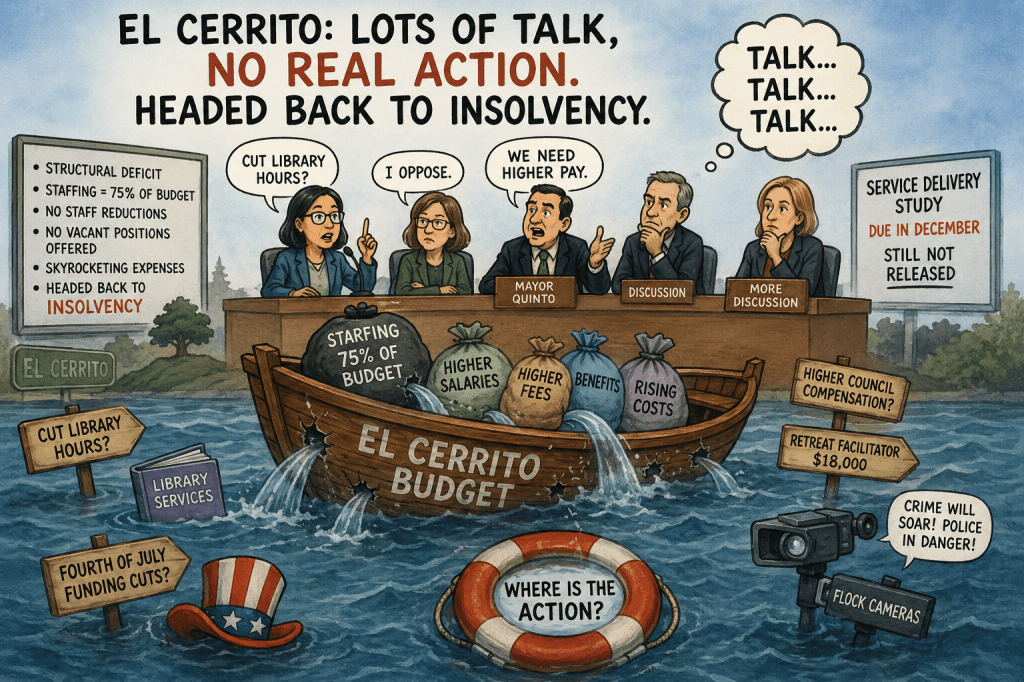
Last night’s El Cerrito City Council meeting offered residents a revealing look at the City’s ongoing structural budget challenges and rising financial pressures. Throughout the discussion, Council acknowledged growing costs and long-term fiscal strain, yet there was little meaningful discussion about reducing staffing levels, eliminating vacant positions, or restructuring operations to control expenses. That omission stood out because personnel costs make up roughly 75% of the City’s budget. Residents heard extensive discussion about financial pressures, but very little concrete action aimed at slowing the growth of skyrocketing expenditures. For many watching, the concern is becoming increasingly clear: El Cerrito appears to be drifting back toward the kind of financial instability that previously pushed the City dangerously close to insolvency.
They are now below the GFOA-recommended amount for unrestricted reserves, although they claim otherwise. Much of their reserves is in an emergency fund, and no auditor would consider those funds unrestricted.
Library Hours Suddenly Become Negotiable
One of the most notable moments came when Councilmember Lisa Motoyama suggested eliminating the additional six library hours currently funded by the City beyond the county baseline.
The discussion generated considerable debate.
Councilmember Rebecca Saltzman opposed reducing the hours.
For many residents, the significance was not simply the six hours themselves. It was what the conversation represented. For months, residents expressing concern about the City’s fiscal trajectory have often been dismissed as alarmist or anti-library. Yet now the Council itself is discussing service reductions before voters have even decided the future of the proposed library tax measure.
And importantly, Motoyama is not up for reelection this cycle.
Fourth of July Funding Also on the Chopping Block
The Council also discussed potential reductions to Fourth of July celebration funding.
While community events may seem secondary compared to larger budget items, these conversations matter because they reveal where fiscal pressure begins surfacing first: visible public services and community programming.
When cities begin debating reductions to library hours and long-standing community traditions, residents naturally begin asking deeper questions about financial sustainability.
The Missing Service Delivery Study
Another issue lingering over the discussion is the still-unreleased service delivery study.
The study was reportedly expected in December. As of May 19, City Manager Karen Pinkos, the City Manager had still not publicly released it.
That absence is becoming increasingly difficult to ignore.
A service delivery study is supposed to evaluate operational efficiency, staffing alignment, workflow effectiveness, and opportunities for improvement before taxpayers are asked for additional revenue. Residents still do not have the benefit of reviewing that analysis while simultaneously hearing discussions about service cuts and higher costs.
The Class and Compensation Study Keeps Coming Back
Earlier discussions again referenced the City’s classification and compensation study, which resulted in higher salaries and increased personnel costs.
But many residents continue asking a straightforward question:
If the City already completed a comprehensive compensation study specifically designed to address concerns about competitive pay, why are compensation pressures and budget strain still dominating discussions so quickly afterward?
The original purpose of the study was to create a sustainable compensation structure that would help attract and retain employees. Instead, residents are now watching simultaneous conversations about:
service reductions
higher fees
continued fiscal strain
additional compensation concerns
and possible future tax increases
That sequence understandably raises concerns about long-term financial planning.
Residents Continue Questioning Fees and Priorities
The conversation also touched indirectly on broader frustrations residents have expressed regarding City fees and service delivery.
Residents continue noticing that El Cerrito charges for certain services that neighboring cities often provide without additional fees, including some tree planting requests.
At the same time, many residents do not feel they are seeing corresponding improvements in efficiency, responsiveness, or visible service outcomes.
The issue is not simply whether employees deserve fair compensation. Most residents support competitive wages for public employees.
The issue is whether City leadership has demonstrated sufficient operational discipline and measurable results before seeking additional financial commitments from taxpayers.
Mayor Quinto’s Appeal for Higher Council Compensation
Mayor Gabe Quinto made an impassioned appeal for increased council compensation during the meeting.
The timing drew attention because it occurred during broader discussions about fiscal constraints, possible service reductions, and public concern regarding affordability.
For many residents, it reinforced the perception that City leadership continues looking toward additional spending before fully addressing structural financial challenges.
Retreat Facilitator Costs and the Flock Camera Debate
The Council also discussed reducing spending on the City’s retreat facilitator, which reportedly costs approximately $18,000 to facilitate meetings.
Meanwhile, Quinto delivered a lengthy warning regarding the earlier Flock Safety camera debate, suggesting that the Council’s decision could contribute to increased crime and greater danger for police officers.
Reasonable people can disagree about surveillance technology, policing tools, and public safety strategies. But many residents are growing weary of exaggerated rhetoric surrounding policy disagreements, particularly when the City is simultaneously grappling with unresolved fiscal and operational concerns.
The Larger Takeaway
Last night’s meeting was not just about library hours or Fourth of July funding.
It was a window into a City wrestling with a larger problem: rising costs, unresolved structural budget pressures, increasing public skepticism, and growing concern about whether leadership is adequately prioritizing long-term financial sustainability.
Residents are increasingly asking for something simple: evidence that existing resources are being managed effectively before they are asked to support additional taxes, additional compensation increases, or additional long-term financial obligations.
In 2016, El Cerrito voters rejected a tax measure. What followed should have been a wake-up call for city leadership.
In the years after that failed measure, El Cerrito’s financial condition deteriorated so badly that the city was identified among the small group of California cities considered most vulnerable to fiscal distress. Out of more than 400 cities statewide, El Cerrito landed near the bottom tier in financial stability indicators.
Residents were warned about structural deficits, shrinking flexibility, and growing long-term obligations.
Then came a financial lifeline.
The real property transfer tax began generating significant revenue during the real estate surge, reportedly bringing in more than $3 million annually. Then the Biden administration provided millions more in pandemic-era federal assistance. Together, those temporary revenue streams helped stabilize the city and reduced reliance on short-term borrowing tools that many residents viewed as the municipal equivalent of payday loans.
But temporary money is not structural reform.
The city did not fundamentally solve the underlying questions about operational efficiency, staffing levels, long-term sustainability, or service delivery performance. Instead, once again, residents are hearing warnings about severe budget pressures and looming catastrophe.
Recently, the Finance Director described the situation in terms that sounded like another round of Washington Monument-style catastrophic event warnings, the familiar governmental strategy of highlighting the most painful or dramatic consequences first when asking taxpayers for additional revenue.
Residents have heard this before.
Next, many expect the City Manager to step forward with similar messaging about impending cuts, difficult choices, and the need for urgency.
And right on cue comes Measure C.
Supporters frame it as a simple library measure. But opponents are not arguing against libraries. They are raising questions about transparency, governance, priorities, and trust.
Because when residents read the measure carefully, they discover something deeply concerning:
The initiative does not legally require that a library actually be built.
That matters.
Residents are being asked to approve a long-term escalating tax without ironclad guarantees regarding the final project, scope, costs, location, or operational consequences. Meanwhile, the city has already invested millions into the BART Transit-Oriented Development strategy and entered agreements strongly pointing toward the BART site outcome.
At the same time, project costs continue to escalate.
Residents remember when the public discussion centered around roughly $21 million. Then later, after signatures had already been gathered, the number reportedly grew to approximately $37 million.
That is one reason the issue of trust keeps resurfacing.
People remember:
• The failed 2016 measure • The city’s near-fiscal crisis afterward • Dependence on temporary outside funding • Escalating project costs • Delayed disclosures • Repeated warnings of catastrophe • And continued requests for taxpayers to approve more revenue without corresponding operational reform
Residents are also asking reasonable questions:
• Why is payroll optimization rarely discussed publicly? • Why are service delivery metrics still difficult to evaluate? • Why does a city of roughly 25,000 residents need a library approximately three times the size of the current facility? • Why does the ballot language not explicitly guarantee the promised outcome? • And why are taxpayers being asked to commit first while details remain flexible later?
A healthy city government should be able to answer those questions directly.
Instead, many residents feel they are being pressured to approve another expensive long-term obligation under the shadow of catastrophic warnings.
El Cerrito deserves a transparent plan, realistic financial assumptions, measurable operational accountability, and binding guarantees — not another trust exercise.