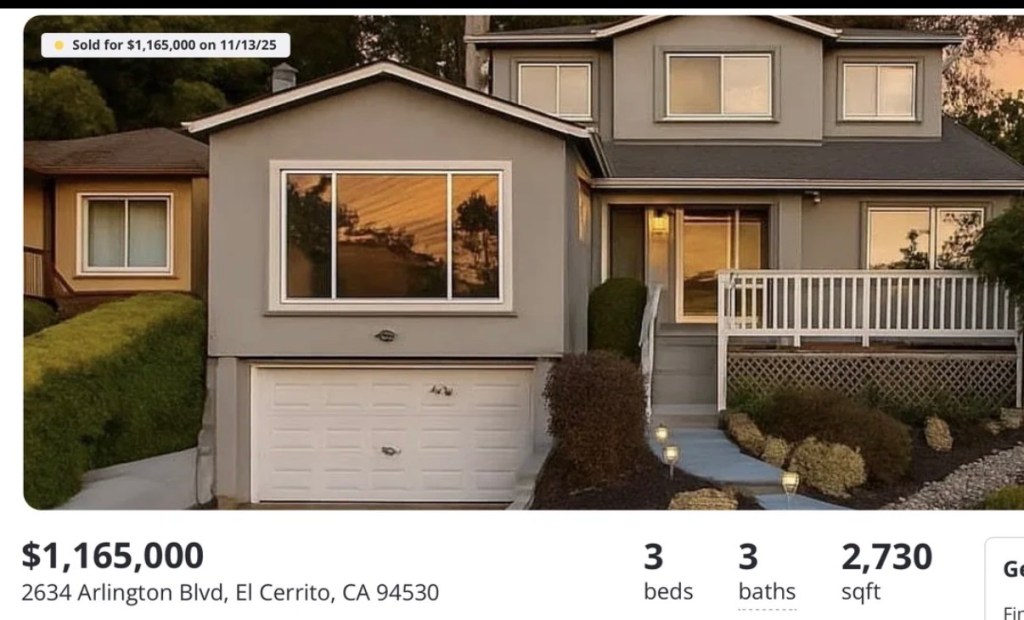
El Cerrito’s housing market is sending mixed signals, and residents can feel it. When a single-family home on The Arlington—one of the most expensive and historically premium streets in the entire city— sells for about $1.165 million, it’s fair to ask what buyers are paying for—and what direction the City is taking.
This wasn’t a tiny cottage, a fixer, or a distressed sale. It was a 3-bedroom, 2-bath home with roughly 2,700 square feet, and contrary to what many might assume at that price point, it didn’t need any additional work. This wasn’t a buyer gambling on potential. It was a buyer paying for a move-in-ready on a street that has long represented the top tier of El Cerrito real estate.
That distinction matters. The Arlington is not a middle-of-the-market street. Along with the homes above Arlington in the hills, it has historically anchored the highest-priced residential tier in El Cerrito—a tier that commands value precisely because it reflects confidence in the city as a whole. When pricing on one of the city’s most expensive streets starts to look shaky—or starts to behave like a “flat market” despite premium location—it’s not a quirky data point. It’s a warning.
In contrast, BART-adjacent neighborhoods have traditionally been the lowest-cost single-family areas in El Cerrito. That hierarchy has been stable for several decades. And that’s why what happened six months earlier is so important: a 3 bedroom home just two blocks from El Cerrito del Norte BART sold for approximately $1.2 million. That sale made sense—transit access, and a market still extending some confidence to El Cerrito’s leadership.
Comparable homes just midway up the hill were selling for $2 million two years ago. Seeing similar pricing now appear on Arlington, without clear improvements in city performance, is not evidence of strength. It suggests prices are being held up by scarcity while confidence underneath them is thinning.
El Cerrito homeowners need to hear this clearly: our housing values are slipping relative to what they should be. For most residents, a home isn’t just a place to live—it’s the primary long-term investment, chosen because real estate is supposed to appreciate steadily over time. El Cerrito is failing that test. While residents pay premium prices and rising taxes, the City is underserving the fundamentals that protect value: safety, stability, competent management, and trust. Appreciation doesn’t crash overnight—it stalls, flattens, and quietly falls behind comparable cities. And that gap compounds every year.
Now make it practical. If you’re a homeowner who may want to refinance, tap equity, or sell, stalled appreciation is not an abstract concept—it’s your balance sheet. A softer valuation can mean a lower appraisal, a higher loan-to-value ratio, tougher terms, or fewer options. If you’re selling, it can mean a longer time on market, more buyer demands, or price reductions that feel like death by a thousand cuts.
Relative to what homeowners were entitled to expect from a well-run city, our housing values have tanked—and the cost is being borne by residents, not City Hall.
People don’t choose where to live based on square footage alone. They buy into safety, stability, and trust—especially in a city where streets like Arlington have long symbolized the very best El Cerrito has to offer. Yet El Cerrito has layered on another drag on desirability: higher and continually rising taxes. When premium home prices are paired with repeated tax measures, growing fees, and little evidence of improved outcomes, buyers notice. They compare. And some decide not to stretch for a city that feels increasingly uncertain.
Even the City’s own market study data points to challenges that undermine confidence. Personal crime rates remain above the national average, with robbery and motor vehicle theft notably high. Layer those realities on top of tax fatigue, organizational churn, and leadership that feels reactive rather than disciplined, and the result is predictable. Buyers hesitate. Long-time residents grow uneasy. Families considering El Cerrito start asking harder questions before making one of the largest investments of their lives.
This is how a city walks itself into a weaker housing market—not overnight, and not because of one sale, but through accumulation. More caveats in conversations. More questions about taxes and safety. More people concluding that El Cerrito is expensive without feeling secure or well-managed. When trust declines, demand becomes fragile. And when demand becomes fragile, everyone pays for it—homeowners trying to protect their equity, first-time buyers stretching to get in, and seniors relying on their homes to fund what comes next.
What makes this moment especially frustrating is that none of this was inevitable. El Cerrito has strong housing stock, a prime location, and a community that cares deeply about where it lives. Streets like Arlington became premium for a reason. What separates cities that hold their value from those that slowly lose momentum is leadership. Strong cities focus relentlessly on public safety outcomes, core services, and long-term financial discipline. They fix systems before asking residents for more money. And they communicate honestly—even when the truth is uncomfortable.
El Cerrito’s current leadership has had that opportunity. The City Council and City Manager have had years to protect the value of neighborhoods like Arlington and the hills above it. They have failed to do so. Residents are paying top-tier prices on top-tier streets while being asked to accept declining confidence, rising taxes, and lower expectations.
Call to Action: 2026 Is a Choice
If you live in El Cerrito—or you’re considering buying here—2026 matters. This is not about one house. It’s about whether residents are willing to accept a future where even the city’s most expensive streets are no longer insulated from governance failure.
It is time for new leadership.
Time for new City Council members who understand that fiscal discipline, public safety, and resident trust are non-negotiable. And it is time for a new City Manager who can deliver results, not a city manager who pretends like the city is stronger than ever.
The current leadership has had ample time to do what was needed to support the people who live here. They have missed—badly. El Cerrito deserves leadership that earns the price of admission, protects homeowners’ most important investment, and restores confidence in the city’s future.
2026 is not just another election.
It is a referendum on whether El Cerrito is willing to change course.
 El Cerrito Committee for Responsible Government (ECCRG)