Editorial
The February 19 special meeting was presented as a chance to explain the details of the proposed library initiative. But let’s be clear: this is not simply about a library. This is about a tax.
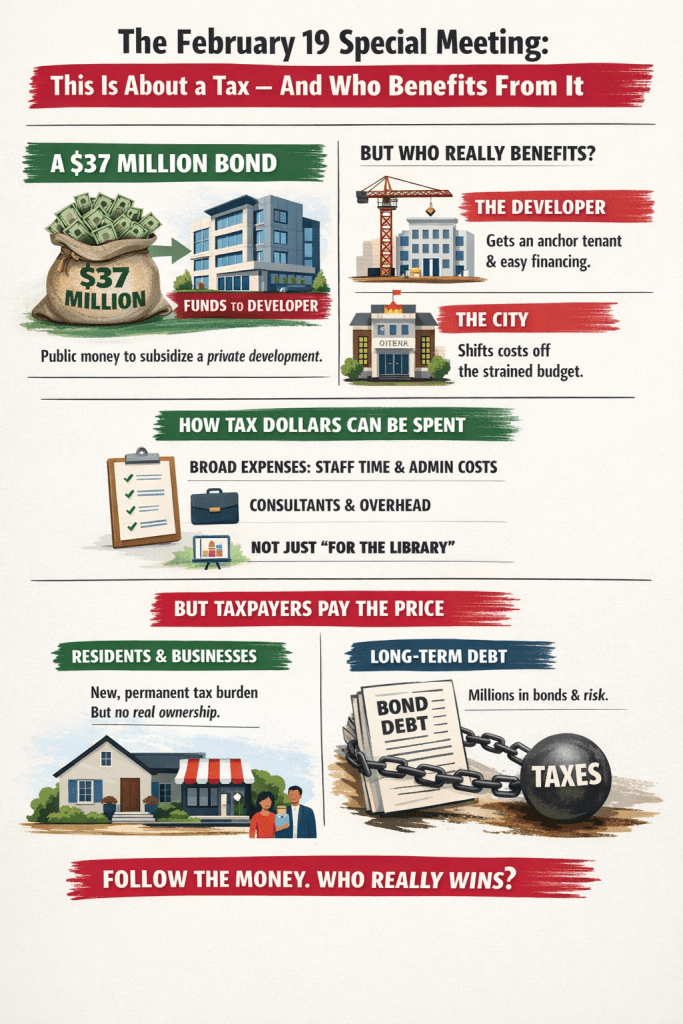
It is about creating a permanent revenue stream so the City can immediately issue approximately $37 million in bonds and transfer those funds to a private developer. Those bond proceeds would be used to help the developer secure the financing needed to construct the building.
Supporters argue that the project will move forward whether or not the City participates. But the reality is that the full funding is not yet in place. Without the City’s bond financing, the project does not currently have complete financial backing.
That is why this tax matters.
It is not just about library services. It is about using taxpayer dollars to underwrite a private development—while presenting it as a simple investment in a public facility.
At the same time, residents are being told they are “buying” a condominium. But a ground lease is not ownership. Paying rent—even if it is only one dollar a year—is not ownership. If the City truly owned the building, there would be no lease payment at all.
This measure asks voters to approve a permanent tax based on a misleading framing of ownership and risk.
The City will tell residents that this tax can only be used for the library. But the actual terms and conditions are very broad. They allow the City to be reimbursed for a wide range of expenses—including staff time, administrative costs, consulting fees, funds currently earmarked for the library and even the time spent preparing presentations for meetings like the February 19 session.
In practice, this means the tax is not limited to bricks and books. It can be used to backfill many internal costs that would otherwise come out of the General Fund.
Who Really Benefits? Follow the Money.
When you follow the money, the beneficiaries become clear.
First, the developer benefits. By securing the City as an anchor tenant backed by roughly $37 million in bond financing, the project gains instant credibility with lenders. That public commitment makes it far easier for the developer to secure the remaining private financing.
Second, the City benefits—at least in the short term. By creating a dedicated library tax, officials can shift major facility and operating costs off the already strained General Fund and onto a new, permanent revenue stream. This relieves budget pressure.
But accounting relief is not the same as real savings.
At the end of the day, El Cerrito residents are still paying for everything.
The money does not come from outside sources. It comes from local households and small businesses, year after year. The tax may be labeled “for the library,” but in practice, it services long-term debt, reimburses internal costs, and supports private financing.
So while the developer gains financing security and the City gains short-term budget flexibility, residents assume the long-term financial obligation.
That is the real tradeoff voters are being asked to approve.
Voters deserve clear, honest information about what they are being asked to fund, who benefits, and what the City will actually own.
This is not a technical detail. It goes to the heart of fiscal responsibility and public trust.
 El Cerrito Committee for Responsible Government (ECCRG)