Tuesday night’s City Council presentation finally included publicly shared usage data for the El Cerrito Library. That matters. Decisions of this magnitude should start with facts.
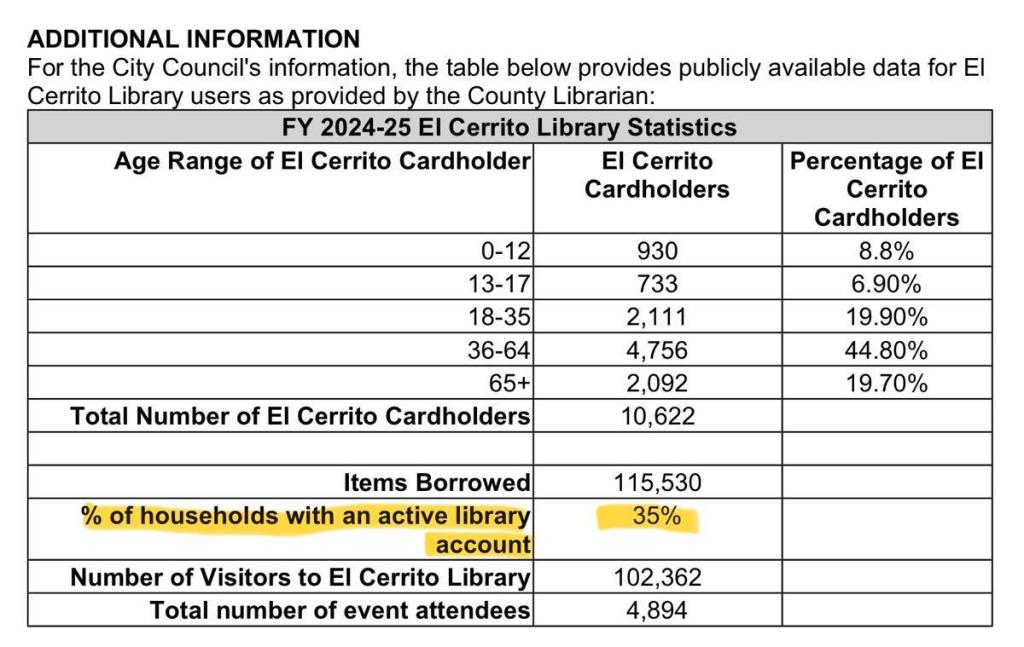
According to the Library’s published FY 2024–25 statistics:
• 10,622 El Cerrito cardholders
• 35% of households with an active account
• 102,362 annual visitors
• 115,530 items borrowed
• 4,894 event attendees
Those numbers provide a baseline. The question is how we interpret them — and how they connect to the scale of the proposed project.
The Age Breakdown Matters
Cardholders by age:
• 0–12: 930 (8.8%)
• 13–17: 733 (6.9%)
• 18–35: 2,111 (19.9%)
• 36–64: 4,756 (44.8%)
• 65+: 2,092 (19.7%)
If we combine residents 36 and older:
4,756 + 2,092 = 6,848 cardholders
Approximately 64.5% of all El Cerrito cardholders are over 36 years old.
Youth (0–17) represent about 15.7% of cardholders.
That doesn’t diminish youth programming. It does suggest that current usage skews older — which should inform programming, design, and space planning assumptions.
Expanding the Key Questions
1. Do current usage levels justify tripling the facility size?
If we are considering a substantially larger building, the community deserves to see:
• Current space utilization rates by hour and by day
• Waitlists for rooms, programs, or seating
• Square footage per visitor benchmarks compared to peer cities
• Documentation of unmet demand
Without that analysis, scale risks being driven by aspiration rather than demonstrated constraint.
2. What capacity constraints exist today?
Are we routinely turning away:
• Students needing study space?
• Seniors needing programming space?
• Community groups needing meeting rooms?
Or is the issue modernization and functionality rather than raw square footage?
There’s a difference between:
• A facility that needs updating
• A facility that is too small
• A facility that is under-optimized
Those require different solutions — and different price tags.
3. What will long-term operating costs look like?
A larger building doesn’t just cost more to build.
It typically means:
• Higher staffing levels
• Increased utilities and maintenance
• Expanded security needs
• Higher lifecycle replacement costs
If we’re evaluating fiscal sustainability, capital costs are only part of the equation. Operating costs compound year after year — long after ribbon cuttings and campaign messaging fade.
4. Who will primarily use a significantly larger facility?
If nearly two-thirds of cardholders are over 36, design assumptions should reflect:
• Adult and senior programming needs
• Quiet study and reading spaces
• Accessible design considerations
• Multi-generational flexibility
If the expansion is justified primarily on projected youth growth, those projections should be transparent and evidence-based — especially given that construction would likely occur 3–5 years from now.
Physical infrastructure should reflect durable demand — not momentary sentiment.
The Core Issue: Alignment
This is not a debate about whether libraries are valuable. They are.
It’s about alignment between:
• Usage data and facility scale
• Capital investment and operating sustainability
• Demographics and design assumptions
• Community priorities and long-term fiscal health
When 35% of households have active accounts, that is meaningful — but it also means 65% do not. A permanent funding structure should be grounded in broad-based, clearly demonstrated need.
Tuesday’s presentation moved the conversation forward by putting numbers on the table.
Now the community deserves:
• Transparent growth projections
• Capacity analysis
• Operating cost modeling
• Peer comparisons
• And a clear articulation of tradeoffs
And alignment starts with asking the hard questions — before committing to long-term financial decisions impacting our already high tax base.
 El Cerrito Committee for Responsible Government (ECCRG)
Is there any data to understand the El Cerrito library visitor who are residents? What about the time of day for library visitors? If so, I would like to understand both of these issues.
LikeLike
hello, thank you for your inquiry. We have not seen any recent data on time of day and whether or not they are residents. However, you can ask the city clerk under the public information ask those questions. The city librarian should at least be able to tell you what the traffic is like.
LikeLike
SECTION 2 Recitals. The people of the City of El Cerrito find and declare as true and correct the following: 5. A new library should be constructed to comply with current building and environmental codes and to support modern technologies essential to today’s libraries. A new library could provide space, furnishings, and equipment for library and community services and amenities such as after-school homework assistance, tutoring and summer reading programs for school-age children; a dedicated children’s area for story time and other programs; art and literacy programs for all ages; programs and space for older adults and seniors; expanded book collections and other media; improved access for older adults and residents with disabilities; and public meeting and community gathering spaces. It could also provide shelter in case of fires, unclean air, excessive heat or cold, earthquakes, floods, or other emergencies
*this is what the new library is for = another Community Center to go along with the 4 community centers EC already has – Community Center Social Hall on Moser that accommodates 224, Arlington Clubhouse accommodates 50 and newly rennovated, Castro Clubhouse 30 people, and Hanna Gardens Community Room capacity 60. *
*Expanded book collections? Contra Costa County manages and purchases all book collections that are available Countywide for all branch libraries. Those referenced in the Initiative would be private collection ie just El Cerrito and who manages that? Its all BS *
On Sun, Mar 1, 2026 at 3:26 PM El Cerrito Committee for Responsib
LikeLike