Changing the spokesperson doesn’t change the story.
The Committee for a Plaza Station Library has a new public face, but the leadership behind the effort remains the same—and so do the concerns.
At the center of it is Greg Lyman, now serving as Chair of the campaign. He is not simply a library advocate. He is a former Mayor and City Councilmember who held leadership roles during a period when El Cerrito’s financial condition deteriorated significantly.
During those years, the City overspent, underfunded pension obligations, depleted reserves, and ignored repeated warning signs. Those decisions were not theoretical—they had consequences. The City ultimately landed on the California State Auditor’s high-risk list, a designation reserved for governments facing serious fiscal and operational challenges.
That context matters.
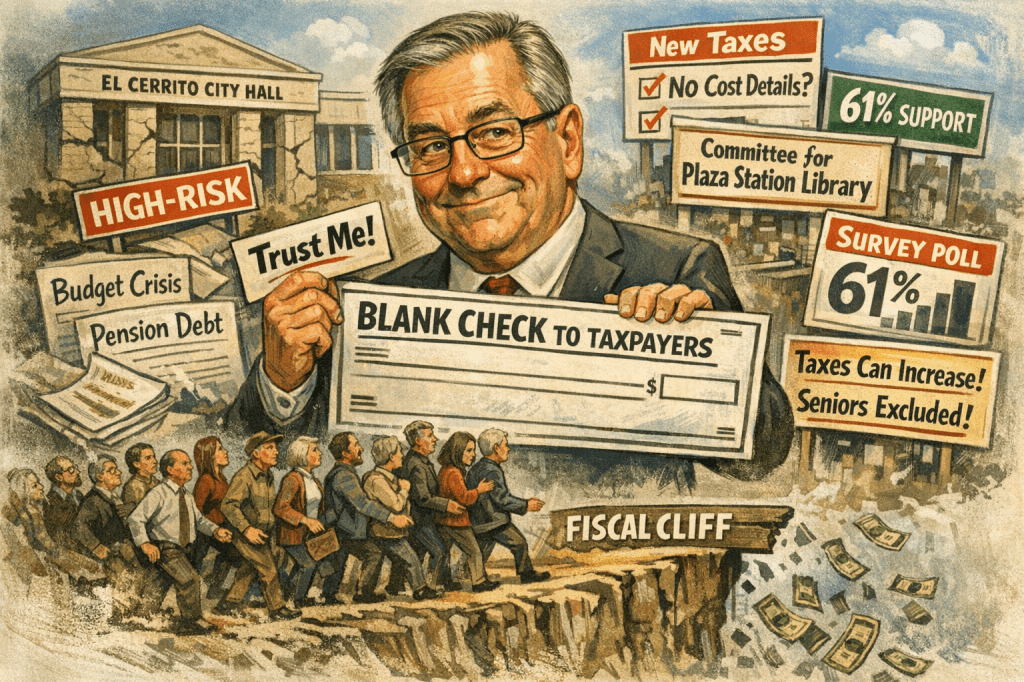
Because now, the same leadership is asking residents to approve another long-term tax—without fully presenting the financial reality behind it.
Instead of a detailed, transparent funding plan, what has been advanced is a “citizen’s initiative.” This approach lowers the approval threshold, allowing a tax to pass with a simple majority—50% plus one vote—rather than the traditional two-thirds required for special taxes.
Even within that framework, the campaign’s own polling reportedly showed only about 61% support—and that was before key details became widely understood. Before residents learned that project cost estimates had nearly doubled. Before questions were raised about the viability of the senior exemption. Before it became clear that the City Council could increase the tax over time without returning to voters.
Those are not minor details. They are fundamental to understanding the true cost and long-term implications of what is being proposed.
And yet, instead of clarity, residents are being asked to move forward based on broad promises.
That’s not planning. That’s risk.
El Cerrito has already experienced what happens when financial decisions are made without discipline, transparency, and accountability. The result was years of instability, difficult tradeoffs, and a loss of public trust.
We should not repeat that pattern.
If this proposal is truly in the best interest of the community, it should be able to stand on clear numbers, transparent assumptions, and an honest discussion of tradeoffs.
Anything less asks residents to sign on to a future they cannot fully see—and to trust a process that has, before, led the City in the wrong direction.
El Cerrito deserves better than that.
It deserves leadership that prioritizes fiscal responsibility, transparency, and long-term stability—not another campaign built on incomplete information and optimistic assumptions.
Before making a decades-long financial commitment, residents should ask a simple question:
Have we seen this approach before—and how did it end?
 El Cerrito Committee for Responsible Government (ECCRG)