This blog was heavily influenced by social media commentary, public documents, and local news coverage.
As voters consider the June 2 library tax initiative, one option continues to receive far less attention than it deserves:
Refreshing and improving the existing library site.
In a debate dominated by relocation plans and 20,000-square-foot expansion concepts, the most fiscally responsible and lowest-risk option is often treated as secondary.
It shouldn’t be.
The $6 Million Distortion
Much of the public narrative has centered on the idea that building at the Plaza BART location could save $10 million.
But that gap only appears when alternative scenarios are inflated with more than $6 million in structured parking and land acquisition costs — while those same costs are excluded from the preferred BART site.
When structured parking is removed and core construction costs are compared consistently, the spread between options narrows significantly.
Here is the apples-to-apples comparison.
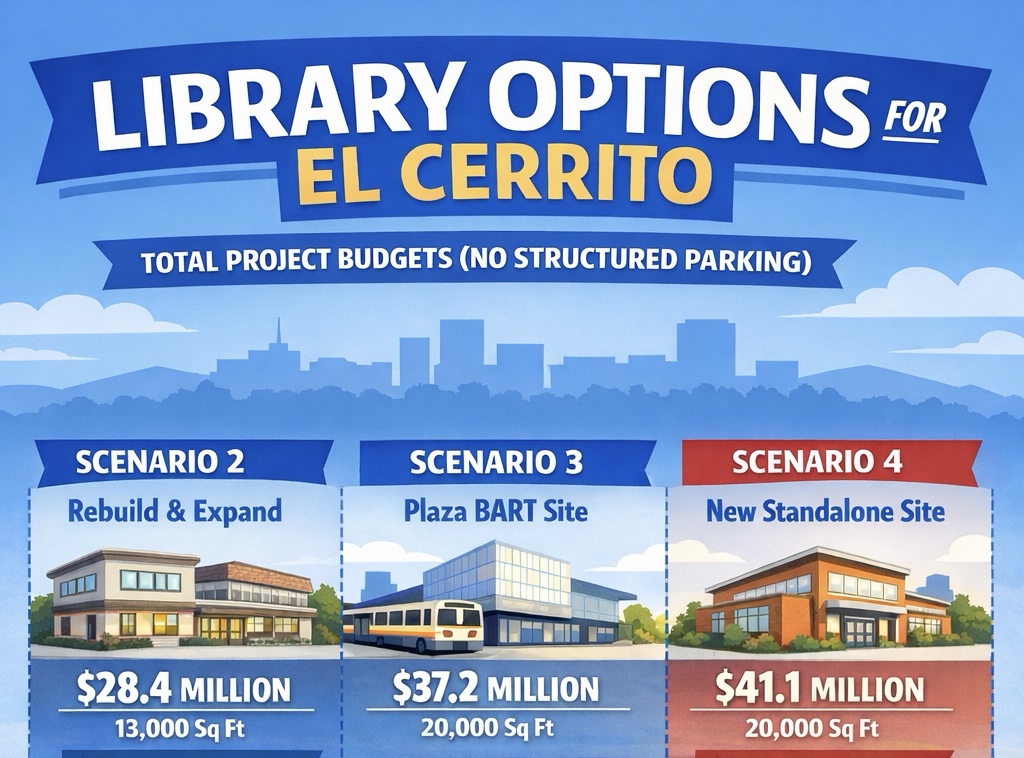
FACT BOX
Library Scenarios 2, 3, and 4 — Base Costs Without Structured Parking
Scenario 2
Rebuild and Expand Existing Library
13,000 square feet
Base Project Budget: $28,383,000
Difference from Scenario 3: $8,841,000 less
Scenario 3
Build Library at Plaza BART TOD
20,000 square feet
Base Project Budget: $37,224,000
Scenario 4
Standalone Library on New Site
20,000 square feet
Base Project Budget: $41,142,000
Difference from Scenario 3: $3,918,000 more
What This Shows
The frequently cited $10 million savings disappears.
Scenario 2 is nearly $9 million less than the Plaza BART option.
Scenario 4 is about $3.9 million more than the Plaza BART option — not $10 million more.
When parking and land assumptions are removed, voters see a much narrower spread between the options.
But even this table leaves out the most affordable alternative.
Renovate and Refresh the Existing Library
Approximately $10.3 million total capital cost
Why Refreshing the Existing Site Makes Sense
First, it is financially prudent.
At roughly $10.3 million, renovation costs are less than one-third of the Plaza BART option and far below new construction alternatives. In a city with a documented history of fiscal strain, proportionality matters.
Second, it avoids land control uncertainty.
The Plaza BART option involves building on land the City does not own. The standalone new-site option requires land acquisition. The existing site avoids both complications.
Third, it minimizes long-term operating costs.
Three of the five scenarios assume a 20,000-square-foot facility — roughly three times the current 6,500-square-foot building. Larger buildings mean higher utilities, increased maintenance, additional staffing, and greater lifecycle obligations.
A right-sized, modernized library avoids locking taxpayers into permanently higher operating costs.
Fourth, it preserves flexibility.
A refresh allows the City to improve functionality now while retaining the option to reassess future needs without committing to a generational tax burden.
A Question of Scale
The real issue is not which option is architecturally most ambitious.
It is which option aligns with El Cerrito’s financial reality, service needs, and long-term sustainability.
Residents value libraries. Supporting a library does not require supporting the most expensive option available.
Refreshing the existing site is not the loudest proposal.
It is the most proportionate.
In a city working to rebuild trust and strengthen fiscal stability, proportionate solutions are often the wisest ones.
 El Cerrito Committee for Responsible Government (ECCRG)