A polished new website has appeared promoting the library tax measure on the June ballot.
It is sleek.
It is well designed.
And it tells a compelling story about a modern library for El Cerrito.
The site appears to be a rebrand of the earlier campaign website that focused heavily on a library at the Plaza. It is unclear whether the change matters, because the city’s own policy documents continue to identify the Plaza as the intended location for the library.
Like most campaign websites, it highlights what supporters want voters to see while leaving out other details that may be relevant for voters trying to understand the full scope of the proposal.
The Real Cost
Campaign materials often highlight selective construction numbers or comparisons.
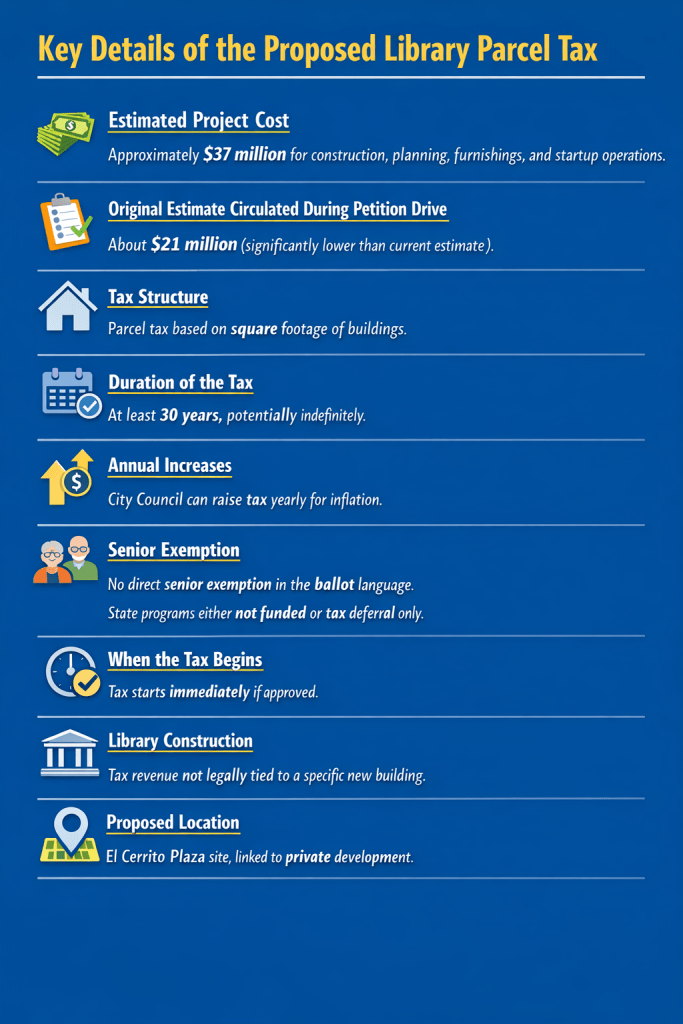
But the proposal before voters is not a $21 million project.
It is approximately a $37 million library project when all elements are considered — including construction, build-out, furnishings, planning costs, and years of operating support included in the measure.
That represents roughly a $17 million increase from earlier estimates, which supporters attribute largely to inflation.
Some residents have questioned whether the earlier lower estimate influenced the signature-gathering process for the citizen initiative that placed the measure on the ballot.
The Missing Senior Exemption
One issue that has received significant attention in community discussions is the question of a senior exemption.
Supporters of the measure suggested during the signature-gathering phase that seniors might qualify for an exemption from the tax.
However, the ballot language itself does not contain a direct senior exemption.
Instead, it references two state programs:
• The Gonzales-Deukmejian-Petris Senior Citizens Property Tax Assistance Law, which has not been funded since 2009.
• The Senior Citizen Property Tax Postponement Program, which allows taxes to be deferred in exchange for placing a lien on the property. This program is a postponement, not an exemption.
The language mirrors provisions used in Measure H (2019), which also referenced these programs. According to public commentary, no El Cerrito residents have qualified for exemptions through these mechanisms.
The City Council recently voted 4-0 to discuss its intentions regarding a potential senior exemption, but discussion alone does not change the ballot language.
At present, no senior exemption exists in the measure voters will see on the ballot.
The campaign website does not address this issue.
The Duration of the Tax
Another element not prominently explained in the campaign messaging is the duration of the tax.
The parcel tax is structured to last at least 30 years and potentially indefinitely.
That means residents could be paying the tax for decades. In practice, parcel taxes in El Cerrito rarely disappear — they are typically renewed before voters ever experience a “sunset.”
For many homeowners, the obligation could outlast their mortgage or the period they expect to live in the city.
Annual Increases Without Additional Voter Approval
The measure also allows the tax to increase annually based on inflation.
These adjustments could be implemented by the City Council without returning to voters for approval.
As a result, the amount residents ultimately pay could increase over time compared with the amount initially presented when the measure was introduced.
The Library Is Not Guaranteed
The campaign website promotes the measure as a way to build a new library.
However, the ballot language itself is broader.
The revenue may be used for library services, facilities, and related costs, and it is not legally tied to constructing a specific new building.
This means the tax could begin immediately even though a new facility is not guaranteed by the measure itself.
The Development Connection
Another issue not heavily discussed on the campaign website is the relationship between the proposed library and the El Cerrito Plaza development project.
The proposed library location is connected to a private development planned near the BART station.
Some critics have suggested the tax could function as a public subsidy connected to that project. Supporters argue that integrating the library into the development may reduce construction costs.
Regardless of perspective, the relationship between the library proposal and the larger development project is an important policy issue for voters to consider.
What the Website Is — and What It Is Not
The website is a campaign website advocating for a tax measure.
It presents a vision of what supporters hope the project will achieve.
It is not a comprehensive financial analysis of the proposal, and it does not address several issues that voters may wish to evaluate, including:
• the full $37 million estimated project cost
• the absence of a direct senior exemption in the ballot language
• the long duration of the tax
• annual inflation adjustments
• the potential housing cost impacts
• the uncertainty around the final library project
• and the relationship to the Plaza development
The Bottom Line
When voters are asked to approve a long-term parcel tax for a major public project, many residents expect clear and complete information.
Campaign websites help communicate a vision, but voters may also look to other sources — including city documents, ballot language, and public discussions — to understand the full details of what they are being asked to approve.
 El Cerrito Committee for Responsible Government (ECCRG)
If you do the math, $0.17/sf x 1500 sf (ave size of home) x 10K (#homes in EC) x 30 years = $76.5M So why are they collecting $76M (and up to $150M w/ escalation)!?!?! Please put that in some where in your highlights.I do not trust the numbers for the library at all. Extreme case study: For the eastern section of the Bay Bridge had initial estimate of $250M (1995) but it ended up to be $6.5Billion (or more nobody’s sure?). A 2,500% budget overrun: the story of the Bay Bridge’s dramatic cost inflation from $250M to $6.5B
| | | | | |
|
| | | | A 2,500% budget overrun: the story of the Bay Bridge’s dramatic cost inf…
Zaha Hadid isn’t the only one who has suffered from hugely inflated construction estimates: back in 1995, Caltra… |
|
|
LikeLike