Engagement Is Allowed. Action Requires an Agenda.
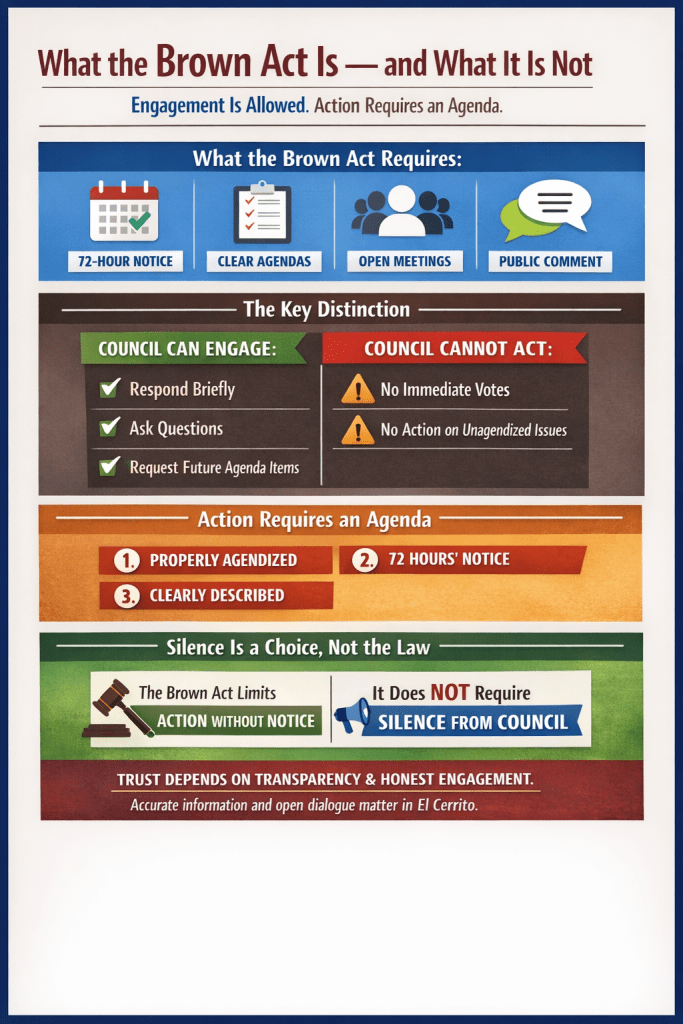
In recent meetings in El Cerrito, we’ve heard councilmembers suggest that they do not respond to residents during public comment because of the Brown Act.
Let’s clarify what the law actually says.
The Ralph M. Brown Act (Gov. Code § 54950 et seq.) is California’s open meeting law for local government. Enacted in 1953, it ensures transparency, accountability, and meaningful public participation in local government.
It is not a gag order.
What the Brown Act Requires:
• 72-hour advance notice for regular meetings
• Clear agendas describing items for discussion
• Open meetings accessible to the public
• Opportunities for public comment
• Strict limits on closed sessions
• Prohibition of serial meetings outside a noticed public meeting
Its core principle is simple:
The public’s business must be conducted in public.
Engagement vs. Action — The Key Distinction
Here is where confusion often occurs.
The Council can engage during public comment. Members may:
• Briefly respond
• Ask clarifying questions
• Provide factual information
• Direct staff to follow up
• Request that an item be placed on a future agenda
What the Council cannot do is:
• Deliberate on an item that is not on the agenda
• Take action on an issue raised during public comment if it has not been properly noticed
If a resident raises a new issue during public comment, the Council cannot suddenly vote on it.
To take action, the item must be:
1. Properly agendized
2. Posted at least 72 hours in advance
3. Clearly described so the public knows action may occur
That is the safeguard.
It prevents surprise decision-making.
It does not prohibit conversation.
Silence Is a Choice, Not a Legal Mandate
There is a difference between not taking action and not acknowledging the public at all.
The Brown Act restricts action without notice.
It does not require officials to remain silent.
Government Code § 54954.3 expressly allows brief responses and clarifications during public comment, so long as members do not engage in substantive deliberation.
Choosing not to respond may be a governance style.
But it should not be described as a legal obligation.
Why This Matters in El Cerrito
El Cerrito is a small city of approximately 25,000 residents. People show up. They read staff reports. They ask informed questions about budgets, taxes, development, reserves, and long-term fiscal sustainability.
When residents receive no acknowledgment — and are told “the Brown Act prevents us from responding” — it creates unnecessary confusion.
City leaders often express concern about declining public trust. They wonder why residents feel skeptical, disengaged, or doubtful about decision-making processes.
This is one of the reasons.
When legal requirements are overstated, when engagement is withheld unnecessarily, and when silence is framed as compliance rather than choice, it erodes confidence.
The Brown Act was designed to increase transparency and public participation.
If trust is the goal, clarity about the law — and a willingness to engage within it — would be a meaningful place to start.
 El Cerrito Committee for Responsible Government (ECCRG)