In any healthy democracy, trust between the public and its government is built on one essential principle: transparency.
When a city openly shares information, explains its decisions, and responds clearly to questions, residents can evaluate those decisions for themselves. Even when people disagree, transparency builds confidence that decisions were made honestly and thoughtfully.
But when information is withheld, obscured, or brushed aside with vague responses, trust erodes.
That is exactly the situation many residents now see unfolding in El Cerrito.
A Simple Request for Public Information
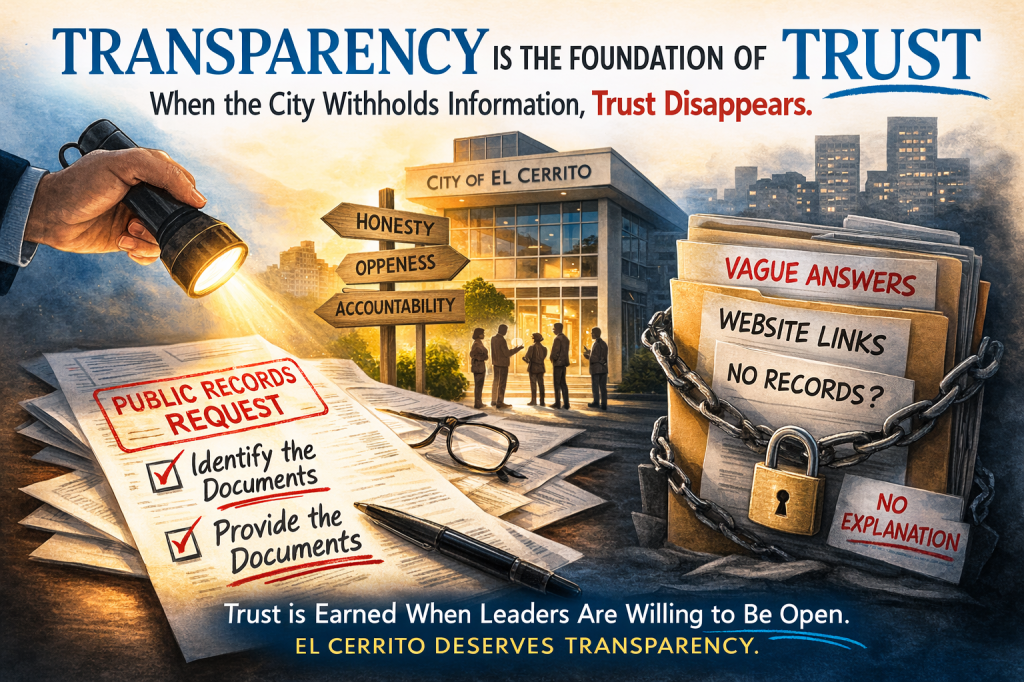
Resident Betty Buginas submitted a straightforward request under the California Public Records Act. She asked the City to identify and provide the reports, studies, memoranda, presentations, consultant materials, or other formal documents supporting the City Manager’s February 19, 2026 statement about city-owned sites that had been evaluated and rejected for a new library.
Her request was not unusual. It did not involve confidential personnel matters, litigation strategy, or protected information.
It asked for the basic documentation that should exist behind a major public claim.
Instead of identifying the responsive records and providing them, the City responded by directing her to two broad sections of the City website containing hundreds of pages of unrelated materials.
Simply telling residents to “look at the website” is not transparency. It is avoidance that occurs often.
The California Public Records Act is clear: when directing a requester to records online, an agency must identify the specific documents that are responsive. Public agencies are also required to assist requesters in identifying records.
That did not happen here.
Why Transparency Matters
Transparency is not just a legal requirement. It is the foundation of public trust.
When residents ask reasonable questions and the City responds with vague or incomplete answers, people begin to wonder what is being hidden — even when the issue may simply be uncomfortable rather than confidential.
In this case, there appears to be no legal reason for withholding the information. There is no claim of confidentiality, no litigation exemption, and no protected personnel matter.
The only apparent risk is that the record may not reflect well on the City’s decision-making process.
But protecting appearances is not a legitimate reason to withhold public information.
A Narrow Search for Alternatives
Buginas’ review of materials on the City’s website raises additional concerns.
Based on available documents, it appears the City considered only two options for building a library on city-owned land:
• A combined theater and library project on the Contra Costa Civic Theatre block, rejected due to cost (2016 feasibility report)
• A combined community center and library project at the current Community Center site discussed in a 2019 workshop
Both options were built around a set of assumptions:
• The library must be approximately 20,000 square feet
• It must have extensive parking
• It must be centrally located
Those assumptions were largely based on a consultant report from 2014 — a very different era for libraries, when DVD circulation dominated usage patterns.
Since then, the City has promoted a different concept: a new library at the BART site.
Yet that proposal appears to apply different criteria.
Parking requirements that were considered essential elsewhere are suddenly flexible. A site that raises concerns about congestion, access, and child-focused design is now being presented as the preferred location. And the City claims the BART option saves $10 million largely because it eliminates structured parking and land acquisition costs.
Meanwhile, the City’s own website states that if the BART opportunity is not pursued, there are no other sites available in the near term.
That conclusion may say less about the availability of sites and more about the limited effort made to identify them.
Trust Requires Openness
Residents do not expect perfection from their government. But they do expect honesty and openness.
If the City evaluated many sites and rejected them for legitimate reasons, the City should be able to identify and provide the documents supporting those decisions.
If no such records exist, that is also information the public deserves to know.
Transparency does not weaken government. It strengthens it.
When leadership is willing to share the facts — even when the facts are messy or inconvenient — trust grows.
When leadership refuses to provide basic information that residents are legally entitled to receive, trust collapses.
The Choice Facing El Cerrito
El Cerrito’s leaders — the City Council, the City Manager, and the City Clerk — face a simple choice.
They can continue offering vague answers and broad website links that leave residents searching for information that may or may not exist.
Or they can identify and provide the documents requested, clarify the record, and demonstrate that transparency still matters in El Cerrito.
Trust is not restored through speeches or press releases.
It is restored through openness.
And it begins with answering reasonable questions from the public.
 El Cerrito Committee for Responsible Government (ECCRG)