El Cerrito’s Departmental Plans Still Avoid the City’s Biggest Problem
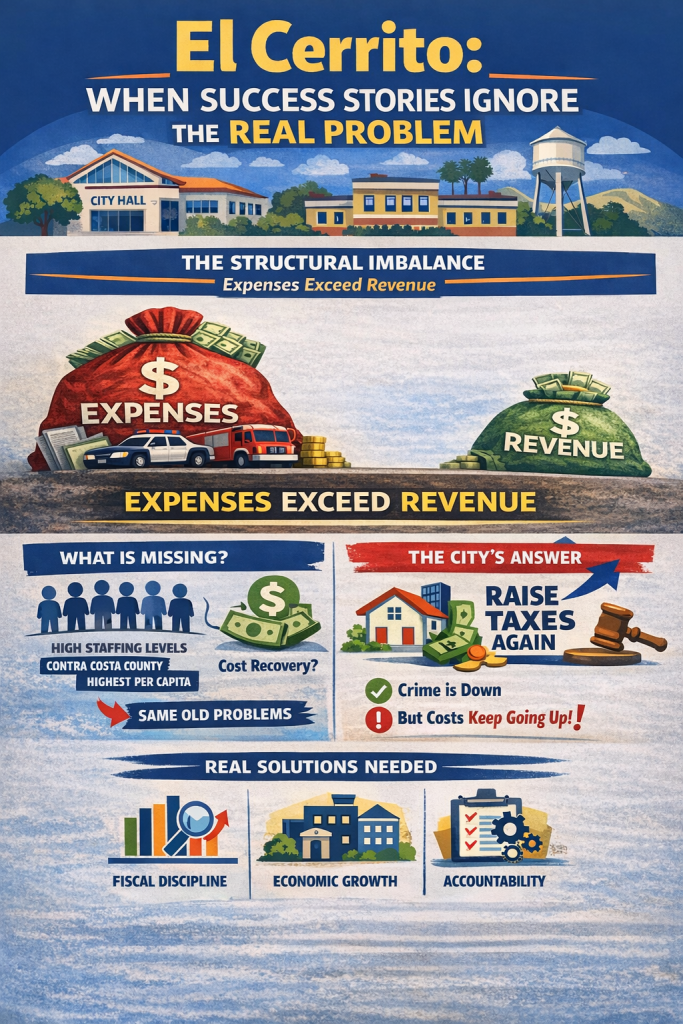
At this week’s budget study session, the City presented departmental plans covering operations, accomplishments, and priorities for the coming years. On the surface, the presentations painted a picture of a hardworking organization. Department after department described how busy the staff is, how much pressure they face, and how committed they are to serving the community. But underneath all of that was the same problem El Cerrito keeps refusing to confront: the City has a structural imbalance. That means the City’s ongoing expenses are exceeding its ongoing revenues. This is not a temporary issue. It is not a one-time anomaly. It is an ongoing built-in mismatch between what the City spends and what it brings in. And yet, instead of seriously discussing how to reduce expenses, improve productivity, right-size operations, or generate more non-tax revenue, the City keeps circling back to the same answer: raise taxes. That is not a fiscal strategy. That is covering for mismanagement.
What stood out most in the departmental plans was how much time was spent describing effort and how little time was spent discussing measurable results, hard choices, or operational shortcomings. Across departments, challenges were barely discussed, accomplishments were often vague, and future plans were more quantified than past performance. That matters because residents are being asked to trust the City with more money while getting very little honest discussion about what is not working. If the City wants credibility, it has to do more than talk about how hard people are working. It has to show that it understands why costs keep rising faster than revenue.
What was missing from these presentations was the most important conversation of all: what is the City doing to close the gap between recurring revenue and recurring spending? Not once did the overall discussion meaningfully focus on reducing the cost structure, redesigning services, improving efficiency, aligning staffing with actual needs, expanding revenue through economic development, or recovering more costs from those who benefit from City services. Instead, the pattern continues: when the City feels pressure, it looks to residents for more tax revenue. That is especially troubling because El Cerrito’s fiscal problem is not new. Residents have been hearing variations of this story for years. The City spends more than its revenue base can sustainably support, then acts as if higher taxes are the only responsible solution. They are not.
The Development Manager’s section included at least some discussion of accomplishments, but even there, the bigger issue remains unresolved: El Cerrito needs stronger economic development tied to actual revenue generation. As the City searches for a replacement, this should be a major priority. The next person in that role should not simply manage programs or process applications. The City should expect leadership that helps grow the local tax base, attract and retain businesses, expand commercial activity, and increase ongoing revenues without burdening residents further. If the City were serious about reducing pressure on taxpayers, this would be front and center.
The Police Chief noted that crime has decreased significantly. That is good news. But even with improved conditions, the presentation still pointed toward additional funding and big-ticket requests, with no serious conversation about offsets. The Fire Chief also missed a key opportunity. There was no meaningful discussion of whether Kensington is paying its fair share for the use of El Cerrito’s fire services. That question should have been addressed long ago, and the City’s own service delivery study should have helped identify those opportunities. Instead, yet another chance to improve cost recovery and increase revenue was allowed to pass. Again, the pattern is familiar: overlook revenue opportunities, avoid operational reform, ask taxpayers for more.
One of the most revealing parts of the discussion was how often departments described vacancies or leaves as if normal operational strain were a crisis. Again and again, the message was that someone is out, staff are stretched, people are covering for each other, and some work may not get done. But no one addressed the elephant in the room: El Cerrito has more employees per capita than any city in Contra Costa County, yet it still struggles with service delivery. That should force a deeper conversation. Instead, the unspoken assumption seems to be that more people will make everything easier. That is not necessarily true. If an organization is not structured well, not managed well, or not clear on priorities, adding positions will not solve the problem. It will just make the cost structure heavier. And in a city with a structural imbalance, that is dangerous.
The City also continues to carry four battalion chiefs, costing at least $2.5 million as a group. For that level of staffing and executive overhead, residents should expect measurable results, financial discipline, and strong service delivery outcomes. Instead, what residents heard was mostly how hard everyone is working. Hard work matters. But in government, especially during fiscal stress, residents also deserve transparency, accountability, prioritization, and results.
El Cerrito’s core fiscal problem is not mysterious. Expenses exceed revenue. That is the structural imbalance. And rather than treating that as a signal to reform operations, improve management, pursue economic development, recover more costs, and rethink staffing, the City has too often focused on one answer: raise taxes to cover the gap. Residents should not accept that as the only option. Because when a city fails to address the causes of imbalance and instead asks taxpayers to absorb the consequences, it is not solving the problem. It is shifting the burden.
The departmental presentations showed committed employees and busy departments. But they also revealed a City government still unwilling to fully confront the real drivers of its financial problems. El Cerrito does not just need more money. It needs better cost discipline, better operational design, stronger revenue strategy, and more honesty about the difference between workload and results. Until that happens, taxpayers will keep being told that higher taxes are necessary, when in reality they are being asked to subsidize a system that has not done enough to fix itself.
Link to the Presentation
 El Cerrito Committee for Responsible Government (ECCRG)