A recent campaign finance filing shows that the President and VP of East Bay Sanitary Co., Inc.—the company that holds El Cerrito’s exclusive solid waste contract—contributed $12,500 to the Committee for a Plaza Station Library.
This is significant because East Bay Sanitary is not just another local business. It holds an exclusive franchise agreement with the City to provide garbage and organics services. That agreement is structured to roll forward annually and can extend through 2047.
There does not appear to have been a competitive procurement process associated with the City’s 2022 agreement or any agreement before then.
That matters.
Under California law, cities are allowed to award exclusive solid waste franchises. A formal RFP is not always required. So this structure may be legally permissible.
But legality is not the same as good governance.
When a contract is not periodically rebid, the City loses one of its most important tools: competition.
Competition keeps pricing disciplined.
Competition drives innovation.
Competition gives the City leverage to negotiate on behalf of residents.
Without it, the system relies on trust.
And trust is not a substitute for accountability.
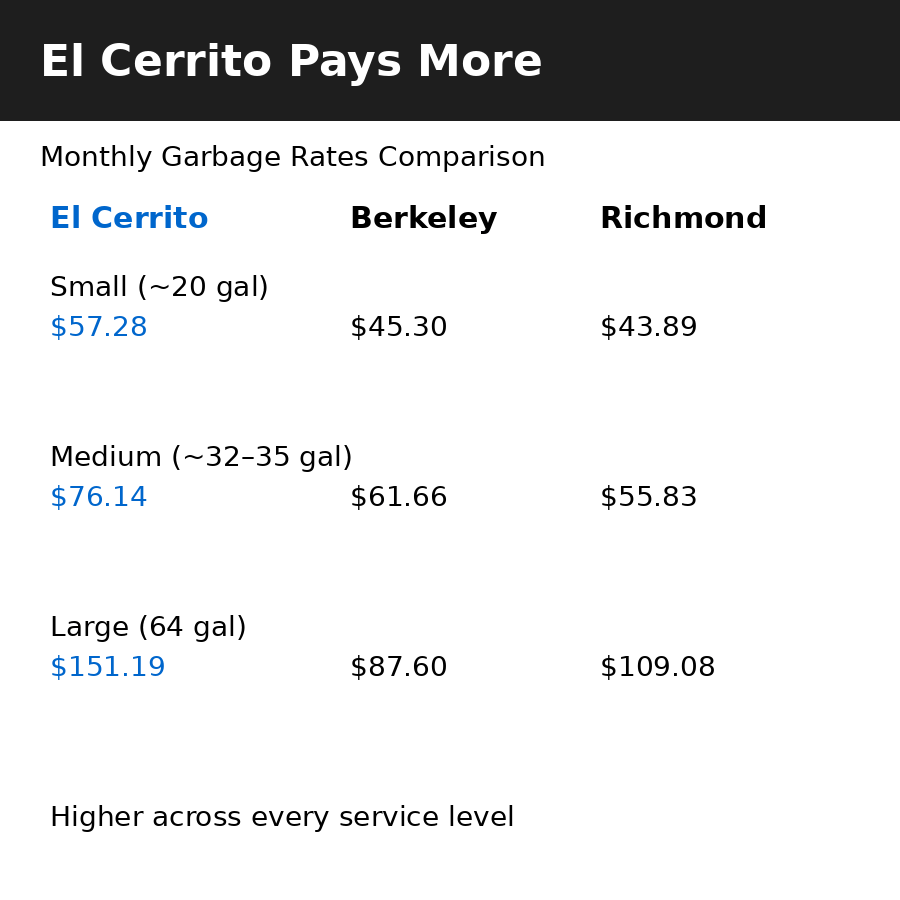
El Cerrito’s solid waste rates already appear higher than neighboring jurisdictions. Yet there has been no recent competitive process to demonstrate that residents are receiving the best value.
At the same time, the company benefiting from that exclusive, non-competed arrangement is participating in local ballot measure funding and donating $12,500 to the “Yes” on Measure C library campaign. This is particularly relevant given that they live in Corte Madera and Lafayette. You can find this data on El Cerrito’s website as well here: .
Let that sink in
When a company has a protected position in a city—one that is not regularly tested through competition—and is also financially participating in local political campaigns, it raises a reasonable question:
Is the system designed to protect the public interest, or is it too insulated from it?
To be clear, this is not an accusation of wrongdoing.
It is a governance issue.
• Should long-term exclusive contracts be periodically rebid?
• Should ratepayers have clearer assurance that pricing is competitive?
• Should there be stronger separation between city contractors and local political campaigns?
These are the questions that matter.
Good governance is not just about following the law.
It is about designing systems that consistently deliver the best outcomes for residents.
Right now, El Cerrito residents are being asked to trust a system that does not regularly test itself.
That is a choice.
And it is one worth examining.
 El Cerrito Committee for Responsible Government (ECCRG)