The following analysis is informed by research and materials compiled by a concerned El Cerrito citizen, along with publicly available City documents.
Before you vote, take a closer look at what is — and isn’t — being said.
This measure is being presented as a simple investment in a new library. But when you step back and look at the numbers, the timeline, and the details, a different picture emerges.
This is not just about a library. It is about committing taxpayers to a long-term financial obligation in a city that is already struggling to manage its current finances.
The City Is Already Running a Deficit
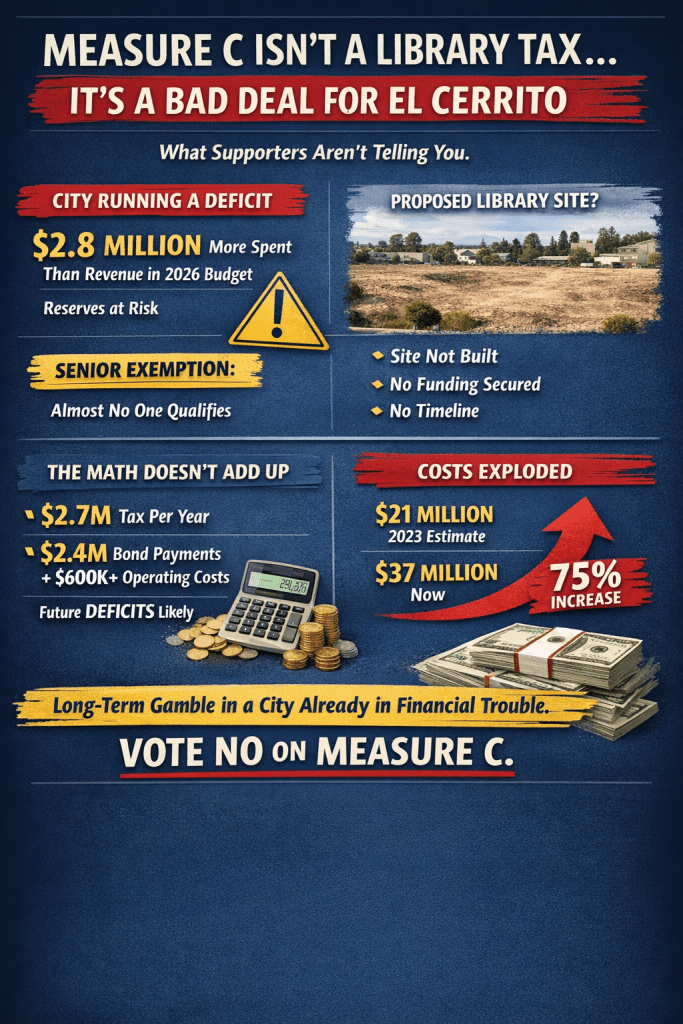
According to the City’s own February 2026 budget report, El Cerrito is spending approximately $2.8 million more than it brings in this fiscal year. The gap is being covered by drawing down reserves.
City finance staff have already warned that reserves could fall below the City’s 17% minimum policy threshold.
At the same time:
- Personnel costs are projected to rise another 9% next year
- Insurance costs increased 17% in a single year
This is the financial context in which the City is asking residents to approve a 30+ year tax.
The Senior Exemption Raises Serious Questions
The ballot language promotes a senior exemption as a key feature of fairness.
But under similar criteria used for another local tax, not a single El Cerrito senior has qualified since 2019.
That raises an obvious question: Is this exemption real in practice — or is it included to make the measure more appealing?
If voters are being given the impression of relief that may not actually be accessible, that is not transparency.
The Proposed Site Does Not Exist
The proposed library would be built on Parcel C West at the BART Plaza.
There is one problem: that site does not yet exist.
It has not been constructed, has not secured required state funding, and has no approved or reliable timeline.
A related parcel has already had a grant application rejected.
That means taxpayers could begin paying in December 2026 while construction may not begin until 2030 — if it happens at all.
There is no mechanism for refunds if the project stalls.
Even If Built, the Location Serves Residents Worse
The proposed location is farther from many neighborhoods than the current library.
It is less walkable for large portions of the city and will have significantly less parking.
We already have a functioning library. It is centrally located, accessible, and has parking.
This proposal replaces certainty with risk — and convenience with limitations.
The Financial Math Doesn’t Work
The measure is projected to generate approximately $2.7 million per year.
Estimated bond payments are approximately $2.4 million annually, and estimated operating costs exceed $600,000 annually.
That leaves a structural gap.
City projections show a $797,000 annual shortfall beginning in Year 11.
That gap does not disappear. It gets pushed back onto the General Fund — meaning potential cuts to police, fire, and road maintenance, or future tax increases.
There is also a real risk that the bond may be difficult to issue under these conditions.
Costs Have Already Escalated — Dramatically
When the petition was circulated in 2023, the project was estimated at $21 million.
The current estimate is $37 million — a 75% increase before construction has even begun.
Tax collection begins in December 2026, while construction is not expected until at least 2030.
Residents are being asked to pay now for a project that may not materialize for years — if at all.
This Is a Long-Term Gamble the City Cannot Afford
El Cerrito already owns a library that serves residents today.
At the same time, roads need repair, infrastructure is aging, and the City is drawing down reserves to stay afloat.
This measure asks residents to take on decades of financial risk in exchange for a project surrounded by uncertainty.
The Bottom Line
This is not simply a vote about a library.
It is a vote about fiscal responsibility, transparency, and priorities.
When a city is already struggling to balance its books, the answer is not to take on a long-term obligation based on optimistic assumptions and incomplete information.
Residents deserve clarity. They deserve accountability. And they deserve a plan that works — not one that hopes everything goes right.
Vote No on Measure C.
 El Cerrito Committee for Responsible Government (ECCRG)