A recent social media post from a City Councilmember suggested that El Cerrito is growing. That may be the narrative. It is not the reality.
El Cerrito has roughly 25,000 residents today—about the same scale it has been for decades. Growth since 1960 has been modest, and in recent years, population has been flat or even slightly declining at times. Household sizes are shrinking, and like many mature communities, El Cerrito is not experiencing the kind of sustained population growth that would naturally drive large-scale housing demand.
And yet, the City is planning for 1,391 new housing units over the next cycle.
That disconnect matters.
Over the last decade, El Cerrito has added only a few hundred units with most of them concentrated in a single development near El Cerrito del Norte BART. The Mayfair project alone accounts for a significant share of all new housing built in the city. Outside of that, development along San Pablo Avenue has been incremental, uneven, and in some cases stalled due to financial feasibility challenges.
Now layer in vacancy.
Affordable housing units—like those in the Elora (Mayfair Phase II) development are quickly absorbed and often oversubscribed. That reflects real need.
But market-rate units tell a different story. Projects like Mayfair continue to lease, but not instantly. Units remain on the market. Along San Pablo Avenue, smaller developments experience uneven occupancy, with units turning over and, at times, sitting vacant.
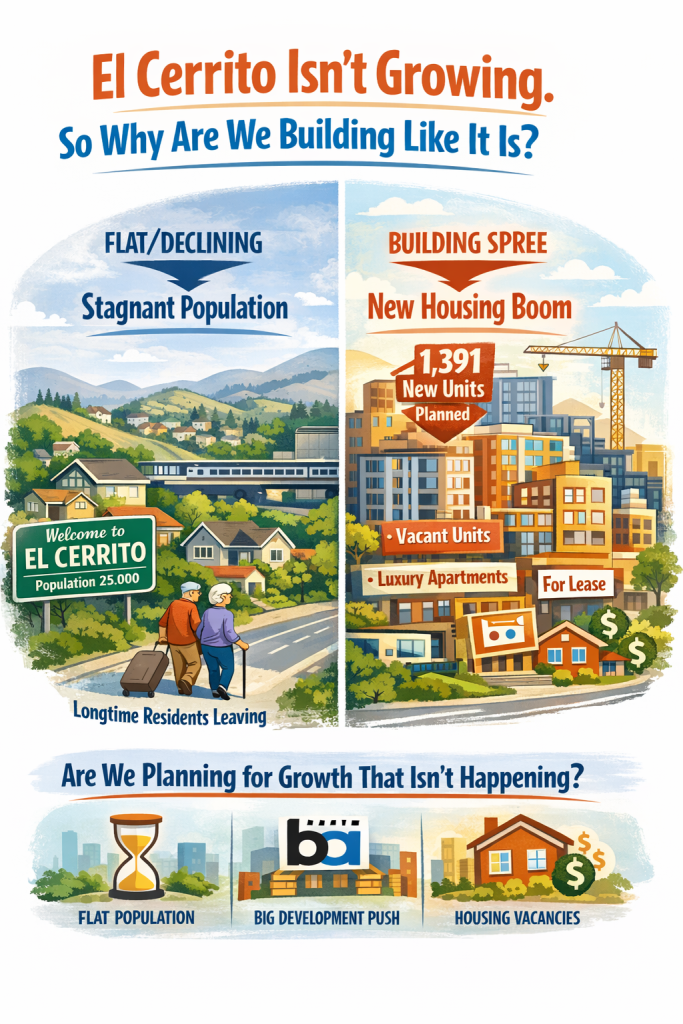
This is not a picture of overwhelming demand. It is a picture of a market that is selective, price-sensitive, and uneven.
So we have three realities:
The population isn’t meaningfully growing.
Housing production has been limited and concentrated.
And even newly built market-rate housing is not fully absorbed.
That raises a reasonable question.
Why are we planning for nearly 1,400 new units?
The answer is not local demand. It is state mandate.
Through the Regional Housing Needs Allocation process, cities like El Cerrito are required to zone for housing capacity—regardless of whether the market supports it or whether the population is growing. “Planning for” housing does not mean it will be built. It means the City must show that it could be built.
But planning has consequences.
Upzoning changes neighborhood expectations. It shapes land values. It drives redevelopment pressure along corridors like San Pablo Avenue and near transit. And it creates a narrative of growth that does not align with lived experience.
There is also a deeper tension that is rarely discussed.
El Cerrito is a stable, built-out community. Many residents stay for decades. Some leave as they age or seek different housing options. But that is not the same as a city experiencing rapid inflows of new residents. It is a city managing natural lifecycle changes—not explosive growth.
And yet, the policy response treats it as if it were the latter.
This is not an argument against housing. It is an argument for alignment.
If affordable housing is oversubscribed, that is where the need is. If market-rate housing is slower to lease, that tells us something about pricing and demand. If population growth is flat, that should inform the scale and pacing of planning.
Because building is not the same as needing.
And planning for growth is not the same as experiencing it.
Before we accept the premise that El Cerrito must continue to expand housing at a scale far beyond its historical pattern, we should ask a basic question:
Are we responding to real local conditions—or to a mandate that assumes a version of this city that does not exist?
That is the conversation worth having.
 El Cerrito Committee for Responsible Government (ECCRG)