What El Cerrito Residents Should Know Before Voting on the Library Tax
Tonight, the El Cerrito City Council will hold a study session on exemptions related to the proposed library parcel tax (Measure C). On the surface, this sounds reassuring—especially for seniors. But when you read the details in the agenda packet (pages 75–84), a more complicated picture begins to emerge.
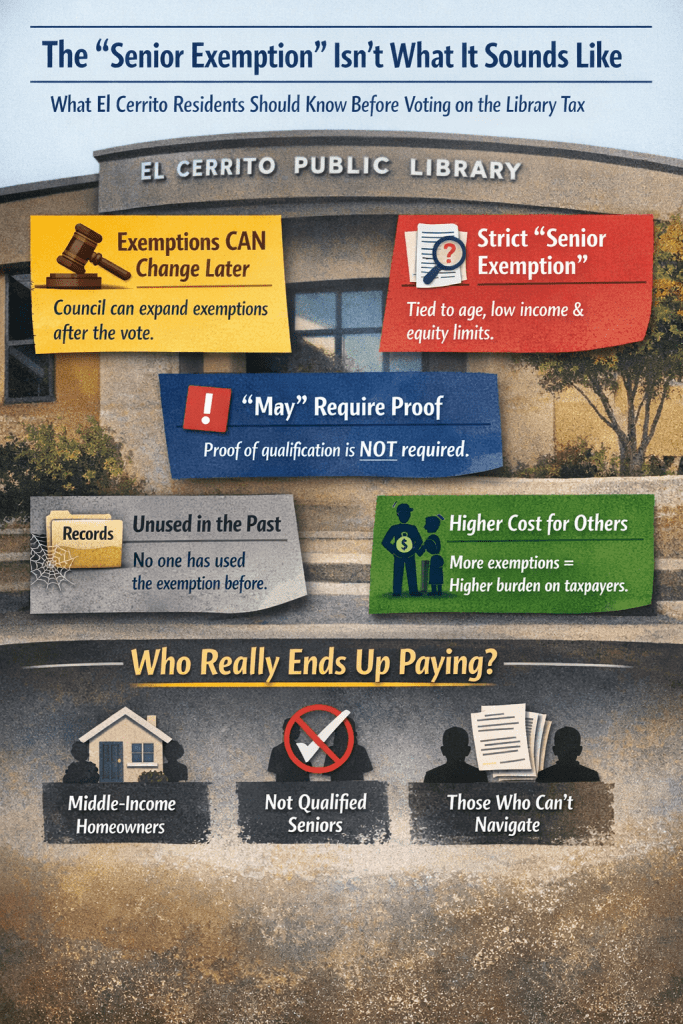
One of the most important takeaways is that if Measure C passes, the City Council will have the authority to expand exemptions later without going back to voters. That means what is presented to voters now may not be the final structure. The Council can adjust who pays and who doesn’t after the election, but the total cost of the project doesn’t disappear. When exemptions expand, the burden simply shifts to others.
The so-called “senior exemption” is also far more limited than many residents may expect. To qualify, a homeowner must meet strict criteria tied to state programs, including age, income limits of roughly $55,000, equity requirements, and restrictions like not having a reverse mortgage. Even for those who meet these thresholds, the measure does not require actual participation in those programs—only that someone qualifies. And critically, the application process “may” require proof of participation, but does not require it. That ambiguity leaves open questions about how exemptions will be verified and how consistently they will be applied.
This structure isn’t new. The City has used a nearly identical exemption approach in a prior tax measure. According to staff, there are no records of anyone successfully applying for that exemption. That raises a natural question: if the exemption exists but has never been used, is it truly accessible in practice?
At the same time, the City cannot expand exemptions so broadly that the project becomes financially unworkable. This creates a balancing act. The more exemptions are granted, the more the cost shifts to those who remain. That reality doesn’t change, regardless of how the policy is framed.
When you step back, the real issue becomes clearer. If many seniors do not qualify, if past exemptions haven’t been used, and if future exemptions can be adjusted after the election, then the question isn’t whether exemptions exist—it’s who will actually end up paying the tax.
In practice, that likely means middle-income homeowners and residents who do not meet strict qualification thresholds or cannot navigate the application process. These are the people who will carry the weight if exemptions remain narrow or expand unevenly.
This isn’t about whether a library is a good idea. It’s about clarity and transparency. Residents deserve to understand who qualifies, who doesn’t, and how the financial responsibility will be distributed before they cast their vote.
Because once the measure passes, those decisions won’t be theoretical—they’ll be real.
 El Cerrito Committee for Responsible Government (ECCRG)