El Cerrito invested $150,000 in a comprehensive service delivery study meant to answer a simple but essential question: are we structured to deliver the services residents expect at a cost the City can sustain?
The answer was supposed to inform the 2026 budget.
Instead, as that budget moves forward, the study remains unfinished—and the questions it was meant to answer remain unresolved.
In June 2025, the City moved forward with a citywide service delivery evaluation led by Citygate Associates. The scope was expansive. Every department. Staffing levels. Workload. Organizational structure. Opportunities to improve service delivery or reduce costs.
This wasn’t a narrow technical review. It was a foundational analysis—one that could shape how the City operates and how it allocates resources.
The timeline reflected that urgency.
The study was designed to be completed in approximately six months. That meant a final report by late 2025 or early 2026—just in time to guide the next budget cycle. The sequencing was intentional. Analysis first. Decisions second.
That sequencing no longer holds.
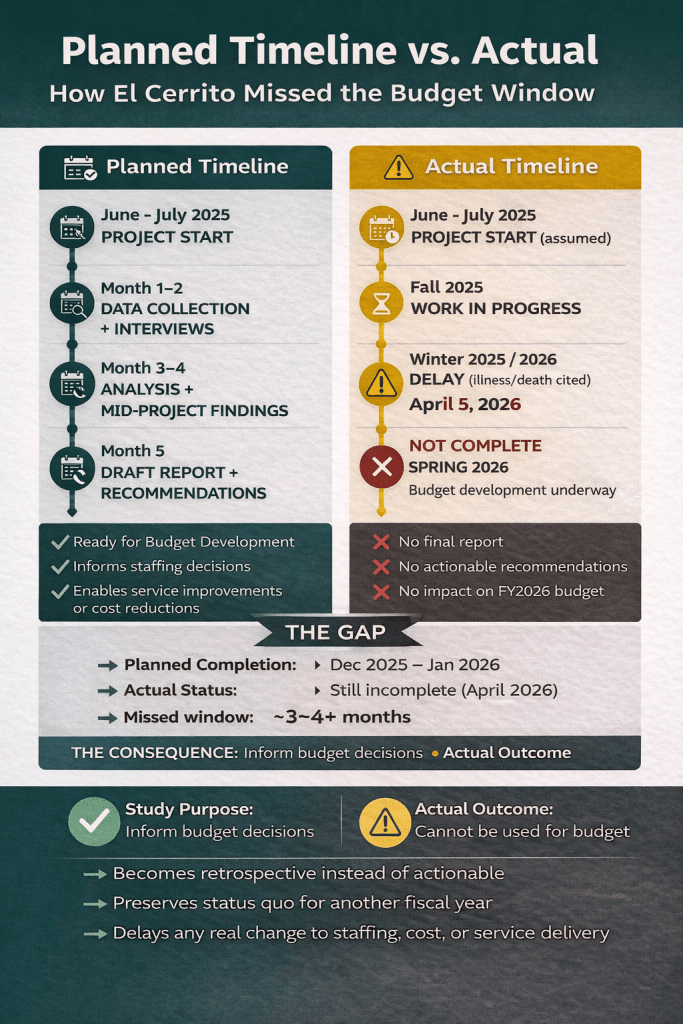
As of April 5, 2026, the study is not complete. And with the budget already moving forward, the opportunity to use it as a decision-making tool has passed.
The City indicated that the delay was due to a serious circumstance—an illness or death affecting the consulting team. If true, that deserves acknowledgment.
But this was not a one-person engagement.
Citygate’s proposal outlines a deep, experienced team with built-in redundancy—what they describe as a Virtual City Hall model, designed specifically to ensure continuity across projects. With that structure, the expectation is that work continues, even when individual contributors cannot.
Which raises a reasonable question:
Why did a team-based engagement, designed for continuity, lose its ability to deliver within the timeframe that made the study useful?
Because at this point, the issue is no longer the reason for the delay.
It’s the impact of it.
The City spent approximately $150,000 on this study.
But the real cost isn’t the contract.
It’s the missed window.
This study was intended to provide clarity before decisions were made—to validate staffing levels, identify inefficiencies, and create a roadmap for improving service delivery or controlling costs.
Without it, the City enters another budget cycle without:
- A validated staffing model
- A clear understanding of workload versus capacity
- A structured plan for improving services or reducing costs
Instead, decisions will once again rely on the same assumptions that have guided prior budgets—assumptions that have yet to be fully tested against data.
And that has real consequences.
Another year where structural imbalances persist.
Another year where service delivery questions remain unresolved.
Another year where costs continue without a clear framework for change.
This delay does not exist in isolation.
Since 2018, the City has faced ongoing questions about per capita staffing, service delivery performance, and its ability to control costs while maintaining quality. These are not new issues. They are recurring ones.
The service delivery study represented an opportunity to address them directly—with data, with analysis, and with accountability.
But timing is everything.
When a study designed to inform decisions arrives too late to influence them, its role changes. It no longer guides the budget—it follows it.
And that distinction matters.
Because without the study:
- There is no external validation pushing staffing changes
- No structured framework requiring service level adjustments
- No data-driven basis forcing difficult tradeoffs
The City can continue forward using existing assumptions—without confronting whether those assumptions hold up under scrutiny.
Whether intentional or not, the outcome is the same.
The study no longer drives decisions.
The City will move forward with its budget. It always does.
But it will do so without the benefit of the analysis it commissioned to guide those decisions.
And that is the real cost.
Because a service delivery study delivered after the budget is finalized doesn’t shape the future.
It explains the past.
For a $150,000 investment, that’s not just a delay.
It’s another missed opportunity.
 El Cerrito Committee for Responsible Government (ECCRG)