There’s a difference between what benefits City Hall administratively—and what ultimately serves the residents who pay the bills.
Nowhere is that tension clearer than in the City’s agreement with East Bay Sanitary (EBS).
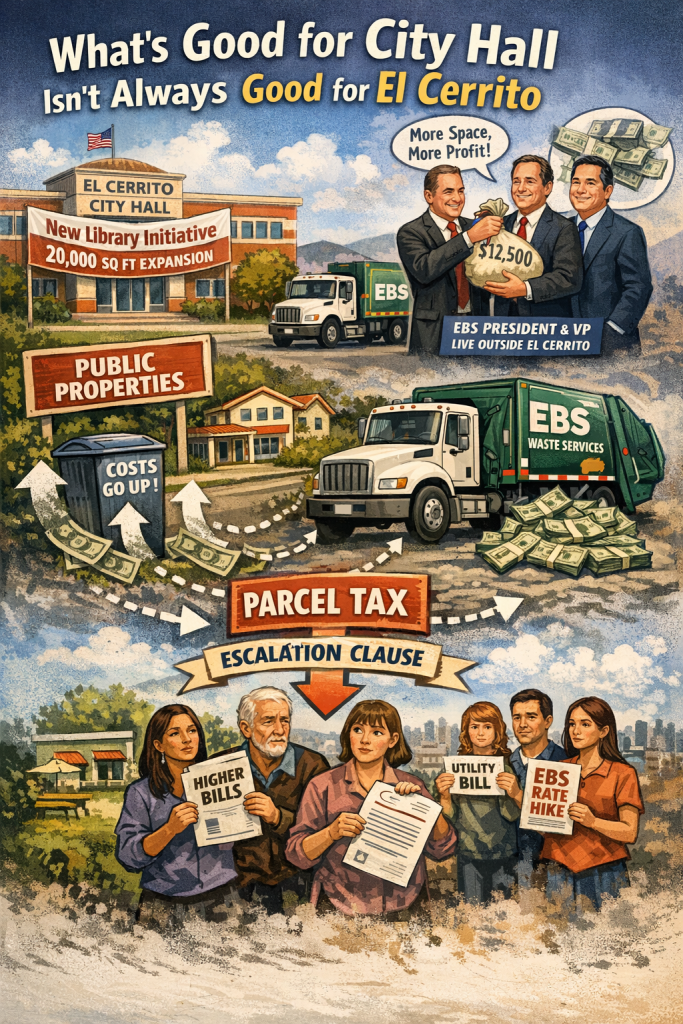
The Structure: How the Agreement Works
In June 2022, the City entered into an exclusive agreement with East Bay Sanitary to provide solid waste collection services across El Cerrito.
That exclusivity matters. It means:
- EBS is the sole provider of waste collection services in the city
- All residents, businesses, and City facilities are tied into that system
- Pricing and cost structures are embedded in a long-term contract (with potential extensions out decades)
But here’s the key point most people don’t see:
EBS is not paid directly by the City in the traditional sense.
Instead, the agreement is structured so that:
- Service recipients (including residents and City facilities) pay EBS directly
- Those payments make up the contractor’s full compensation
- EBS can include additional costs—like franchise fees and other expenses—into what they charge customers
In other words:
The public pays. Always.
Public Properties = Public Costs
The City itself is also a “service recipient.”
That means:
- Every park
- Every public building
- Every facility
…requires waste service—and those costs are embedded in the same system residents ultimately fund.
The agreement explicitly defines City facilities as service recipients receiving collection services just like any other user.
So when City Hall expands its footprint…
The cost structure expands with it.
The Library Proposal: Follow the Square Footage
If the proposed library initiative moves forward, it’s expected to add approximately 20,000 square feet of new public space.
That’s not just a construction issue.
That’s a permanent operational obligation:
- More waste collection
- More service frequency
- More long-term cost
And under the current agreement, those costs don’t disappear into a line item somewhere.
They flow through the system.
Right back to residents.
The Part That Should Raise Eyebrows
Here’s where things get harder to ignore.
The President and Vice President of East Bay Sanitary have reportedly contributed at least $12,500 to the “Yes” campaign supporting the library initiative.
Neither individual lives in El Cerrito.
Let that sink in.
- They do not pay the parcel tax
- They are not directly impacted by the long-term financial burden
- But their company stands to benefit from expanded service demand tied to new City facilities
This isn’t about intent.
It’s about structure.
The Escalation Clause Reality
The agreement allows for annual adjustments to contractor compensation, tied to indexed factors like CPI.
It also allows costs—including franchise-related costs—to be built into service rates charged to customers.
Which means:
- Costs go up over time
- Those increases are baked into the system
- And they are passed through to residents and businesses
Not absorbed.
Not offset.
Passed through.
What This Means for Residents
This is the part that often gets lost in the conversation.
When new public infrastructure is added:
- It doesn’t just cost money to build
- It creates long-term operational obligations
- Those obligations feed into contracted systems like waste, maintenance, and services
And when those systems are structured the way this one is…
Residents carry the weight—directly or indirectly.
The Bottom Line
City Hall may see:
- Expanded facilities
- New services
- Visible investments
But residents should be asking a different question:
Who benefits—and who pays over time?
Because in this case, the answer isn’t abstract.
It’s built into the contract.
And it shows up, quietly but consistently, in the bills people receive every month.
If we’re going to make long-term decisions for El Cerrito, we owe it to ourselves to look past their headlines—and follow how the system actually works.
The Cost Structure: How the Money Actually Flows
To understand what the City pays East Bay Sanitary (EBS), you have to understand how the contract is built. This is not a simple “City pays vendor” arrangement. It’s a layered cost structure—and every layer ultimately flows back to the public.
EBS is paid through Service Rates, which are charged to all service recipients—including residents, businesses, and City facilities like parks, buildings, and public spaces. These rates are the primary source of compensation for EBS and cover collection, transportation, labor, equipment, and operational overhead. The key point is that there is no separate City payment shielding residents. The same system that bills residents is what funds City services.
Costs are not fixed—they increase based on usage. Container size, pickup frequency, and waste volume all drive pricing. Public corridors can require service up to five times per week, and City operations like the Corporation Yard rely on roll-off containers that may be serviced multiple times per week depending on demand. When the City expands facilities, costs automatically increase because the service demand increases.
The agreement also allows EBS to pass through major cost categories directly to customers. These include disposal fees, processing costs, and franchise fees paid to the City. These are defined as pass-through costs, meaning they are not absorbed by the contractor. When those costs go up, rates go up. There is no buffer in the system to protect residents from those increases.
On top of that, EBS pays the City a franchise fee equal to a percentage of its revenue, but the contract allows EBS to include that fee in what it charges customers. So while it may appear that the City is generating revenue, that revenue is ultimately funded by the same residents and businesses paying for service.
Rates are also adjusted annually using a formula that reflects EBS’s actual cost structure. This includes labor, fuel, equipment maintenance, and other operating costs—not just general inflation. Over time, this creates a system where rates are designed to increase as underlying costs increase, with those increases built directly into the contract.
In plain terms, the system works like this: the City expands services or facilities, that expansion increases service demand, increased demand drives higher costs, those costs are passed through, and rates increase. Residents and businesses ultimately pay the difference.
This matters now because the proposed library would add approximately 20,000 square feet of new public space. That means more waste, more service, and more long-term cost. Under this structure, those costs do not stay contained within City Hall. They flow through the system and show up in higher bills over time.
At the same time, East Bay Sanitary’s leadership has contributed to the campaign supporting the library initiative, while not living in El Cerrito or paying the parcel tax. Their company, however, stands to benefit from expanded service demand tied to new City facilities.
This isn’t just about one agreement. It’s about how the system is designed. What looks like investment at the City level becomes a long-term financial obligation within a cost structure where expenses escalate, fees are layered, and nothing is absorbed.
 El Cerrito Committee for Responsible Government (ECCRG)