El Cerrito residents are being asked to consider a $37 million investment in a new library facility.
Supporters describe a modern, code-compliant building with updated technology, expanded programming, improved accessibility, community gathering space, and even emergency shelter capabilities.
Those goals sound positive on paper.
But before we commit tens of millions of dollars, we need to ask a basic question:
Are we building a library — or another community center?
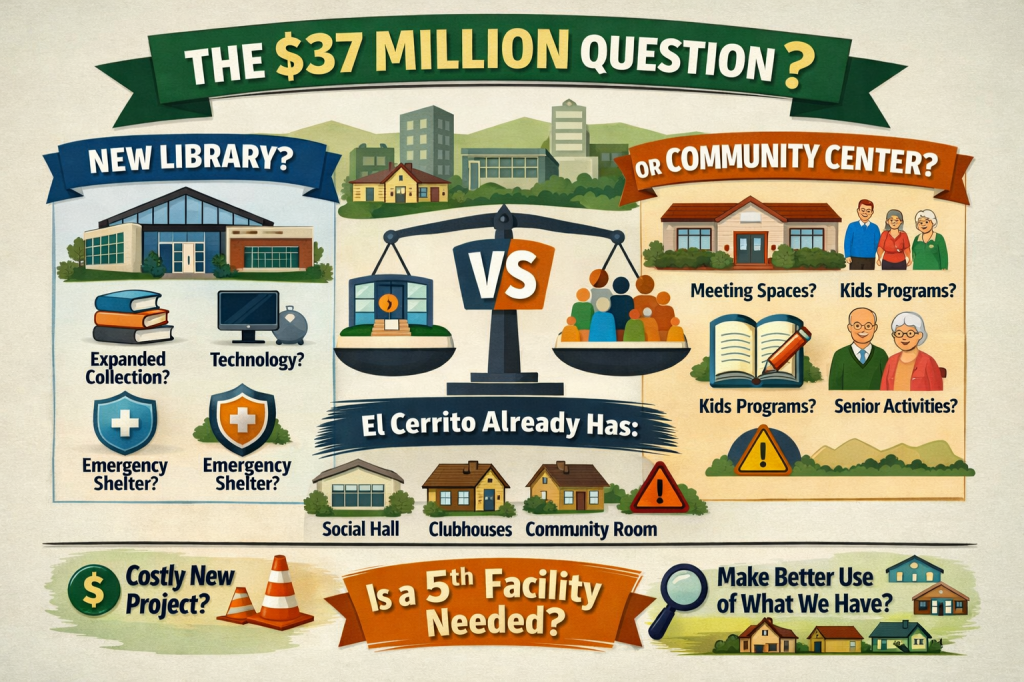
El Cerrito is not lacking in meeting space.
We currently have underutilized spaces:
Community Center Social Hall (Moeser Lane) – capacity approximately 224
Arlington Clubhouse – capacity approximately 50 (recently renovated)
Castro Clubhouse – capacity approximately 30
Hanna Gardens Community Room – capacity approximately 60
That’s four existing facilities designed specifically for gatherings, events, and programming.
If the primary rationale for the new facility is expanded programming, gathering space, tutoring rooms, literacy events, and senior activities, those functions resemble what community centers are already designed to do.
So the real question becomes:
Why do we need a fifth publicly funded gathering facility?
We also need to acknowledge how public library usage has changed.
We are no longer in the 1970s — or even the 1960s— when book circulation was the primary metric of community engagement.
Today, digital media has replaced much physical circulation. Countywide systems share books across branches. Foot traffic patterns have shifted significantly. Remote access to materials is common.
The ballot language references expanded book collections. But book acquisition and systemwide collections are managed by Contra Costa County Library.
If materials are purchased and distributed countywide, what exactly would expanded collections mean? Would El Cerrito fund a separate private collection? Who would manage it? What are the ongoing operational costs?
These are not minor implementation details. They are governance and fiscal questions.
The measure also references emergency shelter during fires, poor air quality, heat waves, earthquakes, or floods.
Emergency resilience matters.
But do our existing community centers meet those needs? Would retrofitting current facilities cost less? Has a cost comparison been presented?
Before approving $37 million in capital spending, plus long-term maintenance and operational costs, residents deserve to see side-by-side alternatives.
A $37 million construction cost does not exist in isolation.
It brings long-term maintenance, utility and energy costs, staffing, insurance, technology upgrades, and future capital reserves.
In a city of roughly 25,000 residents and approximately 11,000 households, that is not a trivial commitment.
Especially in a time when foot traffic is declining, digital access is increasing, and residents are already facing cost pressures.
Local ballot measures can be appropriate tools.
But they should not become the default way to fund expansion.
Before asking taxpayers for $37 million, has the city evaluated optimal facility utilization? Has it analyzed whether existing community spaces are fully used? Has it demonstrated operational right-sizing? Has it provided long-term cost modeling?
A modern building is not a strategy.
It is a financial obligation.
Libraries are valuable institutions. Community space matters. Emergency resilience is important.
But responsible governance requires clarity, cost transparency, alternatives analysis, and measurable need.
El Cerrito residents deserve more than aspirational language. They deserve data, comparisons, and a clear explanation of why four community facilities are insufficient before approving a fifth.
Because once built, the cost doesn’t disappear.
It becomes permanent.

