A Reality Check on the Library Proposal
Supporters of the proposed library tax are now suggesting the project will create an economic boom for El Cerrito. At this point, it feels like they are grasping at straws.
Public libraries are valuable community assets. But they are not economic development engines, and they are rarely structured as financing tools for private real estate projects.
El Cerrito even has a dedicated economic development officer. If this is the strongest economic development argument the city can put forward, residents should reasonably ask whether the claim holds up.
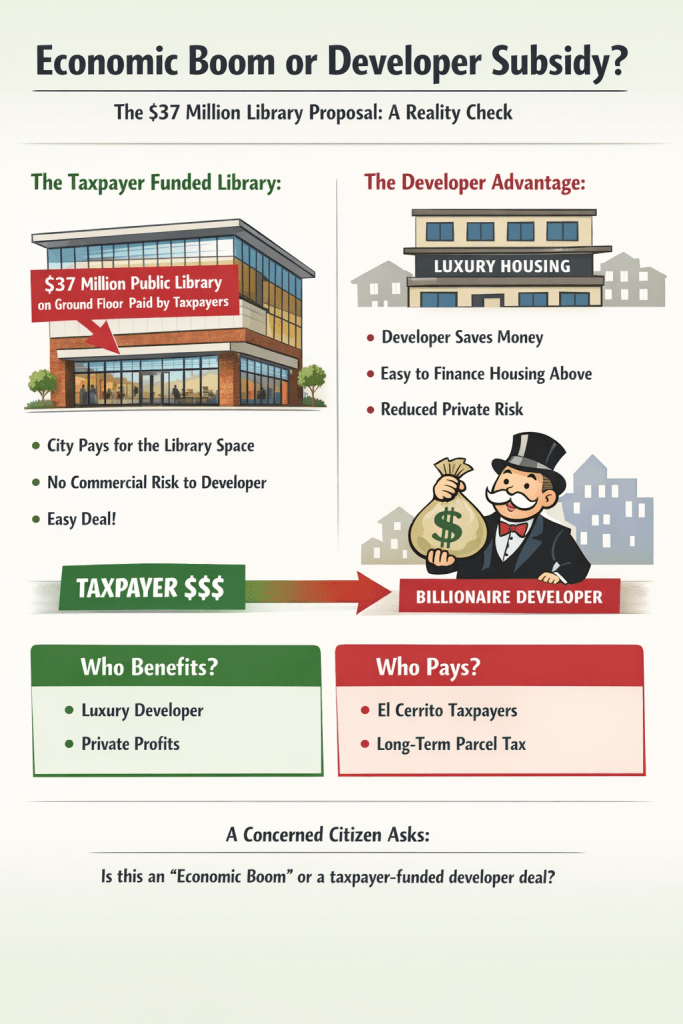
What is being proposed appears to function very differently from the way it is being presented.
The proposal effectively asks El Cerrito property taxpayers to fund a $37 million public library as the ground floor of a private mixed-use development.
The issue is not simply the library itself. It is how the building is being used in the financing structure.
In mixed-use projects, ground floor commercial space is often the hardest space to finance.
Banks typically hesitate to lend against speculative retail space, low-rent commercial tenants, or uncertain cash flow. Because that income stream is unreliable, banks frequently will not underwrite significant debt against it.
A publicly funded library solves that problem.
If taxpayers fund the ground floor, the developer avoids financing the most difficult portion of the building. The developer reduces their own equity investment. The rest of the building—particularly housing above—becomes easier to finance.
In other words, public funds de-risk the private development.
Under the proposal, El Cerrito taxpayers fund the $37 million library space. The library occupies the most difficult space to finance. The remaining private portions of the building become easier for the developer to finance.
This is why critics argue the library is functioning less like a civic investment and more like an equity contribution from taxpayers into a private project.
Supporters describe the project as economic development. But residents should ask a basic question.
Economic development for whom?
The developer receives a fully funded ground-floor tenant. The project becomes easier to finance. Private risk is reduced.
Meanwhile taxpayers carry the long-term parcel tax, the city assumes the public cost, and the economic return to residents remains unclear.
That raises a legitimate public policy question.
Is the purpose of the library tax to fund a library, or to help make a private real estate development financially viable?
Libraries serve communities because they provide learning, access to information, public gathering space, and educational resources. Those are strong reasons to invest in a library.
But when a public facility becomes part of a complex real estate financing structure, voters deserve a full and transparent explanation of the economics behind it.
Right now, residents are being asked to approve a tax based on claims of economic development.
Before voting, the community should clearly understand who the economic development is actually for.
This analysis was also informed by insights shared by another concerned El Cerrito resident who has been closely examining the financial structure behind the proposal.
 El Cerrito Committee for Responsible Government (ECCRG)
The library parcel tax is pure finance with NO SOCIAL OR ECONOMIC BENEFITS TO THE SECURED PROPERTY TAXPAYER or RESIDENTS. The big winner is the City Council members of El Cerrito who have to do no work managing the City finances because they keep raising taxes on City residents to cover for its poor financial management. The parcel tax provides $37,000,000 in cash equity to construct a 6 story apartment complex. That’s it. AND the parcel tax goes up each and every year!!!! Who votes for a tax increase every year? That’s really all that can be said and the first floor of the building will be owned by the City of El Cerrito who will lease it to CCC for the EC CCC branch library. Full stop. The TOD developer, Stephen Ross a Trump supporter and billionaire, will have secured a ROC for himself and investors, of between 8-10% minimum. He only contributed $100 (yes one hundred dollars) for his equity ownership of the apartment building being constructed now. This is a big big grift by the organizers of the Citizens Initiative and the City Council and BART.
On Mon, Mar 23, 2026 at 9:47 AM El Cerrito Committee for Responsib
LikeLike
one other thing where are the “subject matter specialists” findings on the benefits being touted? nobody not one single document or person with any CV because the data isn’t there pure speculation but the City has no skin in the game (skin=$) its all free money for the City and the billionaire developer Relational (Stephen Ross) taxpayer Go Fund Me for the City and Trumpster
LikeLike