There’s something deeply uncomfortable about what’s emerging from the pro-library tax campaign.
Not because people support a library. Most of us do.
But because of how this campaign is choosing to make its case.
Buried in the outreach is a call for students—our kids—to join the campaign as “youth social media contributors.” The pitch? Spend a few hours a week helping “shape the future of our library” while learning storytelling and digital strategy.
Let’s be honest about what that really means.
It means asking students to promote a tax measure they didn’t design, don’t fully understand, and are not be financially responsible for.
That’s not civic engagement. That’s outsourcing advocacy.
The campaign frames this as mentorship and skill-building. But storytelling requires a story grounded in truth, tradeoffs, and transparency. And that’s exactly what’s missing here.
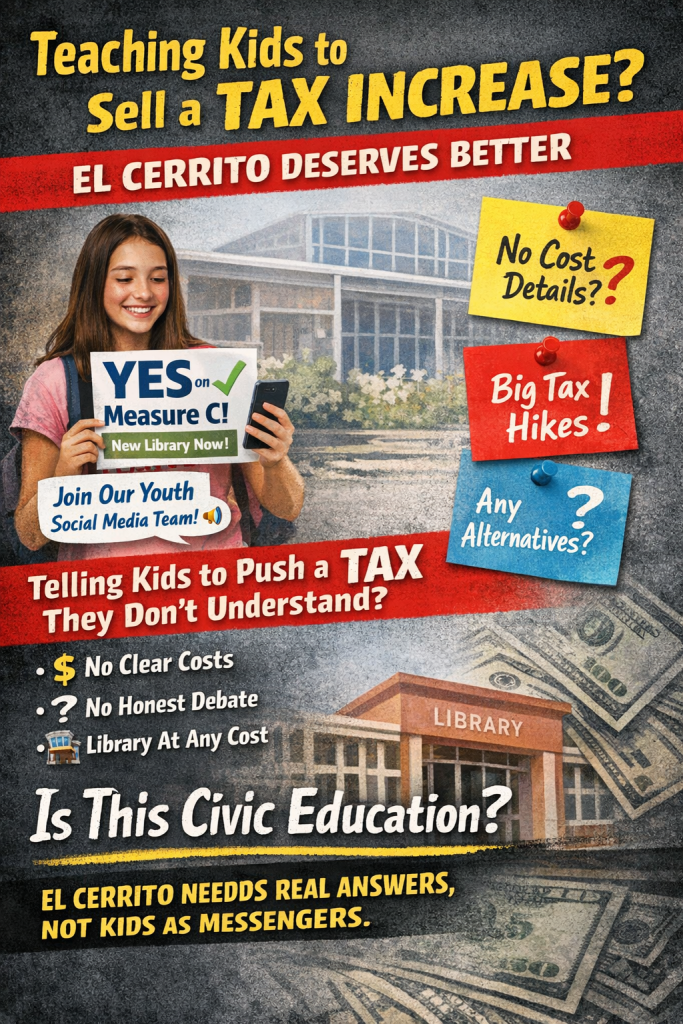
There is no clear, stable cost.
There is no honest discussion of long-term financial impact.
There is no acknowledgment that this tax is designed to grow year after year.
Instead, what we’re seeing is a push for a library at any cost—wrapped in feel-good language about community, safety, and the future.
If the case for this tax were truly strong, it wouldn’t need student amplifiers.
It would stand on its own.
And that raises a bigger question: what are we teaching young people about civic responsibility?
Are we teaching them to ask hard questions about public finance?
To weigh tradeoffs?
To challenge assumptions?
Or are we teaching them that advocacy comes first—and understanding comes later?
Because those are two very different lessons.
Real civic education doesn’t recruit students into campaigns.
It equips them to analyze them.
It teaches them to ask:
Who pays for this?
How much will it really cost over time?
What are the alternatives?
What are we giving up?
Those are the questions adults in this community are still trying to get answered.
And until they are, asking students to help “sell” the measure feels premature at best—and inappropriate at worst.
El Cerrito deserves a real conversation.
One grounded in facts, not framing.
In transparency, not tactics.
And certainly not one that leans on students to carry a message that adults haven’t fully justified.


Perfect analysis. Not a good testimonial for the “Yes, to the Bad Plan” supoprters.
The “Love Libraries, but not this bad plan” campaign should offer FREE afternoon tutoring on “Critical Thinking” using the 9 page Measure C as the case study. Ask the students to list what the plan does and doesn’t do, as written. Then publish the results on ND.
LikeLike