Credit: A concerned citizen
El Cerrito residents are being asked to approve a library measure that, on its surface, feels familiar: invest now, build later, trust the process. But when you take a closer look at how the measure is structured, it begins to resemble something Californians know all too well—the high-speed rail project.
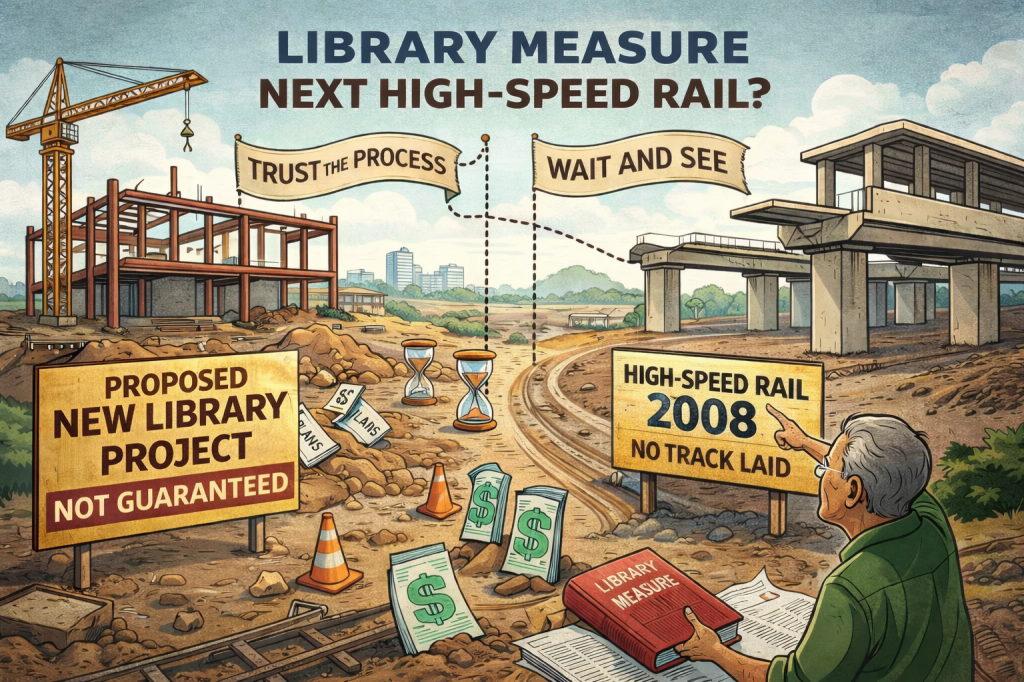
Not because a library and a rail system are comparable in scale. But because the risk isn’t about size. It’s about structure.
A concerned citizen recently raised a point that is worth careful consideration: the tax can be collected and spent on planning, permitting, consultants, and administrative costs indefinitely—until bonds are issued. And bonds are not guaranteed. That means the timeline to actual construction is not fixed. It’s conditional.
We’ve seen this before.
In 2008, voters approved high-speed rail with a clear vision: a modern transportation system connecting major regions of California. Nearly two decades later, billions have been spent, timelines have shifted—and not one mile of track has been laid that delivers on that original vision.
The issue wasn’t whether the idea was compelling. It was whether the execution framework ensured delivery.
That same question now sits in front of El Cerrito voters.
If a tax is authorized without a clear, enforceable pathway to construction, what ensures that the project moves forward? If the mechanism to stop the tax is tied to bond issuance, what happens if bonds are delayed, restructured, or never pursued? And if the measure allows ongoing expenditures for planning, what limits exist on how long that phase can last?
Residents in the community are already asking these questions. As one concerned citizen noted, the language appears to allow for extended planning periods without requiring construction to begin. Another resident asked a simple but important question: if the library does not move forward, what actually stops the tax?
These aren’t abstract concerns. They go directly to how public dollars are protected.
This creates a structural imbalance.
It shifts the risk to taxpayers while leaving the timeline open-ended.
To be clear, this is not about whether El Cerrito should have a new library. Many residents support that goal. The issue is whether the measure, as written, guarantees delivery—or simply funds a process.
Public projects succeed when accountability is built into the structure. Clear milestones. Defined timelines. Measurable outcomes. Without those, even well-intentioned initiatives can drift.
That’s where the comparison to high-speed rail becomes relevant.
Not as a political statement, but as a cautionary framework.
Because once a funding mechanism is in place without strict guardrails, the momentum shifts. The question is no longer Should we build this It becomes How long will we keep funding the idea of building it
El Cerrito deserves clarity before commitment.
Before approving a long-term tax, residents should understand exactly what triggers construction, what happens if those triggers aren’t met, and whether there are enforceable limits on how long funds can be spent without delivering the project itself.
That’s not opposition. That’s due diligence.
And it’s the difference between building a library—and funding a process that never quite gets there.


PLEASE READ MY NEXTDOOR POSTS chew through this document
On Tue, Apr 14, 2026 at 4:33â¯PM El Cerrito Committee for Responsib
LikeLike
We have read it already
Ingenuous
LikeLike