Credit concern citizen on social media
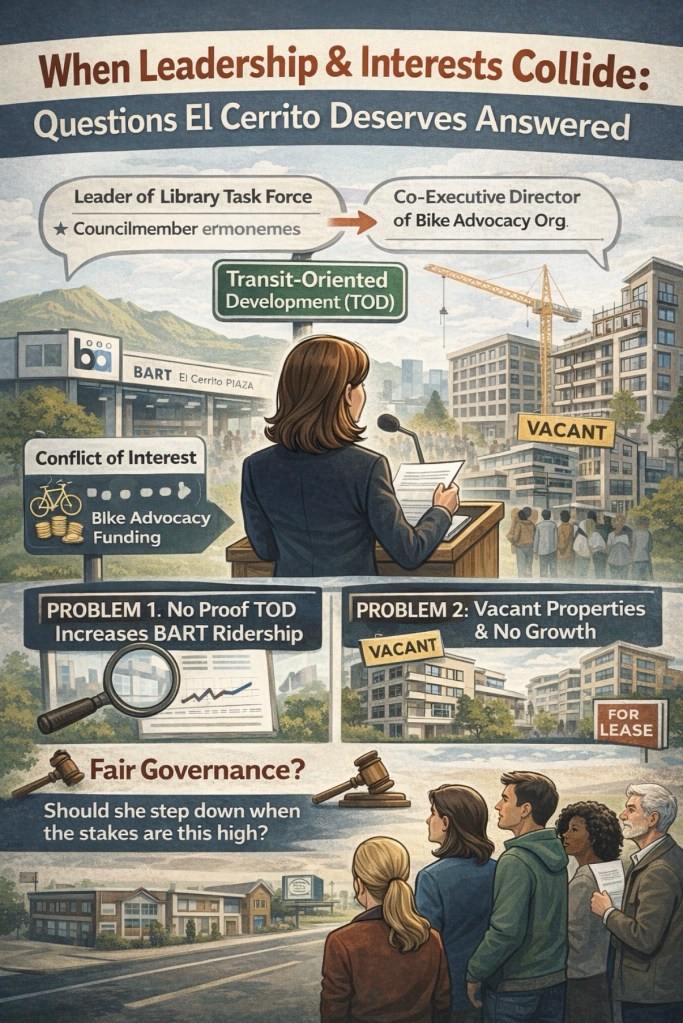
The City of El Cerrito recently established a new library task force to assess potential sites following community concerns that the City Council had already made its decision to place a new library at the El Cerrito Plaza BART location. This shift did not happen in a vacuum. It was influenced in part by ongoing social media conversations where residents raised concerns, shared information, and challenged the narrative around both the location and the process. Councilmember Rebecca Saltzman was selected to lead this effort. At first glance, this may seem like a reasonable step forward, but when you look more closely, serious questions emerge—questions that go beyond process and speak directly to public trust. Ms. Saltzman currently serves as Co-Executive Director of Bike East Bay, an organization that is receiving funding tied to the broader BART development efforts, including the El Cerrito Plaza site. This creates a situation where decisions related to the project could directly benefit an organization she leads.
In addition, Ms. Saltzman previously served as a director for Bay Area Rapid Transit, where advancing transit-oriented development was a clear institutional priority. That history matters, because it reflects a long-standing policy position—not a neutral starting point. This raises a fundamental question: can the public have confidence in a process led by someone with both current organizational ties and prior institutional commitments aligned with a specific outcome? In most professional environments, this would not be a gray area. It would be a clear signal to step back.
The Bigger Issue: Is TOD the Right Answer Here?
Even setting aside the conflict concerns, the underlying assumptions driving this decision deserve scrutiny. Transit-oriented development is often promoted as a way to increase transit ridership, but where is the verifiable evidence that TOD meaningfully increases ridership for systems like BART? This claim is frequently repeated, yet rarely substantiated with clear, local, data-driven outcomes. Without that evidence, using TOD as justification for major public decisions becomes more of a belief than a strategy. At the same time, El Cerrito is not facing a shortage of newly built housing. Recent developments have added units, and many remain vacant, raising a practical question about whether demand is keeping pace with supply. If existing inventory is not being absorbed, continuing to build does not resolve a problem—it risks compounding it. Population trends further reinforce this concern. El Cerrito is not experiencing meaningful growth, and that reality should inform decisions about new construction, long-term tax commitments, and infrastructure tied to projected demand. Building for growth that is not occurring is not planning—it is speculation.
Why This Matters
This is not about personalities. It is about governance. When public officials are in positions where their professional roles align with specific project outcomes, their past institutional commitments reinforce those outcomes, and the underlying assumptions of those outcomes remain unproven, it creates a situation where trust is strained, regardless of intent. Good governance is not just about doing the right thing—it’s about ensuring the public can clearly see that the process is fair, unbiased, and grounded in evidence.
The Question Before Us
Would your employer allow you to make a decision that directly benefits an organization you lead? If the answer is no, then the standard should not change simply because the setting is public office. At a minimum, this situation calls for serious consideration of recusal to protect the integrity of the process. Because once trust is lost, it is far harder to rebuild than any library we could ever construct.

