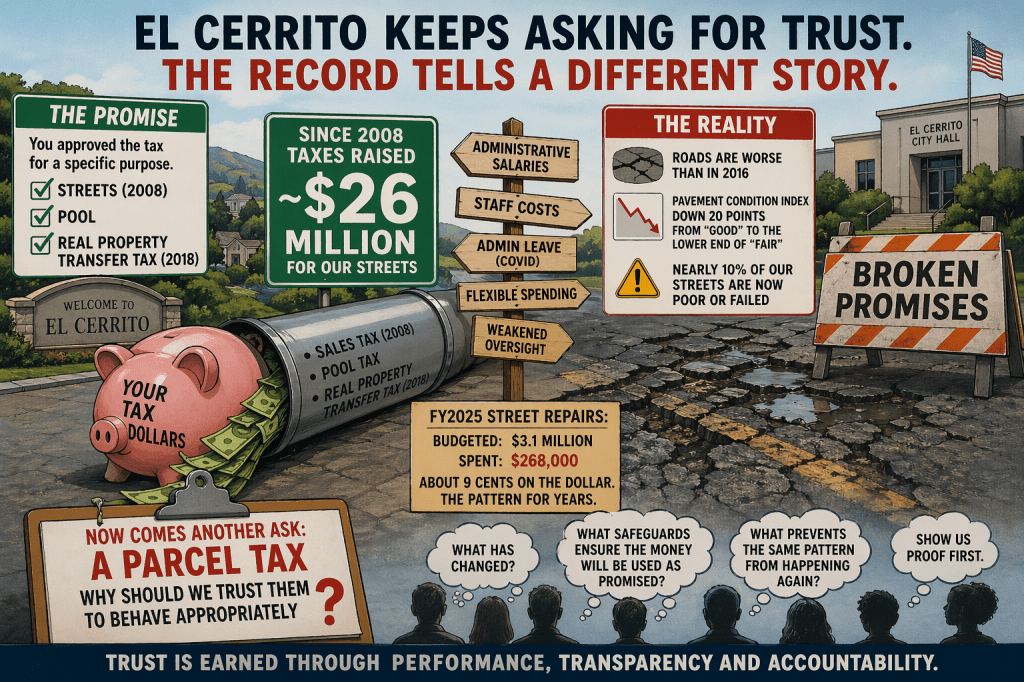
A concerned citizen recently laid out a simple question: when El Cerrito asks residents to approve a tax for a specific purpose, does the money actually get used that way?
The answer, based on years of public records, is not reassuring.
The Street Tax That Didn’t Fix the Streets
In 2008, voters approved a permanent half-cent sales tax to fix and maintain streets. Since then, roughly $26 million has been collected.
Yet today, road conditions are worse than they were nearly a decade ago. The city’s Pavement Condition Index has dropped significantly, with streets slipping from Good to the lower end of Fair, and a growing share now classified as Poor or Failed.
Even more concerning is how the money has been used.
In FY2025, the city budgeted $3.1 million for street repairs from this fund. It spent just $268,000—about nine cents on the dollar. That is not a one-year anomaly. It reflects a pattern.
The original promise was clear: no administrative salaries would be charged to the fund. Over time, that changed. Staff costs were billed to it. Even COVID-related administrative leave was charged against a fund voters believed was for fixing roads.
Oversight weakened too. A committee that was supposed to review spending shifted its own rules—from requiring members to review source documents like invoices to simply allowing it. Meetings saw no public attendance. Transparency became optional.
This is not just about deteriorating pavement. It is about a breakdown between what was promised and what was delivered.
The Pattern Extends Beyond Roads
This isn’t an isolated case.
Residents have seen similar dynamics with other revenue measures:
- The pool tax, where expectations and outcomes have not aligned
- The real property transfer tax under Measure V, where spending flexibility appears broader than many voters understood
Each time, the message to voters is clear and specific at the ballot box. Each time, the execution becomes more flexible after approval.
The Core Issue Isn’t Legality. It’s Trust.
To be fair, much of this spending may be legally permissible. Municipal finance rules often allow broad discretion once funds are collected, especially when language is not tightly constrained.
But legality is not the standard voters use when they make decisions. Trust is.
Voters are told their money will go to a defined purpose. They reasonably expect that purpose to be honored—not diluted, redirected, or absorbed into broader administrative uses.
When outcomes consistently diverge from expectations, the issue is no longer about a single program. It becomes systemic.
Now Comes Another Ask: A Parcel Tax
The city is once again asking residents to approve a new tax—this time a parcel tax.
The question voters should be asking is straightforward:
What has changed?
- What safeguards ensure funds will be used exactly as presented?
- What oversight mechanisms are truly independent and enforceable?
- What prevents the same pattern—broadening use, under-delivery, weakened oversight—from repeating?
When these guardrails are flexible, as history has shown us, this is not a question of supporting services. It is indicative of whether commitments will be kept.
Trust Is Earned Through Performance
Cities rely on public trust to function. That trust is built when promises are matched by outcomes, when oversight is real, and when transparency is not optional.
Right now, residents are being asked to trust again.
Given the record, it is reasonable to draw your own conclusions.

