You’ve just received your voter information guide. El Cerrito voters are being asked to trust the City Attorney’s “Impartial Analysis” of Measure C. But before residents accept that label at face value, they should ask a simple and reasonable question:
Can a person who has advised the same city for roughly a decade truly be viewed as independent on a tax measure the city wants approved?
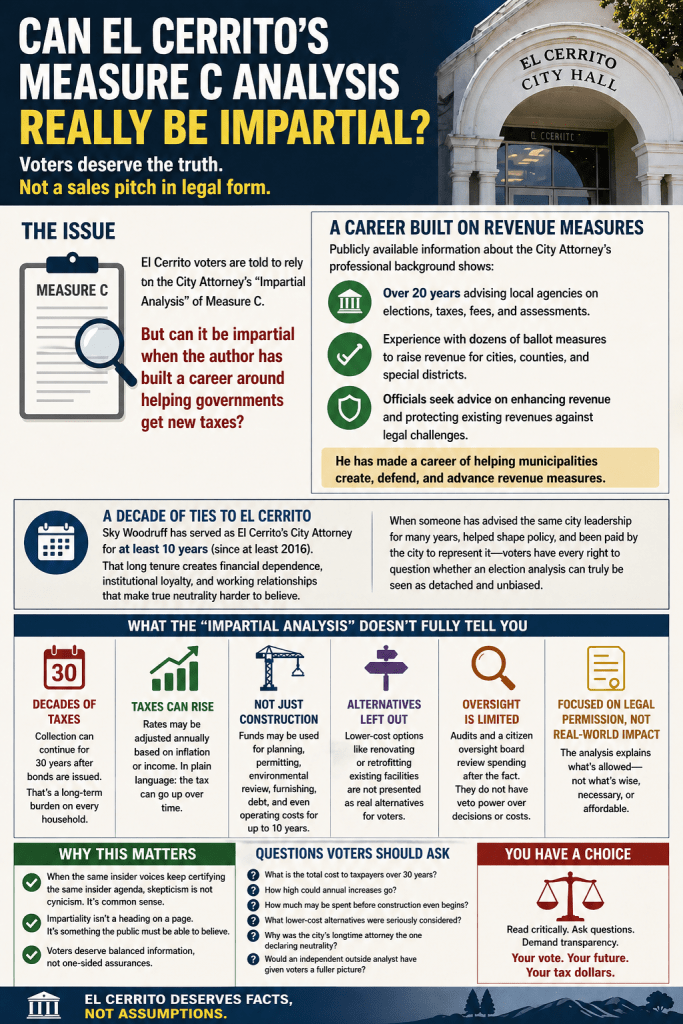
That question is not personal. It is about public confidence, institutional relationships, and common sense.
A Decade of Ties Matters
Sky Woodruff has served as El Cerrito’s City Attorney for at least ten years, with public records showing him in the role since at least 2016.
That means for roughly a decade he has been paid to represent the city, advise its leadership, help navigate legal matters, and work alongside councils and senior staff through changing political priorities.
Long tenure creates familiarity. It creates loyalty. It creates relationships. It can also create financial dependence on continuing municipal contracts.
Even if someone acts professionally, voters are entitled to recognize that this is not the same as bringing in a fresh, outside, independent voice.
His Professional Background Also Matters
According to publicly available professional biographies, Woodruff has spent more than twenty years advising local governments on elections, taxes, fees, assessments, and ballot measures. Those same materials describe experience helping cities and agencies enhance revenues and defend existing revenues from legal challenge.
That is an important context.
When the author of an “impartial” analysis has built part of a career helping governments structure and preserve revenue measures, voters may reasonably wonder whether they are reading a neutral explanation or the work of someone institutionally aligned with municipal taxation tools.
Again, that is not an accusation. It is a credibility question.
What the Measure C Analysis Softens or Leaves Out
The official analysis explains legal mechanics, but it does not fully emphasize several practical concerns many taxpayers care about.
1. This Is a Long-Term Tax Commitment
The measure allows taxes to continue for 30 years after the initial issuance of bonds.
That is not temporary. That is a generation-long obligation.
2. Taxes May Increase Over Time
The measure permits annual adjustments tied to inflation or income indexes.
Plain English: taxpayers could pay more over time.
3. Funds Are Not Limited to Construction
Revenue may be used for planning, permitting, environmental review, furnishing, financing costs, and operating costs for the new library’s first ten years.
Many residents hearing “library tax” may assume the money is mostly for building construction. The permitted uses are much broader.
4. Lower-Cost Alternatives Are Not Centered
Many residents are aware of discussion around lower-cost renovation or retrofit options for the existing library site.
Yet the official analysis does not frame the vote as a choice between expensive new construction and potentially less costly alternatives.
That omission matters because cost comparisons are central to how many people decide.
5. Oversight Is Not the Same as Control
The report references audits and a citizen oversight board.
But oversight boards typically review spending after the fact. They do not necessarily decide project scope, halt overruns, or reduce taxes if plans change.
Why Independence Is So Important
Government has every right to advocate for its priorities. Voters have every right to hear that advocacy.
But an “impartial analysis” should be something different. It should come from a source the public can trust as detached, balanced, and free from longstanding institutional loyalties.
When the analysis comes from a longtime insider with a decade of ties to the city and a professional background steeped in municipal revenue measures, skepticism is natural.
That skepticism is not cynicism.
It is exactly how informed voters should think.
Questions Voters Should Ask Before Voting
- What is the full cost to taxpayers over 30 years?
- How much could annual increases add over time?
- How much can be spent before construction begins?
- What lower-cost options were seriously considered?
- Why was the city’s longtime attorney the one certifying neutrality?
- Would an outside independent analyst have presented the tradeoffs differently?
Final Thought
Impartiality is not created by printing the word at the top of a page.
It is earned through independence and public trust.
And when the person writing that “impartial” report has advised the same city for a decade and built a career around helping municipalities with revenue measures, El Cerrito voters are justified in asking whether they received neutral guidance or simply a polished insider case for Measure C.
‘s

