El Cerrito voters have received another polished, professionally designed mailer from the Yes campaign. It is glossy, confident, and filled with myths and facts, messaging meant to reassure residents. But once voters look past the slick presentation, the bigger issue becomes clear: major details are still missing, and some of the real impacts are barely acknowledged.
This campaign continues to rely on careful wording, selective framing, and trust us later promises instead of giving voters direct answers.
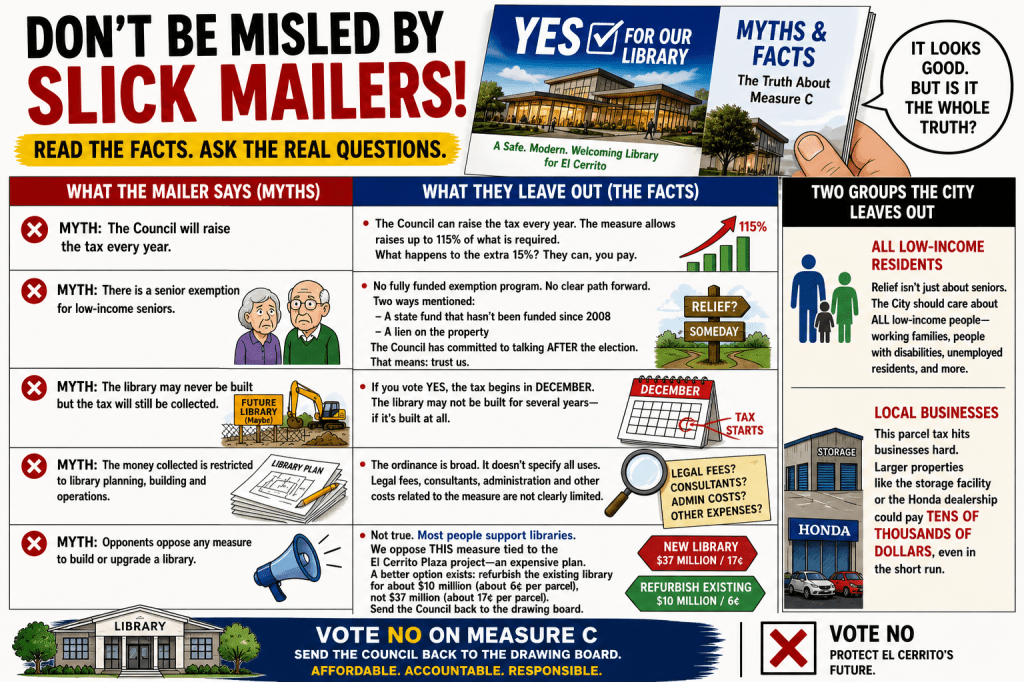
The Tax Increase Distinction Matters
One of the mailer’s claims is that saying the Council will raise the tax every year is a myth. Their explanation is that the measure authorizes increases but does not require them.
That is not the same thing.
The real question is whether the Council can raise the tax annually. The answer is yes. Voters deserve to understand that authority exists, even if officials say they may choose not to use it.
The mailer also notes the tax can rise to 115 percent of the amount required. Residents should reasonably ask why a measure promoted as precise and necessary includes room for an additional 15 percent.
The Exemption Story Leaves Out Too Much
The mailer claims the measure provides exemptions for low-income seniors. That sounds reassuring, but it leaves out key realities.
The Council has not committed to a fully funded local exemption program or presented a clear path forward now. Instead, voters are being asked to approve the tax first and sort out the relief later.
There are also two groups largely left out of this discussion.
First, relief should not be limited only to low-income seniors. The city should be thinking about all low-income residents. Financial hardship does not begin at a certain age. Working families, disabled residents, unemployed residents, and others struggling to stay in El Cerrito deserve consideration too.
Second, businesses are not mentioned in this conversation, yet they will also be required to pay this tax.
Businesses Will Pay Significant Costs
Because this parcel tax is based on square footage, larger commercial properties could face very large annual bills.
That means businesses such as the storage facility, the Honda dealership, and other larger sites could pay tens of thousands of dollars, even in the short run.
Those costs do not simply disappear. They can affect pricing, rents, hiring, investment decisions, and expansion plans. In a city that says it wants economic vitality, adding substantial costs to local employers should be openly discussed.
Instead, the campaign messaging barely addresses it.
The Tax Starts Before the Library Exists
Another important fact remains unchanged: if approved, the tax begins before a new library is built.
Residents and businesses start paying first, while planning, financing, design, and construction could take years.
There is no immediate new library in exchange for the immediate tax burden.
That timing matters for households on fixed incomes, working families, and businesses already dealing with high costs.
Opposing This Measure Is Not Anti Library
The Yes campaign often tries to frame opponents as anti-library or anti-progress.
That is false, and no matter how many times they repeat it, it remains false.
Many residents support improving library service. What they oppose is this particular measure and this expensive path.
A lower-cost alternative has been publicly discussed before: refurbishing and retrofitting the existing library site at a much lower estimated cost, often cited around $10 million, compared with the roughly $37 million concept tied to the new project discussion.
That is not anti-library.
That is pro affordability, pro accountability, and pro common sense.
What Voters Should Ask
Before approving a long-term parcel tax, voters should ask:
Why are all low-income residents not central to the relief discussion?
Why are business impacts not mentioned?
Why does the tax begin now while the project may take years?
Why are voters being asked to trust future councils to solve the details later?
Why should we vote for a 17-cent tax when a 6-cent tax would be sufficient?
The Real Choice
This election is not about whether El Cerrito values libraries.
It is about whether residents want to approve a 17 cent parcel tax now, with unanswered questions and future promises, or send City Hall back to develop a more practical, affordable, and transparent plan.
Voters deserve substance, not just slick mailers.

