A concerned citizen recently assembled a timeline of city documents, campaign statements, and official reports that raises a serious question for El Cerrito voters:
If leaders now say the proposed library could go in multiple locations, why does the public record show years of commitment to El Cerrito Plaza?
That question deserves more than campaign talking points.
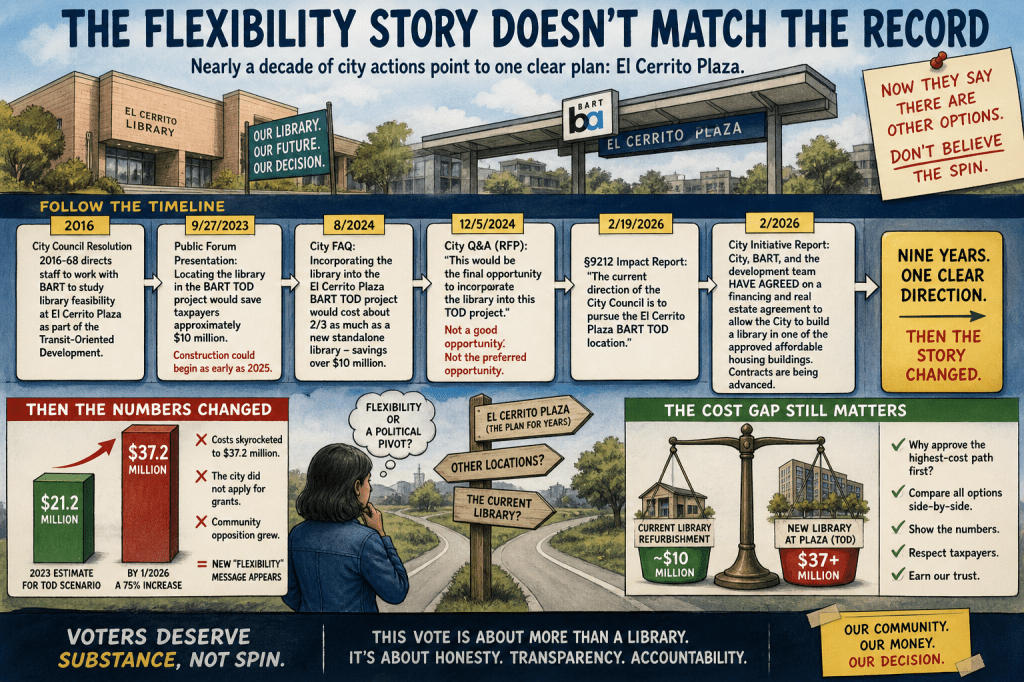
Nearly a Decade of Direction Toward Plaza
According to materials highlighted by the concerned citizen, the path appears consistent.
In 2016, the City Council adopted a resolution directing staff to work with BART to study the feasibility of placing a library at the El Cerrito Plaza station site as part of the Transit Oriented Development project.
By September 2023, a public forum presentation reportedly stated that locating the library within the BART TOD project would save taxpayers approximately $10 million.
That same presentation projected construction could begin as early as 2025 if voters approved funding.
In August 2024, city FAQ materials reportedly continued the same theme, stating that incorporating the library into the Plaza project would cost about two thirds as much as a standalone library, with savings exceeding $10 million.
Then in December 2024, a city Q&A regarding the Owner’s Representative RFP allegedly described the TOD opportunity in unmistakable terms as the final opportunity to incorporate the library into the project.
Not one opportunity.
The final opportunity.
That language does not sound like five equal options under active consideration.
Even 2026 Reports Pointed to Plaza
The concerned citizen also cites the city’s own 2026 initiative impact report, which reportedly stated that the current direction of the City Council was to pursue the El Cerrito Plaza BART TOD location.
That is important because it suggests the Plaza site was still the active path even as public debate intensified.
Another resident cited language saying the city, BART, and the development team had already agreed upon a financing and real estate framework to allow construction of a new library within one of the approved affordable housing buildings, and that written contracts were being advanced.
If accurate, that sounds far beyond a casual concept.
That sounds like implementation planning.
Then the Messaging Changed
Only after several things happened did a new narrative seem to emerge:
Costs reportedly rose from earlier estimates around $21.2 million to roughly $37 million.
The city did not apply for grants that supporters had pointed to as part of the funding picture.
Community resistance grew.
At that point, voters began hearing that there were multiple sites and broad flexibility.
Residents are right to ask whether this was a genuine reopening of options or simply a political repositioning once the original plan became harder to sell.
The Cost Gap Still Matters
The same concerned citizen notes that refurbishment of the current library has been discussed at approximately $10 million, far below the $37 million new-build figure often associated with the Plaza concept.
That leaves a practical question many households understand immediately:
Why approve a much larger permanent tax first if a lower-cost modernization option may exist?
Before asking seniors, renters, families, and fixed-income homeowners to absorb new taxes, the city should clearly compare:
Current site renovation costs
New Plaza construction costs
Parking impacts
Ownership and land control issues
Construction timeline risks
Operating costs after opening
What happens if TOD timelines slip
Trust Is Earned Through Straight Answers
El Cerrito residents are not asking for perfection.
They are asking for honesty.
If Plaza has been the preferred plan for years, acknowledge it.
If there are truly five viable locations, publish side-by-side facts for all five.
If renovation is inferior, prove it with transparent numbers.
If the tax is the only path, explain why less expensive alternatives are not enough.
This Vote Is About More Than a Library
It is about governance.
When messaging changes but the paper trail remains, people naturally become skeptical.
When officials ask for trust while withholding clear comparisons, confidence declines.
And when voters sense they are being managed rather than informed, they begin asking harder questions.
That is not cynicism.
That is citizenship.

