Inspired by research from an informed and concerned citizen.
The city’s own numbers don’t add up. Here’s the simple version.
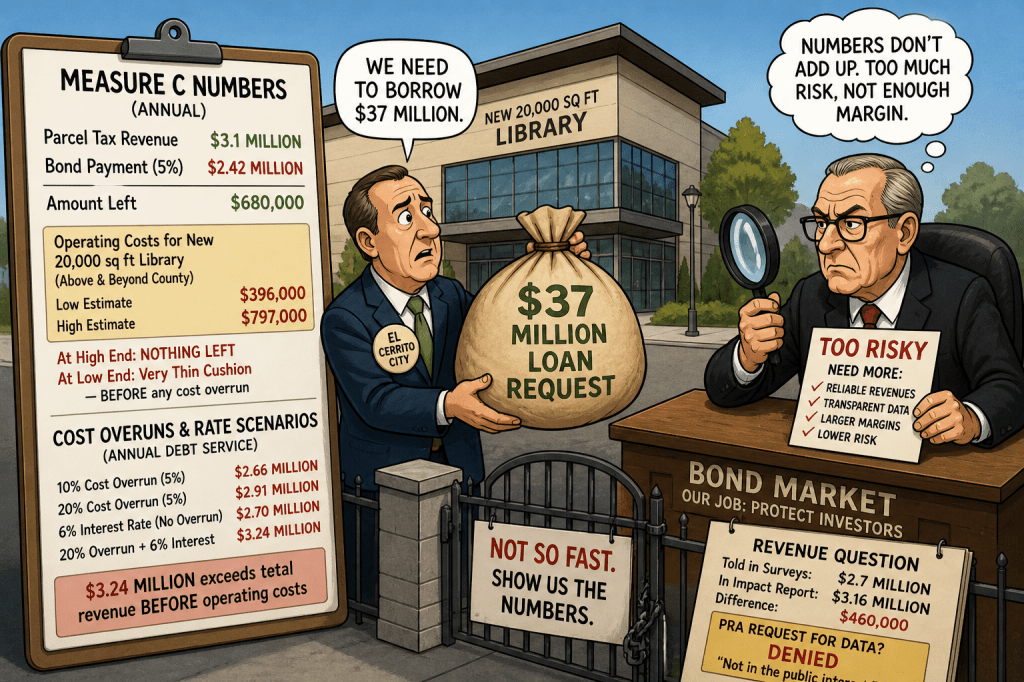
Measure C is projected to collect about $3.1 million per year in parcel tax revenue.
The annual bond payment is estimated at $2.42 million. That leaves roughly $680,000.
Now layer in the cost to operate a larger, 20,000 square foot library. The city’s own impact report puts those additional annual costs between $396,000 and $797,000. That includes extended hours, maintenance, utilities, and equipment on top of what Contra Costa County Library already funds.
At the high end, there is nothing left. At the low end, the margin is thin, and that is before a single cost overrun, staffing adjustment, or unexpected expense.
That is the baseline.
What Happens When Lenders Do Their Homework
Before anyone lends $37 million, bond buyers and rating agencies run their own scenarios. They do not rely on best-case assumptions.
If construction costs come in 10 percent higher, annual debt service rises to about $2.66 million.
At 20 percent higher, it climbs to roughly $2.91 million.
If interest rates land at 6 percent instead of 5 percent, annual payments move closer to $2.70 million.
Combine higher rates with a 20 percent cost overrun, and annual debt service reaches about $3.24 million.
That exceeds total projected tax revenue, before paying a single dollar to operate the building.
At that point, the question is no longer about optimism. It is about feasibility.
The Revenue Question No One Has Answered
There is another issue that deserves attention.
When the city conducted its community surveys, residents were told Measure C would generate approximately $2.7 million per year.
The official impact report later used a higher figure, about $3.16 million. That is a $460,000 increase.
No clear explanation has been provided for the change.
A Public Records Act request was filed for the underlying data. The city declined to release it, stating that disclosure was not in the public interest.
That response may be sufficient in a public debate. It will not be sufficient in a credit review.
What Bond Markets Actually Care About
Bond buyers are not swayed by messaging. They look for
Reliable and consistent revenue projections
Clear documentation and transparent assumptions
Adequate coverage above debt service
Realistic operating cost forecasts
A demonstrated ability to manage risk
If revenues are uncertain, margins are thin, and costs are rising, lenders do not ignore it. They price it or they walk away.
The Bottom Line
This is not a question of whether El Cerrito values its library. Most people do.
The question is whether this specific financial plan is strong enough to support $37 million in borrowing.
Right now, the numbers suggest a plan with little room for error, unanswered questions about revenue, and real exposure to cost increases.
Before asking voters to approve the tax, the city should be able to clearly answer a straightforward question
Who, exactly, will lend El Cerrito $37 million on these terms?
 El Cerrito Committee for Responsible Government (ECCRG)
Get your diligence straight. The buyers of the bonds don’t give a rats ass about the City credit or the economics of the apartment building. The bondholders don’t care about the TOD project and
LikeLike
Tell us more about how will it impact our interest rates?
LikeLike
the rate on the bonds will be at the very low end of rates close to us treasuries because a parcel tax is NEARLY RISK FREE REVENUE there is only 2.5% default rate on PROPERTY TAXES the tax collector has a lien on your property so the tax payment debt is ALWAYS PAID the city cannot by law make payments on the bond debt because your home is the collateral not the city owned condo being built in the TOD apartment development and the revenue for the bond repayment can only be your property tax collection the bond lenders are so excited about a debt security like this is that the bondholders WILL NOT ALLOW DEBT PREPAYMENTS or if they do allow debt prepayments it will be a very very limited redemption size. THIS BOND IS SUCH A SWEET INVESTMENT INVESTORS WANT THIS LOAN TO BE OUT FOR THE ENTIRE TERM – 30 YEARS
On Wed, May 13, 2026 at 4:58 PM El Cerrito Committee for Responsib
LikeLike