Inspired by research from an informed and concerned citizen.
One of the most troubling aspects of Measure C is not simply the price tag. It is the timeline.
Residents were repeatedly told that a new library at El Cerrito Plaza would cost about $21 million and save taxpayers roughly $10 million compared to other options. That message was used for years to build support for the project and to gather signatures for a citizens initiative.
But according to the timeline now available, the city’s own consultant had already produced a report showing a dramatically different number before the signature campaign even began.
That matters.
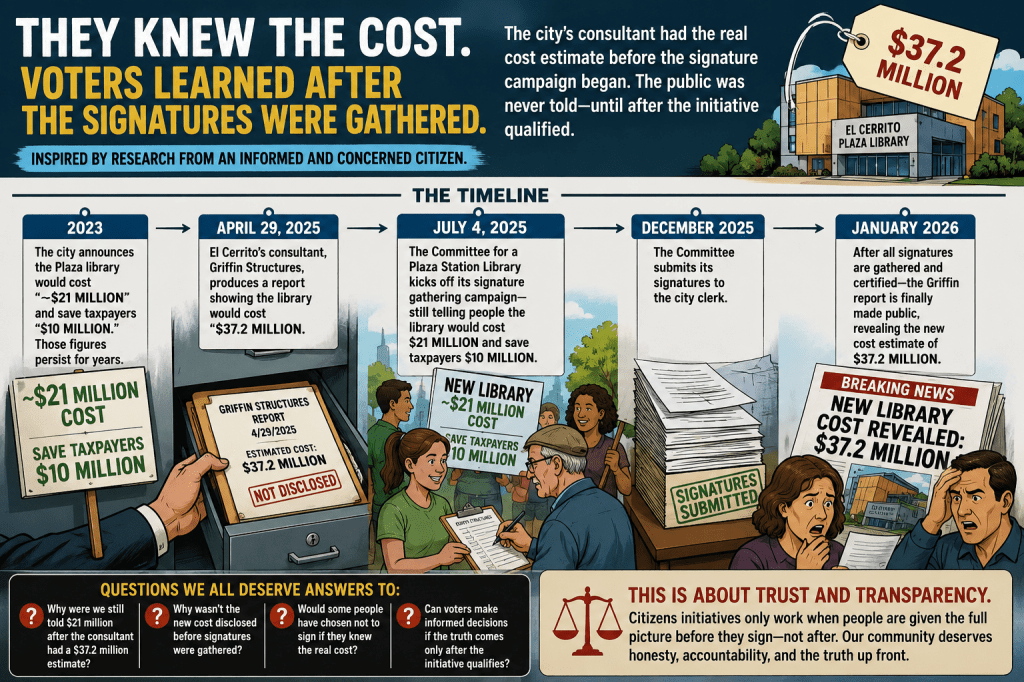
Because once signatures are gathered and certified for a citizens initiative, the political momentum changes completely. At that point, voters are no longer being asked whether the project concept makes sense. They are being pushed toward approving a specific measure that has already qualified for the ballot.
Here is the timeline residents should consider carefully.
In 2023, the public was told the Plaza library concept would cost approximately $21 million. Residents were also told the Plaza approach would save around $10 million compared to a standalone library.
Those numbers became part of the public narrative surrounding the project.
Then on April 29, 2025, the city’s consultant, Griffin Structures, reportedly produced a report showing the projected cost had risen to approximately $37.2 million.
That is not a minor adjustment.
That is a roughly 77% increase over the number residents had been hearing.
Yet on July 4, 2025, the Committee for a Plaza Station Library, headed by Greg Lyman, launched its signature-gathering campaign, while public messaging still centered on the older $21 million figure and the claim of massive savings.
The signatures were gathered.
The initiative qualified.
And only afterward, in January 2026, was the Griffin report finally made public, revealing the substantially higher projected cost.
That sequence raises obvious questions:
- Why were residents still hearing $21 million after the consultant had reportedly identified a $37.2 million estimate?
- Why wasn’t the updated cost information broadly disclosed before signatures were gathered?
- Would some residents have declined to sign if they knew the estimated cost had increased by more than $16 million?
- Can voters make informed decisions if critical financial information surfaces only after the initiative qualifies?
This is bigger than whether someone supports or opposes a new library.
Most residents support libraries.
Most residents support public investment when it is transparent, financially responsible, and honestly presented.
The issue here is trust.
Citizens initiatives carry enormous weight because residents assume they are signing based on complete and accurate information. If key financial realities were already known but not disclosed until after the petition process was complete, people have every right to question whether the public was given the full picture at the moment it mattered most.
A project that is financially sound should be able to withstand scrutiny before signatures are collected — not after.

