In 2016, El Cerrito voters rejected a tax measure. What followed should have been a wake-up call for city leadership.
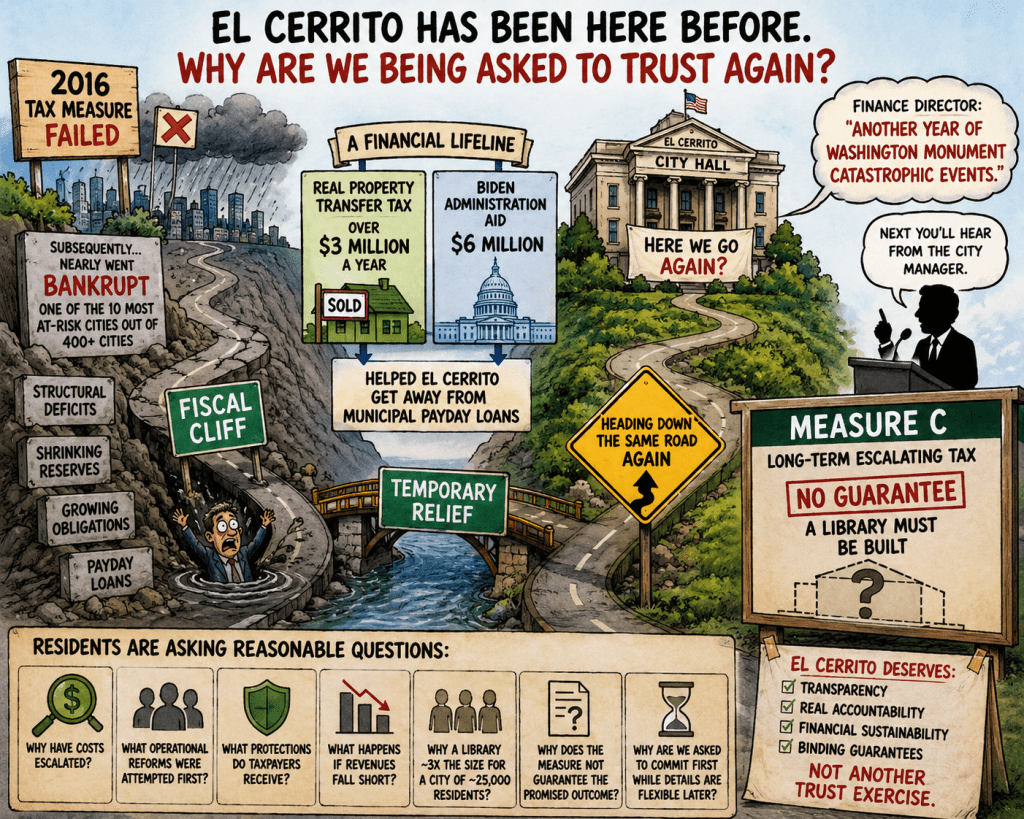
In the years after that failed measure, El Cerrito’s financial condition deteriorated so badly that the city was identified among the small group of California cities considered most vulnerable to fiscal distress. Out of more than 400 cities statewide, El Cerrito landed near the bottom tier in financial stability indicators.
Residents were warned about structural deficits, shrinking flexibility, and growing long-term obligations.
Then came a financial lifeline.
The real property transfer tax began generating significant revenue during the real estate surge, reportedly bringing in more than $3 million annually. Then the Biden administration provided millions more in pandemic-era federal assistance. Together, those temporary revenue streams helped stabilize the city and reduced reliance on short-term borrowing tools that many residents viewed as the municipal equivalent of payday loans.
But temporary money is not structural reform.
The city did not fundamentally solve the underlying questions about operational efficiency, staffing levels, long-term sustainability, or service delivery performance. Instead, once again, residents are hearing warnings about severe budget pressures and looming catastrophe.
Recently, the Finance Director described the situation in terms that sounded like another round of Washington Monument-style catastrophic event warnings, the familiar governmental strategy of highlighting the most painful or dramatic consequences first when asking taxpayers for additional revenue.
Residents have heard this before.
Next, many expect the City Manager to step forward with similar messaging about impending cuts, difficult choices, and the need for urgency.
And right on cue comes Measure C.
Supporters frame it as a simple library measure. But opponents are not arguing against libraries. They are raising questions about transparency, governance, priorities, and trust.
Because when residents read the measure carefully, they discover something deeply concerning:
The initiative does not legally require that a library actually be built.
That matters.
Residents are being asked to approve a long-term escalating tax without ironclad guarantees regarding the final project, scope, costs, location, or operational consequences. Meanwhile, the city has already invested millions into the BART Transit-Oriented Development strategy and entered agreements strongly pointing toward the BART site outcome.
At the same time, project costs continue to escalate.
Residents remember when the public discussion centered around roughly $21 million. Then later, after signatures had already been gathered, the number reportedly grew to approximately $37 million.
That is one reason the issue of trust keeps resurfacing.
People remember:
• The failed 2016 measure
• The city’s near-fiscal crisis afterward
• Dependence on temporary outside funding
• Escalating project costs
• Delayed disclosures
• Repeated warnings of catastrophe
• And continued requests for taxpayers to approve more revenue without corresponding operational reform
Residents are also asking reasonable questions:
• Why is payroll optimization rarely discussed publicly?
• Why are service delivery metrics still difficult to evaluate?
• Why does a city of roughly 25,000 residents need a library approximately three times the size of the current facility?
• Why does the ballot language not explicitly guarantee the promised outcome?
• And why are taxpayers being asked to commit first while details remain flexible later?
A healthy city government should be able to answer those questions directly.
Instead, many residents feel they are being pressured to approve another expensive long-term obligation under the shadow of catastrophic warnings.
El Cerrito deserves a transparent plan, realistic financial assumptions, measurable operational accountability, and binding guarantees — not another trust exercise.

