The latest election results reveal something remarkable. Measure C currently has approximately 1,550 “Yes” votes, a number that appears to be significantly lower than the more than 2,000 signatures gathered to qualify the measure as a citizen initiative.
That fact alone should give city leaders pause.
Residents were told that Measure C was a grassroots effort driven by community demand. More than 2,000 signatures were collected to place the measure on the ballot. Yet now, after months of campaigning, public outreach, mailers, consultant studies, and advocacy, the measure appears to be receiving fewer votes than the number of people who originally signed the petition.
Why?
One possible answer is that voters learned more about the details.
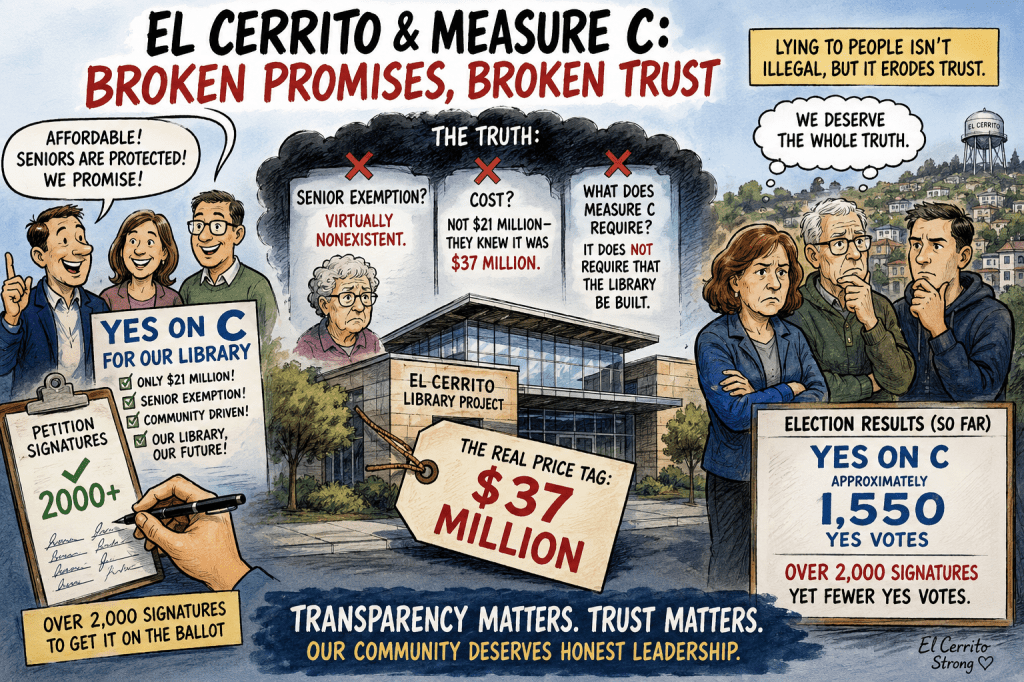
Throughout the campaign, residents were repeatedly told that the project would cost approximately $21 million. Yet city officials already knew the estimated cost had increased dramatically, reaching roughly $37 million. That is not a minor discrepancy. It represents millions of dollars in additional public obligations that voters deserved to understand before casting their ballots.
Residents were also told that seniors would be protected through an exemption program. In reality, the exemption is so limited that many residents have described it as virtually nonexistent. The promise sounded reassuring in campaign materials, but the practical benefit appears far smaller than many voters were led to believe.
Perhaps most importantly, many voters were never clearly informed that Measure C itself does not require construction of the proposed library project. The measure authorizes the collection of a permanent parcel tax and potentially the issuance of bonds, but it does not legally guarantee that a new library will ultimately be built. That distinction matters.
Reasonable people can disagree about taxes. Reasonable people can disagree about the best location for a library. Reasonable people can even disagree about whether El Cerrito should spend $37 million on a new facility.
What should not be controversial is the expectation that voters receive complete and accurate information before being asked to approve a permanent tax.
Lying to voters is not necessarily illegal. Omitting inconvenient facts is not necessarily illegal. Presenting only the most favorable version of a proposal is not necessarily illegal.
But it does erode trust.
Trust is one of the most valuable assets a local government possesses. Once residents begin to believe that important details are being withheld, future initiatives become harder to pass, future public engagement becomes more difficult, and confidence in local leadership declines.
Most El Cerrito residents want a great library. They want quality public services. They want a city that plans responsibly for the future.
What many residents appear unwilling to support is a process that leaves out critical facts while asking taxpayers to make a permanent financial commitment.
Whatever happens with Measure C, the lesson should be clear: transparency matters. Public trust matters. And when voters feel they have not been given the whole story, they have a way of making their voices heard at the ballot box.

