

As the El Cerrito City Council considers steps to address our budget challenges, we must confront a hard truth: continuing to rely on the General Fund’s unrestricted balance as a form of overdraft protection is not sustainable. History has shown us the risks of this approach, and without meaningful action, we risk depleting the very reserves meant to protect us during times of crisis.
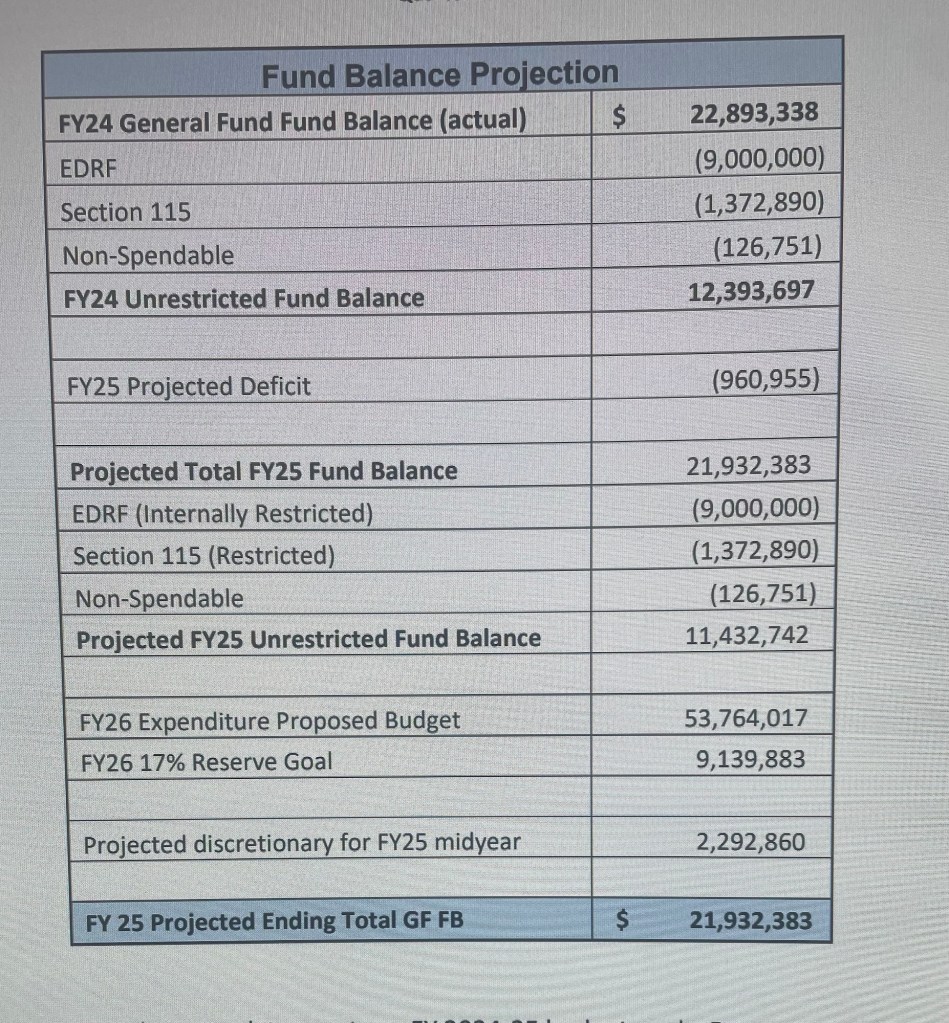
In addition to the $960,955 structural deficit, the City Manager proposes to reduce reserves by an additional $2,292,860 to use as discretionary spending. If both these transactions are approved by the City Council, $3.3 million of the $12.4 million in reserves will vanish. The City Manager has touted a strong financial position, but we are back to the minimum recommended reserves of $9.1 million. Given the structural deficits the City Manager will need to dip further into reserves by FY26 which begins in July 2025.
Why the General Fund Cannot Be a Long-Term Safety Net
The General Fund’s unrestricted balance is intended to serve as a financial cushion—a safeguard against unexpected emergencies, economic downturns, or unforeseen expenses. However, the City Manager plans to use at least $1 million of the $12.4 million in unrestricted reserves. Additionally, the proposal includes using another $2.3 million from reserves this year.
Using reserves repeatedly to cover budget shortfalls may seem like an easy fix in the short term, but it erodes our financial stability over time. When we treat the General Fund like overdraft protection:
- We delay making tough, necessary decisions about structural imbalances in our budget.
- We weaken our ability to respond to true emergencies, leaving us vulnerable when the next economic downturn or natural disaster strikes.
- We create a false sense of security, masking the underlying fiscal issues that require strategic, long-term solutions.
A New Approach: Fiscal Discipline and Structural Reform
To break this unsustainable cycle, the El Cerrito City Council should direct the City Manager to implement a net reduction of $1 million in expenditures for the current and next fiscal year. This is more than just a budget cut—it’s a commitment to fiscal discipline and a shift toward structural financial reform.
We recognize that some expenses from 2024 must still be honored, but even with these obligations, our directive remains clear: balance the budget without further draining the General Fund.
Key Strategies for Sustainability
- Operational Efficiencies: Identifying redundancies, streamlining processes, and improving productivity without compromising essential services.
- Priority-Based Budgeting: Focusing on programs and services that deliver the greatest value to our community while reevaluating or scaling back lower-priority initiatives.
- Long-Term Financial Planning: Moving beyond annual budget cycles to develop multi-year financial strategies that anticipate challenges and plan accordingly.
- Building Reserves, Not Draining Them: Shifting from a mindset of “using what’s available” to one that prioritizes replenishing and protecting reserves for future generations.
A Call for Community Engagement
We know that budget decisions affect every resident, employee, and business in El Cerrito. That’s why transparency and community involvement are at the heart of this process. We encourage residents to share their feedback and ideas with the City Council to help shape a fiscally responsible future.
Contact Your City Council Members
If you have thoughts, questions, or suggestions about the budget and our city’s financial priorities, please reach out to your City Council members directly.
• Mayor Carolyn Wysinger
Email: cwysinger@ci.el-cerrito.ca.us
• Mayor Pro Tem Gabe Quinto
Email: gquinto@ci.el-cerrito.ca.us
• Councilmember Lisa Motoyama
Email: lmotoyama@ci.el-cerrito.ca.us
• Councilmember Rebecca Saltzman
Email: rsaltzman@ci.el-cerrito.ca.us
• Councilmember William Ktsanes
Email: wktsanes@ci.el-cerrito.ca.us
The Bottom Line
We cannot afford to repeat the mistakes of the past. Relying on the General Fund’s unrestricted balance as a crutch will only lead us to the same fiscal cliffs we’ve faced before. By making strategic, thoughtful reductions now, we can build a budget that is not just balanced—but sustainable.
Together, we can create a city that thrives not just today, but for years to come.
 El Cerrito Committee for Responsible Government (ECCRG)