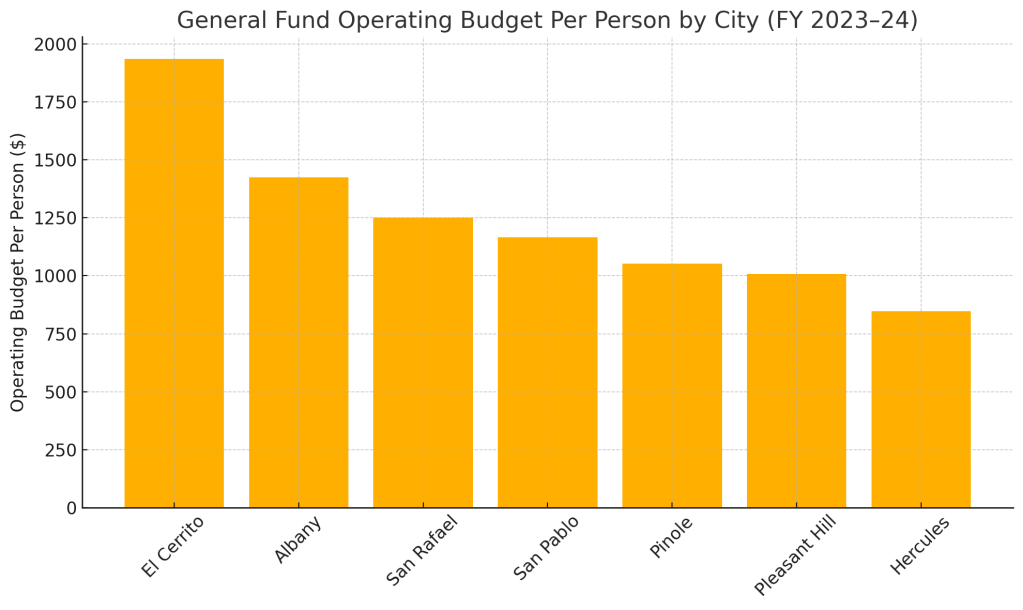
With just 25,000 residents, El Cerrito isn’t the largest city in the Bay Area, but its spending footprint rivals those of much larger communities. For fiscal year 2023–24, El Cerrito’s General Fund expenditures totaled $48.4 million, with $13.5 million allocated to the Police Department and $14.4 million to Fire Services.
At first glance, these numbers might not raise eyebrows—until you compare them to neighboring cities.
- Albany, with a population of 20,000, operates with a General Fund budget of $28.5 million—nearly 40% less than El Cerrito’s.
- Pleasant Hill, serving over 33,000 residents, spends $33.7 million, while San Pablo, with 30,000 residents, runs its city on $35 million.
- Even San Rafael, with 60,000 residents—more than double El Cerrito’s population—has a proportionately leaner per capita spend.
So, what’s driving El Cerrito’s cost structure?
While public safety is always a top priority, El Cerrito’s combined police and fire budget—totaling nearly $28 million—exceeds the entire General Fund of cities like Pinole and Hercules, each of which serves a comparable or larger population.
Moreover, fire services in neighboring cities like Pleasant Hill, Hercules, San Pablo, and Pinole are provided through regional fire districts—allowing for shared resources and cost efficiency. El Cerrito, by contrast, continues to fully fund its own fire department.
This level of spending might be justifiable—if residents were consistently seeing high levels of service, fiscal resilience, and investment in long-term infrastructure. But with El Cerrito’s persistent struggles around budget reserves, pension obligations, and mid-year budget adjustments, the sustainability of this model is questionable.
Transparency is also a concern. While cities like Albany publicly report city manager compensation (Albany: $250K; San Rafael: $300K), El Cerrito has not consistently provided this information in an easily accessible way. For a city asking residents to trust its fiscal decisions—and at times, consider new taxes—public confidence depends on open disclosure.
The Bottom Line
El Cerrito residents deserve a city government that aligns spending with outcomes, not just comparisons. Why are we outspending similar cities—without outperforming them?
It’s time to ask tough questions. Not because we don’t value public safety or city services. But because we do.
Smart cities make strategic choices. El Cerrito should be one of them.
 El Cerrito Committee for Responsible Government (ECCRG)