Peter Pan’s Nextdoor post reads less like an objective discussion about public safety and more like campaign messaging designed to help Mayor Gabe Quinto during election season.
The timing and framing are hard to ignore.
According to the post, Gabe Quinto and Carolyn Wysinger are portrayed as the only councilmembers protecting residents, while the other three councilmembers are blamed for supposedly making El Cerrito unsafe. That creates a simple political storyline: Gabe voted “yes,” therefore Gabe is the public safety candidate.
But governing is bigger than one symbolic vote.
Gabriel Quinto has been one of the longest-serving members of the City Council during a period when El Cerrito experienced significant fiscal decline, growing structural deficits, deferred maintenance concerns, and declining public confidence in city management. Those realities developed over many years, not over one camera vote.
Residents remember:
- El Cerrito being placed on the California State Auditor’s high-risk list
- Ongoing budget instability
- Increasing conversations about taxes and service cuts
- Complaints about infrastructure and responsiveness
- Expansion in management costs while residents are repeatedly asked for more revenue
That is the broader record voters are evaluating.
So when political supporters suddenly frame Gabe Quinto as the singular protector of public safety because of one vote, many residents are understandably skeptical.
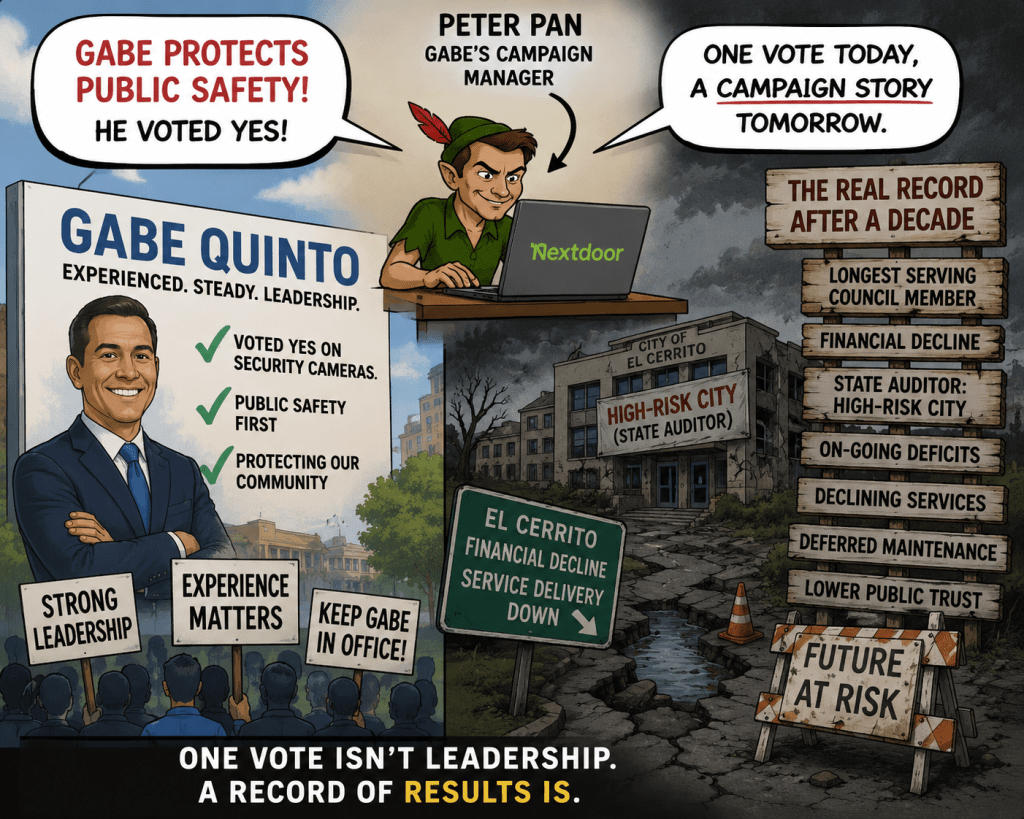
The rhetoric in the post is also exaggerated. Claiming criminals will now come to El Cerrito “with impunity” because of a council vote is political fear messaging, not balanced public policy discussion. Public safety depends on far more than surveillance cameras alone.
And residents are smart enough to recognize when a narrative is being crafted for campaign purposes.
Quite honestly, it is difficult not to conclude that this vote is now being used as election material so supporters can later say:
Gabe Quinto voted to “protect public safety.”
That may work as a slogan.
But voters are also looking at the overall condition of the city after a decade of leadership decisions.

