One of the clearest moments in the El Cerrito library debate did not involve a vote. It involved the refusal to even have one.
Councilmember William Ktsanes asked the Council to consider alternatives to the Transit-Oriented Development (TOD) library proposal at El Cerrito Plaza. He did not ask the Council to approve an alternative. He simply asked that other options be discussed publicly.
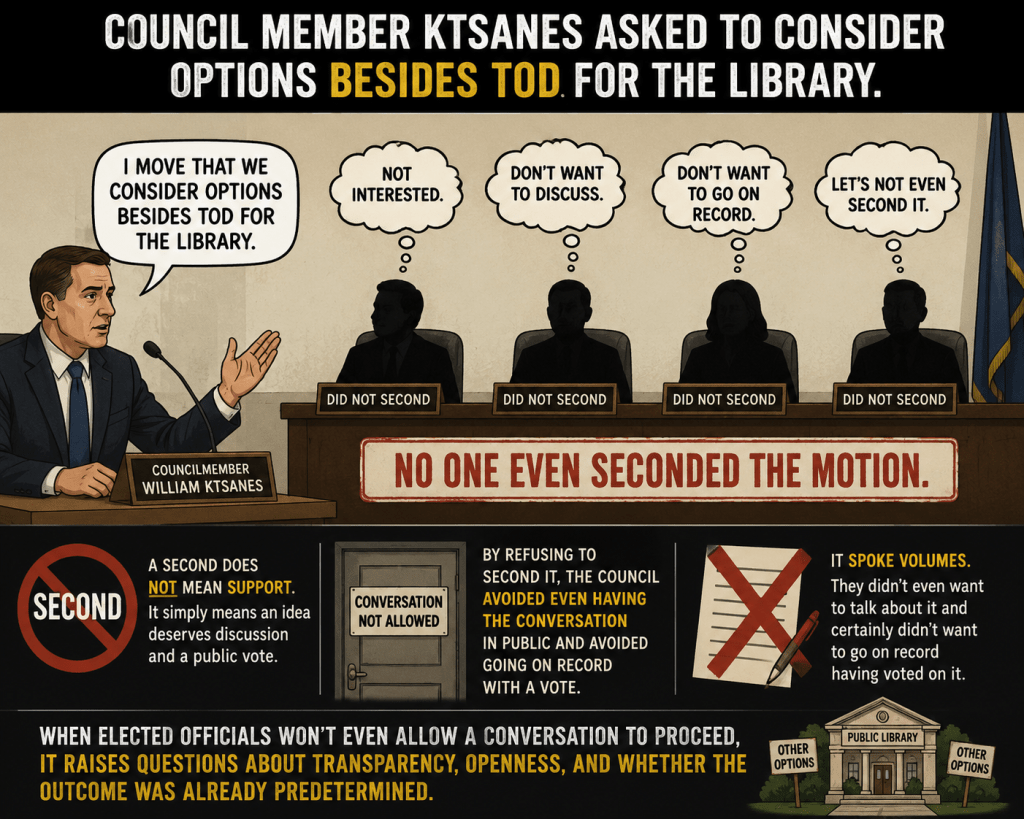
No one even seconded the motion.
That detail matters.
In public meetings, a second is not an endorsement. It does not mean agreement. A second simply means an idea deserves discussion and a public vote. Councils second motions all the time that members ultimately vote against. It is part of transparent public governance.
By refusing to second the motion, the Council prevented any public discussion from occurring and avoided having individual members go on record with a vote.
For many residents, that moment spoke volumes.
Recently, residents have been told there were options on the table. Yet when a councilmember formally requested a discussion about alternatives, the Council would not even allow the conversation to proceed. That raised legitimate concerns about whether alternatives were ever seriously considered.
The refusal to second the motion reinforced the perception that the Plaza location had already been decided behind the scenes and that public engagement was largely about gaining acceptance for a predetermined outcome rather than evaluating competing ideas openly.
This matters because the library discussion is not a small policy issue. Residents are being asked to support a major long-term tax commitment tied to a project with significant financial, operational, and community implications.
In situations like this, transparency matters. Public debate matters. Recorded votes matter.
When elected officials will not even allow a discussion to happen in public, residents are left to draw their own conclusions about openness, accountability, and whether dissenting viewpoints are truly welcome in the decision-making process.


I love this blog, I really appreciate the posts and have learned a lot. However it would be tremendously helpful to the readers if you could source the particular events you are describing.
For example, when did this happen? Did this happen at the last city council meeting? Could you point to a particular point in the meeting if possible (if you have gone through the recording for example)?
It helps better understand context and also makes the blog’s points much stronger.
Thank you for all of the work you do!
LikeLike
Thank you. We were not at that meeting. However Ktsanes said it publicly with other councilmembers present and no one contradicted him. We appreciate your kind words. All of us are volunteers so our research time is limited and we do the best we can.
The purpose of this blog is to educate people as much as possible, and sometimes there’s a bit of information gathering needed.
LikeLike