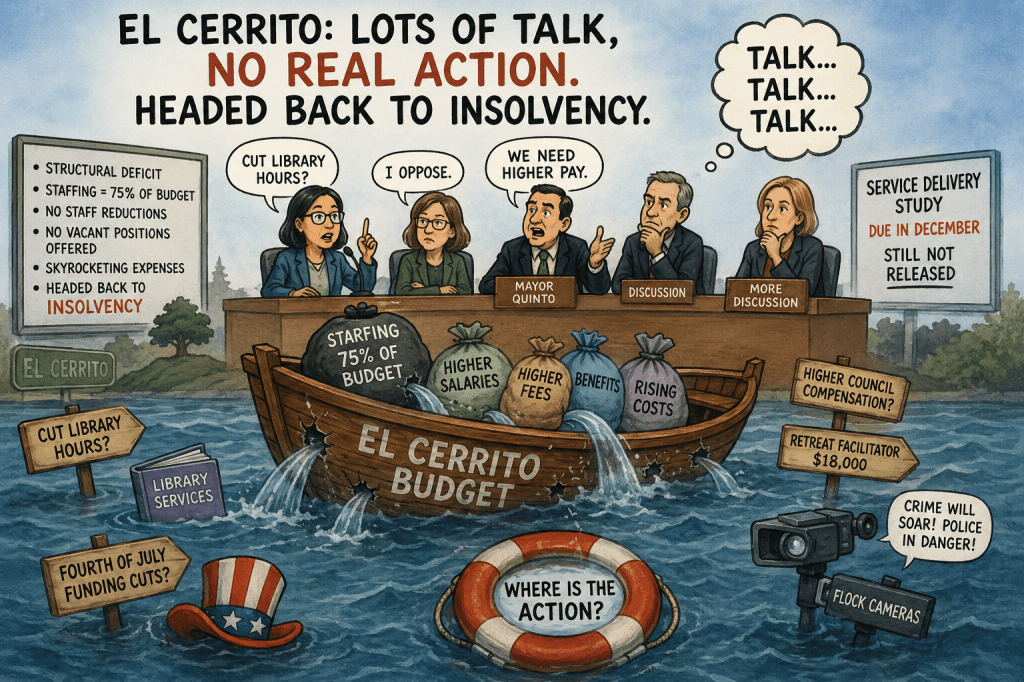
Last night’s El Cerrito City Council meeting offered residents a revealing look at the City’s ongoing structural budget challenges and rising financial pressures. Throughout the discussion, Council acknowledged growing costs and long-term fiscal strain, yet there was little meaningful discussion about reducing staffing levels, eliminating vacant positions, or restructuring operations to control expenses. That omission stood out because personnel costs make up roughly 75% of the City’s budget. Residents heard extensive discussion about financial pressures, but very little concrete action aimed at slowing the growth of skyrocketing expenditures. For many watching, the concern is becoming increasingly clear: El Cerrito appears to be drifting back toward the kind of financial instability that previously pushed the City dangerously close to insolvency.
They are now below the GFOA-recommended amount for unrestricted reserves, although they claim otherwise. Much of their reserves is in an emergency fund, and no auditor would consider those funds unrestricted.
Library Hours Suddenly Become Negotiable
One of the most notable moments came when Councilmember Lisa Motoyama suggested eliminating the additional six library hours currently funded by the City beyond the county baseline.
The discussion generated considerable debate.
Councilmember Rebecca Saltzman opposed reducing the hours.
For many residents, the significance was not simply the six hours themselves. It was what the conversation represented. For months, residents expressing concern about the City’s fiscal trajectory have often been dismissed as alarmist or anti-library. Yet now the Council itself is discussing service reductions before voters have even decided the future of the proposed library tax measure.
And importantly, Motoyama is not up for reelection this cycle.
Fourth of July Funding Also on the Chopping Block
The Council also discussed potential reductions to Fourth of July celebration funding.
While community events may seem secondary compared to larger budget items, these conversations matter because they reveal where fiscal pressure begins surfacing first: visible public services and community programming.
When cities begin debating reductions to library hours and long-standing community traditions, residents naturally begin asking deeper questions about financial sustainability.
The Missing Service Delivery Study
Another issue lingering over the discussion is the still-unreleased service delivery study.
The study was reportedly expected in December. As of May 19, City Manager Karen Pinkos, the City Manager had still not publicly released it.
That absence is becoming increasingly difficult to ignore.
A service delivery study is supposed to evaluate operational efficiency, staffing alignment, workflow effectiveness, and opportunities for improvement before taxpayers are asked for additional revenue. Residents still do not have the benefit of reviewing that analysis while simultaneously hearing discussions about service cuts and higher costs.
The Class and Compensation Study Keeps Coming Back
Earlier discussions again referenced the City’s classification and compensation study, which resulted in higher salaries and increased personnel costs.
But many residents continue asking a straightforward question:
If the City already completed a comprehensive compensation study specifically designed to address concerns about competitive pay, why are compensation pressures and budget strain still dominating discussions so quickly afterward?
The original purpose of the study was to create a sustainable compensation structure that would help attract and retain employees. Instead, residents are now watching simultaneous conversations about:
- service reductions
- higher fees
- continued fiscal strain
- additional compensation concerns
- and possible future tax increases
That sequence understandably raises concerns about long-term financial planning.
Residents Continue Questioning Fees and Priorities
The conversation also touched indirectly on broader frustrations residents have expressed regarding City fees and service delivery.
Residents continue noticing that El Cerrito charges for certain services that neighboring cities often provide without additional fees, including some tree planting requests.
At the same time, many residents do not feel they are seeing corresponding improvements in efficiency, responsiveness, or visible service outcomes.
The issue is not simply whether employees deserve fair compensation. Most residents support competitive wages for public employees.
The issue is whether City leadership has demonstrated sufficient operational discipline and measurable results before seeking additional financial commitments from taxpayers.
Mayor Quinto’s Appeal for Higher Council Compensation
Mayor Gabe Quinto made an impassioned appeal for increased council compensation during the meeting.
The timing drew attention because it occurred during broader discussions about fiscal constraints, possible service reductions, and public concern regarding affordability.
For many residents, it reinforced the perception that City leadership continues looking toward additional spending before fully addressing structural financial challenges.
Retreat Facilitator Costs and the Flock Camera Debate
The Council also discussed reducing spending on the City’s retreat facilitator, which reportedly costs approximately $18,000 to facilitate meetings.
Meanwhile, Quinto delivered a lengthy warning regarding the earlier Flock Safety camera debate, suggesting that the Council’s decision could contribute to increased crime and greater danger for police officers.
Reasonable people can disagree about surveillance technology, policing tools, and public safety strategies. But many residents are growing weary of exaggerated rhetoric surrounding policy disagreements, particularly when the City is simultaneously grappling with unresolved fiscal and operational concerns.
The Larger Takeaway
Last night’s meeting was not just about library hours or Fourth of July funding.
It was a window into a City wrestling with a larger problem:
rising costs, unresolved structural budget pressures, increasing public skepticism, and growing concern about whether leadership is adequately prioritizing long-term financial sustainability.
Residents are increasingly asking for something simple: evidence that existing resources are being managed effectively before they are asked to support additional taxes, additional compensation increases, or additional long-term financial obligations.


Why does compensation continue to be discussed? Why is spending reverting to uncontrolled spending? One common denominator; the city manager’s ego and lack of vision/leadership is the problem. She is so focused on bilking the city out of travel funds and focused on the ICMA organization, she has no time to properly run city. When one spends their time coaxing vacations out of the city (see a dozen countries and massive number of continental trips) she loses focus of what matters in the city she is supposed to be running. She is also focused on getting her own benefits (EPMC PERS contribution counted as salary) which is the same benefit she took from the rest of the city. What this means; the city’s PERS contribution will be counted as part of her retirement salary thus increasing her pay by 13% and her retirement pay until she dies at the same rate. The library and bad financial decisions are because of an oversized ego and being/remaining unprepared for the position. The definition of insanity is doing the same thing over and over, but expecting different results and I would our council is insane.
LikeLike
We agree
LikeLike