El Cerrito’s fiscal challenges did not appear overnight, and they are not simply the result of inflation, Proposition 13, passed in 1978, or a temporary economic downturn. The deeper issue is structural. The way the City is governed has created conditions where spending expands easily during good years, but meaningful correction becomes politically and operationally difficult when conditions tighten.
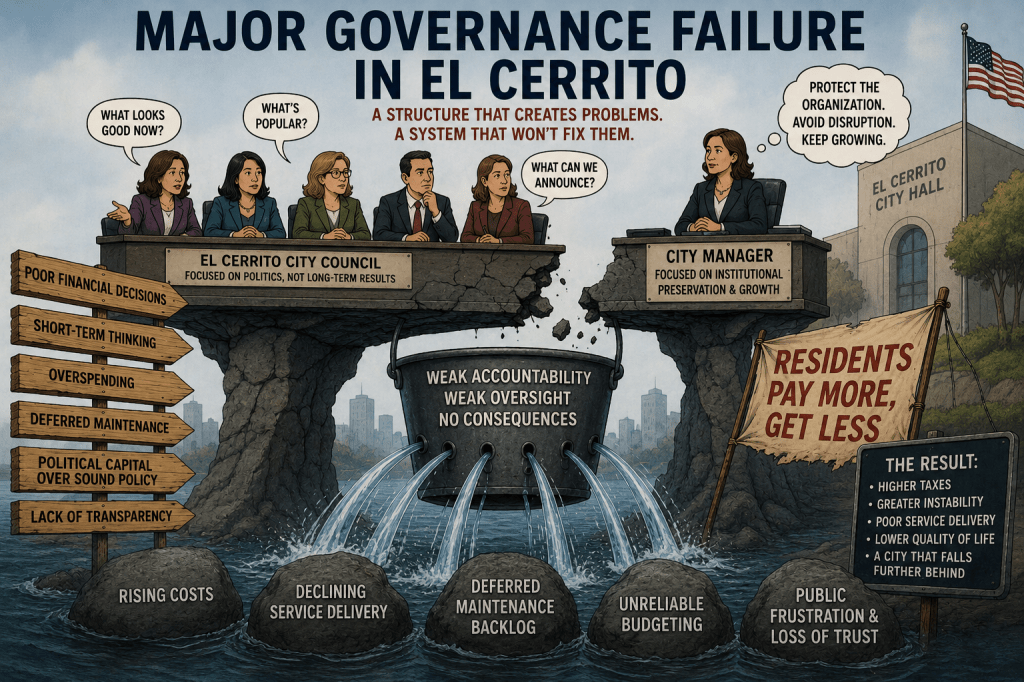
The way the City is governed has created conditions where spending expands easily during good years, but meaningful correction becomes politically and operationally difficult when conditions tighten.
Several residents recently raised an uncomfortable but important point: El Cerrito operates under a council-manager form of government that can weaken accountability when leadership culture becomes overly insulated from long-term consequences.
Under this structure, the City Council sets policy and hires the City Manager, while the City Manager oversees administration and operations. In theory, this model can work very well. Many cities use it successfully.
But the model only works when there is strong financial discipline, clear accountability, and elected officials willing to make difficult decisions before problems become crises.
That has not consistently happened in El Cerrito.
Over time, the City expanded staffing levels, compensation obligations, deferred maintenance exposure, and long-term financial commitments without building a sustainable revenue structure capable of supporting them indefinitely.
The result is what residents increasingly recognize today:
• Structural budget pressure
• Rising costs outpacing revenue growth
• Service expectations exceeding available resources
• Deferred maintenance accumulating quietly over years
• Increasing reliance on taxes and parcel measures
• Public frustration over paying more while seeing inconsistent service delivery
• Unrestricted reserves projected to fall to approximately 16%, below the City’s own reserve policy threshold
That last point matters.
Reserve policies exist for a reason. They are intended to protect cities during economic downturns, emergencies, unexpected infrastructure failures, pension volatility, and revenue instability. When a city falls below its own reserve targets, it is not simply an accounting issue. It is a warning sign that long-term financial flexibility is eroding.
What makes the problem especially difficult is that the current structure diffuses accountability.
When unpopular cuts become necessary, elected officials often avoid forcing them because the political consequences are immediate. Meanwhile, administrative leadership naturally tends toward institutional preservation. Neither side is strongly incentivized to aggressively reduce costs early enough to prevent larger problems later.
That creates a dangerous cycle.
During growth periods, spending and commitments expand. During downturns, leaders seek new revenue rather than fundamentally reevaluating operational structure, prioritization, or service delivery models.
Residents are now seeing the consequences play out across multiple issues.
The tree fee controversy became one example. Fees were dramatically increased, public backlash followed, and years later the City partially reversed course while presenting the reduction as a major accomplishment rather than acknowledging the original policy failure. Whether one agrees with the policy itself or not, the episode reflected a broader pattern: short-term political framing often replacing long-term operational thinking.
The same concerns now surround larger financial decisions, including Measure C and major capital expansion proposals.
Many residents are not opposing libraries, parks, trees, or public services. They are questioning whether City leadership has demonstrated the financial discipline and operational credibility necessary to justify asking taxpayers for tens of millions of additional long-term commitments.
That distinction matters.
A fiscally responsible city does not simply ask:
“How do we fund more?”
It also asks:
• What can we realistically sustain?
• What services are core priorities?
• What operational changes are necessary?
• What projects should wait?
• What obligations are already crowding out future flexibility?
• Are we measuring outcomes or simply expanding spending?
Those conversations are uncomfortable because they require tradeoffs. But avoiding them does not eliminate the consequences. It merely delays them.
Some residents have also pointed to signs that parts of the finance function may be moving toward more transparent accounting practices, including better visibility around deferred maintenance and amortization obligations. If true, that is encouraging. Honest financial representation is the first step toward rebuilding trust.
But transparency alone is not enough.
El Cerrito’s challenge is ultimately cultural and structural. The City needs leadership willing to prioritize long-term sustainability over short-term political convenience. It needs elected officials willing to publicly debate alternatives instead of narrowing discussion prematurely. And it needs a governance culture where accountability is measured not by slogans or ribbon cuttings, but by whether services remain sustainable five, ten, and twenty years from now.
Because residents are increasingly recognizing something important:
Financial problems are often symptoms.
Governance problems are usually the cause.

