Based on research by a concerned citizen
For months, supporters of Measure C have suggested that El Cerrito still has flexibility — that the city could potentially rebuild the library somewhere other than the El Cerrito Plaza BART transit-oriented development site.
But the public record tells a far more specific story.
Internal emails, board meeting minutes, city presentations, consultant reports, and official planning documents all point to the same conclusion:
The Plaza Station location was not one option among many.
It was the plan.
And city leadership appeared to move forward as though that decision had already been made long before voters were asked to approve funding.
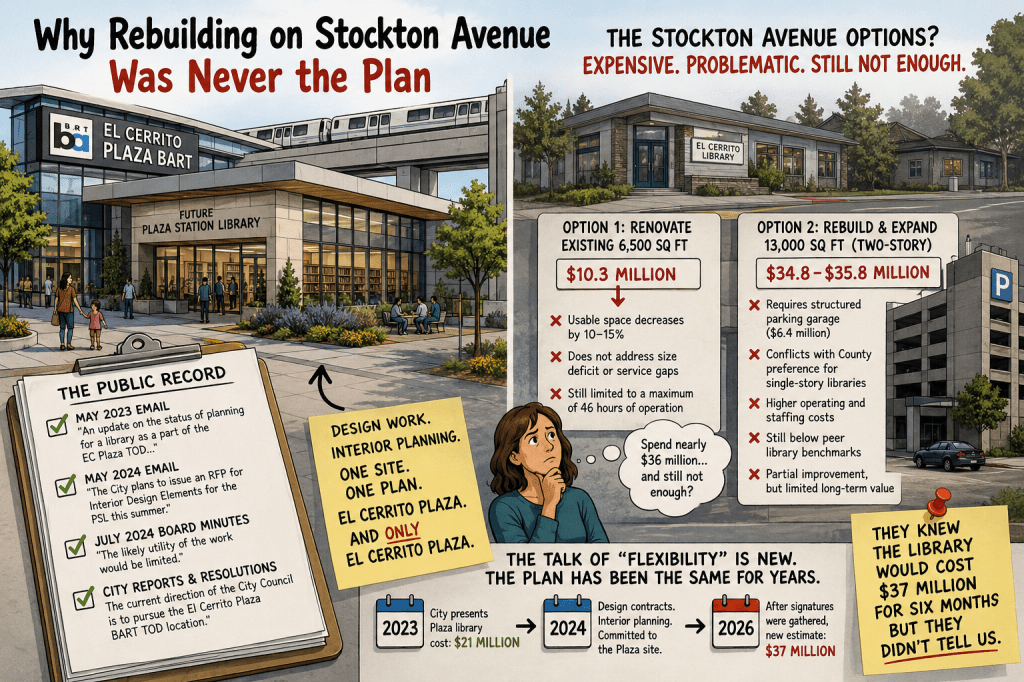
The Private Emails Tell a Different Story
In May 2023, Community Development Director Melanie Mintz sent an invitation to library stakeholders describing the effort as:
“An update on the status of planning for a library as a part of the EC Plaza TOD and the possible upcoming measure.”
Not a future library somewhere in El Cerrito.
Not a citywide site selection process.
The EC Plaza TOD.
Then in May 2024, Assistant City Manager Will Provost wrote to a library supporter that:
“The City plans to issue an RFP for Interior Design Elements for the PSL [Plaza Station Library] this summer.”
Interior design planning.
For a specific site.
Before voters had approved a single dollar in funding.
By July 2024, Library Foundation Board minutes reflected concern about whether that design work would even be useful if Measure C failed and the city had to pursue another location. The recorded response acknowledged that:
“The likely utility of the work would be limited.”
That statement matters.
Because it confirms what many residents suspected: the work being commissioned was so tailored to the Plaza location that it would have little value elsewhere.
The Plaza site was not simply under consideration.
It was already embedded in planning assumptions.
The Stockton Avenue Alternative Was Never Presented as a Strong Solution
In public discussions, city officials and Measure C supporters sometimes suggest that rebuilding at the current Stockton Avenue location remains a viable alternative.
But the city’s own consultants and technical documents repeatedly undermine that claim.
Option One: Renovate the Existing Library
The Griffin Structures ROM report, referenced in the February 19, 2026 §9212 Impact Report, evaluated renovation of the current 6,500-square-foot facility.
The conclusion was striking.
The report found that renovation would largely be limited to:
- basic code compliance
- accessibility improvements
- modest modernization
The city’s January 2026 presentation summarized the problem directly:
- it would not solve the size deficit
- it would not address service gaps
- operating hours would remain constrained
Even supporters of expansion have acknowledged that renovation alone would not meet long-term needs.
Option Two: Rebuild a Larger Two-Story Library on Stockton
The second Stockton Avenue option involved constructing a larger two-story facility of roughly 13,000 square feet.
At first glance, this may sound more viable.
But again, the city’s own reports raise major concerns.
The projected cost climbed to approximately $35–36 million — nearly the same price range now associated with the Plaza Station proposal.
A major reason?
Parking.
Because the existing Stockton site lacks sufficient land, the project would require a structured parking garage costing millions of dollars on its own.
The city’s own January 2026 presentation acknowledged additional concerns:
- still below peer library benchmarks
- conflicts with county preference for single-story libraries
- higher operating and staffing costs
- limited long-term value
Contra Costa County’s own library design standards strongly favor single-story layouts because they improve:
- staff efficiency
- visibility
- operations
- security
- accessibility
A two-story Stockton rebuild would conflict with those standards immediately.
Even Measure Supporters Acknowledged the Reality
The campaign’s own materials appear to reinforce the same conclusion.
The C4PSL FAQ reportedly states:
“There are no current, affordable alternatives to the El Cerrito Library at the Plaza Station.”
Meanwhile, the official §9212 Impact Report states plainly:
“The current direction of the City Council is to pursue the El Cerrito Plaza BART TOD location.”
Not explore.
Not evaluate.
Pursue.
The Public Messaging Changed After the Cost Increased
Perhaps the most troubling issue for many residents is not simply the location debate.
It is the timing of the financial disclosures.
In 2023, city leadership repeatedly promoted the Plaza Station concept using an estimated project cost of approximately $21 million, often emphasizing that the project could save the city substantial money compared with other alternatives.
But after signatures were gathered and momentum behind Measure C was already established, residents learned the estimated project cost had increased dramatically to approximately $37 million.
According to concerned residents reviewing city documents, leadership may have known about the higher estimate for roughly six months before the public was formally informed.
That raises legitimate questions residents are now asking:
- Why did public messaging continue using earlier estimates?
- When did city leadership fully understand the cost escalation?
- Why were voters not updated sooner?
- Would public support have changed if the higher number had been disclosed earlier?
Those questions are not anti-library questions.
They are governance questions.
This Debate Is Bigger Than a Building
At its core, this debate is no longer simply about whether El Cerrito deserves a modern library.
Most residents agree that it does.
The deeper issue is whether the public was given a transparent and complete understanding of:
- the true costs
- the true planning assumptions
- the actual level of flexibility
- the financial risks
- and the extent to which key decisions may have already been made before voters were asked to weigh in
Because when internal planning, design work, consultant analysis, and official reports all point overwhelmingly toward one predetermined outcome, it becomes difficult to argue that all options were still genuinely on the table.
And when project costs nearly double while public messaging remains anchored to older numbers, trust inevitably becomes part of the conversation too.


parking is an issue at Stockton library? and how is that worse than zero parking at the TOD library? in fact parking is plentiful on Stockton. in front of the veterans building. on Liberty street. Fairmont is out of school 130 days of the year – 4 months of no school when the library is open. building parking on top of a two story building is stupid. only reason that is in there because EC wants to build a community center (major component of the parcel tax) with library parcel tax dollars and then almost anybody in EC govt can get paid out of the parcel tax!
On Wed, May 27, 2026 at 4:39 PM El Cerrito Committee for Responsib
LikeLike