There’s a difference between being a compelling voice and being capable of governing. In El Cerrito, the stakes are too high to blur that line. The city doesn’t run on slogans or mailers. It runs on budgets, contracts, policies, and performance data. And all of that requires functional literacy in a very real, practical sense.
This isn’t about polish. It’s about whether someone can actually do the work of a council member.
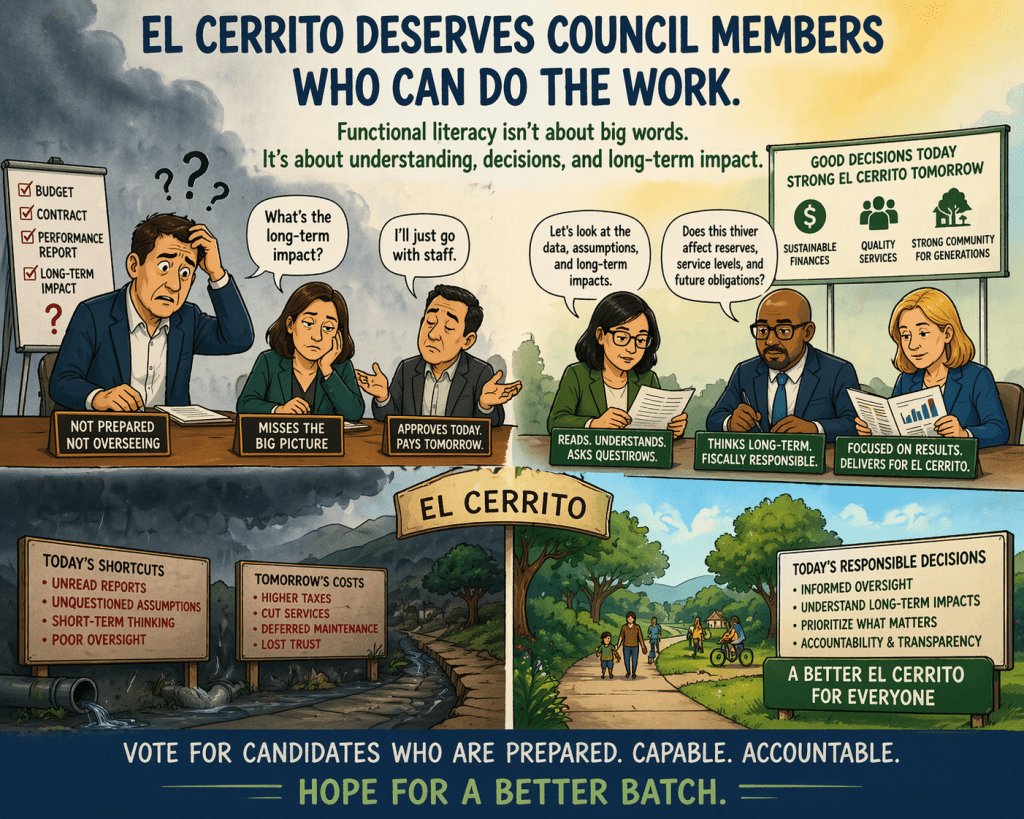
What Functional Literacy Looks Like in El Cerrito
A council member in El Cerrito should be able to read a staff report and understand what is being recommended and what is not. They should be able to follow a budget document, identify where assumptions are being made, and recognize when numbers don’t align.
They need to understand the difference between one-time funding and ongoing obligations. Between capital and operating costs. Between restricted funds and discretionary dollars.
They should be able to review a contract and grasp scope, deliverables, timelines, and risk well enough to ask informed questions before approving significant public spending.
They need to interpret performance data, response times, cost per unit, service levels and connect those metrics to real outcomes for residents.
And critically, they must understand the long-term implications of decisions made today.
That means recognizing when a “small” ongoing cost compounds into a structural deficit over time. It means understanding how labor agreements, pensions, and benefit structures create future obligations. It means seeing beyond the current budget cycle to the multi-year impact on reserves, service levels, and financial stability.
That’s functional literacy in local government. It’s applied. It’s practical. And it’s non-negotiable.
Why This Matters in El Cerrito Right Now
El Cerrito has been asking residents to approve new taxes and trust that funds will be used as promised. At the same time, the city is navigating real fiscal pressure, competing priorities, and growing expectations for service delivery.
In that environment, council oversight matters more than ever.
When council members cannot fully interpret financial information or challenge it, the risk isn’t theoretical.
Budgets get approved without a clear understanding of long-term impacts.
Administrative costs expand because no one is tracking how they’re allocated.
Revenue projections go unchallenged.
Tradeoffs are missed because they’re not recognized.
Short-term decisions start to drive long-term consequences.
This is how structural imbalance takes hold where ongoing commitments quietly outpace sustainable revenue. The warning signs are often in the documents. But if those documents aren’t fully understood, the risks aren’t either.
Service Delivery in El Cerrito Depends on It
The same issue shows up in service delivery.
If council members cannot read and interpret operational reports, they cannot hold departments accountable for results. If they cannot connect spending to outcomes both now and over time, they cannot prioritize effectively.
That leads to misalignment.
Resources are allocated without clear performance expectations.
Programs continue without evidence of impact.
Operational inefficiencies persist because they are not identified or addressed.
Over time, this compounds. Deferred maintenance grows. Service quality erodes. Costs increase without corresponding improvements.
Residents experience this as slower response times, uneven service, and a growing gap between what is promised and what is delivered.
This Is About Readiness, Not Rhetoric
Running for office in El Cerrito is a choice. Governing is a responsibility.
Functional literacy is part of being prepared to serve. It’s what allows a council member to move beyond surface-level understanding and engage with the substance of decisions that affect the entire community, not just today, but years down the line.
Without it, the role becomes reactive instead of strategic. Decisions are made based on partial understanding rather than full context.
And over time, that shows up—in the budget, in operations, and in public trust.
A Better Standard for El Cerrito
Voters in El Cerrito don’t need candidates who sound good. They need candidates who can demonstrate how they think, how they analyze, and how they account for long-term consequences.
The question is simple: can they read the material, understand it, challenge it, and make decisions that hold up over time?
The hope is just as simple: that the next group of candidates is a better batch—prepared, capable, and ready to do the work the role actually requires.
Because El Cerrito deserves nothing less.

