Influenced By a Concerned Citizen
Most residents voting on Measure C likely believe they are voting for a straightforward library project.
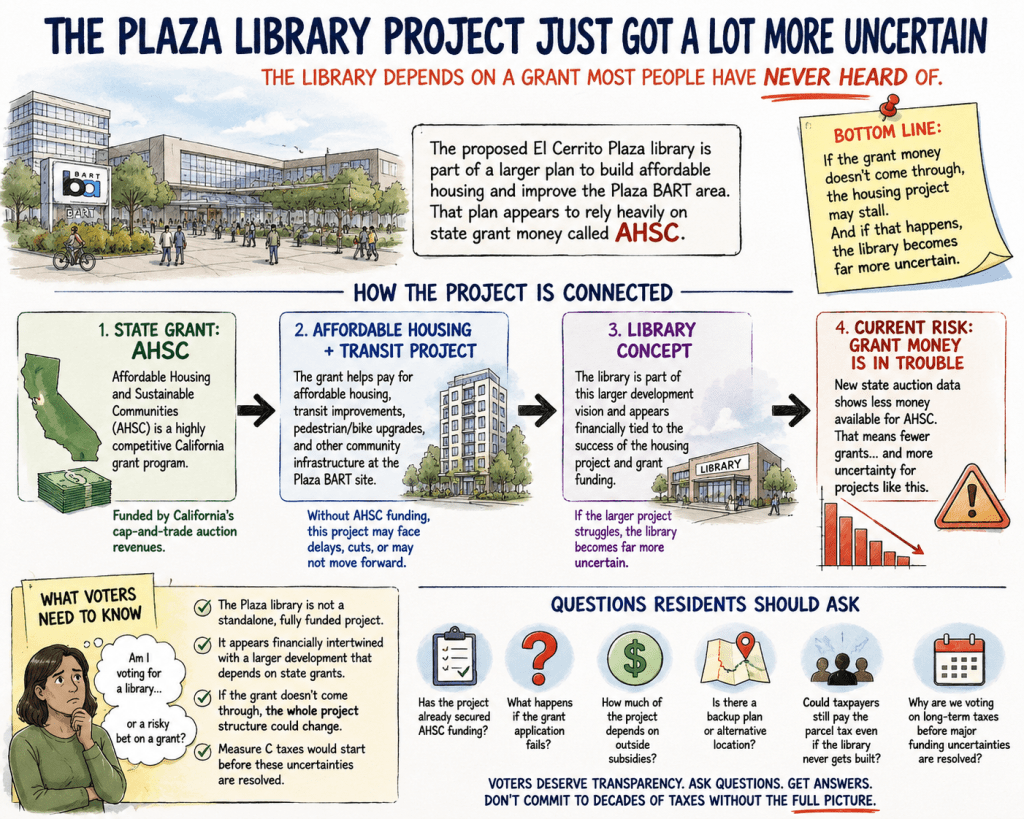
But the reality appears far more complicated.
The proposed El Cerrito Plaza library concept is deeply connected to a larger transit-oriented affordable housing development planned for the BART parking lot. And that broader project appears to rely heavily on a California state grant program called Affordable Housing and Sustainable Communities — commonly known as AHSC.
Most people have never heard of AHSC.
But without it, the entire Plaza project may face serious financial uncertainty.
What Is AHSC?
AHSC is a California grant program funded primarily through the state’s cap-and-trade auction system.
The program is designed to fund projects that combine:
- affordable housing
- transit-oriented development
- climate goals
- pedestrian and bicycle infrastructure
- and community-serving amenities
Projects near major transit hubs like BART are often designed specifically to compete for these grants.
That appears to be exactly what is happening with the Plaza proposal.
The affordable housing project, transit improvements, and library concept all appear financially interconnected within a larger development strategy.
Why This Suddenly Matters
This week, California released troubling new cap-and-trade auction results.
Those auction proceeds help fund AHSC grants.
When auction revenues weaken, the amount of money available for future AHSC awards can also shrink.
That creates a major problem for projects depending on those funds.
And AHSC funding is already highly competitive even in strong funding years.
If the Plaza development does not secure sufficient AHSC support, several things could happen:
- the housing project could be delayed
- project scope could change
- financing gaps could emerge
- timelines could stretch significantly
- or portions of the project may need to be restructured entirely
And if the housing development struggles, the proposed Plaza library concept may also become uncertain.
The Library Is Not a Standalone Project
This is the part many voters may not fully understand.
The proposed Plaza library does not appear to operate as an isolated, fully funded civic project with all financing already secured.
Instead, it appears connected to a much larger redevelopment strategy involving:
- affordable housing subsidies
- state grants
- transit-oriented development financing
- developer participation
- and future bond financing
That is a very different level of financial risk and uncertainty than many residents may realize.
Residents Deserve Full Transparency
None of this means the project cannot move forward.
But it does mean residents deserve honest conversations about:
- what funding has actually been secured
- what funding is still speculative
- how dependent the project is on AHSC
- what happens if grants are not awarded
- whether alternative locations or scaled options exist
- and what financial risks ultimately fall on taxpayers
Those are reasonable questions.
Especially because Measure C taxes would begin before many of these uncertainties are fully resolved.
Before Voting, Residents Should Ask
- Has the project already secured AHSC funding?
- If not, what happens if the application fails?
- How much of the Plaza concept depends on outside subsidies?
- Is there a backup plan?
- Could taxpayers still pay the parcel tax even if the Plaza library never materializes?
- Why are residents being asked to approve long-term taxes before major funding uncertainties are resolved?
These are not anti-library questions.
They are accountability questions.
And voters deserve clear answers before committing taxpayers to decades of new taxes tied to a project that may be far less certain than many have been led to believe.
 El Cerrito Committee for Responsible Government (ECCRG)