Measure C supporters continue to promote a long list of endorsements as though names alone should settle the issue. But El Cerrito voters should look deeper and ask two straightforward questions:
Were these leaders part of the era when El Cerrito’s finances deteriorated?
And do they fully understand what they are endorsing now?
Those are fair questions when taxpayers are being asked for more money.
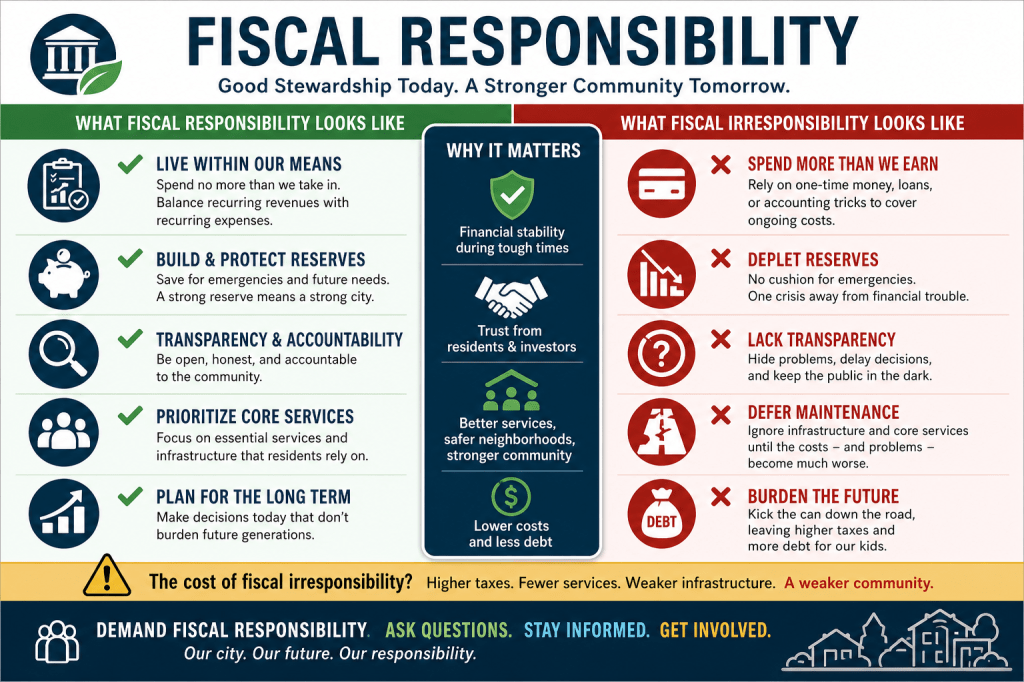
The Warning Signs Started Years Before the State Auditor
El Cerrito’s financial troubles did not begin with the California State Auditor report. Many of these endorsers served on the council during the decline.
The warning signs were visible as early as 2017, when the city was already facing serious fiscal strain. Then came a going concern warning in 2018, followed by another warning afterward.
A going concern warning is serious. It means auditors see reason to question whether an organization can continue financially without meaningful corrective action.
Later, the California State Auditor described El Cerrito’s condition in stark terms, citing excessive spending, inadequate corrective action, weak financial management, and risks to ongoing fiscal viability.
During council member Lyman’s, council member Quinto’s, and City Manager Pinkos’ reign, the City of El Cerrito was designated the seventh most financially at-risk city among over 470 California cities.
These same people are asking for our trust with over $37 million in additional dollars.
The high-risk designation only applies to the bottom 3% of 400+ California cities.
Let that sink in.
El Cerrito is off the highest risk list and still in the bottom 10% of over 400 cities. Despite this, leaders claim financial stability.
The Names on the Endorsement List Matter
The endorsement list includes current and former El Cerrito officials such as:
- Gabe Quinto
- Rebecca Saltzman
- Lisa Motoyama
- Carolyn Wysinger
- Greg Lyman
- Paul Fadelli
- Mark Friedman
- Rochelle Pardue-Okimoto
- Tessa Rudnick
- Rich Bartke
It also includes outside elected officials such as:
- John Gioia
- Jesse Arreguín
- Betty Yee
- Buffy Wicks
Voters are entitled to ask what exactly each of these endorsers knows about the measure, its costs, its alternatives, and El Cerrito’s financial history.
Rebecca Saltzman and Carolyn Wysinger
Rebecca Saltzman and Carolyn Wysinger joined the council later than some of the earlier officials tied to prior fiscal decline. That distinction is fair to acknowledge.
However, since joining city leadership, they have not established a clear record of advancing consistently fiscally responsible initiatives or supporting a durable balance between ongoing revenues and ongoing expenses.
That matters because sustainable governance is not only about raising revenue. It is about aligning spending, priorities, and long-term obligations with what taxpayers can realistically support.
Residents Have Seen the Impact
Fiscal irresponsibility is not abstract. It affects daily life.
When finances weaken, service delivery weakens too.
Residents experience it through:
- deferred maintenance
- growing infrastructure needs
- pressure on city services
- repeated tax requests
- uncertainty about priorities
- excessive unfunded pension debt
Prior Taxes Did Not End the Problems
El Cerrito voters have heard promises before.
We had a pool tax, yet reserves still had to be tapped for pool repairs.
We had a road tax, yet pavement condition scores reportedly fell from the mid-80s into the 60s.
That naturally raises a question:
If earlier dedicated taxes did not fully solve the promised problems, why should voters approve another blank check now?
John Gioia Raises a Bigger Concern
At a recent event, John Gioia appeared unfamiliar with important details of the initiative when asked about it. That matters because he is being presented as a trusted validator of the proposal. If one prominent endorser seemed unclear on the basics, voters are justified in asking:
How many others endorsed first and studied later?
An endorsement without understanding is not leadership. It is politics.
What Responsible Leadership Looks Like
Before asking taxpayers for more money, city leaders should provide:
- a final and transparent plan
- clear project costs
- honest discussion of alternatives
- measurable accountability
- explanation of past tax outcomes
- proof mistakes will not be repeated
- a credible path to structural balance between revenues and expenses
Instead, residents are too often hearing:
Approve now. Details later.
The Bottom Line
This election should not be decided by a flyer full of names.
It should be decided by competence, transparency, fiscal discipline, and results.
El Cerrito has already lived through years of warning signs, weakened finances, and repeated asks.
So voters are right to ask:
Can we trust the people asking for more money when the city still lacks a proven culture of balanced, responsible financial stewardship?


sure Gioia endorses the library CCC is fueling the TOD development and needs EC property taxpayers money CCC got the game kicked off for the building under construction with a $35,000,000 bond issuance for 515 Richmond Street now under construction JP Morgan bought the bond and then sold it to DC non profit housing fund they converted $22,000,000 of the bond into equity and CCC has the same CCC bond financing on the project for the balance of about $8,000,000 and JP morgan has $3,000,000 plus EC lent $10,000,000 that never gets repaid all very complicated and meant to be that way
On Tue, May 5, 2026 at 11:01 AM El Cerrito Committee for Responsib
LikeLike
He’s running a opposed this term, but backing this measure isn’t helping him
LikeLike