But Does It Have a True Community Center or Senior Center?
A concerned resident recently raised a point that deserves more thoughtful discussion than it has received so far.
Much of the current civic conversation in El Cerrito has centered around building a new library. But some residents are asking a broader question:
What community infrastructure is actually missing in El Cerrito today?
And more specifically:
Does El Cerrito already lack the very kinds of gathering spaces that many communities consider essential?
According to the City’s own facility descriptions, the answer may be yes.
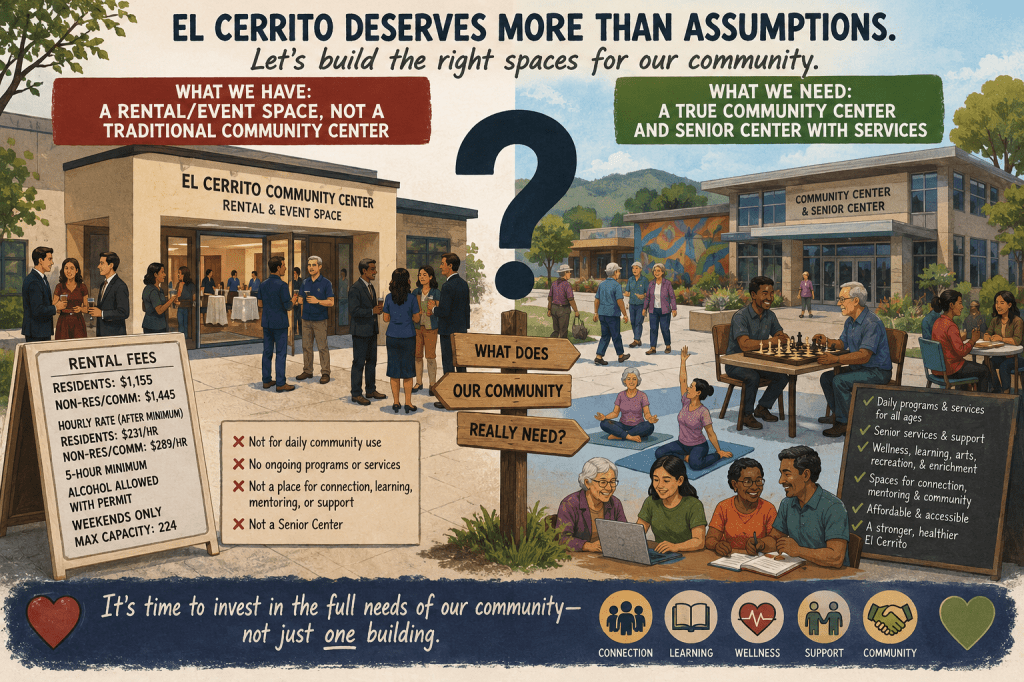
El Cerrito Already Closed the Senior Center. Now Residents Are Being Asked to Pay More for Additional Space.
Many residents assume El Cerrito already has a traditional community center and robust civic gathering infrastructure.
But the reality is more complicated.
The City’s Community Center functions largely as a rentable event facility, with significant emphasis placed on private rentals, weekend reservations, alcohol permits, kitchen use, tables, chairs, and event capacity.
And the rental costs are not minor.
For many residents, neighborhood groups, nonprofits, seniors, and community organizations, the pricing structure places the facility financially out of reach for regular use. What exists in theory as a public community space often functions in practice as a costly event venue.
That distinction matters.
A true community center is usually designed around ongoing, accessible community life:
- youth activities
- senior programming
- neighborhood meetings
- arts and music programs
- workshops and mentoring
- low-cost gathering spaces
- daily social connection
- informal civic interaction
Those spaces help reduce isolation, strengthen neighborhoods, and create a sense of belonging.
A high-cost rental hall is not necessarily the same thing.
The Senior Center Closure Changes the Conversation
What makes this debate even more significant is that El Cerrito already shuttered its Senior Center.
That decision left many older residents with fewer dedicated gathering spaces, fewer social opportunities, and fewer community-centered services specifically designed for aging populations.
Now, at the same time residents are being told the City cannot sustain certain services or facilities, they are also being asked to support additional taxes and fees for yet another major capital project.
That contradiction is difficult for some residents to reconcile.
Many cities prioritize senior centers because they provide essential daily support, including:
- wellness and exercise programs
- social activities and connection
- nutrition assistance
- technology support
- caregiver resources
- transportation coordination
- educational workshops
- health screenings
- intergenerational programming
As populations age, these services become more important, not less.
Residents are increasingly asking:
Why was the Senior Center closed if the City’s broader vision is supposedly centered on community investment?
And if existing public gathering spaces are already financially inaccessible to many residents, why should taxpayers now be asked to fund even more space before those underlying accessibility issues are addressed?
This Is About Priorities
El Cerrito already has a library.
Reasonable people can disagree about whether it should be renovated, expanded, relocated, or rebuilt.
But residents are now questioning whether the City’s civic priorities have become too narrowly focused on one expensive project while other community infrastructure needs remain unresolved.
People are asking practical questions:
- Why were existing community spaces allowed to diminish?
- Why did the Senior Center close?
- Why are affordable gathering spaces still limited?
- Why are residents being asked for more taxes and fees before broader community needs are addressed?
- Will ordinary residents actually be able to afford to use these facilities once they are built?
These are not anti-library questions.
They are questions about balance, accessibility, affordability, and long-term community planning.
A Community Is More Than Buildings
At its core, this debate is not simply about construction projects or square footage.
It is about what kind of civic life El Cerrito wants to support.
Libraries matter.
But so do affordable spaces where seniors gather, neighbors connect, young people participate in programs, and residents build relationships outside of expensive private venues.
Many residents increasingly feel that El Cerrito is asking taxpayers to continuously fund new projects while simultaneously reducing or limiting access to the very community-centered spaces people already depended on.
That tension deserves an honest public conversation.
Not slogans.
Not assumptions.
And not dismissing residents who are asking where all of this ultimately leads.

