Influenced by a Concerned Citizen
In local government, public trust matters.
Residents expect elected officials to make decisions and public endorsements based on what is best for the community, not on who recently contributed to a political campaign.
That is why some residents are raising questions after reviewing recent campaign finance disclosures connected to Measure C.
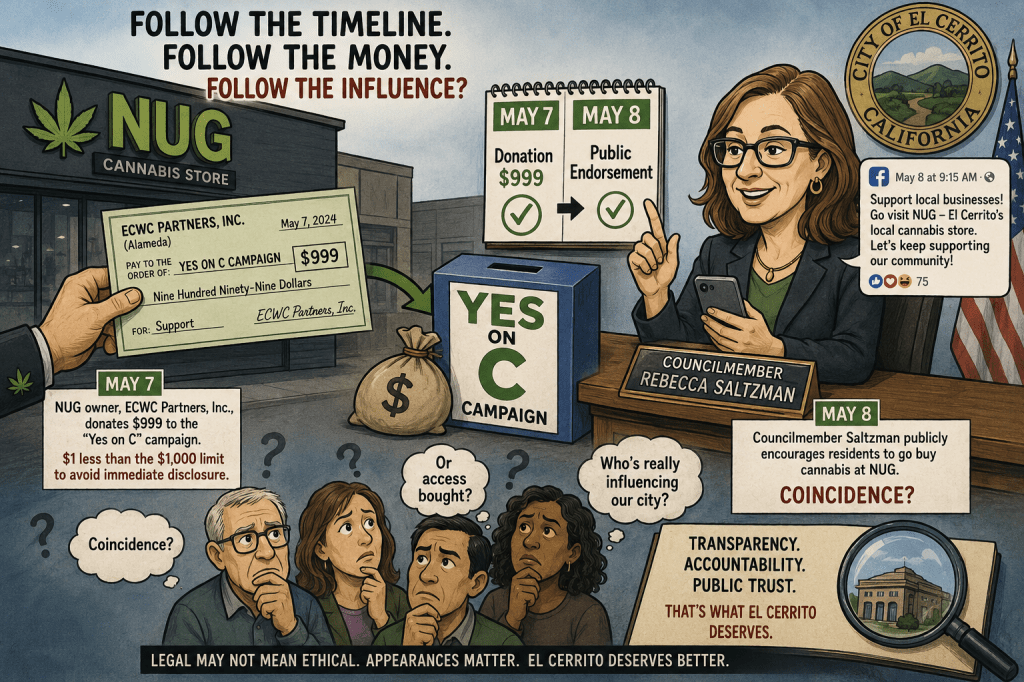
According to publicly available campaign filings, Alameda-owned cannabis business ECWC Partners, Inc., operating as NUG, donated $999 to the “Yes on C” campaign on May 7. The amount is notable because it falls just below the $1,000 threshold that would have triggered more immediate disclosure requirements.
The following day, on May 8, El Cerrito City Councilmember Rebecca Saltzman publicly encouraged residents to patronize the cannabis business in a social media post.
Residents can review the campaign disclosure filing themselves here:
The referenced social media post can be viewed here:
To be clear, campaign contributions are legal. Businesses, organizations, unions, developers, and advocacy groups contribute to campaigns across California every election cycle.
But legality and public perception are not always the same thing.
The issue many residents are discussing is not whether a law was technically violated. The issue is whether the sequence of events creates the appearance of political favoritism or transactional politics.
That distinction matters.
Local government depends heavily on public confidence. Residents want to believe that endorsements, public advocacy, and policy positions are grounded in independent judgment, especially when tax measures are involved.
When campaign contributions and public promotion occur within days of one another, people naturally begin asking questions:
Was this coordinated?
Was access or visibility influenced by campaign support?
Would the same public endorsement have happened without the contribution?
Even if the answer to those questions is “yes, it was coincidental,” the appearance issue still exists.
That is why transparency standards matter so much in local government. Public officials are not only expected to avoid actual conflicts of interest; they are also expected to avoid situations that reasonably undermine public confidence.
Many residents are already concerned about transparency surrounding Measure C, including evolving project costs, unclear long-term financing assumptions, questions about the project’s actual scope, and the growing role of political advocacy in what supporters describe as a community investment measure.
This latest disclosure is likely to intensify those concerns.
Ultimately, voters will decide for themselves whether this sequence of events reflects ordinary politics or something more troubling about how influence operates in local government.

