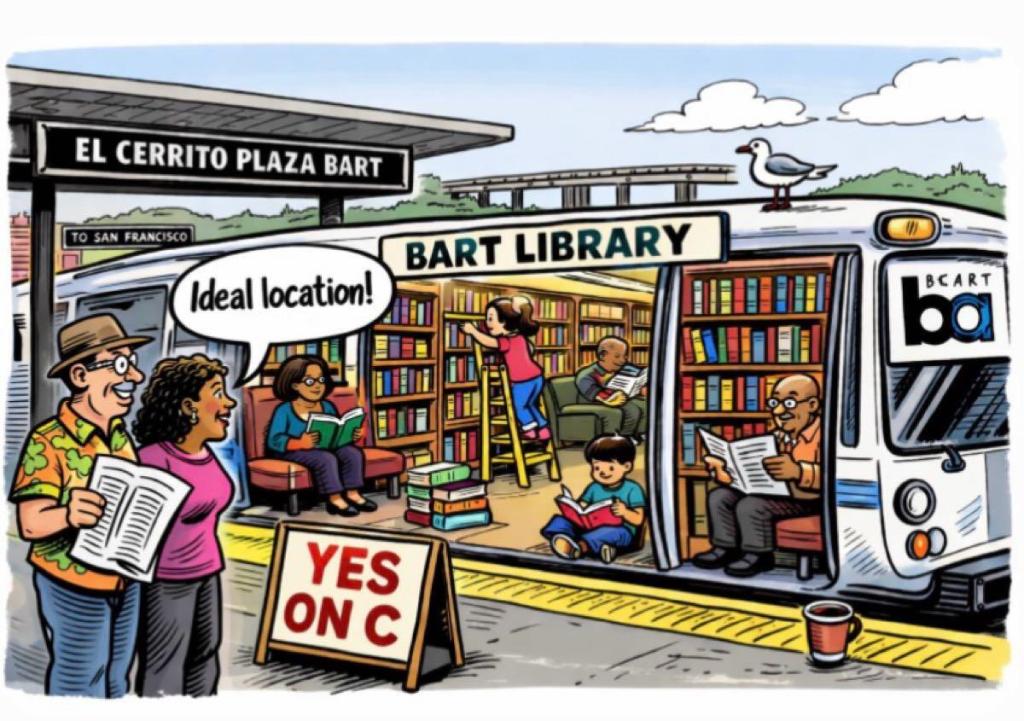
Trying to justify the lack of parking at the proposed library in El Cerrito Plaza. A recent suggestion making the rounds is that residents could simply ride Bay Area Rapid Transit from El Cerrito del Norte station to El Cerrito Plaza to access a new library.
On paper, it sounds convenient. In practice, it raises a much bigger question: who is actually doing this?
Illustration credit — Next Door Post
The Reality of Cost and Time
A short BART trip between Del Norte and Plaza isn’t free. Fares are typically in the range of a couple of dollars each way. Add in wait times—often 10–20 minutes depending on the schedule—and what was supposed to be a quick library visit becomes a coordinated transit trip.
That might make sense for a regional commute. It doesn’t make sense for checking out a book, attending a children’s program, or studying for an hour.
How Residents Actually Get Around
Very few residents use BART to travel within El Cerrito. It’s designed for regional movement across the Bay Area, not short local trips between neighborhoods. Most people walk, drive, bike, or take short local routes.
Suggesting BART as the primary way to access a neighborhood library ignores how people actually live day to day.
Convenience Matters
Libraries work best when they are easy to reach. The current location has proven that. It’s familiar, accessible, and integrated into the community.
Who is realistically choosing to go through a train station, wait on a platform, and ride a train just to visit a library?
A More Practical Path Forward
There’s another option that deserves serious consideration: rebuild and expand at the current site. That approach:
Preserves a location residents already use
Avoids unnecessary transit barriers
Can be delivered faster and at a lower cost. City estimates say $10 million
Keeps the library embedded in the neighborhood it serves
The Bigger Concern
This isn’t just about location. It’s also about the funding structure.
A parcel tax that starts at a set amount but increases every year with inflation and stays on property tax bills indefinitely is a long-term commitment. Residents should fully understand that before voting.
The Bottom Line
Everyone supports libraries. The question is how to deliver one that is accessible, practical, and financially responsible.
Relying on BART for everyday library access isn’t realistic for most residents. A well-designed, expanded library at its current location is.
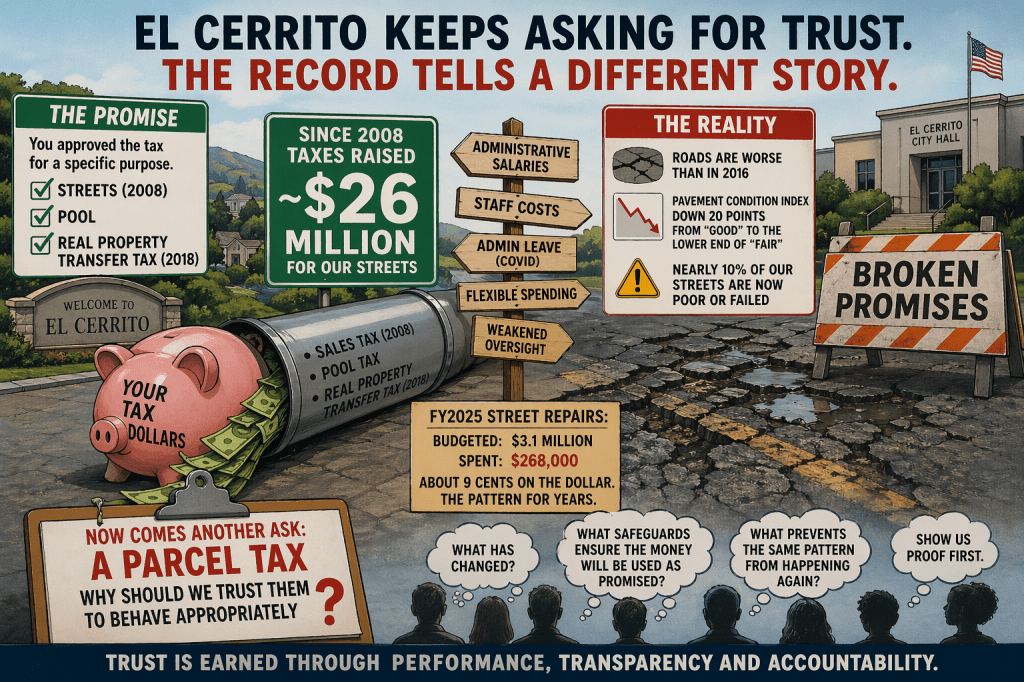
A concerned citizen recently laid out a simple question: when El Cerrito asks residents to approve a tax for a specific purpose, does the money actually get used that way?
The answer, based on years of public records, is not reassuring.
The Street Tax That Didn’t Fix the Streets
In 2008, voters approved a permanent half-cent sales tax to fix and maintain streets. Since then, roughly $26 million has been collected.
Yet today, road conditions are worse than they were nearly a decade ago. The city’s Pavement Condition Index has dropped significantly, with streets slipping from Good to the lower end of Fair, and a growing share now classified as Poor or Failed.
Even more concerning is how the money has been used.
In FY2025, the city budgeted $3.1 million for street repairs from this fund. It spent just $268,000—about nine cents on the dollar. That is not a one-year anomaly. It reflects a pattern.
The original promise was clear: no administrative salaries would be charged to the fund. Over time, that changed. Staff costs were billed to it. Even COVID-related administrative leave was charged against a fund voters believed was for fixing roads.
Oversight weakened too. A committee that was supposed to review spending shifted its own rules—from requiring members to review source documents like invoices to simply allowing it. Meetings saw no public attendance. Transparency became optional.
This is not just about deteriorating pavement. It is about a breakdown between what was promised and what was delivered.
The Pattern Extends Beyond Roads
This isn’t an isolated case.
Residents have seen similar dynamics with other revenue measures:
The pool tax, where expectations and outcomes have not aligned
The real property transfer tax under Measure V, where spending flexibility appears broader than many voters understood
Each time, the message to voters is clear and specific at the ballot box. Each time, the execution becomes more flexible after approval.
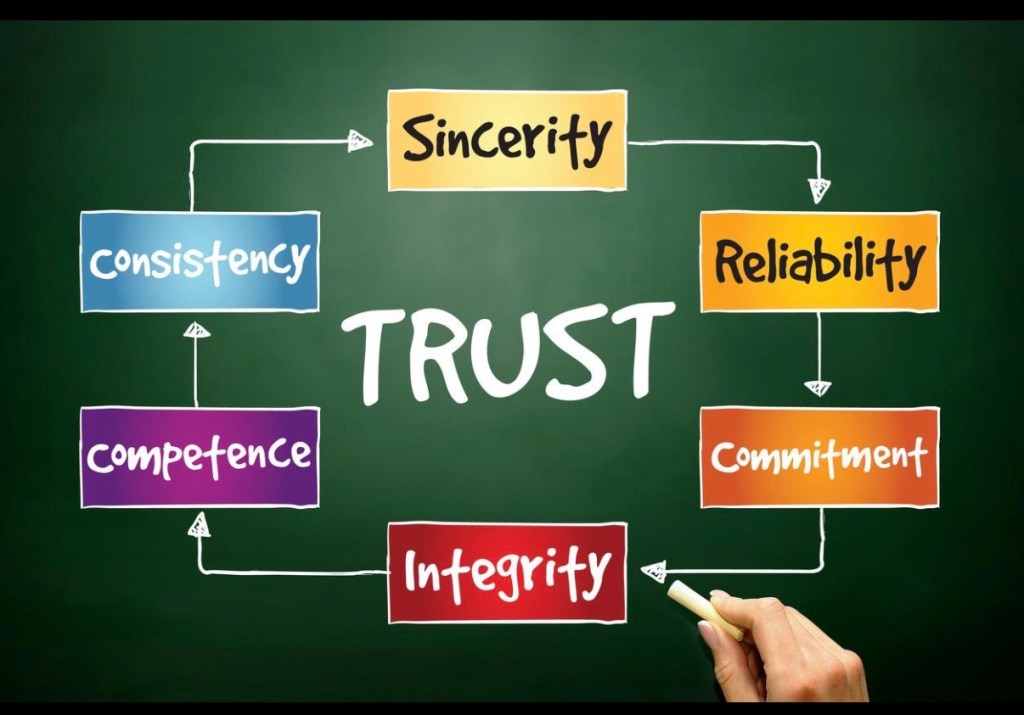
The Core Issue Isn’t Legality. It’s Trust.
To be fair, much of this spending may be legally permissible. Municipal finance rules often allow broad discretion once funds are collected, especially when language is not tightly constrained.
But legality is not the standard voters use when they make decisions. Trust is.
Voters are told their money will go to a defined purpose. They reasonably expect that purpose to be honored—not diluted, redirected, or absorbed into broader administrative uses.
When outcomes consistently diverge from expectations, the issue is no longer about a single program. It becomes systemic.
Now Comes Another Ask: A Parcel Tax
The city is once again asking residents to approve a new tax—this time a parcel tax.
The question voters should be asking is straightforward:
What has changed?
What safeguards ensure funds will be used exactly as presented?
What oversight mechanisms are truly independent and enforceable?
What prevents the same pattern—broadening use, under-delivery, weakened oversight—from repeating?
When these guardrails are flexible, as history has shown us, this is not a question of supporting services. It is indicative of whether commitments will be kept.
Trust Is Earned Through Performance
Cities rely on public trust to function. That trust is built when promises are matched by outcomes, when oversight is real, and when transparency is not optional.
Right now, residents are being asked to trust again.
Given the record, it is reasonable to draw your own conclusions.
El Cerrito is being asked to commit $37 million in public funding to support a development at the El Cerrito Plaza BART site—a project that includes a new library and housing.
That number isn’t a bonus. It isn’t a contingency.
It’s the difference between the project moving forward… or not happening at all.
And that should give us pause.
Start with the Market: Vacancy Is Not Tight
Every housing project begins with a simple question:
Is there enough demand to support it?
Here’s what the data shows for El Cerrito:
Overall vacancy rate: ~5.2%
Rental vacancy (U.S. Census): ~3.2%
At first glance, that might seem manageable. But look a little closer:
Affordable (income-restricted) units typically operate at near full occupancy
That means vacancy is largely concentrated in market-rate housing
👉 Which leads to a reasonable, evidence-based conclusion: Market-rate vacancy in El Cerrito is likely in the ~5%–7% range, or higher in certain pockets.
That’s not a tight market.
That’s a balanced to soft market—the kind where:
Units take longer to lease
Rent growth slows or declines
Developers face real revenue uncertainty
The Bigger Issue: El Cerrito Isn’t Growing
If demand isn’t being driven by today’s market, maybe it’s being driven by growth.
Except… it isn’t.
Here’s El Cerrito’s population over time:
1960: 25,437
1970: 25,190
1980: 22,731
1990: 22,869
2000: 23,171
2010: 23,549
2020: 25,962
Today, estimates place the population at roughly 26,000 residents.
Let’s be clear about what that means:
👉 Over 65 years, El Cerrito has added roughly 1,000 residents total.
That is not growth in any meaningful planning sense.
That is stability.
Recent trends reinforce it:
Growth since 2000 has averaged well under 1% annually
Some projections show near-zero growth or slight decline through 2030
This Is a Mature, Built-Out City
El Cerrito is not:
A high-growth suburb
A job-center boomtown
A city absorbing rapid in-migration
It is:
Established
Built out
Demographically stable
Which raises a fundamental question:
Why are we planning major new housing supply as if the city is expanding?
The $37 Million Reality
Now we come back to the number that matters most:
$37 million.
That is what the developer needs from the City of El Cerrito residents to make this project viable.
In real estate terms, that tells you everything:
The project does not pencil on its own
Expected rents and absorption do not support the costs
Private capital alone is not willing to take the risk
So the city is being asked to step in and do three things:
Close the financial gap
Reduce investor risk
Signal credibility to outside lenders and equity partners
In effect, the city becomes the anchor investor of last resort.
Why This Matters
When a project requires this level of subsidy, it’s not just about funding.
It’s about what the market is telling you.
And right now, the signals are consistent:
Vacancy is not tight
Rents are not accelerating
Population is not growing
That combination makes projects harder to finance for a reason.
Because the underlying demand isn’t strong enough to carry them.
The Risk No One Wants to Discuss
If the assumptions behind this project don’t hold—if:
Lease-up takes longer
Rents come in lower than projected
Vacancy rises even slightly
Then one of two things happens:
The project struggles financially
Or additional public support is requested
That’s how these deals work.
The initial subsidy is rarely the end of the story when fundamentals are weak.
Building on Hope Instead of Data
There’s nothing wrong with wanting investment.
There’s nothing wrong with wanting a new library.
But those goals don’t change the underlying math.
Right now, El Cerrito has:
Flat population growth over decades
Moderate market-rate vacancy (~5–7%)
Softening rental conditions
And yet, we are being asked to fund a project that depends on:
$37 million in public money just to exist.
Final Thought
If the market were strong, this project would move forward without this level of subsidy.
It wouldn’t need the city to step in as a financial backstop.
So the real question isn’t whether we can build it.
It’s this:
Why are we being asked to fund a project that the market itself is not confident in?
Because when a project doesn’t pencil without $37 million…
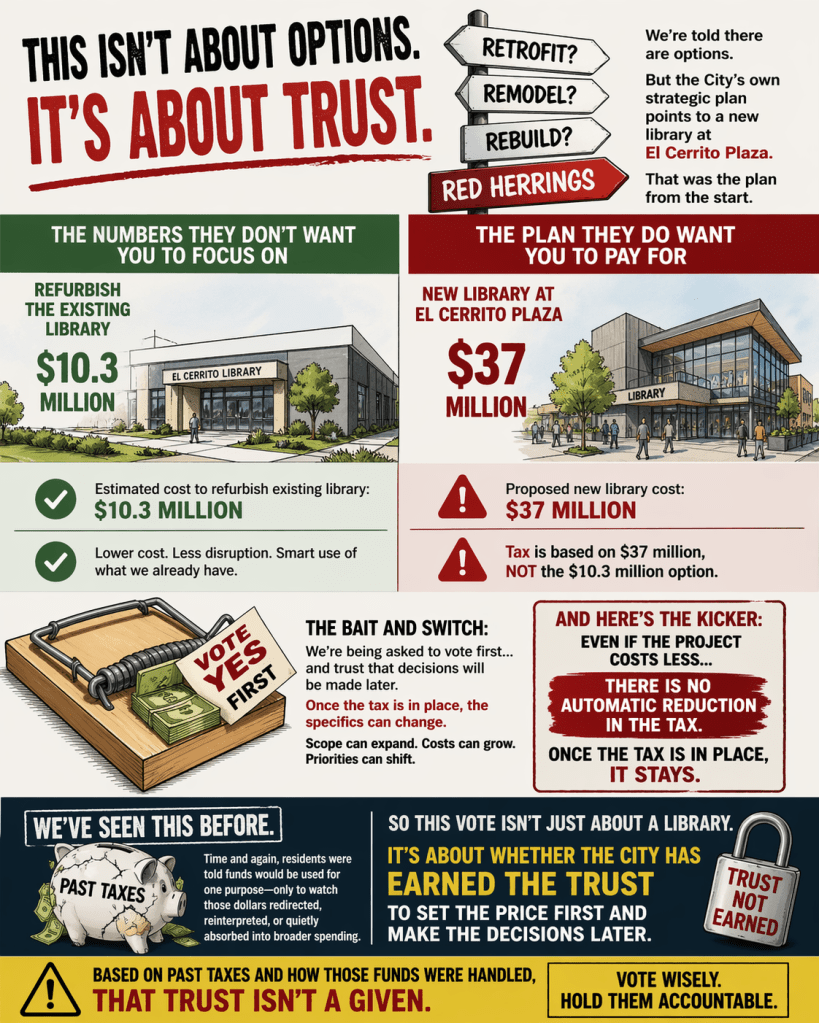
We’re being told there are multiple paths forward. Retrofit. Remodel. Rebuild.
But those “options” are a distraction.
The City’s own strategic plan already points to a new library at El Cerrito Plaza. That was the direction from the start. Early materials reflected that site before the rebrand.
Now we’re being asked to vote first… and trust that the real decisions will come later.
At the same time, the numbers raise a fundamental question.
The City has indicated the existing library could be refurbished for about $10.3 million. Yet the tax is being structured around a $37 million project.
That’s not a small difference. That’s a $26.7 million gap.
And here’s what matters most:
So even if a lower-cost approach is ultimately chosen, there is no reduction in the tax.
Once the tax is in place, it stays.
That means residents are being asked to approve funding at the highest projected cost without a binding commitment to that scope and without any guarantee of savings being returned if the project costs less.
We’ve seen this before.
Time and again, residents were told funds would be used for one purpose only to watch those dollars redirected, reinterpreted, or quietly absorbed into broader spending.
So this vote isn’t just about a library.
It’s about whether the City has earned the trust to set the price first and make the decisions later.
And based on past taxes and how those funds were handled, that trust isn’t a given.
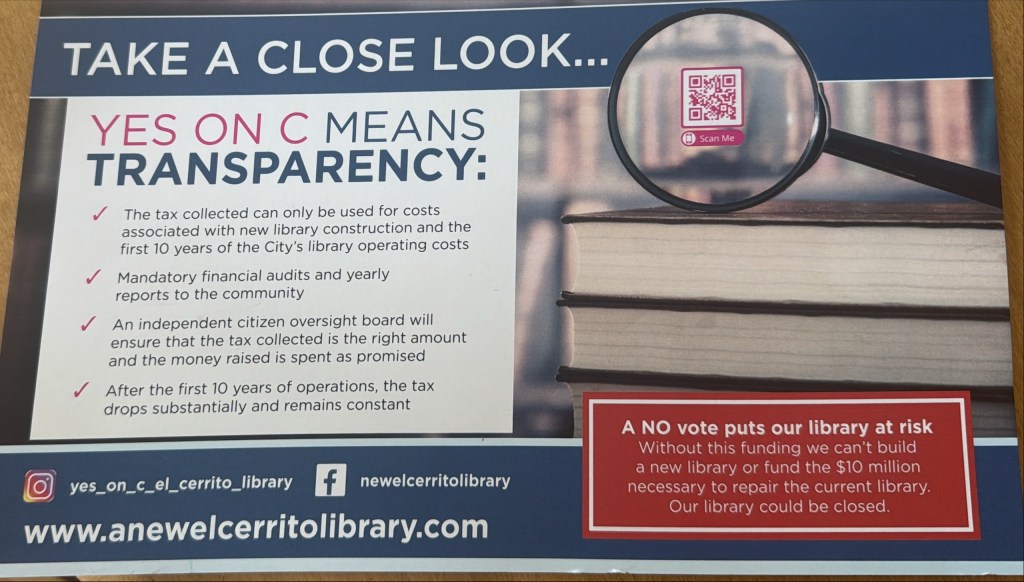
El Cerrito residents recently received a new, highly polished campaign mailer urging a “yes” vote—warning that if the measure fails, the library could potentially close.
It is a powerful message. It is also misleading.
First: The county funds 40 hours of library services at our current Stockton street library and will continue doing if we vote no.
Second: Libraries do not simply shut down because a single funding measure fails. Cities make budget decisions. They prioritize services. They adjust spending. Framing this as vote yes or risk losing the library is not a neutral statement. It is a pressure tactic.
But the most revealing part of the mailer may not be the warning. It is the math.
Third: The mailer acknowledges that the existing library could be retrofitted for approximately $10 million. At the same time, it promotes a $37 million project for a significantly larger, Barnes and Noble sized facility.
That comparison changes everything.
Because now the conversation is no longer about whether El Cerrito will have a library.
It is about what kind of investment the city is choosing to pursue.
A $10 million retrofit suggests a very different path forward. One that focuses on upgrading what already exists. Addressing safety and structural needs. Modernizing the interior. Extending the life of the building. Maintaining service without dramatically expanding the footprint or cost. That’s why we vote no on the $37 million dollar tax on the table and send them back to the drawing board.
Cities across California take this approach every day, especially in established communities like El Cerrito.
Nearly 30 percent of the city’s housing stock, more than 3,800 homes, was built before 1950. Some structures date back to the late 1800s. This is a city that has long managed aging assets through maintenance, retrofit, and thoughtful reinvestment.
Which raises a straightforward question.
If a $10 million option exists, why wasn’t that the starting point?
Why wasn’t it fully presented, analyzed, and discussed with residents before advancing a $37 million proposal? Because the city’s Strategic Plan says the library will be built in the El Cerrito Plaza. It’s that simple.
What has not been provided is that level of clarity.
Instead, the mailer presents two ideas at once. A lower cost alternative is acknowledged. At the same time, a worst case narrative is introduced about potential closure.
That combination deserves scrutiny.
Because if a functional, improved library can be delivered for a fraction of the cost, then this is not a question of survival.
It is a question of scale, priorities, and trade-offs.
A $37 million project carries real implications. It affects long-term financial commitments. It competes with other city needs. It raises questions about operating costs and sustainability particularly since this $37 million initiative will cost at least $100 million to cover bond and tax escalation costs.
A glossy mailer can create urgency. It can shape perception. But it cannot replace transparency.
Residents are not choosing between a library and no library.
They are choosing between different ways to invest in one.
And when one option costs nearly four times as much as another, the community deserves a full and honest conversation.
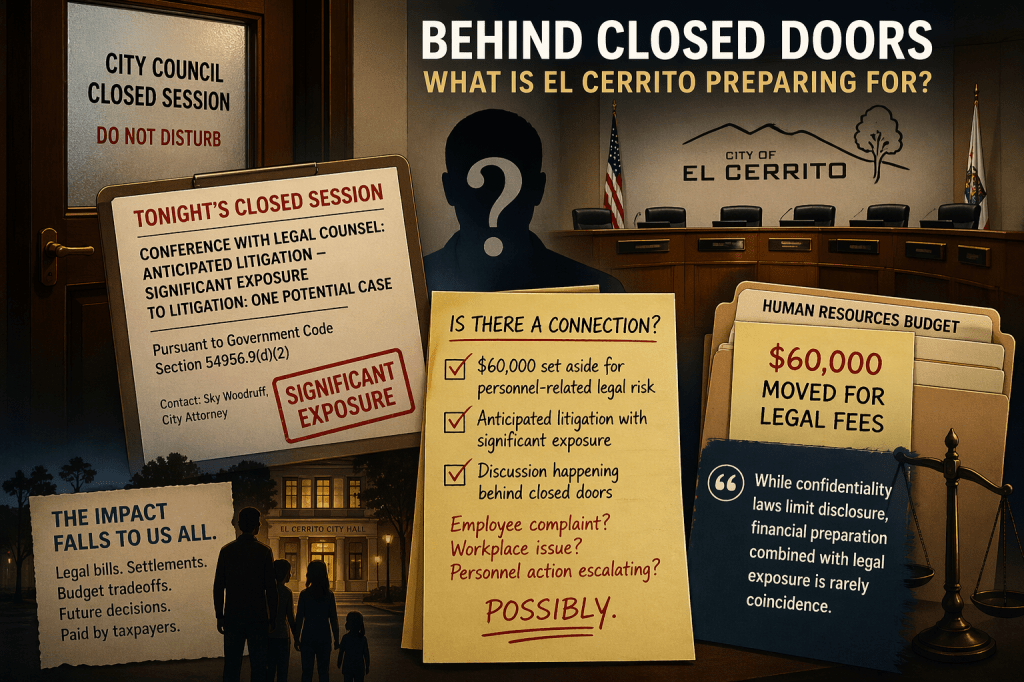
CLOSED SESSION – CONFERENCE WITH LEGAL COUNSEL: ANTICIPATED LITIGATION – SIGNIFICANT EXPOSURE TO LITIGATION: ONE POTENTIAL CASE Pursuant to California Government Code Section 54956.9(d)(2) Contact: Sky Woodruff
That language is not routine. It means the City believes a lawsuit is likely and that the potential consequences could be significant.
Just recently, staff returned to the City Council with a request to move $60,000 into the Human Resources budget for legal fees. That funding was tied specifically to personnel-related legal risk. At the time, it may have seemed like a routine adjustment. Tonight’s closed session suggests it may not have been.
Let’s connect the dots:
The City set aside funding tied to employee-related legal risk The City now acknowledges anticipated litigation with significant exposure The discussion is being handled behind closed doors
Could this be related to an employee complaint, a workplace issue, or a personnel action now escalating? Possibly.
And while confidentiality laws limit disclosure, financial preparation combined with legal exposure is rarely coincidence.
What the public knows is limited but meaningful. There is one potential case. The City believes exposure is significant. Legal counsel is actively advising leadership. What is not disclosed is the nature of the issue, who is involved, or what the potential cost may be.
That gap is intentional under the law, but it leaves residents with signals instead of answers.
Legal exposure does not stay contained behind closed doors. It shows up in legal bills, settlements, budget tradeoffs, and future financial decisions. Those impacts ultimately fall to residents.
The $60,000 allocation and tonight’s closed session may be unrelated. But they may not be.
When a city prepares for personnel-related legal costs and then identifies significant exposure to litigation, it raises a fair and reasonable question.
What is coming and how much will it cost?
Residents will not get those answers tonight. But they should expect them eventually.
A concerning shift continues to unfold in the conversation around the proposed library tax and it is not about the merits of a library. It is about how neighbors are being treated.
Since the pro camp can’t defend many years of poor management, fiscal irresponsibility, or poor planning on this project, they have resorted to personal attacks. We’ve seen it and are not surprised by it, but some comments have gone too far.
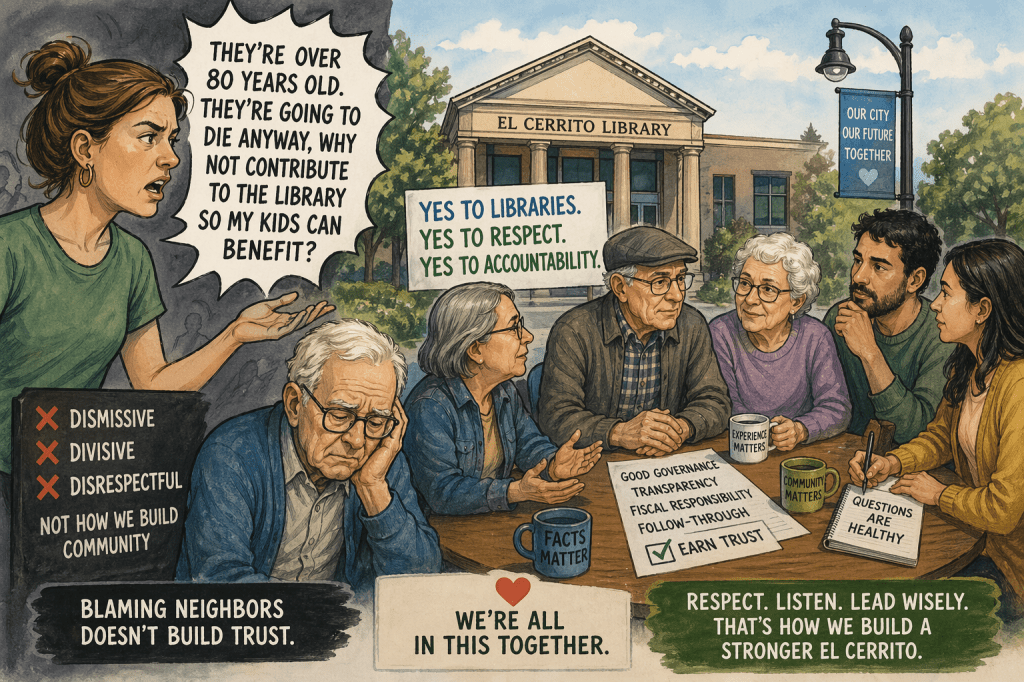
In a recent exchange on Blue Sky, one yes supporter who describes herself as a young mother advocating for libraries suggested that residents over 80 are going to die anyway so they should contribute more now so her children can benefit.
That statement should give all of us pause.
Not because it is shocking in today’s online discourse but because it reveals how quickly a policy debate can lose its grounding in respect, shared community, and basic decency.
This community includes people at every stage of life. Young families raising children. Working professionals. And seniors, many of whom have lived here for decades, paid into the system, supported past measures, and helped build the very community we are now discussing.
Reducing any group, especially our oldest residents, to a calculation about how much more they should contribute before they are gone is not advocacy. It is dismissal.
And it undermines the very argument being made.
Because this is not a question of whether children deserve access to libraries. Of course they do. That is not in dispute.
The real question is whether this specific proposal is the right approach and whether it reflects sound financial stewardship, transparency, and accountability.
Those concerns do not disappear because someone is older.
In fact, they often come from experience. From having seen multiple tax measures come and go. From watching how funds were promised, allocated, and sometimes redirected. From living through decisions that led to where the city stands today.
That perspective is not something to be brushed aside. It is something to be valued.
El Cerrito residents across generations have consistently contributed. Sales taxes have risen. Parcel taxes have been approved. The real property transfer tax was increased. These decisions were not made lightly and they were not made by one age group alone.
So when someone raises a concern today, whether they are 35 or 85, it deserves to be addressed on the merits.
Not dismissed based on how many years they may have left.
If the case for this measure is strong, it should be able to stand without targeting neighbors. Without framing one generation’s needs against another’s. Without suggesting that some voices matter less because of their age.
A healthy community does not ask who matters more.
It finds a way to respect everyone at the table and to make decisions that reflect both shared values and responsible governance.
El Cerrito is now facing a lawsuit under the California Voting Rights Act (CVRA)—a law that has been on the books since 2001.
Let that sink in.
For more than two decades, cities across California have been expected to comply with this law, which is designed to ensure fair and equitable representation in local elections. And yet, here we are in 2026, reacting as if this came out of nowhere.
It didn’t.
This Was Predictable
The CVRA is not obscure. It is not new. And it is not optional.
Cities throughout California have already gone through this process—many after being sued, and almost none successfully defending themselves. The pattern is well established: cities delay, get challenged, and ultimately pay the price.
El Cerrito appears to be following that same script.
The Real Cost Isn’t Just Legal Fees
Now the city is in a position to respond under pressure, incurring legal costs, consulting fees, and administrative expenses that could have been minimized or avoided altogether with proactive planning.
And make no mistake: residents will bear those costs. They always do. When obligations are ignored or delayed, the bill doesn’t disappear; it grows. And when it finally comes due, like this overdue obligation, it’s the residents who are left paying at the most expensive moment.
And now, because we’re rushed, we’re looking at a $250,000 cost—money the city simply cannot afford because the expense must be covered by reserves.
This, on top of a structural imbalance of about $2.5 to $3 million more than expenses than revenue.
At a time when the city is already asking voters to consider new taxes, it’s fair to ask a basic question:
Why wasn’t this addressed earlier?
Governance Means Doing the Basics
This situation raises a broader concern about priorities.
City leadership has the responsibility to manage risk, anticipate obligations, and ensure compliance with longstanding laws. That’s not extraordinary leadership, that’s the baseline.
When a law has existed for 25 years, compliance isn’t a surprise requirement. It’s a basic function of governance.
It Shouldn’t Take a Lawsuit
What’s most frustrating is that it often takes the threat—or reality—of a lawsuit to force action.
That’s not how good governance works.
Doing the right thing should not depend on whether someone is willing to sue the city. It should be built into how the city operates every day.
Where Do We Go From Here?
El Cerrito is not weighing multiple options. The direction has already been decided. Rather than an open evaluation of compliant approaches, the city is moving forward with a predetermined redistricting path and is not considering options such as rank voting. This path will likely still require time, money, and public resources to implement, but without the benefit of a fully transparent or inclusive decision-making process.
But the bigger issue is this:
How many other “known” obligations are being deferred until they become crises?
Residents deserve better than reactive governance. They deserve leadership that anticipates issues, manages them early, and avoids unnecessary costs.
Because in the end, the bill always comes due—and it’s the public who pays for the delay.
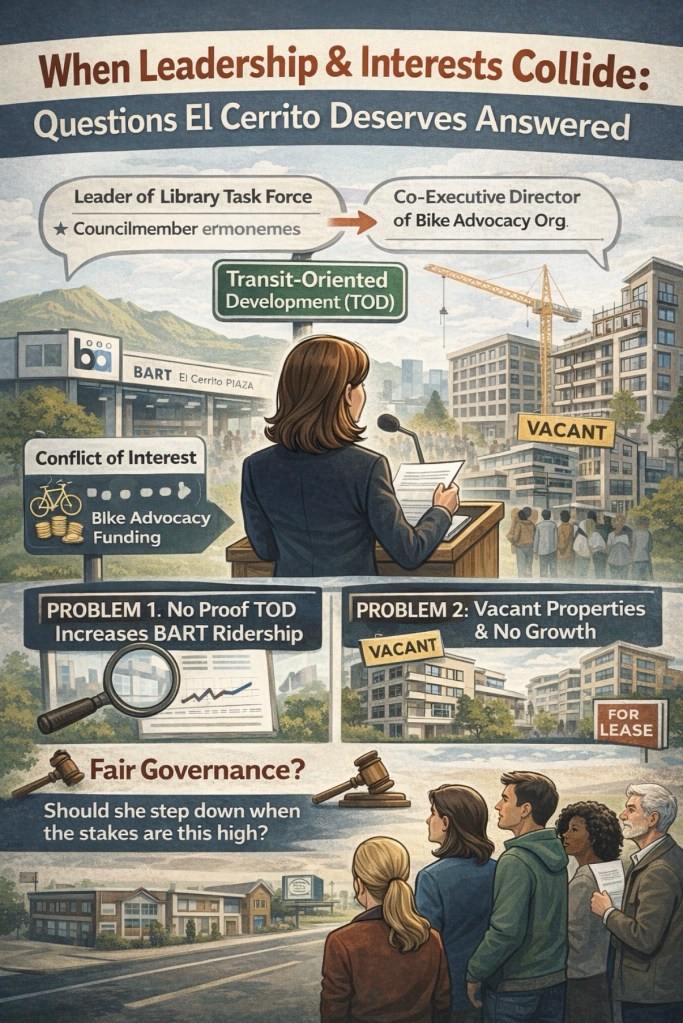
The City of El Cerrito recently established a new library task force to assess potential sites following community concerns that the City Council had already made its decision to place a new library at the El Cerrito Plaza BART location. This shift did not happen in a vacuum. It was influenced in part by ongoing social media conversations where residents raised concerns, shared information, and challenged the narrative around both the location and the process. Councilmember Rebecca Saltzman was selected to lead this effort. At first glance, this may seem like a reasonable step forward, but when you look more closely, serious questions emerge—questions that go beyond process and speak directly to public trust. Ms. Saltzman currently serves as Co-Executive Director of Bike East Bay, an organization that is receiving funding tied to the broader BART development efforts, including the El Cerrito Plaza site. This creates a situation where decisions related to the project could directly benefit an organization she leads.
In addition, Ms. Saltzman previously served as a director for Bay Area Rapid Transit, where advancing transit-oriented development was a clear institutional priority. That history matters, because it reflects a long-standing policy position—not a neutral starting point. This raises a fundamental question: can the public have confidence in a process led by someone with both current organizational ties and prior institutional commitments aligned with a specific outcome? In most professional environments, this would not be a gray area. It would be a clear signal to step back.
The Bigger Issue: Is TOD the Right Answer Here?
Even setting aside the conflict concerns, the underlying assumptions driving this decision deserve scrutiny. Transit-oriented development is often promoted as a way to increase transit ridership, but where is the verifiable evidence that TOD meaningfully increases ridership for systems like BART? This claim is frequently repeated, yet rarely substantiated with clear, local, data-driven outcomes. Without that evidence, using TOD as justification for major public decisions becomes more of a belief than a strategy. At the same time, El Cerrito is not facing a shortage of newly built housing. Recent developments have added units, and many remain vacant, raising a practical question about whether demand is keeping pace with supply. If existing inventory is not being absorbed, continuing to build does not resolve a problem—it risks compounding it. Population trends further reinforce this concern. El Cerrito is not experiencing meaningful growth, and that reality should inform decisions about new construction, long-term tax commitments, and infrastructure tied to projected demand. Building for growth that is not occurring is not planning—it is speculation.
Why This Matters
This is not about personalities. It is about governance. When public officials are in positions where their professional roles align with specific project outcomes, their past institutional commitments reinforce those outcomes, and the underlying assumptions of those outcomes remain unproven, it creates a situation where trust is strained, regardless of intent. Good governance is not just about doing the right thing—it’s about ensuring the public can clearly see that the process is fair, unbiased, and grounded in evidence.
The Question Before Us
Would your employer allow you to make a decision that directly benefits an organization you lead? If the answer is no, then the standard should not change simply because the setting is public office. At a minimum, this situation calls for serious consideration of recusal to protect the integrity of the process. Because once trust is lost, it is far harder to rebuild than any library we could ever construct.
When people hear “library tax,” it sounds simple. Familiar. Even reassuring. A community investing in a library. But that label doesn’t tell you what this measure actually is. This is not a construction bond. This is not a guaranteed capital project. This is a parcel tax. And that distinction matters more than anything else.
What a Parcel Tax Really Means
A parcel tax is a long-term charge on property owners that is typically based on square footage, not property value, applied annually through your property tax bill, structured to increase over time with inflation, and designed to last decades—not years. In simple terms, the bigger your home, the more you pay, and you keep paying year after year. This is not a one-time investment. It is a permanent addition to your cost of living.
The Missing Piece: No Requirement to Build a Library
Here’s the part that deserves the most attention: this tax does not legally require that a library be built. That’s not speculation. That’s how the measure is structured. The measure is tied to the idea of a library—but not the delivery of one. That means the tax can be collected, the timeline can shift, costs can escalate, and plans can change, all while residents continue paying.
This Is About Tax Design, Not Intent
Most people agree on one thing: libraries matter. They are community spaces, learning centers, and public assets worth protecting. But this conversation isn’t about whether libraries are valuable. It is about how taxes are designed. Well-designed taxes clearly define what they fund, require specific outcomes, include accountability measures, and respect the principle of informed consent. This measure leaves too much open-ended. It asks voters to approve the funding before locking in the outcome.
The Long-Term Financial Reality
Parcel taxes don’t feel like much at first, but over time they become a permanent line item in your housing costs, subject to annual increases, and a burden that continues regardless of project outcomes. For residents on fixed incomes, that stability matters. For younger homeowners, it compounds over decades. For renters, it often gets passed through in higher costs.
A Familiar Principle, Still Relevant Today
There’s a reason the phrase taxation without representation has endured for centuries. It wasn’t just about voting. It was about clarity, accountability, and consent. That principle emerged during the American Revolution, when colonists pushed back against being taxed without meaningful voice or control. While today’s system provides representation through elections and ballot measures, the underlying question has not disappeared—it has evolved. Today, it shows up in whether voters have clear, accurate information, whether a tax is tied to a specific and enforceable outcome, and whether there are real accountability mechanisms after approval. The issue is no longer whether people can vote. It is whether that vote reflects fully informed consent.
The Real Question
This measure isn’t really about whether you support libraries. It is about whether you support this kind of tax structure. A long-term parcel tax with annual increases without a binding requirement to deliver the promised project. That’s the decision in front of voters. Because once the tax is approved, the question changes. It’s no longer will the library be built. It becomes the tax is in place—now what happens next.
The El Cerrito City Council created a new library task force after residents raised a clear concern: the decision to locate a new library at the El Cerrito Plaza BART Station appeared to have already been made.
The purpose of the task force was simple—restore confidence in the process.
But structure alone does not create trust. Independence does.
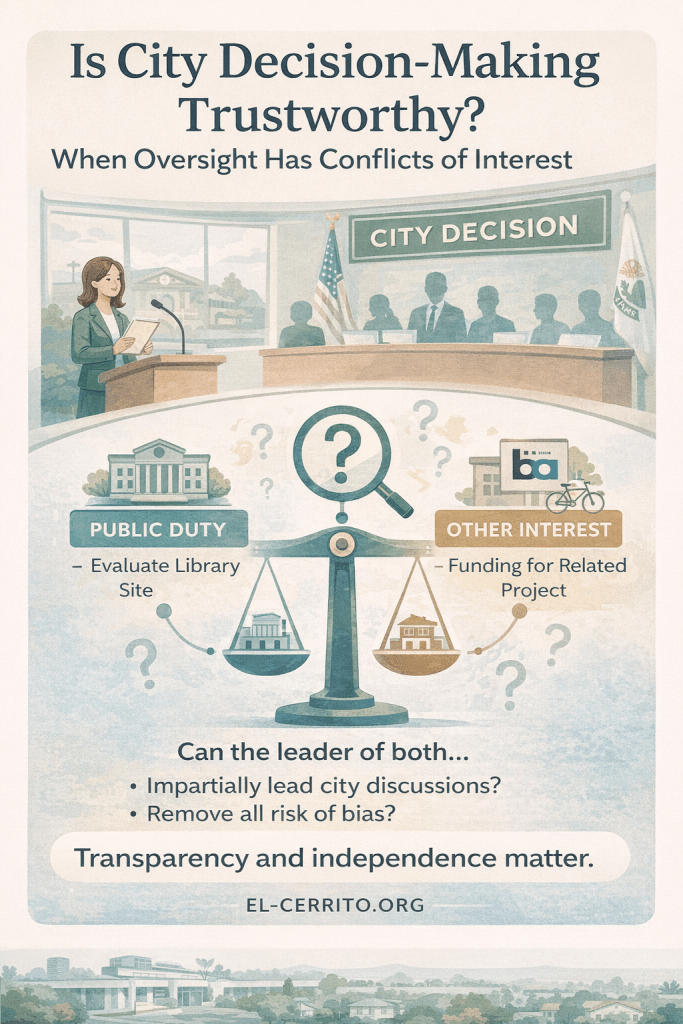
Rebecca Saltzman was selected to lead the effort. At the same time, she serves as Co-Executive Director of Bike East Bay—an organization connected to and expected to benefit from funding tied to development at that same BART location.
That overlap is not a technical detail. It is the issue.
Because when a decision-maker is affiliated with an organization that stands to benefit from a specific outcome, the question is no longer just about fairness. It is about whether the process can be trusted at all.
In most organizations, the response to this situation is clear: disclose the relationship and step aside.
Not as an admission of wrongdoing, but as a safeguard.
This is especially true in public decision-making, where the standard is not simply to act fairly, but to demonstrate fairness in a way the public can see and believe.
The task force was meant to reset the process.
Instead, this leadership choice risks reinforcing the very concern it was meant to address: that the outcome may already be aligned with interests beyond the public’s view.
This is not about intent.
It is about structure.
And right now, the structure raises a simple, unavoidable question:
Can a process be considered independent if its leadership is not clearly separate from the outcome?
Until that question is addressed, trust will remain out of reach.
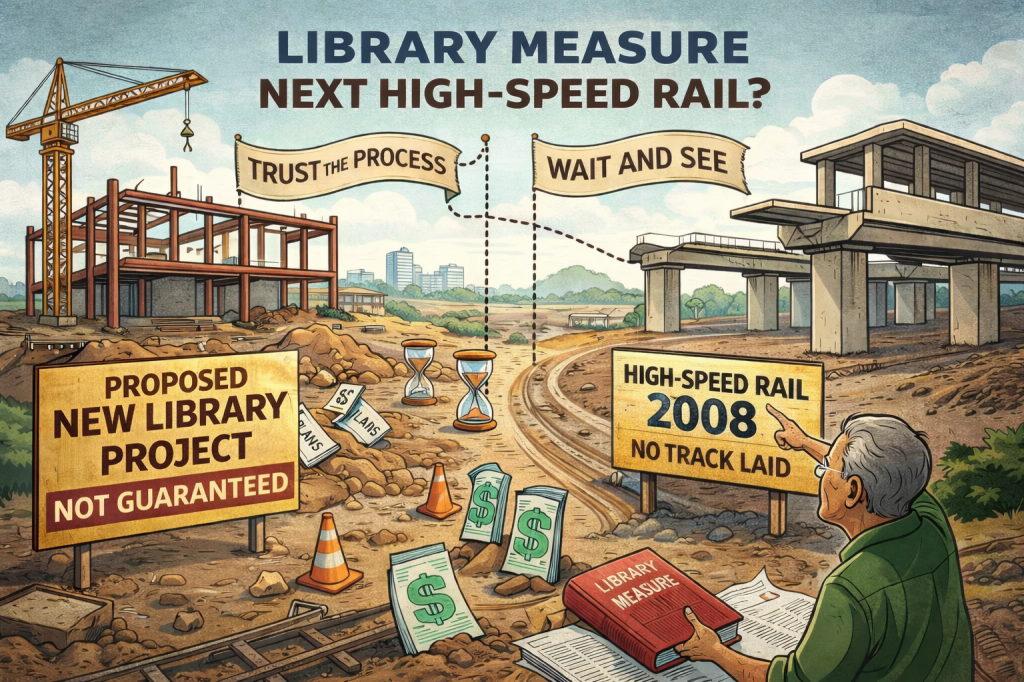
El Cerrito residents are being asked to approve a library measure that, on its surface, feels familiar: invest now, build later, trust the process. But when you take a closer look at how the measure is structured, it begins to resemble something Californians know all too well—the high-speed rail project.
Not because a library and a rail system are comparable in scale. But because the risk isn’t about size. It’s about structure.
A concerned citizen recently raised a point that is worth careful consideration: the tax can be collected and spent on planning, permitting, consultants, and administrative costs indefinitely—until bonds are issued. And bonds are not guaranteed. That means the timeline to actual construction is not fixed. It’s conditional.
We’ve seen this before.
In 2008, voters approved high-speed rail with a clear vision: a modern transportation system connecting major regions of California. Nearly two decades later, billions have been spent, timelines have shifted—and not one mile of track has been laid that delivers on that original vision.
The issue wasn’t whether the idea was compelling. It was whether the execution framework ensured delivery.
That same question now sits in front of El Cerrito voters.
If a tax is authorized without a clear, enforceable pathway to construction, what ensures that the project moves forward? If the mechanism to stop the tax is tied to bond issuance, what happens if bonds are delayed, restructured, or never pursued? And if the measure allows ongoing expenditures for planning, what limits exist on how long that phase can last?
Residents in the community are already asking these questions. As one concerned citizen noted, the language appears to allow for extended planning periods without requiring construction to begin. Another resident asked a simple but important question: if the library does not move forward, what actually stops the tax?
These aren’t abstract concerns. They go directly to how public dollars are protected.
This creates a structural imbalance.
It shifts the risk to taxpayers while leaving the timeline open-ended.
To be clear, this is not about whether El Cerrito should have a new library. Many residents support that goal. The issue is whether the measure, as written, guarantees delivery—or simply funds a process.
Public projects succeed when accountability is built into the structure. Clear milestones. Defined timelines. Measurable outcomes. Without those, even well-intentioned initiatives can drift.
That’s where the comparison to high-speed rail becomes relevant.
Not as a political statement, but as a cautionary framework.
Because once a funding mechanism is in place without strict guardrails, the momentum shifts. The question is no longer Should we build this It becomes How long will we keep funding the idea of building it
El Cerrito deserves clarity before commitment.
Before approving a long-term tax, residents should understand exactly what triggers construction, what happens if those triggers aren’t met, and whether there are enforceable limits on how long funds can be spent without delivering the project itself.
That’s not opposition. That’s due diligence.
And it’s the difference between building a library—and funding a process that never quite gets there.
Over the past several days, many El Cerrito residents have received unsolicited emails from the Yes on Measure C campaign.
Not postcards. Not public forums. Emails.
Directly to personal inboxes.
Without consent.
And when residents ask to be removed, the response is telling:
As neighbors bringing forth this citizens initiative it’s our responsibility to educate about the Measure. Like all campaigns, we are encouraged to communicate with voters.
That framing sounds reasonable—until you step back and ask a simple question:
How did they get your email address in the first place?
For some of us, the answer raises even more concern.
The email address used in this outreach is not one that has been widely shared, used for subscriptions, or broadly circulated. It’s rarely used.
Which makes its appearance on a political campaign’s distribution list more than a coincidence—it’s a signal.
A signal that the source of that information is likely not organic, not voluntary, and not based on typical campaign list-building methods.
And that’s where the issue becomes more serious.
Because if residents begin to suspect that their limited-use or privately held contact information is being accessed through channels connected to civic engagement whether directly or indirectly it erodes trust in both the process and the institutions around it.
Residents should not have to wonder whether interacting with their city, the chamber, or engaging in community process would later result in being added to a political campaign’s outreach list.
That line should be clear.
Right now, it isn’t.
Let’s also talk about the content itself.
The email leans heavily on nostalgia—1948, the “Greatest Generation,” community investment—while offering a simplified cost framing: up to $28 per month.
What it does not fully engage with is the complexity behind that number:
– The long-term duration of the tax
– The cumulative financial impact over decades
– The broader fiscal condition of the City
– The trade-offs residents will face when additional costs are layered on
Those are not small omissions. They are central to an informed decision.
But even before we get to the policy debate, there is a more immediate issue:
Respect for residents.
When someone says “please remove me from your list,” the answer should not be a justification for continued outreach. It should be immediate compliance.
Anything less reinforces the perception that this campaign is more focused on volume than genuine engagement.
El Cerrito residents are thoughtful. They are engaged. And they are capable of evaluating a measure on its merits.
They do not need to be flooded with unsolicited messaging to understand the stakes.
And they should not have to question how a rarely used, privately held email address ended up in a campaign database.
If this is what “community outreach” looks like, it’s worth asking:
Where is the line between outreach and intrusion—and who decided it could be crossed?
Because trust, once lost, is far harder to rebuild than any library.
There’s a difference between what benefits City Hall administratively—and what ultimately serves the residents who pay the bills.
Nowhere is that tension clearer than in the City’s agreement with East Bay Sanitary (EBS).
The Structure: How the Agreement Works
In June 2022, the City entered into an exclusive agreement with East Bay Sanitary to provide solid waste collection services across El Cerrito.
That exclusivity matters. It means:
EBS is the sole provider of waste collection services in the city
All residents, businesses, and City facilities are tied into that system
Pricing and cost structures are embedded in a long-term contract (with potential extensions out decades)
But here’s the key point most people don’t see:
EBS is not paid directly by the City in the traditional sense.
Instead, the agreement is structured so that:
Service recipients (including residents and City facilities) pay EBS directly
Those payments make up the contractor’s full compensation
EBS can include additional costs—like franchise fees and other expenses—into what they charge customers
In other words:
The public pays. Always.
Public Properties = Public Costs
The City itself is also a “service recipient.”
That means:
Every park
Every public building
Every facility
…requires waste service—and those costs are embedded in the same system residents ultimately fund.
The agreement explicitly defines City facilities as service recipients receiving collection services just like any other user.
So when City Hall expands its footprint…
The cost structure expands with it.
The Library Proposal: Follow the Square Footage
If the proposed library initiative moves forward, it’s expected to add approximately 20,000 square feet of new public space.
That’s not just a construction issue.
That’s a permanent operational obligation:
More waste collection
More service frequency
More long-term cost
And under the current agreement, those costs don’t disappear into a line item somewhere.
They flow through the system.
Right back to residents.
The Part That Should Raise Eyebrows
Here’s where things get harder to ignore.
The President and Vice President of East Bay Sanitary have reportedly contributed at least $12,500 to the “Yes” campaign supporting the library initiative.
Neither individual lives in El Cerrito.
Let that sink in.
They do not pay the parcel tax
They are not directly impacted by the long-term financial burden
But their company stands to benefit from expanded service demand tied to new City facilities
This isn’t about intent.
It’s about structure.
The Escalation Clause Reality
The agreement allows for annual adjustments to contractor compensation, tied to indexed factors like CPI.
It also allows costs—including franchise-related costs—to be built into service rates charged to customers.
Which means:
Costs go up over time
Those increases are baked into the system
And they are passed through to residents and businesses
Not absorbed.
Not offset.
Passed through.
What This Means for Residents
This is the part that often gets lost in the conversation.
When new public infrastructure is added:
It doesn’t just cost money to build
It creates long-term operational obligations
Those obligations feed into contracted systems like waste, maintenance, and services
And when those systems are structured the way this one is…
Residents carry the weight—directly or indirectly.
The Bottom Line
City Hall may see:
Expanded facilities
New services
Visible investments
But residents should be asking a different question:
Who benefits—and who pays over time?
Because in this case, the answer isn’t abstract.
It’s built into the contract.
And it shows up, quietly but consistently, in the bills people receive every month.
If we’re going to make long-term decisions for El Cerrito, we owe it to ourselves to look past their headlines—and follow how the system actually works.
The Cost Structure: How the Money Actually Flows
To understand what the City pays East Bay Sanitary (EBS), you have to understand how the contract is built. This is not a simple “City pays vendor” arrangement. It’s a layered cost structure—and every layer ultimately flows back to the public.
EBS is paid through Service Rates, which are charged to all service recipients—including residents, businesses, and City facilities like parks, buildings, and public spaces. These rates are the primary source of compensation for EBS and cover collection, transportation, labor, equipment, and operational overhead. The key point is that there is no separate City payment shielding residents. The same system that bills residents is what funds City services.
Costs are not fixed—they increase based on usage. Container size, pickup frequency, and waste volume all drive pricing. Public corridors can require service up to five times per week, and City operations like the Corporation Yard rely on roll-off containers that may be serviced multiple times per week depending on demand. When the City expands facilities, costs automatically increase because the service demand increases.
The agreement also allows EBS to pass through major cost categories directly to customers. These include disposal fees, processing costs, and franchise fees paid to the City. These are defined as pass-through costs, meaning they are not absorbed by the contractor. When those costs go up, rates go up. There is no buffer in the system to protect residents from those increases.
On top of that, EBS pays the City a franchise fee equal to a percentage of its revenue, but the contract allows EBS to include that fee in what it charges customers. So while it may appear that the City is generating revenue, that revenue is ultimately funded by the same residents and businesses paying for service.
Rates are also adjusted annually using a formula that reflects EBS’s actual cost structure. This includes labor, fuel, equipment maintenance, and other operating costs—not just general inflation. Over time, this creates a system where rates are designed to increase as underlying costs increase, with those increases built directly into the contract.
In plain terms, the system works like this: the City expands services or facilities, that expansion increases service demand, increased demand drives higher costs, those costs are passed through, and rates increase. Residents and businesses ultimately pay the difference.
This matters now because the proposed library would add approximately 20,000 square feet of new public space. That means more waste, more service, and more long-term cost. Under this structure, those costs do not stay contained within City Hall. They flow through the system and show up in higher bills over time.
At the same time, East Bay Sanitary’s leadership has contributed to the campaign supporting the library initiative, while not living in El Cerrito or paying the parcel tax. Their company, however, stands to benefit from expanded service demand tied to new City facilities.
This isn’t just about one agreement. It’s about how the system is designed. What looks like investment at the City level becomes a long-term financial obligation within a cost structure where expenses escalate, fees are layered, and nothing is absorbed.
Influenced by a concerned citizen’s social media post
The takeaway from the Plaza BART library issue is simple: we need to pay far more attention to what our city government is doing. Many of us only became aware of the flaws in this measure because a few individuals started asking questions and raising the alarm. That should give all of us pause.
There are plenty of other things happening in El Cerrito that deserve the same level of scrutiny. This wasn’t an isolated situation—it was a glimpse into how decisions are communicated, how information is shared, and how much effort it takes for the public to truly understand what’s being proposed in our name.
One of the biggest challenges is the lack of consistent, professional journalism focused on El Cerrito. That’s why the presence of www.livableelcerrito.org matters. We are glad it’s here because the journalism brings a level of attention, curiosity, and effort to understanding city operations that has been missing. Having someone take the time to dig deeper, ask questions, and present information in a structured way is not something to take for granted.
At the same time, one voice—even a strong one—is not enough. El Cerrito needs broader circulation of information and more independent, unbiased coverage so residents can see the full picture. A healthy civic environment depends on multiple perspectives, thoughtful analysis, and access to clear, factual reporting that isn’t filtered through a single lens.
Without that kind of ecosystem, many residents are left relying on partial information. In the case of this measure, many petition signers only had access to what the backers told them. That’s not informed consent—it’s a gap in transparency.
Just as important is how decisions are actually made. Too often, the public is brought into the process after key decisions have already taken shape. By the time a proposal reaches a public meeting, the direction is largely set, the framing is established, and the range of options has already been narrowed. What’s presented as “public input” can feel more like validation than genuine engagement.
That doesn’t mean the process is intentionally exclusionary, but it does mean it’s incomplete. True public engagement happens earlier—when options are still open, trade-offs are still being debated, and community input can meaningfully shape the outcome. When that early engagement doesn’t happen, trust erodes, and residents begin to feel like decisions are being made for them rather than with them.
The reality is that most of the information we receive about the city’s ongoing operations comes directly from the city itself. Public input opportunities exist, but they are often structured around decisions that have already taken form. For many residents, the only moment of real influence comes at the ballot box.
That’s why informal channels have become so important. The lively discussion on Nextdoor is one example. It can get messy, but that’s the nature of real public debate. And it’s not just Nextdoor—this blog also gets messy at times. But that messiness reflects something important: people are paying attention, pushing back, and trying to understand.
Before, Nextdoor and this blog were among the only places where candid, unfiltered conversations about city operations and finances were happening. They weren’t perfect, but they were honest. And in a landscape where official narratives often dominate, that honesty matters.
The lesson from Measure C shouldn’t just be about one project or one vote. It should be a turning point. We need earlier engagement, more transparency in how decisions are formed, and more independent voices helping residents understand what’s really at stake.
Because if we only engage at the end, we’re not really shaping our city—we’re reacting to it
A resident asked us to benchmark city manager salaries.
There’s a common instinct when a city faces financial strain: look at executive salaries. It’s an easy place to point. A visible number. A clear target. But in El Cerrito, that instinct leads to the wrong conclusion.
The El Cerrito City Manager is not paid at the top of the market. However, her city has been in financial distress since she took over in 2018 and service delivery is questionable, especially since they don’t measure it. That shifts the conversation entirely.
This is not about compensation. This is about leadership.
Let’s start with the facts. El Cerrito’s City Manager earns approximately $261,000 annually before a modest increase. Comparable cities tell a different story. Albany is paying roughly $323,000 with longevity pay. San Pablo’s base salary is about $274,000, and when you include deferred compensation and allowances, total compensation approaches $300,000. El Cerrito is not leading the market. It’s not even at the midpoint. If anything, it sits below peer cities.
So we can set aside the idea that the City is overpaying for this role.
Since 2018, under current leadership, the City has faced a consistent pattern: ongoing structural imbalance, spending exceeding revenues, reliance on reserves to close gaps, and rising personnel and pension costs. This is not a one-year issue. It is a sustained trend.
The City has been drawing down reserves at an estimated $2.5M to $3.0M or more annually. Over time, that erodes financial stability. And once reserves are depleted, the choices become unavoidable: cut services, raise taxes, or both.
At the same time, there is little evidence that the City is systematically measuring service delivery. There are no clearly defined service level agreements. No consistent cost-per-service-unit analysis. Limited benchmarking against comparable cities. No transparent performance metrics tied to spending.
That is not a systems failure. That is a leadership failure.
Because measurement is a choice.
Accountability is a choice.
Clarity is a choice.
And those choices sit squarely with the City Manager.
The City commissioned a $150,000 service delivery study intended to answer these exact questions. Are we structured to deliver services effectively and sustainably? But the study has been delayed beyond the point where it could inform the current budget. That is not just a missed opportunity. It is a failure of execution.
Leadership is not just about managing what exists. It is about ensuring the organization has the tools, data, and discipline to make informed decisions. That has not happened here.
Albany | ████████████████████████████████ $323K San Pablo | ████████████████████████████ $274K–$300K* El Cerrito | ████████████████████████ $261K
El Cerrito does not have a compensation problem at the top. It has a performance problem at the top.
Budgets are growing, but outcomes are unclear. Costs are rising, but service levels are not defined. Decisions are being made without the data needed to support them. These are not abstract governance issues. They are the direct result of how the organization is being led.
The El Cerrito City Manager is not paid at the top of the market. But leadership is not judged by salary. It is judged by results.
And right now, the results raise a much more serious question:
What has the City actually gained from that leadership since 2018?
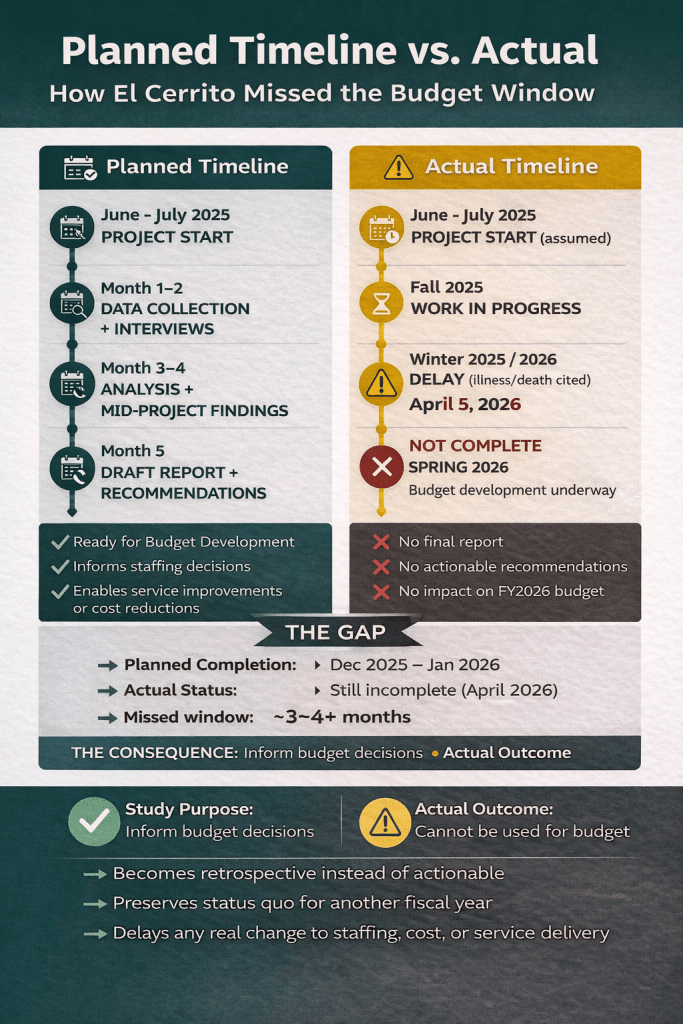
El Cerrito invested $150,000 in a comprehensive service delivery study meant to answer a simple but essential question: are we structured to deliver the services residents expect at a cost the City can sustain? The answer was supposed to inform the 2026 budget. Instead, as that budget moves forward, the study remains unfinished—and the questions it was meant to answer remain unresolved.
In June 2025, the City moved forward with a citywide service delivery evaluation led by Citygate Associates. The scope was expansive. Every department. Staffing levels. Workload. Organizational structure. Opportunities to improve service delivery or reduce costs. This wasn’t a narrow technical review. It was a foundational analysis—one that could shape how the City operates and how it allocates resources. The timeline reflected that urgency. The study was designed to be completed in approximately six months. That meant a final report by late 2025 or early 2026—just in time to guide the next budget cycle. The sequencing was intentional. Analysis first. Decisions second. That sequencing no longer holds.
As of April 5, 2026, the study is not complete. And with the budget already moving forward, the opportunity to use it as a decision-making tool has passed.
The City indicated that the delay was due to a serious circumstance—an illness or death affecting the consulting team. If true, that deserves acknowledgment.
But this was not a one-person engagement.
Citygate’s proposal outlines a deep, experienced team with built-in redundancy—what they describe as a Virtual City Hall model, designed specifically to ensure continuity across projects. With that structure, the expectation is that work continues, even when individual contributors cannot.
Which raises a reasonable question: Why did a team-based engagement, designed for continuity, lose its ability to deliver within the timeframe that made the study useful? Because at this point, the issue is no longer the reason for the delay. It’s the impact of it.
The City spent approximately $150,000 on this study.
But the real cost isn’t the contract. It’s the missed window. This study was intended to provide clarity before decisions were made—to validate staffing levels, identify inefficiencies, and create a roadmap for improving service delivery or controlling costs. Without it, the City enters another budget cycle without:
A validated staffing model
A clear understanding of workload versus capacity
A structured plan for improving services or reducing costs Instead, decisions will once again rely on the same assumptions that have guided prior budgets—assumptions that have yet to be fully tested against data. And that has real consequences. Another year where structural imbalances persist.
Another year where service delivery questions remain unresolved. Another year where costs continue without a clear framework for change.
This delay does not exist in isolation.
Since 2018, the City has faced ongoing questions about per capita staffing, service delivery performance, and its ability to control costs while maintaining quality. These are not new issues. They are recurring ones.
The service delivery study represented an opportunity to address them directly—with data, with analysis, and with accountability.
But timing is everything.
When a study designed to inform decisions arrives too late to influence them, its role changes. It no longer guides the budget—it follows it.
And that distinction matters. Because without the study:
There is no external validation pushing staffing changes
No structured framework requiring service level adjustments
No data-driven basis forcing difficult tradeoffs The City can continue forward using existing assumptions—without confronting whether those assumptions hold up under scrutiny. Whether intentional or not, the outcome is the same. The study no longer drives decisions.
The City will move forward with its budget. It always does.
But it will do so without the benefit of the analysis it commissioned to guide those decisions.
And that is the real cost.
Because a service delivery study delivered after the budget is finalized doesn’t shape the future.
It explains the past.
For a $150,000 investment, that’s not just a delay.
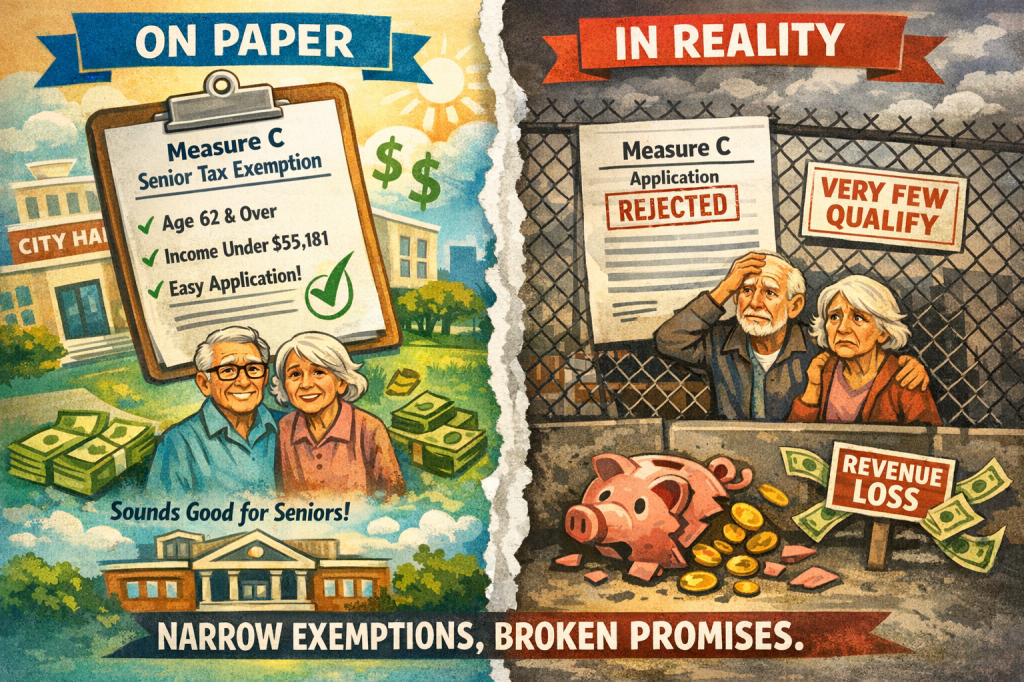
Last night, April 7, 2026, the El Cerrito City Council held a study session on the senior exemption tied to Measure C. What unfolded was not a meaningful effort to support seniors, but a narrow discussion that raised more concerns than it resolved.
The Council directed staff and the city attorney to return with an ordinance that simplifies the current exemption language. Under the proposed revision, a senior would need to be at least 62 years old and have a household income of $55,181 or less, with the City responsible for processing applications.
At first glance, this may appear to be progress. It is not.
This exact structure has existed in El Cerrito for more than 25 years. It was used in both the Measure A Swim Center Tax and the Measure H Parks and Recreation Tax. According to the City’s own agenda materials, staff reviewed historical records and found no evidence that a single resident has ever successfully used this exemption. Not one application. Not one approval. Not in over two decades.
That is not a functioning exemption. That is a policy that exists on paper but fails in practice.
The contrast with other local exemptions is striking. The West Contra Costa Unified School District parcel tax exemption applies to homeowners age 65 and older without an income test or enrollment in a state program. Thousands of El Cerrito seniors rely on it. It is accessible, understandable, and actually used.
By comparison, the proposed Measure C exemption continues to rely on an income threshold that will exclude a significant portion of El Cerrito seniors, including many living on fixed incomes. The result is predictable: an exemption that appears supportive but is structurally out of reach.
The Council also acknowledged a critical constraint: any exemptions would need to remain narrow because of the potential revenue loss associated with the tax. In other words, the more meaningful and accessible the exemption becomes, the greater the impact on projected revenues—creating a built-in incentive to limit eligibility from the outset.
Equally concerning is what was not discussed.
The staff report relied on Census-based estimates to identify potentially eligible households. These are not precise counts. They are statistical estimates with margins of error that can span hundreds of households in either direction. Yet these figures are being used to inform policy decisions about eligibility and revenue impacts.
Even more troubling, the City paid a consultant to compile data that is publicly available through the United States Census Bureau. The issue is not the existence of data, but how it is being interpreted and applied in decision-making.
Despite these uncertainties, the Council showed no interest in holding a public forum on the exemption before ballots are distributed. Residents are expected to vote on Measure C without a transparent, community-based discussion about who actually qualifies for relief.
Ballots are expected to reach voters around May 4. The window for meaningful public engagement is closing rapidly, and the opportunity for residents to weigh in on a critical component of the measure is being bypassed.
The bottom line is clear. An exemption that has gone unused for more than 25 years is being repackaged and presented as a meaningful safeguard for seniors. The structure has not changed in any fundamental way, and there is no evidence to suggest the outcome will be different this time.
This is not a solution. It is a continuation of a system that does not work—now placed before voters without full transparency or public input.
What El Cerrito Residents Should Know Before Voting on the Library Tax
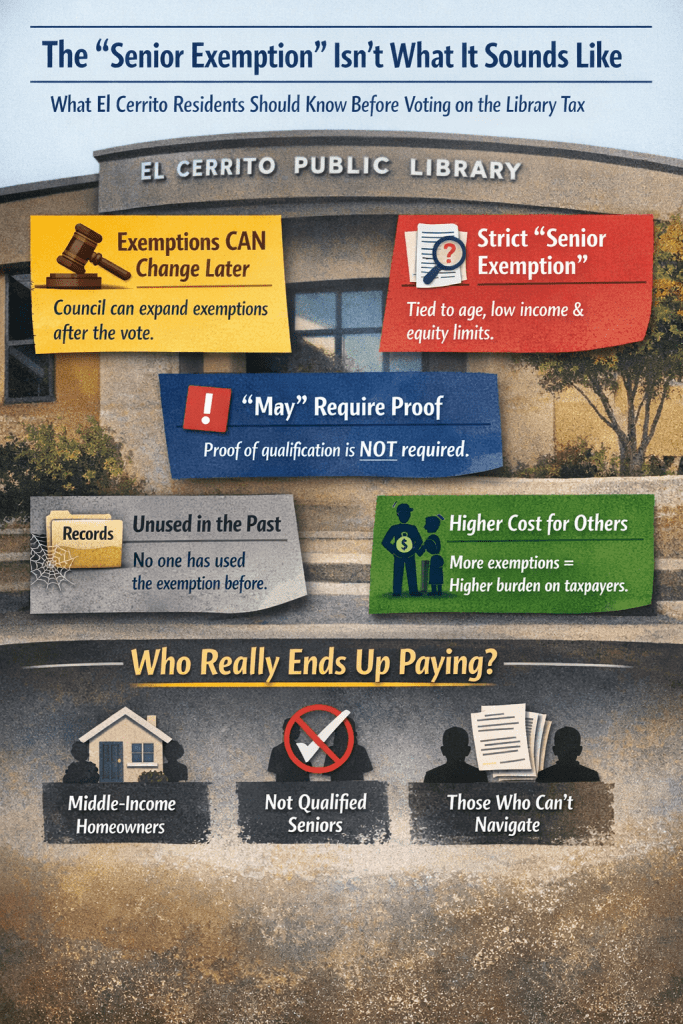
Tonight, the El Cerrito City Council will hold a study session on exemptions related to the proposed library parcel tax (Measure C). On the surface, this sounds reassuring—especially for seniors. But when you read the details in the agenda packet (pages 75–84), a more complicated picture begins to emerge.
One of the most important takeaways is that if Measure C passes, the City Council will have the authority to expand exemptions later without going back to voters. That means what is presented to voters now may not be the final structure. The Council can adjust who pays and who doesn’t after the election, but the total cost of the project doesn’t disappear. When exemptions expand, the burden simply shifts to others.
The so-called “senior exemption” is also far more limited than many residents may expect. To qualify, a homeowner must meet strict criteria tied to state programs, including age, income limits of roughly $55,000, equity requirements, and restrictions like not having a reverse mortgage. Even for those who meet these thresholds, the measure does not require actual participation in those programs—only that someone qualifies. And critically, the application process “may” require proof of participation, but does not require it. That ambiguity leaves open questions about how exemptions will be verified and how consistently they will be applied.
This structure isn’t new. The City has used a nearly identical exemption approach in a prior tax measure. According to staff, there are no records of anyone successfully applying for that exemption. That raises a natural question: if the exemption exists but has never been used, is it truly accessible in practice?
At the same time, the City cannot expand exemptions so broadly that the project becomes financially unworkable. This creates a balancing act. The more exemptions are granted, the more the cost shifts to those who remain. That reality doesn’t change, regardless of how the policy is framed.
When you step back, the real issue becomes clearer. If many seniors do not qualify, if past exemptions haven’t been used, and if future exemptions can be adjusted after the election, then the question isn’t whether exemptions exist—it’s who will actually end up paying the tax.
In practice, that likely means middle-income homeowners and residents who do not meet strict qualification thresholds or cannot navigate the application process. These are the people who will carry the weight if exemptions remain narrow or expand unevenly.
This isn’t about whether a library is a good idea. It’s about clarity and transparency. Residents deserve to understand who qualifies, who doesn’t, and how the financial responsibility will be distributed before they cast their vote.
Because once the measure passes, those decisions won’t be theoretical—they’ll be real.
Changing the spokesperson doesn’t change the story.
The Committee for a Plaza Station Library has a new public face, but the leadership behind the effort remains the same—and so do the concerns.
At the center of it is Greg Lyman, now serving as Chair of the campaign. He is not simply a library advocate. He is a former Mayor and City Councilmember who held leadership roles during a period when El Cerrito’s financial condition deteriorated significantly.
During those years, the City overspent, underfunded pension obligations, depleted reserves, and ignored repeated warning signs. Those decisions were not theoretical—they had consequences. The City ultimately landed on the California State Auditor’s high-risk list, a designation reserved for governments facing serious fiscal and operational challenges.
That context matters.
Because now, the same leadership is asking residents to approve another long-term tax—without fully presenting the financial reality behind it.
Instead of a detailed, transparent funding plan, what has been advanced is a “citizen’s initiative.” This approach lowers the approval threshold, allowing a tax to pass with a simple majority—50% plus one vote—rather than the traditional two-thirds required for special taxes.
Even within that framework, the campaign’s own polling reportedly showed only about 61% support—and that was before key details became widely understood. Before residents learned that project cost estimates had nearly doubled. Before questions were raised about the viability of the senior exemption. Before it became clear that the City Council could increase the tax over time without returning to voters.
Those are not minor details. They are fundamental to understanding the true cost and long-term implications of what is being proposed.
And yet, instead of clarity, residents are being asked to move forward based on broad promises.
That’s not planning. That’s risk.
El Cerrito has already experienced what happens when financial decisions are made without discipline, transparency, and accountability. The result was years of instability, difficult tradeoffs, and a loss of public trust.
We should not repeat that pattern.
If this proposal is truly in the best interest of the community, it should be able to stand on clear numbers, transparent assumptions, and an honest discussion of tradeoffs.
Anything less asks residents to sign on to a future they cannot fully see—and to trust a process that has, before, led the City in the wrong direction.
El Cerrito deserves better than that.
It deserves leadership that prioritizes fiscal responsibility, transparency, and long-term stability—not another campaign built on incomplete information and optimistic assumptions.
Before making a decades-long financial commitment, residents should ask a simple question:
Have we seen this approach before—and how did it end?