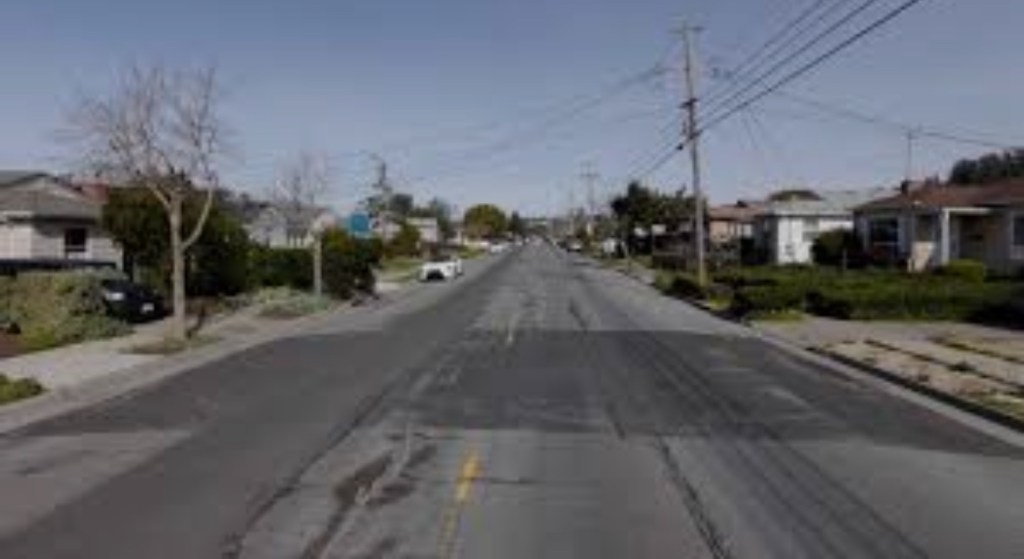
At the July 15 City Council meeting, something fundamental became painfully clear: the real greenhouse-gas giants—the military-industrial complex, Big Oil and refineries, industrial agriculture, and the chronic underfunding of clean, long-range mass transit—are going unchallenged, while working-class residents, seniors, and disabled individuals on Richmond Street are the ones being asked to sacrifice.
Let’s call it what it is: a distraction. A cosmetic fix that sidesteps the real contributors to climate change.
In a functioning democracy, citizens are entitled to informed consent—or dissent. On July 15, that right felt hollow. The Council pushed forward with significant parking reductions, citing “safety” without presenting meaningful data. No bicycle-involved injuries were noted on Richmond Street. The plan may feel good, but it solves nothing and creates many problems to the residents on Richmond Street.
Meanwhile, Liberty Street—less busy, already one-way, and a natural fit for bike lanes—was left out of the conversation. Instead, we were asked to imagine an 80-year-old biking to Monterey Market in Berkeley, then hauling groceries up the hill. This isn’t policy—it’s fantasy.
What about families with two cars and short driveways? What about those with mobility challenges? What about families with small children? Do you take groceries home while leaving them unattended in the car? Or do they leave those littles at home while they trek to the car to get the groceries? Those practical concerns were dismissed by those living in an alternate reality where symbolism is mistaken for substance.
Here’s the truth: this isn’t about reducing emissions. It’s about performative politics. If the City were serious about addressing GHG emissions, they’d push for regional transit solutions, not gut neighborhood parking.
And let’s not forget: Councilmember Gabe Quinto voted for the Richmond Street bike lane—despite having spent his entire elected career championing Chevron, one of the world’s biggest polluters. The contradiction is stunning. You can’t prop up fossil fuel interests for years and then pretend bike lanes make up for it.
Residents who question this narrative risk being labeled reactionary, even MAGA, which is laughable. It’s the oldest trick in the political playbook: label and dismiss anyone who deviates from the script. But many of us are simply tired of the same two-party shell game, where both sides enable the status quo.
I applaud Councilmember William Ktsanes. He may not share every view I’ve expressed here, but he stands on his own convictions. That takes courage.
This resident has lived in El Cerrito since 1976. They have seen the decline—not just in climate, but in political integrity. I’m not running for office. I prefer to speak freely, without the burden of party politics or performative alliances.
We deserve better leadership. We deserve vision:
Investment in real mass transit, not just trendy striping on streets. A peace dividend, redirecting military excess to infrastructure. Genuine policies that respect and include the elderly, disabled, and working class
Until we demand it, we’ll continue to receive distractions like this one—and the people who have benefited from the current system will continue to pretend it’s progress.
At a time when too many residents feel unheard and overlooked, The El Cerrito Daily News has become a powerful force for civic awareness and engagement. We extend deep thanks to the founding members who stepped forward to shine light on our city’s decisions, priorities, and gaps. You’ve created a much-needed platform where truth can be told plainly, and residents can speak openly.
Among the issues you’ve helped elevate is one of the most egregious: El Cerrito is the only city along the San Pablo Avenue corridor that no longer has a dedicated senior center.
Let that sink in.
Every neighboring city—from Oakland to Hercules—has committed space, resources, and programming to serve their growing older adult populations. El Cerrito, by contrast, shuttered its Midtown Activity Center during the pandemic and never reopened it. A misleading “Senior Center” sign still hangs over an empty room near City Hall, but the real heart of senior services is gone.
The data is clear. El Cerrito’s population is aging—nearly 27% of residents are over 60, far higher than the state average. And yet, city leadership has allowed senior services to wither, scattering a few programs across church basements and multi-use rooms.
Senior centers save lives. They reduce isolation, provide access to critical services, and foster connection, dignity, and joy. Before it was closed, El Cerrito’s center offered everything from exercise classes to tax help, tech support, meals, and legal advice.
We’re grateful that The El Cerrito Daily News has helped document this decline. And we’re equally grateful for the volunteers behind the El Cerrito Senior Center Action Committee, who are working to change it. Their effort to partner with Contra Costa County Supervisor John Gioia to restore the Veterans Memorial Building on Stockton Avenue is a step in the right direction—but they shouldn’t have to do it alone.
Thank you again to the founding members of The El Cerrito Daily News. Your work is helping us tell the full story—including the one our city would rather leave out.
El Cerrito’s budget problems are no secret—but too often, they’re discussed in the abstract. This post provides clear, verifiable evidence that over the past eight years, the City has been living beyond its means. The numbers are drawn directly from official city documents and CalPERS reports. The analysis is nonpartisan and was created to inform—not alarm—residents and policymakers alike.
Rising Pension Debt: The Classic Safety UAL
The unfunded liability (UAL) for the City’s Classic Safety pension plan has grown from 38 million dollars in 2014 to nearly 89 million dollars in 2023.
This chart, based on CalPERS actuarial valuations, shows the year-by-year rise:
These numbers matter. Every dollar spent servicing pension debt is a dollar that can’t be spent on fire protection, police, or infrastructure.
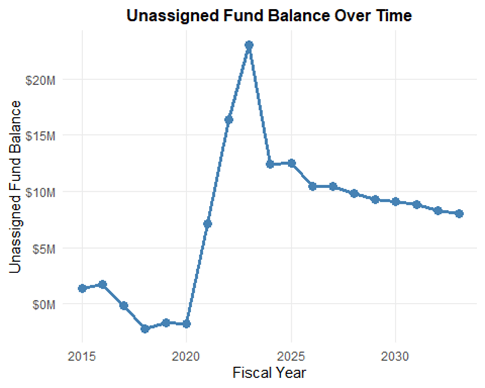
The Unassigned Fund Balance: A Warning Sign
For four consecutive years, El Cerrito’s unassigned General Fund balance was negative—a sign the City lacked even the most basic fiscal cushion.
A Broader Pattern of Unsustainable Spending
Additional analysis (available in the full report) reveals the following:
– General Fund expenditures have grown much faster than inflation, particularly in the core Fire department. – Revenues have not kept pace, leading to repeated operating shortfalls. – The City’s Pavement Condition Index (PCI) has hovered at dangerously low levels. – El Cerrito’s credit rating was downgraded multiple times over the past decade—signaling investor concern over the City’s financial management.
These trends are presented in an interactive dashboard, along with downloadable data and documentation:
– Be transparent about the structural imbalance between revenue and expenses. – Avoid new capital obligations (like a library that may cost over $100 million over the next 30 years) until pension liabilities are better controlled. – Consider modest new revenue sources, such as a temporary parcel tax to fund pension stabilization. – Set policies for managing one-time surpluses and long-term capital needs.
This isn’t about blame. It’s about clarity.
The longer hard decisions are delayed, the fewer options the City will have. The data is there. The time to act is now.
It’s hard to believe what the mayor said during the recent debate over the Richmond Street bike lane project. In an effort to justify a deeply flawed ordinance, she accused longtime residents of “appropriating the language of the oppressed.” Somehow, homeowners—many of them retired, working-class, or first-time buyers—were cast as the oppressor class.
This isn’t equity. It’s a power play.
Richmond Street is one of the most affordable neighborhoods in El Cerrito. One resident who lived on nearby Liberty Street for seven years before moving up the hill remembers it well. The people there aren’t privileged elites—they’re carpenters, teachers, postal workers, and bus drivers. Many scraped together what they could to buy their first (and often only) home. Now, they’re being told they’re standing in the way of progress.
Let’s be honest: this ordinance harms them. That’s the con. And the “pro”? A self-congratulatory narrative where the City Council gets to claim it’s saving the environment, and residents up the hill get to signal virtue by saying they live in a progressive, climate-conscious city.
But the mayor didn’t stop there. Her actions were more than condescending—they were colonial in nature. She used her political power to impose a plan on a working-class neighborhood without meaningful input, then cloaked that harm in moral language. That’s not leadership. That’s the behavior of a colonizer—using authority to displace and disrupt others, then justifying it as the greater good.
It’s especially galling when there are plenty of alternative bike routes already in use. The Ohlone Greenway is a safe, car-free corridor. Cyclists have navigated El Cerrito safely for years. And yet, the city chose to remove parking in a dense residential neighborhood—knowing full well it would hit the elderly, the disabled, and low-income residents the hardest.
Some bike lane advocates would gladly eliminate cars entirely—not because of climate concerns, but because they don’t own one. That aloofness—the disdain for anyone who doesn’t fit their lifestyle—is actually the language of the oppressor.
Meanwhile, investment firms are watching closely. Medium- and high-density developments are coming, and policies like these make it easier to force them through—especially when the people in the way are cast as obstacles instead of neighbors.
This isn’t about bikes. It’s about who gets to live here—and who doesn’t.
So no, this isn’t justice. And it’s certainly not equity. It’s displacement, disguised as progress.
On July 15, 2025, the El Cerrito City Council voted to proceed with a controversial redesign of Richmond Street, which eliminates nearly two-thirds of on-street parking. Despite passionate opposition from many residents, the revised plan is moving forward with little interest in compromise from city leadership.
Residents who live on Richmond Street say they had little opportunity for meaningful input—only to learn, after the fact, that a major change was coming. Some pleaded with the council to consider a less extreme approach, such as removing parking on only one side of the street to preserve at least half the spaces. They also pointed to safety data: just one injury accident has been reported on this eight-block stretch in the past decade—none involving bicycles.
Others raised serious concerns about accessibility. The revised plan shifts disabled parking to side streets, an unnecessary hardship for seniors and residents with mobility challenges.
Proponents Cite Sustainability, Critics See Overreach
Bike lane supporters argue that El Cerrito must invest in infrastructure to reduce car use and support more cycling. They envision a network that makes biking safer and more appealing, especially for faster-moving e-bikes, which they say aren’t suitable for the nearby Ohlone Greenway.
But opponents ask: why push such an aggressive plan where there is no demonstrated safety issue—especially when the tradeoff means losing neighborhood access, inconveniencing seniors, and reducing quality of life?
Ktsanes Offers a Compromise—The Council Refuses
In an effort to find middle ground, Councilmember William Ktsanes offered a motion to have staff explore reasonable alternatives, including:
Options that minimize parking loss. A version that preserves at least 50% of the parking. An East Side Bicycle Boulevard alternative is already included in the city’s own transportation plan. A public hearing to discuss all options side-by-side
It was a practical proposal that acknowledged the complexity of the issue and the concerns of both sides.
Not one council member seconded it.
Mayor Dismisses Resident Concerns as “Privilege”
The conversation veered away from listening to a dismissive and personal tone. Councilmember Lisa Motoyama dismissed the city’s own 2016 plan, arguing instead that current “best practices” should take precedence. She claimed that if a better idea existed, the public works director would have taken it into account. This statement elicited audible coughs and chuckles from the crowd.
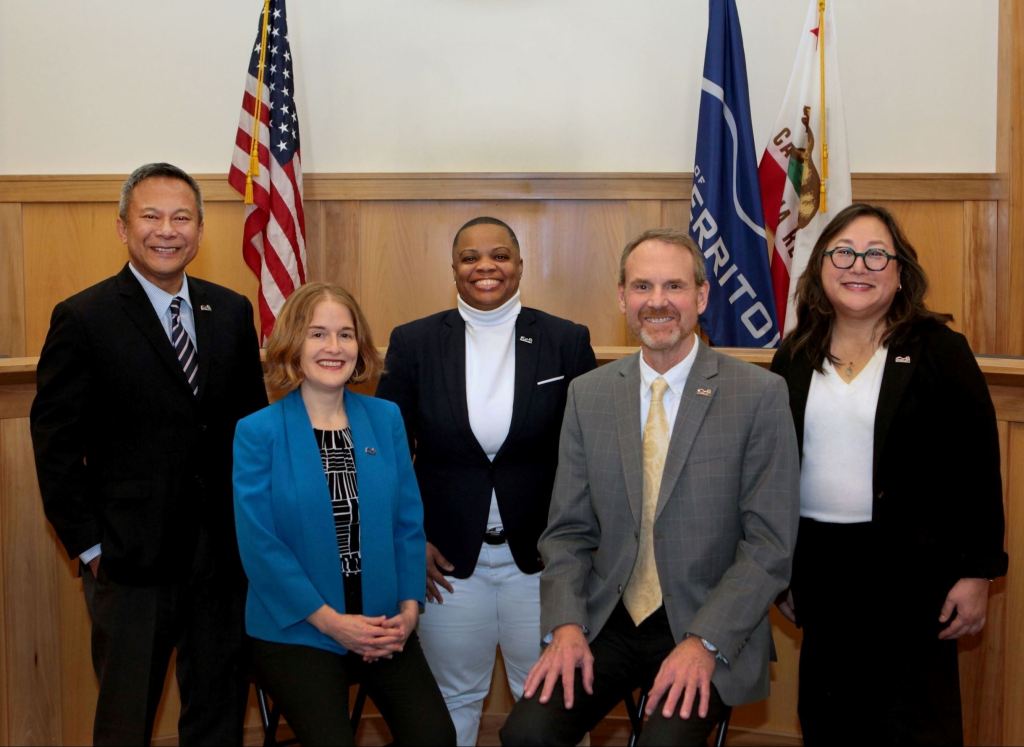
Mayor Carolyn Wysinger went further—attacking residents who voiced concerns about losing parking. She labeled them “privileged” and accused them of “appropriating the language of the oppressed.” Her remarks suggested that because she had experienced hardship, others should endure the loss of convenience and accessibility. But the rest of us know that it’s not okay to inflict harm on others simply because she has endured hardship.
Let’s be clear: This isn’t about privilege. It’s about reasonable expectations. Residents, particularly long-standing elderly homeowners, should be able to carry groceries from their cars, park near their homes, and access safe, nearby disabled parking. Dismissing those concerns outright is not leadership—it’s arrogance.
The Clock Is Ticking—and So Is the Public’s Patience
The mayor’s term doesn’t end until 2026, but the decisions made now will shape El Cerrito’s future for decades. Gabe Quinto is also up for reelection next year. The residents of this city deserve leaders who respect their voices—not just follow a checklist of ideological goals.
We’ve seen this before: plans that don’t consider those most negatively impacted, questionable spending, and leadership unwilling to listen. El Cerrito can’t afford more decisions like this—especially with budget challenges still looming.
📣 It’s time to pay attention, get engaged, and prepare to vote.
If this council won’t listen now, we must be ready to elect people who will. Start asking tough questions. Show up to meetings. And come November 2026, vote for leadership that values public input, fiscal discipline, and common-sense solutions.
More than a decade ago, El Cerrito’s financial warning lights were flashing red. While city officials were promoting visions of sustainability and stability, internal financial records told a very different story—one of depleted reserves, risky practices, and long-term instability. And yet, the city’s leadership looked away. The El Cerrito Committee for Responsible Government also reported on these problems years ago, highlighting the very same risks that were later confirmed in the city’s own audits. Their warnings, like those of the auditors, were ignored.
The 2013 Comprehensive Annual Financial Report (CAFR), discussed during a May 6, 2014 City Council meeting, provided a clear and deeply troubling financial snapshot. At the helm of the city during this period were then-Mayor Greg Lyman and Assistant City Manager Karen Pinkos, both of whom were in positions of direct responsibility. The report by Maze & Associates, the City’s auditing firm, didn’t mince words.
The General Fund—El Cerrito’s primary fund for day-to-day operations—was already spending more than it was bringing in. Expenditures exceeded revenues by $948,104. Meanwhile, the General Fund’s unrestricted cash balance represented less than five days of operating expenses. That is not a typo—less than a week’s worth of available cash.
More alarmingly, the unassigned fund balance, which reflects the actual cushion available for emergencies or unexpected needs, was down to only 16 days of expenditures. That figure is far below even the most lenient best practices for municipal finance.
The auditors didn’t stay quiet. Their Memorandum on Internal Control called out a material weakness in the city’s financial management and warned that if deficit spending continued, “it reduces the likelihood that the City will be able to continue as a going concern.”
That phrase—“going concern”—is not thrown around lightly in the world of public finance. It is a red flag of the highest order. It means that an auditor sees a real risk that the organization—here, a city entrusted with managing public services—may not be able to continue operating without significant intervention.
Let that sink in. In 2014, the city’s own auditor told leadership that their trajectory could lead to insolvency. But despite this, the city continued on with business as usual.
The City Manager Scott Hanin, Assistant City Manager Karen Pinkos and the City Council Knew—And Ignored It
This wasn’t some obscure internal memo. The agenda bill is public. Concerned residents discovered this document years ago and have repeatedly tried to raise awareness. It’s archived on the City’s own website—El Cerrito FY 2013 CAFR—for anyone who wishes to see the warnings in black and white.
Despite this, the City Manager, Assistant City Manager, and members of the City Council pushed forward with spending, approved additional projects, and assured the public that everything was fine.
Some will try to suggest this was a different era, that financial forecasting was imperfect, or that unanticipated challenges derailed the plan. But that’s not what the record shows. The record shows a conscious disregard of available information.
The report even notes short-term borrowing between city funds to cover operational costs—a practice that’s often a sign of deep cash flow issues. The city was literally shuffling money between accounts to keep the lights on.
Even worse, the city had known grant revenue that it misreported, leading to a restatement of its Capital Improvement Fund. The grant had been booked prematurely, giving the illusion of more money than there actually was. These aren’t simple missteps. They are systematic signs of financial mismanagement.
Fast Forward to 2025: Still No Transparency, Still No Answers
Now, over a decade later, the same leadership circle continues to operate with troubling opacity. The city is once again pursuing a costly ballot measure—this time for a new library—and embroiled in yet another legal battle. But how much are these legal costs? Where is the money coming from to pay the lawyers? No one seems to know—or if they do, they’re not saying.
Despite growing legal activity, the City has not provided a clear breakdown in its public budget documents showing how much is being allocated—or has already been spent—on outside legal counsel. Residents are left to guess whether the money is coming from reserves, deferred maintenance, or elsewhere.
Meanwhile, unrestricted General Fund reserves continue to dwindle. Despite repeated warnings and temporary influxes of revenue, the city has once again returned to the very behavior that placed it at financial risk in the past: overreliance on one-time funds to support ongoing costs, weak long-term planning, and no credible strategy to rebuild reserves.
We’ve seen this movie before. In 2014, depleted reserves triggered warnings about the city’s ability to function as a going concern. Instead of learning from that near-collapse, El Cerrito is repeating history—only this time, with even fewer excuses. The economy is stronger, revenues have grown, and the public has stepped up again and again with tax support. Yet the reserves shrink, costs mount, and transparency vanishes.
What’s worse is that past failures haven’t humbled decision-makers. They’ve become more practiced in messaging and less committed to accountability. The script hasn’t changed—but the stakes are higher.
A Pattern, Not a Fluke
In 2018, voters were asked to approve a Real Property Transfer Tax under the promise of funding a new senior center. That tax passed. And what happened? The senior center was shut down less than two years later, and now city officials say it’s no longer a priority. Instead, we are being told that a library and public safety building take precedence. Again, goals change. Promises don’t materialize. Residents are left holding the bill.
There is a pattern here—of overpromising, underdelivering, and ignoring uncomfortable truths. What was clear in 2014 is just as clear today: Fiscal discipline has never been the priority. Managing the narrative has.
It’s Time to Ask: Who Is Paying the Price?
While the city continues to prioritize public relations and new ballot initiatives, many core services remain underfunded, basic facilities go without maintenance, and trust in leadership continues to erode. City officials are now considering new taxes and fees, yet have not owned up to the poor decisions that got us here in the first place.
The question is no longer “How did we get here?” The documents show exactly how.
The question now is: Why do we keep letting it happen?
This blog is informed by archived financial reports, public records, and observations from concerned residents. Readers are encouraged to review the FY 2013 CAFR and related materials on the City of El Cerrito’s website.
When public agencies ask for more funding, whether through tax measures or budget reallocations, they often ask residents to trust their financial stewardship. But what happens when the numbers they present don’t align—even in their own reports?
Recently, while reviewing El Cerrito’s financials, a concerning inconsistency emerged. The unassigned General Fund balance for FY 2023 and FY 2024 is reported differently in the city’s Annual Comprehensive Financial Report (ACFR) and in the General Fund projections published by the finance director just last month. The difference is not minor—it amounts to several million dollars. No explanation has been provided.
This raises a fundamental question: why should the public place confidence in the city’s financial reporting when basic figures like the General Fund balance cannot be reconciled between official documents?
There’s more.
The city projects a General Fund balance of $12.52 million as of June 30, 2025. But before that date even arrives, a large CalPERS payment is expected. Historically, the city has paid around $8 million each July for its unfunded pension liability (UAL). If that trend holds, the actual available balance will be significantly lower than the projection—again, without clear acknowledgment or explanation in the published numbers.
Additionally, General Fund projections show the city spending more than it takes in for the remainder of the fiscal year. If the monthly average deficit exceeds $1 million, as current trends suggest, then the city could deplete another $9–10 million before June 30, 2025.
This is not a minor bookkeeping issue—it goes to the heart of fiscal transparency and accountability. Residents are being asked to support critical initiatives, including potential tax measures. But before doing so, there’s a right to ask:
Why do the ACFR and General Fund projections report different fund balances? Will the city disclose whether it intends to pay CalPERS $8 million this month for its UAL? Are monthly deficits exceeding $1 million built into the plan? And most importantly, when will the city explain these inconsistencies?
Financial credibility is earned through clarity, not confusion. If the city wants the trust of its residents, it must ensure that its reports tell a consistent story—and that the public can understand how much money is truly available.
Call to Action:
Attend Tuesday’s City Council meeting. Ask your elected officials to explain the conflicting numbers. Demand a reconciliation of fund balance projections and actuals. Insist on a full accounting of planned pension payments and monthly deficits. Transparency isn’t optional—it’s the foundation of good governance.
For years, residents have raised red flags about El Cerrito’s unsustainable pension obligations and the threat they pose to the City’s ability to maintain basic services. Now, with barely a whisper, City management has finally acknowledged the obvious: ballooning CalPERS pension liabilities are crowding out essential services and deferring needed repairs.
Buried on the July 15 consent calendar, Agenda Item 7E recommends a City-wide Service Delivery Study—at a cost of nearly $150,000—to assess the efficiency, effectiveness, and sustainability of City operations. The study, to be conducted by Citygate Associates, is a long-overdue response to mounting warnings from financial advisors and watchdogs. It follows a May 2025 presentation by NHA Advisors that made one thing abundantly clear: El Cerrito is on an unsustainable financial path through at least 2035.
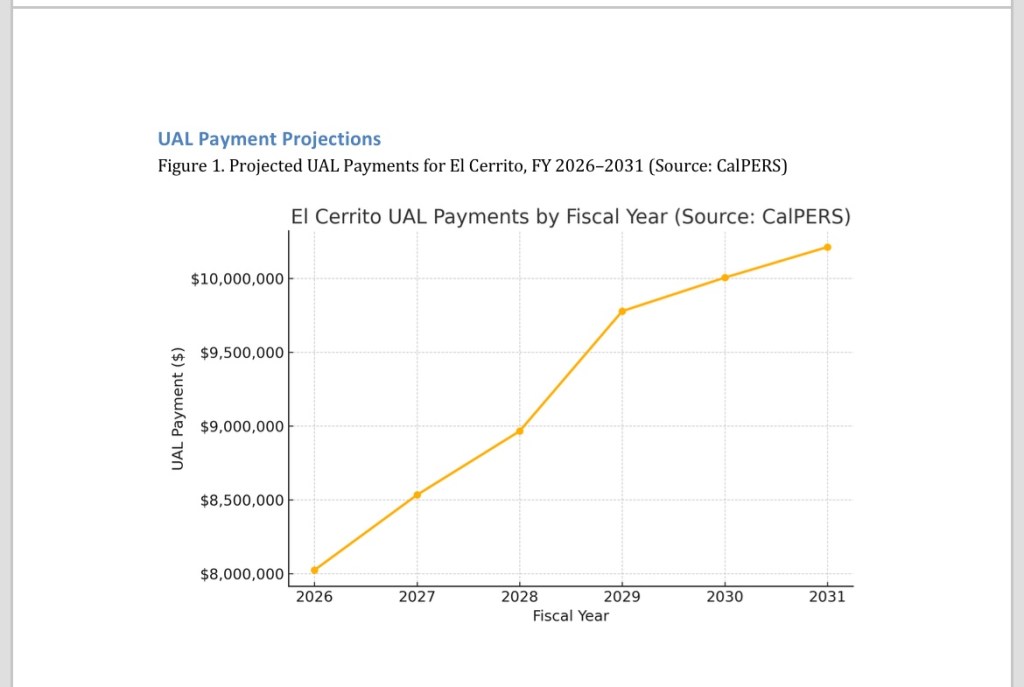
According to the City’s own records, CalPERS Unfunded Accrued Liability (UAL) payments have more than tripled since 2018—from $3 million to a projected $10 million by 2031. Even worse, 98 percent of these costs stem from pre-2013 “Classic” pension plans—meaning these debts are largely the result of past decisions, yet they are paid with today’s and tomorrow’s dollars.
The real cost? Roads go unrepaired. Parks and public spaces fall behind. Public-safety resources get stretched thinner each year. The City is sacrificing its present and future to pay for the past.
The citizen has been tracking these issues closely since the California State Auditor’s 2021 report first labeled El Cerrito a high-risk city. Independent analyses have consistently shown how unchecked pension liabilities are choking the City’s fiscal flexibility and undermining its ability to invest in core services residents rely on.
The proposed Service Delivery Study is a start—but it is only that. There are three real tests ahead:
Conducting an in-depth, independent analysis that thoroughly examines the impact of escalating pension costs on service delivery.
Releasing the study’s findings to the public in a timely and transparent manner so residents can see the full scope of the challenge.
Following through with bold, necessary action to restructure and realign City operations in a fiscally sustainable way.
Approving a study is easy; acting on its findings is what counts.
Residents must stay informed, engaged, and vocal. Leadership must be held accountable not just for ordering reports, but for delivering results. A robust, data-driven response to the pension crisis is critical to El Cerrito’s future.
It’s time for transparency. It’s time for urgency. It’s time for leadership.
Call to Action:
Attend Tuesday’s City Council meeting and make your voice heard. Ask tough questions. Demand real follow-through—not just another study that gathers dust. El Cerrito deserves a sustainable path forward.
El Cerrito’s pension liability has grown into a major fiscal challenge—and one a local data scientist is working on to make the problem more understandable for the public and policymakers.
Since the California State Auditor placed El Cerrito on her high-risk cities watch list in late 2019, the city has faced heightened scrutiny over its financial practices. Now, the city projects annual deficits for the next ten years, even before accounting for basic infrastructure needs. At the center of the crisis is El Cerrito’s CalPERS Unfunded Accrued Liability (UAL), a debt that currently totals more than $89 million.
To help the community better grasp the scale and long-term implications of this obligation, Ira Sharenow, an El Cerrito-based data scientist and researcher, has produced a comprehensive analysis using state pension data. Sharenow has been analyzing city finances since the auditor’s review began, and his latest contribution brings a level of clarity and technical depth rarely seen in local government reporting.
His findings are summarized in a well-documented Word report that includes: – A breakdown of pension liabilities by plan (e.g., Classic Safety vs. PEPRA) – Analysis of amortization schedules through FY 2030 – Side-by-side comparisons of assumptions used by CalPERS and private pension systems – Historical trend charts on funding status, payroll, and UAL growth – Risk metrics including the asset volatility ratio and support ratio
To complement the written report, Sharenow also developed an interactive Excel workbook featuring dynamic pivot tables and charts that allow readers to explore the data by plan, year, and metric. For those who prefer a visual summary, he published an interactive Tableau dashboard that illustrates how El Cerrito’s pension burden grew over time.
What makes this work especially compelling is that it goes beyond surface-level numbers. It explains how overly optimistic assumptions—such as CalPERS’ 6.8% return rate—can distort fiscal projections. The report also references external research, including a Stanford researcher’s 2017 warning about pension costs crowding out local services, and includes a detailed appendix on actuarial assumptions and public pension risks.
The data are clear: without meaningful policy adjustments or a more aggressive funding strategy, El Cerrito’s pension debt will continue to limit its ability to provide basic services like public safety, recreation, and senior support.
Sharenow’s work provides residents, journalists, and decision-makers with a roadmap for understanding the problem and weighing solutions. It’s an example of how civic-minded data analysis can shine a light on public sector challenges—and perhaps help drive change.
Over the holiday weekend, a local resident shared a detailed history of the Richmond Complete Streets public engagement process. Their reflection included conversations with a couple of El Cerrito residents—neither of whom lives on Richmond Street. While both individuals were neutral about the plan, they reportedly felt the project was being pushed from the top down and wasn’t responsive to community input. The resident wrote a recap to counter that perception and highlight the City’s public engagement efforts.
The post traces the process back to September 2024, when an in-person workshop and online survey kicked things off. More than 165 people responded to the survey and around 75 attended the first meeting. Feedback was consistent on one front—drivers speed through the area and create safety issues for pedestrians and cyclists. But when it came to solutions like dedicated bike lanes, responses were divided: in-person attendees skewed 56% against bike lanes, while 61% of online respondents supported them. It illustrated the common pattern in public engagement where status quo voices dominate in-person meetings, while broader community sentiment leans toward change.
A second meeting in November 2024 introduced preliminary designs based on this feedback. By then, some options—like fully protected bike lanes—had already been ruled out. The session focused on refining chicane elements and balancing parking with safety. The resident captured the tension well: “the grand vision of complete streets meets the lived experience of residents who need somewhere to put their garbage cans.”
However, the third meeting was invite-only and specifically for Richmond Street residents. The local resident acknowledges they didn’t attend and, importantly, does not live on Richmond Street. The post also does not include any direct quotes or reactions from people who do. That omission matters.
The most recent public meeting in June 2025 drew a full crowd. City staff and consultants made a visible effort to explain the proposal and treat residents respectfully. The local resident praised this effort, and encouraged people to listen to the recordings or read the transcript. Still, they observed a telling contradiction: while residents demand safer crossings and lower speeds, many remain unwilling to support the parking trade-offs or infrastructure changes that would make those safety improvements possible.
The post ends on a thoughtful note about how public engagement often struggles to activate neutral residents early enough—and how these processes can be dominated by those with the most time to participate.
In another comment the writer also disparaged the residents by suggesting they were merely afraid of change. In truth, their concerns are valid, as the proposed changes would have a significant negative impact on them.
It’s also important to note that this perspective, while informed, does not come from someone who lives on Richmond Street. This citizen’s post supports the idea behind Complete Streets and applauds the City’s public engagement efforts. However, their summary misses a crucial element—how these plans may affect the people who live directly along Richmond Street. Trade-offs like reduced parking, rerouted traffic, or construction disruption can have a profound effect on daily life. These are not abstract concerns—they’re specific, immediate, and deeply felt by the people living where the change will happen.
In short, the citizen offers a helpful timeline and critique of broader public engagement dynamics. But for a truly complete perspective, it’s essential to elevate the voices of Richmond Street residents themselves. Any well-meaning analysis must consider not just process and theory—but the real-world consequences for the people at the heart of the issue.
This citizen’s post supports the idea behind Complete Streets and applauds the City’s public engagement efforts. However, their summary misses a crucial element—how these plans may affect the people who live directly along Richmond Street. Trade-offs, such as reduced parking, rerouted traffic, or construction disruptions, can have a profound impact on daily life. These are not abstract concerns—they’re specific, immediate, and deeply felt by the people living where the change will happen.
In short, the citizen offers a helpful timeline and critique of broader public engagement dynamics. However, for a truly comprehensive perspective, it’s essential to amplify the voices of Richmond Street residents themselves. Any well-meaning analysis must consider not just process and theory, but the real-world consequences for the people at the heart of the issue.
If Richmond Complete Streets is to succeed, those most directly impacted should be at the center of the discussion—not just included, but prioritized. A complete streets plan requires a full understanding of its community—block by block.
A concerned citizen would like to add their perspective to a recent post on Nextdoor, which they believe deserves a second read.
The proposed library tax may sound appealing on the surface, but it carries long-term financial consequences that have not been fully explained. Before signing the petition or casting a vote, residents are urged to take a closer look.
El Cerrito currently holds a BBB credit rating with a positive outlook. That’s not a particularly strong position. While there was some expectation of an upgrade to BBB+/A- in 2023, the city’s ongoing deficit spending, its continued use of general funds to address deferred maintenance, and the lack of a medium-term savings strategy make such an upgrade unlikely. In fact, a revision to neutral looks more probable. That shift alone could increase borrowing costs, potentially adding $3.5 million in interest over the life of a library bond. That’s enough to purchase two fire trucks or fully renovate the community swim center.
The proposed library wouldn’t even be owned by the city. Yet the city would still be responsible for $2.5 million in annual debt payments for 30 years—more than $75 million in total. Unlike discretionary services, debt payments can’t be deferred or reduced during financial downturns. That loss of flexibility is dangerous, especially for a city already struggling with financial sustainability.
The citizen also points to Proposition 13 as a structural challenge that flat parcel taxes are trying to patch. Because of how Prop 13 works, residents who bought their homes decades ago often pay far less in property tax than their neighbors. Yet those same residents are sometimes the loudest voices pushing for new public spending. If properties were reassessed closer to market value, the city could collect an estimated $3 million more each year—enough to invest in infrastructure without creating new tax burdens. Ignoring this disparity only makes long-term planning harder.
El Cerrito already faces serious, mandated obligations: it must build 1,600 new housing units by 2031—570 of which must be low-income—and its pension liabilities continue to grow. The city has no concrete plan to address either. Taking on a new, long-term financial obligation for a non-mandated library project—especially one that increases fixed costs without increasing city-owned assets—is fiscally reckless.
There is also no guarantee the new library will provide better service. Library usage is down. The proposed location is less accessible than the current one. The project seems more focused on constructing a new building than improving library services.
This citizen emphasizes that they are not against libraries—they are against irresponsible budgeting. The city should demonstrate two or more years of budget surpluses, actively save for major investments, and stop funding routine maintenance from general reserves before proposing new capital projects. Financial basics must come first.
When a city is managing its finances well, a community conversation about a new library makes sense. But when budgets are being balanced through accounting tricks and one-time fixes, pretending the city can afford a shiny new library does more harm than good.
Many of the same individuals who championed this project were also responsible for El Cerrito’s financial problems prior to 2019. The community cannot afford to repeat the same mistakes.
Unless the city shows that it can manage existing obligations, this proposal should not move forward. This citizen urges others: don’t sign the petition, vote no, and speak up. El Cerrito deserves better—and so do its taxpayers.
At the July 4 celebration in El Cerrito — a day filled with vendor booths, food, and community spirit — we had the opportunity to speak with Will Provost. Amid the festivities, we discussed something far more serious: how to ensure that senior issues in El Cerrito get the attention they deserve.
Will suggested that the most effective way to move senior priorities forward is through a formal recommendation from the Committee on Aging. According to him, this would place the issue on the City Council’s consent calendar, giving the council the opportunity to decide whether to agendize the item for discussion. From there, the council could choose to have a full conversation — or not. They are not required to act, even if the committee raises valid concerns or proposals. That’s the current process.
Of course, this route has been tried before. A few years ago, the Committee on Aging made a similar recommendation. The council took no action. We’re hopeful that this time will be different. El Cerrito’s senior population continues to grow — and so does our concern.
El Cerrito no longer has a dedicated senior center. And while some in City Hall claim there’s more participation now that the center is gone, let’s be honest: the previous facilities were far from ideal, but at least they provided a place for seniors to gather, connect, and build community. Now we’re left with scattered programs and vague assurances that seniors are still “included.” It doesn’t feel like inclusion. It feels like an afterthought.
This isn’t about nostalgia. It’s about what our community needs now: visibility, dialogue, and meaningful policy that supports older residents. Seniors are not asking for special treatment. We are asking for our voices to be heard and our concerns to be addressed — just like any other group in this city.
Seniors — and soon-to-be seniors — need to support one another. The senior center is gone, despite promises to the contrary. The city is now proposing a $300 “forever tax”, and we’ve seen residential parking quietly eliminated on our streets, making access even more difficult for aging residents. These are not isolated decisions — they form a pattern that deserves our collective attention.
We hope the Committee on Aging will consider making a new recommendation. We hope the council will rise to the occasion and choose to agendize it. But more than anything, we hope our city remembers that the dignity and well-being of our senior population isn’t a back-burner issue. It’s a measure of who we are.
Let’s coordinate our dissatisfaction at the voting booth. Our voices matter. Our votes matter. Let’s make sure the city knows it.
— Concerned Citizens of El Cerrito P.S. The city should be careful not to confuse the absence of complaint with satisfaction. Seniors deserve more than a place at the table — we deserve to be part of the conversation.
— But Where’s the Cost Analysis? And long-term Forecast
From a Concerned Citizen
At this year’s July 4 celebration in Cerrito Vista Park, the campaign to build a new El Cerrito library was out in full force — banners, booths, and volunteers circulating petitions for a proposed parcel tax to fund an inaccessible “trophy library” at El Cerrito Plaza. The campaign’s visibility was unmistakable. What’s missing? A credible cost analysis from the City or from campaign leader Greg Lyman.
This proposal isn’t just about a library. It’s about creating a long-term revenue stream — potentially up to $100 million over 30 years — with little clarity, oversight, or planning.
Lyman, who leads the campaign, says the group may collect more than 15% of El Cerrito’s registered voters’ signatures. But he hinted that they might withhold some in order to give the City Council discretion to delay the measure until the November 2026 ballot, rather than triggering a costly June election. This isn’t just strategic — it’s manipulative.
When asked about how the new library would cover its operating costs after 10 years, Lyman replied, “That’s a long way away.” Translation? There is no plan.
And therein lies the danger. Once these funds are collected, they go into the General Fund, where they can legally be used for anything — not just the library. City leaders will likely use familiar scare tactics: warn of cuts to police and fire services if voters don’t approve another tax to maintain services the original tax was supposed to support. We’ve seen it before — with 2018’s Measure V and 2024’s Measure G.
The truth is, this tax could easily become a slush fund to plug budget gaps, pay rising pension costs, or fund pet projects. The library is simply the cover.
And let’s be honest: the current plan is flawed. There’s no dedicated parking, it’s tied to a risky transit-oriented development, and it ignores the City-owned existing library site — a location that already has infrastructure and could accommodate a 12,000 sq. ft. modern library for the same cost or less.
There’s another problem the City may have overlooked: its senior citizen voting bloc. El Cerrito has a growing population of older residents, many of whom vote consistently — and they are paying attention. This proposal not only creates higher taxes for seniors on fixed incomes, it’s coupled with plans to eliminate parking in their neighborhoods. That’s not just poor planning. It’s dismissive.
El Cerrito residents must ask the hard questions:
Why hasn’t the City provided a cost-benefit analysis?
What happens if the housing project tied to the development fails?
Why isn’t the existing site being considered?
Will the funds be restricted to library use only — and for how long?
If we don’t get answers, the only responsible choice is to reject this tax.
The opposition to this irresponsible plan must come at the voting booth.
— El Cerrito’s $100M Library Tax Initiative Deserves Scrutiny
As El Cerrito residents gather for the 4th of July Festival—complete with vendor booths, food trucks, and carnival rides—you’ll likely see another attraction: petitioners collecting signatures for the $100 million Library Parcel Tax Initiative. But before you sign anything—or agree to fund a project that binds taxpayers for three decades—it’s time to ask some tough questions. If those questions aren’t answered clearly and convincingly, the right move is simple: vote no on the tax.
What Is This Really About? According to the city attorney’s official summary, the proposed initiative would impose a new parcel tax to fund the planning, construction, furnishing, and operation of a new library for up to 10 years. The tax itself would continue for 30 years from the issuance of construction bonds. That means: The tax will be collected before construction begins. The vote likely takes place before the housing developer even secures financing. Taxpayers could be locked into this obligation for three decades, regardless of whether the library ever gets built.
Ask These Questions Before You Sign
🧾 What happens if the housing project fails? The library is tied to a mixed-use development. What if the developer doesn’t receive tax credits or other public subsidies? Do we end up with a tax and no library?
📅 What happens after 10 years of library operations? The measure funds operations for only 10 years. What’s the long-term plan after that? Will the city ask for another tax?
💰 What happens if the city over-collects? The tax rate can be adjusted annually. If revenues exceed costs, what will the city do with the surplus? Refund it—or quietly redirect it?
🏛 Can El Cerrito really afford this? With persistent financial pressures, is this the time to take on a 30-year tax? Why not consider using existing vacant properties already owned by the city?
📊 What’s the true cost? Though the project is billed as a $21 million library, the actual taxpayer burden over 30 years could easily exceed $100 million, once you include interest on bonds, fees, and administrative overhead.
Don’t Be Rushed. Don’t Be Fooled. The petitioners want your signature starting July 4th, with the goal of placing the measure on the November 2026 ballot. But this extended timeline also means there’s no excuse for lack of transparency. If the city can’t answer basic questions now, why should we trust them to manage a multi-million-dollar commitment?
Oversight Isn’t a Guarantee of Good Governance. Yes, there will be an audit and an oversight board. But audits don’t stop misguided spending, and oversight boards don’t always have the power—or independence—to stop projects from going off course. A “yes” vote now gives the city a long-term revenue stream before any construction is confirmed, before any operational plan is finalized, and before anyone knows whether the development is viable at all.
Bottom Line: Ask First. Sign Later. At the July 4th event, while you’re enjoying the festivities, take a moment to ask the petitioners: What’s the fallback plan if the project fails? Why does the tax last 30 years if operations are only funded for 10? What’s the site plan and timeline? Where’s the accountability for extra funds? Why not use one of the city’s existing underutilized properties?
If you don’t get clear, credible answers, don’t sign. And when it comes time to vote, make sure to vote no on the library tax.
📍 This Independence Day, enjoy the food, rides, and community spirit—but don’t give away your vote for free. Ask the hard questions. El Cerrito deserves answers.
This blog is informed by the concerns and research of engaged El Cerrito residents.
El Cerrito voters are once again being asked to open their wallets—this time for a new library. But before signing on to another tax, residents should ask: Who really benefits?
The Pattern: Promise a Service, Divert the Funds
This isn’t the first time voters have heard grand promises. El Cerrito’s tax measures were sold to the public as ways to expand services, protect core programs, and build a new senior center. Instead, the revenue was swept into the General Fund—with no meaningful service expansion and no senior center, a reduction in library hours and a 37.5 hour work week while the rest of us work 40+ hours.
Even the city’s federal ARPA funds, intended to help communities recover from the pandemic, were largely used to plug budget holes and sustain payroll—not to deliver direct community benefits.
Once money enters the General Fund, it can be spent at the discretion of the City Council—often rubber-stamping management’s priorities. Historically, that’s meant raises for senior staff, not services for residents.
We’ve seen this tactic before: claim a service will be maintained or enhanced, pass a tax, then redirect funds elsewhere. Now it’s happening again—with a library as the shiny new bait.
The San Rafael Comparison Falls Apart
El Cerrito’s library tax is modeled after San Rafael’s Measure P, but with a higher cost and fewer benefits.
San Rafael: 14.5 cents/sq ft with parking El Cerrito: 17 cents/sq ft with escalators but no parking
This is a significant cost increase for less accessibility.
Why Now?
The city is already floating the idea of another regional transit tax in 2026. Meanwhile, residents are being asked to commit to yet another “forever tax”—a term that entered local vocabulary with 2024’s Measure G.
The initial rate is about $300 per year for a typical homeowner—and it may escalate over time.
Serious Red Flags
The library might not be built. The project is years behind and hinges on a complex housing development. The tax only covers 10 years of operations. After that, expect another tax campaign. Funds now used for operating costs could be diverted—potentially to employee compensation—once the new tax is passed. The existing library site could be sold off, with proceeds going to salaries instead of services.
Key Questions to Ask
How will the city cover long-term operating costs after 10 years? Why rent expensive space for a library when the city already owns one? Why is there no dedicated parking? Why prioritize this over more urgent needs—like fire equipment or a new facility for older adults?
The Campaign’s Credibility Problem
The “grassroots” campaign is led by former Councilmember Greg Lyman, under whose leadership El Cerrito’s credit rating dropped from AA- to BBB-, even after multiple tax hikes.
And while the city’s original ballot language claimed no money would go to city officials, they quietly backtracked after a legal challenge. Read more here.
What You Can Do
Don’t let another tax slip through without scrutiny. Here’s how you can take action:
Ask tough questions at public events and signature-gathering booths—especially on July 4 at Cerrito Vista Park. Demand transparency from city leaders: Where is the ARPA money? What happened to the promised services? Refuse to sign any petition until the city provides honest answers and guarantees funding is tied to real outcomes—not vague promises. Speak up at City Council meetings, in letters to the editor, and on social media. Your voice matters. Support new leadership in 2026—leaders who will put residents, not raises, first.
Let’s stop the cycle of overpromising, overtaxing, and underdelivering. El Cerrito deserves better.
This Fourth of July weekend, while many are celebrating with barbecues and fireworks, one El Cerrito resident is inviting neighbors to celebrate in a quieter, more reflective way.
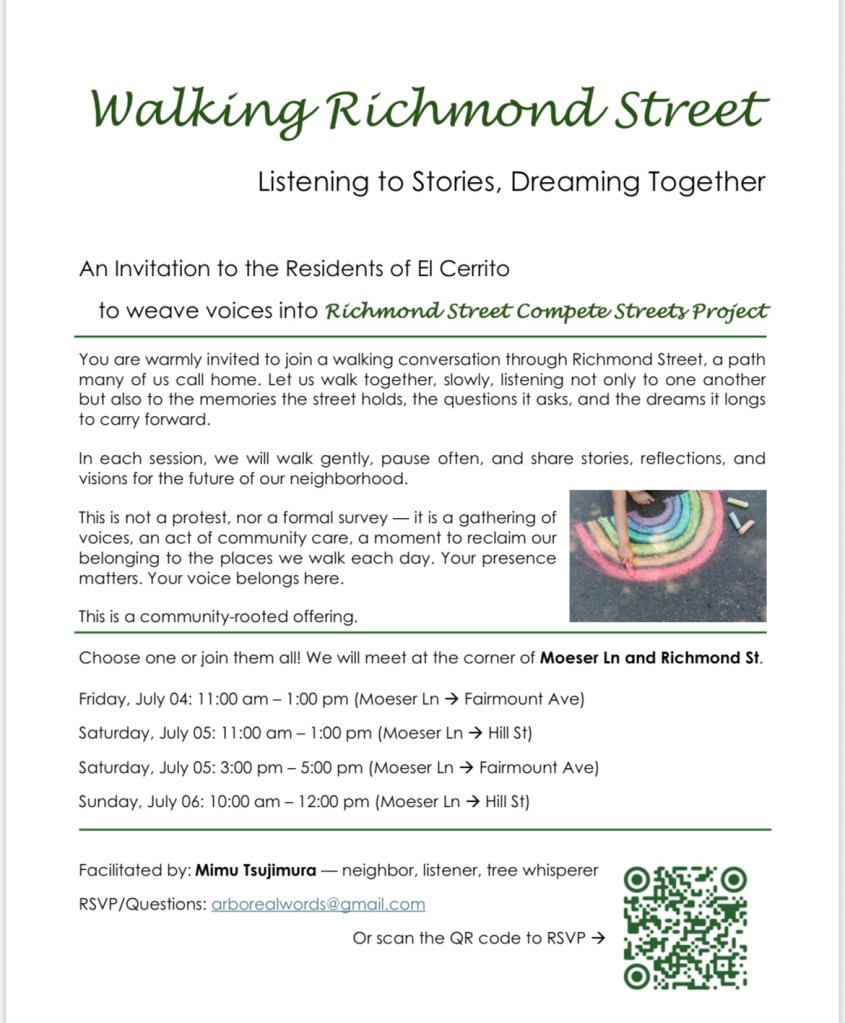
Mimu Tsujimura, a local resident and gentle presence in our community, is offering something both simple and profound: a series of walking conversations on Richmond Street. Her invitation isn’t a protest or a political statement—it’s an act of community care, a reminder that change begins when we slow down enough to listen.
The walks, part of an initiative she calls “Listening to Stories, Dreaming Together,” invite El Cerrito residents to explore Richmond Street—not just as a route on a map, but as a living, breathing part of our shared lives. Mimu describes this as a chance to “weave voices into the Richmond Street Complete Streets Project,” offering an alternative way for residents to reflect on changes proposed by the city, outside of formal meetings and city-sponsored surveys.
Each session is designed to be unhurried. Participants will walk gently, pause often, and share stories, memories, and dreams for the future of our neighborhood. It’s a reminder that our streets don’t just carry cars—they carry histories, families, footsteps, and futures.
Mimu’s approach centers on belonging and care, not confrontation. As she writes:
“This is not a protest, nor a formal survey — it is a gathering of voices, an act of community care, a moment to reclaim our belonging to the places we walk each day.”
Event Details:
📍 Meeting Point: Moeser Ln & Richmond St
🗓️ Schedule:
Friday, July 4: 11:00 AM – 1:00 PM (Moeser Ln to Fairmount Ave) Saturday,
Saturday, July 5: 11:00 AM – 1:00 PM (Moeser Ln to Hill St)
Saturday, July 5: 3:00 PM – 5:00 PM (Moeser Ln to Fairmount Ave)
Sunday, July 6: 10:00 AM – 12:00 PM (Moeser Ln to Hill St)
💌 Facilitated by: Mimu Tsujimura — neighbor, listener, tree whisperer
📧 RSVP/Questions: arborealwords@gmail.com
Whether you’ve lived here for decades or just moved in, this is a chance to connect—with neighbors, with place, and with possibility.
If you’ve ever wondered what community engagement could look like without a podium or PowerPoint, take a walk with Mimu. Richmond Street has stories to tell—and so do you.
Informed by a Concerned Citizen, Homeowner, and Democrat
Last month, El Cerrito residents received a city-sponsored “message test” poll about a proposed library tax. But rather than inform the public, the survey seemed more like a carefully crafted sales pitch. A closer look reveals that the proposal is less about building a library and more about subsidizing the El Cerrito Plaza BART housing development. Here are 9 reasons this El Cerrito homeowner is voting no:
1. The True Cost Is $75 Million, Not $21 Million Although the city claims it’s building a $21 million library, the actual cost to taxpayers is projected at $75 million over 30 years, the majority of which will go toward interest payments—not materials, programs, or community services.
2. The $1/year Lease Is Misleading While officials tout a $1-per-year lease for the library space, they fail to mention that taxpayers are prepaying $21 million in construction costs to secure it. That equates to $2.5 million in taxes each year for a space the city doesn’t even own.
3. Homeowners Will Pay an Estimated $7,650+ Over Time The proposed 17¢ per square foot parcel tax means the typical El Cerrito homeowner would pay $288 in the first year, or more than $7,650 over 30 years—not including annual inflation adjustments. Those with larger homes will pay significantly more.
4. Longtime Seniors Face Steep Tax Hikes Because this is a parcel tax (not based on assessed value), longtime homeowners—especially seniors who bought their homes decades ago—could see their property tax bills increase by 12% or more.
5. Each Book Checkout Could Cost $28.50 Factoring in the $75 million tax and the $820,000 annual operating subsidy from Contra Costa County, library spending could reach $3.3 million per year. With only around 118,000 checkouts annually, the city could end up spending $28.50 per book—and that’s based on optimistic usage numbers.
6. Faster, Cheaper Options Exist Contrary to the city’s claims, this is not the cheapest path forward. There are multiple vacant retail spaces—such as the old Barnes & Noble at El Cerrito Plaza or locations on San Pablo—that could house a library at a fraction of the cost and be operational much sooner.
7. This Proposal Acts as a Bailout for the Plaza BART Project The El Cerrito City Council committed to a high number of below-market-rate units at the Plaza BART site—far beyond what state law requires. The result? A development that isn’t financially viable. To compensate, the city is using taxpayer money—under the guise of a library project—to subsidize the developer, Related Companies.
8. The City Is Using a Loophole to Bypass Voter Thresholds City leaders know a tax of this size would likely fail to meet the two-thirds voter approval normally required. So they’re backing what they claim is a “citizen-led initiative” to place it on the ballot—where it only needs a simple majority. It’s a strategic workaround, but one that undermines public trust.
9. City-Funded Campaigning Is Over the Line El Cerrito has reportedly spent nearly $100,000 on polling and message testing to promote this tax. That kind of political spending typically comes from campaign committees or PACs—not the general fund. The use of taxpayer dollars for promotional efforts is deeply concerning.
The Bottom Line: This proposal does not prioritize the community’s best interests. There are more affordable, efficient ways to deliver a modern library to El Cerrito residents. Unfortunately, those alternatives don’t support the city’s hidden agenda: propping up a struggling real estate development. This homeowner is voting no—and encourages others to take a closer look before signing.
What do you think? Are there other red flags the public should be aware of? 📣 Speak up, get informed, and share with your neighbors.
For years, El Cerrito residents have been misled — by City Attorney Sky Woodruff, who quietly shapes how ballot measures are presented, and by former Councilmember Greg Lyman, whose decisions nearly bankrupted the city.
Now they’re back, pushing a new library tax through a campaign riddled with misleading claims and questionable tactics. This time, they were caught — but how many times haven’t they been?
A Summary Full of Falsehoods
On June 10, a “pre-litigation demand letter” was filed against City Attorney Woodruff for including seven false and misleading statements in the official summary of a proposed library tax measure. That summary was supposed to neutrally inform voters before they signed a petition to qualify the measure for the ballot. Instead, it included exaggerations and misstatements that gave the campaign a clear advantage.
Among the claims struck from the summary:
That library use is increasing (it isn’t), That the building would serve as emergency shelter (with no proof or requirements), That the money couldn’t be used for city salaries (it can), And that services like tutoring and summer programs were guaranteed (they aren’t).
Each of these was quietly removed only after the threat of legal action — not because of transparency, but because they were caught.
City Attorney or Political Operative?
Let’s not forget: Sky Woodruff is not just a consultant — he’s the City Attorney. His job is to safeguard the law, not spin narratives. The fact that he included multiple misleading claims in an official ballot measure summary should concern every El Cerrito resident and voter.
And if this is what they caught him doing — imagine what’s slipped by. How many other ballot measures, council decisions, or contracts have been filtered through his office without full accuracy? This isn’t the first time . What other truths have been massaged into half-truths or no truth to push an agenda?
The role of a city attorney should be apolitical. Yet Woodruff’s actions raise serious doubts about his objectivity, judgment, and fitness to serve a community that expects facts — not fiction.
Lyman Returns with the Same Reckless Strategy
Former Councilmember Greg Lyman, who authored the flawed ballot initiative, is no stranger to financial irresponsibility. During his time on the Council, El Cerrito’s financial situation spiraled. Budget reserves were depleted. Spending soared. And when tough choices were needed, Lyman failed to make them.
Now, rather than working through a transparent City Council process — which would require two-thirds voter approval — Lyman is using the citizen initiative process to pass the tax with a simple majority.
And just like before, the rollout is steeped in confusion and manipulated messaging. A taxpayer-funded $38,000 survey designed to “test” which library tax messages would perform best was conveniently released after the ballot language was filed — but suspiciously aligned with the campaign’s talking points. Residents who took the survey said it was more propaganda than polling.
This Is a Pattern — Not a Fluke
Both Lyman and Woodruff have spent years shaping policy with misleading narratives, unsupported promises, and half-truths. It’s a pattern — not a fluke. And El Cerrito is still paying for it, both in dollars and in trust.
Yes, El Cerrito deserves a better library. But we also deserve honest governance, not manipulation. We deserve to know:
Who’s really benefiting from this tax? What guarantees are actually in place? And how many times we’ve been misled — without even knowing it?
Time to Break the Cycle
This is not just about a library. It’s about accountability. It’s about the quiet erosion of public trust, one misleading sentence at a time. If we keep empowering the same voices with no scrutiny, we’ll keep getting the same results: poor planning, inflated promises, and a shrinking pool of public confidence.
Let’s stop rewarding those who have repeatedly failed to tell us the complete truth.
If you’re tired of the spin, show up. Speak up. Share this. And let’s hold El Cerrito’s leadership — past and present — to the standards our city deserves.
El Cerrito’s City Manager would like you to believe that the Richmond Street Complete Streets project is a model of transparency and community engagement. In her June newsletter, she thanks residents for attending the June 26 Open House, touting it as a meaningful opportunity for public input. She references nearly a year of outreach, surveys, and community events, and encourages residents to review the plans and submit comments by July 9.
But let’s be honest: the train has already left the station.
The claim that public input will shape the project’s outcome doesn’t hold up under scrutiny. The truth is, key decisions—especially the inclusion of bike lanes—were made long before last week’s meeting. The presentation on June 26 wasn’t a forum for co-creating a solution. It was a rollout.
The format made that clear. Residents were asked to submit questions on index cards. Most went unanswered. When City staff finally addressed concerns, it became evident that critical elements of the plan, like the controversial bike lanes, had already been decided.
This isn’t transparency. It’s performative engagement. It gives the appearance of listening without any real intention to change course based on what residents say.
Yes, the City held community events. Yes, they posted online surveys. But real transparency means more than checking the boxes. It means incorporating input before final decisions are made, not inviting comment after the design is effectively locked in.
The newsletter also stresses alignment with various City-adopted plans. But here’s the thing: none of those policies mandate bike lanes on Richmond Street. They offer flexibility and require thoughtful consideration of actual community needs—not just policy compliance.
So when the City Manager says, “The preliminary plans were developed following nearly a year of community outreach…”—what she’s really saying is that the City informed residents of what they’d already decided to do.
If that feels like a betrayal of public trust, it should.
The final design will be approved by the City Engineer later this month, and the Council will discuss the broader transportation policies guiding these projects on July 15. If you’re concerned about the future of our streets being decided without authentic public input, show up. Speak up.
And if you’re tired of being ignored, it’s time to act.
We need new leadership—on the City Council and in the City Manager’s office. Leaders who believe in transparency, respect public input, and understand that residents aren’t a box to check off. They’re the reason local government exists in the first place.
If you’ve ever thought, “This city could be better run”—now is the time to step up. El Cerrito needs leaders who will listen, question, and prioritize the public interest over pre-packaged plans. The next City Council election is in November 2026, and it’s not too early to start building a campaign rooted in transparency, accountability, and real community engagement. We need two strong candidates who are ready to challenge the status quo and stand up for residents. If that sounds like you—or someone you know—it’s time to get organized. Let’s not settle for being explained to. Let’s elect people who will lead with integrity.
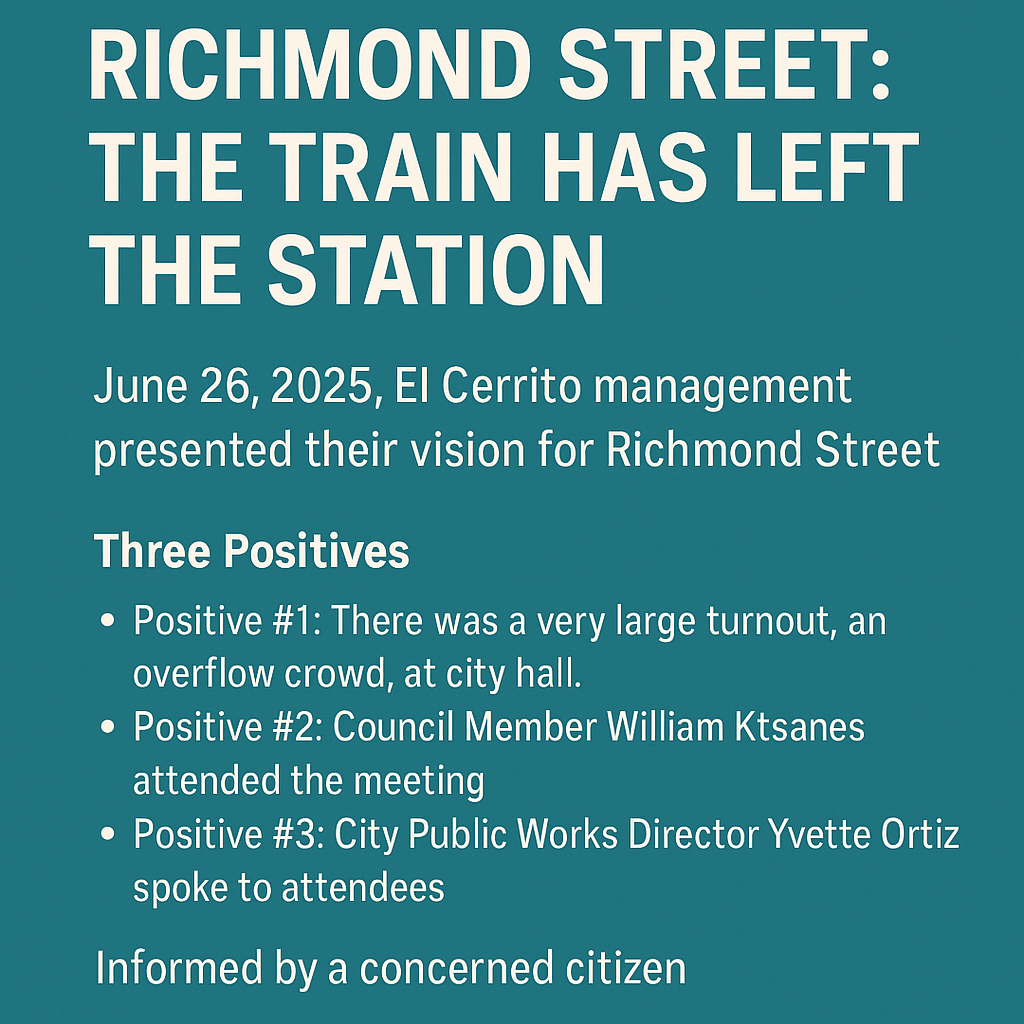
Yesterday on June 26, 2025, El Cerrito management presented their vision for the Richmond Street project—and if you missed the meeting, you can watch the recording here:
Let’s start with the good news. There were a few bright spots:
Public Engagement
City Hall was packed. Standing room only. That kind of turnout doesn’t happen by accident—it’s a sign that people are paying attention and want to be heard. Let’s carry that momentum into the next election. If you’re frustrated by how decisions are made in this city, it’s time to organize and run two strong candidates for City Council in November 2026.
Council Member Ktsanes Showed Up
Councilmember William Ktsanes not only attended the meeting—he stayed, listened, and spoke with residents. That’s what representation should look like. If you appreciated his presence, consider sending him a quick thank-you email. Elected officials need to hear when they get it right.
Yvette Ortiz Was Clear
Public Works Director Yvette Ortiz made it clear that the bicycle path on Richmond Street can be removed—and doing so would not jeopardize funding for the rest of the project. That clarity matters.
But Here’s the Real Story: The Decision Was Already Made
As is often the case in El Cerrito, city management had already decided on a direction before the community was invited in. The purpose of the meeting? Not to gather feedback, but to explain the pre-packaged plan. When asked why certain design choices were made, staff offered vague references to a 2016 general plan—suggesting their hands were tied unless Council gives new instructions. But anyone familiar with El Cerrito governance knows the pattern: management sets the agenda, and Council rubber-stamps it.
Where’s the Data? Where’s the Logic?
There are no publicly shared studies on bicycle usage in El Cerrito. No data on accident rates. No meaningful discussion of alternatives. We were told that Richmond Street is the only flat, continuous north-south route—but the proposed bike lane won’t even cover the full length of the street. So what’s the actual strategy? This feels all too familiar—just like the library project. Management defines the “public benefit,” then spends public dollars to convince the community they got it right. Public input doesn’t appear to have shaped any part of the Richmond Street plan. If it did, no one mentioned it.
Next Steps: July 15 and Beyond
The City Council will discuss the plan on July 15, 2025. If you care about how your tax dollars are spent—and whether your input counts—now’s the time to show up, speak up, and stay engaged.
Time for New Voices at City Hall
If you’ve ever thought, “This city could be better run”—now is the time to step up. El Cerrito needs leaders who will listen, question, and prioritize the public interest over pre-packaged plans. The next City Council election is in November 2026, and it’s not too early to start building a campaign rooted in transparency, accountability, and real community engagement. We need two strong candidates who are ready to challenge the status quo and stand up for residents. If that sounds like you—or someone you know—it’s time to get organized. Let’s not settle for being explained to. Let’s elect people who will lead with integrity.












 El Cerrito Committee for Responsible Government (ECCRG)