El Cerrito’s Financial Mismanagement: A Legacy of Deficits, Missed Promises, and Depleted Reserves

El Cerrito has faced budget deficits in 18 of the last 21 years. Since 2003, the city has been plagued by financial shortfalls, repeatedly dipping into emergency reserves and relying on short-term loans, known as “TRANS” (Tax Revenue Anticipation Notes), to stay afloat. By 2017, the reserves were fully depleted, leaving the city with no cushion to manage future financial crises.

In June 2019, during a City Council meeting, City Manager Karen Pinkos and Finance Director Mark Rasiah assured the council that the city’s financial outlook was improving. Rasiah boldly declared that the going concern statement, which had been issued for two consecutive years, would likely disappear by the end of the fiscal year. His optimism was mirrored by Council members, but the reality was starkly different. By January 2020, the city had incurred a $2.9 million cost overrun, and the going concern statement reappeared for the third time in a row. Despite these financial warnings, the council approved increases in management wages, further deepening the fiscal crisis.

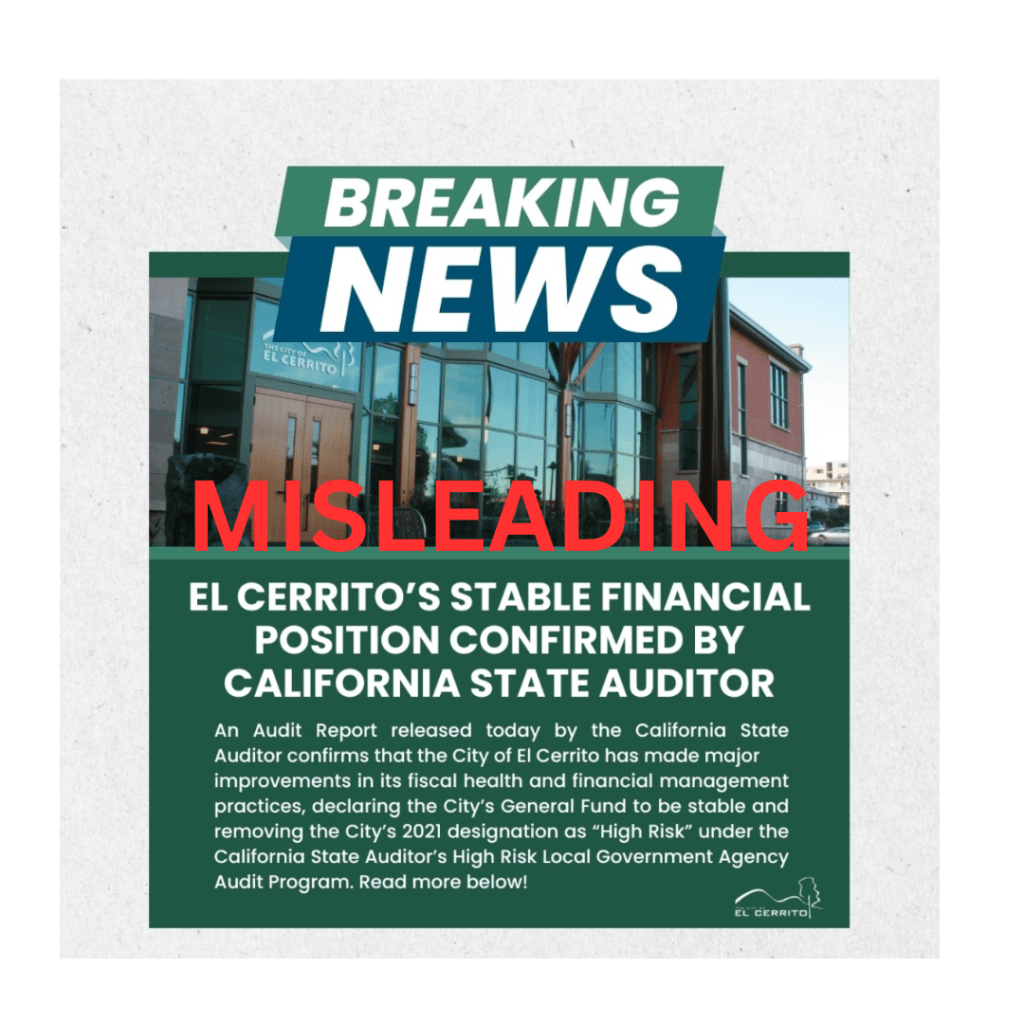
The current council members often tout the city’s improvement from 6th to 13th on the State Auditor’s list of California cities most likely to face bankruptcy. However, what they conveniently omit is that there are over 400 cities in the state—being 13th is no cause for celebration. Additionally, the city’s BBB bond rating, barely above junk status, underscores the persistent financial instability.

Much of this mismanagement can be traced back to long-serving council members like Greg Lyman (2008-2020), Gabe Quinto (2014-present), and now Lisa Motoyama (2020-present). All three have contributed significantly to the city’s financial troubles by repeatedly voting for policies that escalated costs without addressing the structural issues underlying the budget crises. Their tenure on the council has been marked by decisions that failed to rein in spending, neglected to prepare for economic downturns, and continuously relied on unsustainable financial practices.

El Cerrito’s legacy of budget deficits, its reliance on short-term fixes like TRANS, and leadership’s unwillingness to confront these issues head-on have left residents paying the price. Despite years of warnings, council members continue to avoid making the hard choices necessary for true financial recovery. The city’s deep-rooted fiscal problems remain, and unless real changes are made, this pattern will continue to burden the people of El Cerrito for years to come.

#ElCerrito #FiscalResponsibility #BudgetDeficit #CityLeadership #GovernmentOversight #CaliforniaBudgetCrisis

Examining the City Manager’s Financial Report – What’s the Real Picture?

At the September 17 City Council meeting, the City Manager presented the 4th Quarter General Fund Update, painting a rosy picture of El Cerrito’s financial health. While the report claims fiscal prudence and a surplus in the General Fund, we believe the City Manager’s interpretation of the numbers may be misleading.

Misleading Use of “General Fund Balance”

The City Manager emphasized that the General Fund balance is projected to be $22.95 million. However, this figure is not the same as a reserve nor an indicator of available financial flexibility. Much of this balance is already earmarked for specific purposes, such as $9 million for the Emergency Disaster Relief Fund (EDRF) and $1.37 million for the Pension Trust. Additionally, the General Fund balance is used to pay day-to-day expenses like payroll and services, which fluctuate regularly.

By including these restricted amounts in the total balance, the City Manager misleads the public into thinking that these funds are part of the City’s reserve—when in reality, they are designated for specific uses and cannot be accessed for general operations without formal approval. This misrepresentation blurs the line between the City’s actual reserves and the broader General Fund balance, which is not a reserve account.

Lack of Disclosure on Unrestricted Reserves

Crucially, the report fails to disclose the amount of the unrestricted reserves, the portion of the General Fund that is truly available for emergencies or unforeseen expenses. This lack of transparency leaves the public in the dark about the City’s real financial safety net. The unrestricted reserves represent the City’s true financial health, and without this information, it’s impossible to assess how prepared El Cerrito is to handle unexpected financial shocks.

Inflated Reserve Percentage

The City Manager claims that reserves equal 43% of General Fund expenditures. However, this calculation appears to include restricted funds like the EDRF and Pension Trust, which cannot be used for daily operations. When these designated funds are excluded, the actual unrestricted reserves are much lower, potentially closer to the 17% goal set by the City’s financial policies. The real reserve percentage is a key indicator of fiscal health, and the public deserves clarity about what portion of the General Fund is truly available for emergency use.

Admission of a Structural Deficit

Despite the optimistic tone of the report, the City Manager acknowledges a $1 million structural deficit in the General Fund Forecast. This means that recurring expenses exceed recurring revenues, a significant problem that contradicts the narrative of financial stability. Fiscal prudence should focus on resolving this deficit, not masking it with temporary gains.

Over-Reliance on Temporary Revenue

The report warns that if the 1-cent sales tax is not renewed, the City will face a 10% across-the-board cut in services, programs, and staff. This demonstrates El Cerrito’s dependence on temporary revenue sources, rather than addressing the long-term issue of excessive expenditures. A stable city budget should not rely on voters to approve short-term fixes.

Conclusion

The City Manager’s report offers an overly optimistic view of El Cerrito’s financial health. While some gains have been made, the continued presence of a structural deficit, combined with a reliance on restricted funds and temporary sales tax revenues, paints a much less stable picture. We encourage the City to present a more transparent and accurate assessment of its finances.

Councilmembers must be wary of following the City Manager blindly without asking critical questions or scrutinizing the numbers closely. Blind adherence has led to poor financial decisions in the past, and council members must take independent responsibility for ensuring the City’s financial health.

It’s time for the community to ask tough questions and demand clarity on what constitutes real financial stability for El Cerrito. Let’s ensure a brighter financial future for El Cerrito. Reach out to your City Council members and let them know your concerns!


Contact Information

City Manager: Karen Pinkos
Email: kpinkos@ci.el-cerrito.ca.us
Phone: (510) 215-4300

City Council Members:


#ElCerrito #FiscalTransparency #FinancialStability #LocalGovernment #ElCerritoCityCouncil #BudgetTransparency #MeasureG #Accountability #PublicFinance #CommunityEngagement

El Cerrito City Manager Newsletter: A Concerned Citizen’s Observations

The El Cerrito City Manager recently published her monthly newsletter, and as concerned citizens, we believe it’s important to take a closer look at the finance section she provided. For your convenience, here is the El Cerrito September City Manager Newsletter. But before diving into the city’s narrative, some key pieces of information are missing from the newsletter that deserve attention.

El Cerrito’s Credit Rating and Financial Struggles

El Cerrito’s current BBB credit rating is one of the biggest issues not addressed in the newsletter. When the current city manager took office, the city had an A- credit rating. That’s a significant downgrade, and it should concern everyone in the community. A lower credit rating makes it harder and more expensive for the city to borrow money when it needs to fund projects or manage its debt.

Another major red flag is that El Cerrito remains on the State Auditor’s high-risk list, which flags municipalities at risk of fiscal insolvency. El Cerrito has been on this list for 3.5 years, and despite reassurances from city leadership, there’s been no meaningful improvement.

Let’s not forget the elephant in the room: El Cerrito’s CalPERS UAL pension liability. The city currently owes $85 million in unfunded pension liabilities, and this massive debt will continue to grow if not properly addressed.

Financial Reserves: A Closer Look

In the September 17, 2024, council meeting packet, the city’s financial reserves were reported as follows:

  • June 30, 2023: $23,143,081
  • June 30, 2024: $22,957,167

That’s a decrease of $185,914 in reserves over one year. It might not sound like much, but considering the long-term trend of deficit spending and dwindling reserves, it’s a troubling sign.

To make it even simpler: the 2023 number is bigger than the 2024 number. El Cerrito readers, do you agree that our reserves should be growing, not shrinking?

Budget Discrepancies: Predicted vs. Actual Spending

Now, let’s talk about the budget. According to the FY 2024 budget document, the city predicted spending $48,435,585 for the fiscal year. However, the unaudited actual expenditures reported in the council meetings totaled $52,340,189. That’s nearly $4 million more than originally planned.

The question for El Cerrito residents is: Did the city spend more than predicted or less than predicted? The numbers clearly show overspending, yet there seems to be little accountability or explanation for this.

Clarifying the Terminology

It’s also important to understand the financial terms are often used in these discussions. Here are a few key definitions:

  • Reserves: Funds set aside by the city, often used as a financial safety net for emergencies or unexpected costs.
  • Expenditures/Expenses: The total amount of money spent by the city in a fiscal year on various operations, programs, and services.
  • Total General Fund Reserves: The overall amount of money the city has saved in its general fund, which can be used to cover shortfalls or emergencies.
  • Unrestricted General Fund Reserves: A portion of the general fund that is not earmarked for specific purposes and can be used at the city’s discretion for any necessary expenses.

Revenues Are Up, Services Are Down

Here’s another puzzle: In FY 2018, the city had actual revenues of $35,783,921. By FY 2024, the unaudited actual revenues had increased to $52,154,276—an increase of nearly $16 million.

But despite this significant revenue growth, services have been cut. For example, the city still has no senior center. Library hours have been reduced and there are no performance standards for management. Why are services being reduced or stagnant when revenues are increasing?

Join the conversation, attend council meetings, and ask tough questions about the city’s finances. It’s our community, and it’s up to us to make sure our voices are heard.

It’s time for El Cerrito residents to demand more transparency and fiscal accountability from our city leadership. With growing revenues and shrinking services, we deserve clear answers on how our money is being managed. Let’s ensure the city is prioritizing fiscal responsibility and delivering the services our community needs.

Contact Your El Cerrito City Council Members and City Manager

If you have concerns about the city’s financial situation or any other issues, it’s important to reach out directly to your city council members and the city manager. Below are their contact details. Let your voice be heard and ask for the accountability and transparency our community deserves.

El Cerrito City Council Members:

El Cerrito City Manager:


Feel free to reach out to your council members and city manager via email or phone to express your concerns or ask questions about the city’s finances. It’s our community, and it’s up to all of us to stay informed and engage.


#ElCerrito #FinancialResponsibility #CityBudget #TransparencyMatters #FiscalAccountability #ElCerritoCommunity #MunicipalFinance #CivicEngagement #PublicServices #ContactYourCityCouncil

Accountability on the Agenda: Electing El Cerrito City Council Members Committed to Oversight

With election season here and three out of five City Council seats up for grabs, it’s a critical time for El Cerrito residents to cast their votes for representatives who will rigorously hold the City Manager accountable for her performance. After serving 12 years as Assistant City Manager, Karen Pinkos took over the role of City Manager on January 1, 2019. Since her tenure began, El Cerrito has encountered numerous serious issues, yet there has been no acknowledgment or substantial response from her office.

Karen Pinkos often assures stakeholders that problematic events would not occur “on her watch,” yet under her leadership, several troubling events have unfolded:

  1. State Auditors Report: A 2021 state audit revealed that El Cerrito’s financial practices were critically deficient, placing the city on the brink of bankruptcy and ranking it among the ten most poorly managed cities in the region. Since then, only marginal improvements have been made, with the city currently standing as the 13th worst among over 400 California cities in terms of financial management.
  2. BBB- Bond Rating: Before Karen Pinkos’ tenure, El Cerrito boasted a prestigious AA- bond rating. However, shortly after she became City Manager, the rating dramatically fell to BBB-, verging on junk bond status.
  3. Costly Sexual Harassment Settlement: Despite facing financial challenges, the city settled a significant sexual harassment lawsuit, paying out over half a million dollars. The city has yet to implement effective policies to prevent such issues in the future.
  4. Unfunded Pension Liability: The city has not properly managed its pension obligations, resulting in an enormous $85 million pension liability. Although $1 million was allocated to the Section 115 trust, there is no legal requirement for these funds to be used to reduce the liability, further jeopardizing the city’s financial future.
  5. High Turnover in Finance Director Position: Over the past two years, El Cerrito has seen three different Finance Directors, with the city’s challenging work environment contributing to their brief tenures. This instability has prevented the effective management and reporting of the city’s financial status.

Furthermore, Karen Pinkos frequently promotes her commitment to “Accountability and Transparency,” yet her actions suggest otherwise. Issues such as unrecorded Financial Advisory Board meetings, inappropriate language towards subordinates, and circumventing financial advisory processes highlight a significant disconnect between her words and her actions.

Also, El Cerrito City Council’s policy of not engaging during public comments is arbitrary. There are no state or federal laws prohibiting engagement with the public. This self imposed practice further erodes public trust and transparency.

As El Cerrito faces dire financial and operational challenges, the necessity for effective governance, transparency, accountability, and prudent decision-making cannot be overstated. It is imperative for the City Council to implement performance standards for the City Manager to ensure these crucial leadership qualities are not only promised but also practiced.

Your Thoughts? What are your experiences with city services in El Cerrito? Do you recognize these issues, or do you view the situation differently? Share your stories and suggestions for how our city can improve. Let’s start a conversation for change.

Here is how you can help:

  • Share this post with other residents.
  • Comment on this post.
  • Attend the monthly Financial Advisory Board meetings in person.
  • Post on social media – tag councilmembers
  • Voice your concerns at City Council meetings, which are available remotely and in person, though public comment is now limited to in-person attendees.

If you want to contact City Council Members or the City Manager, all their emails are provided below:

  • Karen Pinkos – City Manager: kpinkos@ci.el-cerrito.ca.us
  • Councilperson Gabe Quinto: gquinto@ci.el-cerrito.ca.us
  • Councilperson Carolyn Wysinger: cywysinger@ci.el-cerrito.ca.us
  • Councilperson Tessa Rudnick: trudnick@ci.el-cerrito.ca.us
  • Mayor Lisa Motoyama: lmotoyama@ci.el-cerrito.ca.us
  • Councilperson Paul Fadelli: pfadelli@ci.el-cerrito.ca.us

Follow Up: The Many Ways Karen Pinkos Has Hurt the Senior Community

In a previous blog, we posed a simple question: How has Karen Pinkos made the lives of seniors better? Unfortunately, based on her actions and the policies implemented under her leadership, it seems the reality paints a much grimmer picture for our senior community.

Under Pinkos’ watch, seniors have faced significant setbacks that seem to contradict her claim of making people’s lives better. The closure of the Senior Center, a critical hub for our aging population, is only the most visible example. Many seniors relied on the center not just for social activities but for health, wellness, and support programs—vital services that improve quality of life, reduce isolation, and promote community engagement.

Instead of protecting this vital resource for our seniors, the center was shut down and rented out to Kensington. This decision is emblematic of an administration that seems out of touch with the needs of its most vulnerable residents. As seniors are left without a dedicated space, the city’s leadership continues to expand its own ranks—claiming to be “lean on staff” while maintaining high-level administrative positions like the Assistant City Manager, even though the city can barely balance its budget.

This failure to prioritize the needs of seniors is especially concerning when you consider that 20% of El Cerrito’s population is over the age of 65. These are our elders, the ones who built the community we live in today, and yet they are being ignored in favor of decisions that place financial strain on the city while offering them nothing in return.

Raising Taxes and Fees: A Burden on Seniors

Adding to the pain, under Karen Pinkos’ leadership, the City of El Cerrito has repeatedly turned to raising property taxes, sales taxes, and a variety of fees to shore up the city’s struggling finances. This approach disproportionately impacts seniors, many of whom are living on fixed incomes. For them, every tax increase, every additional fee, represents a significant financial strain.

Property taxes, in particular, hit seniors hard. As longtime residents, many have paid off their homes but now face rising property tax bills, which continue to climb. The increase in sales tax also eats into their limited budgets, affecting their ability to afford everyday necessities. Pinkos has not only pushed for these tax hikes but also failed to address the root causes of El Cerrito’s financial problems—choosing short-term fixes over sustainable, long-term solutions.

In addition to property and sales tax increases, the city has implemented or raised other fees—from garbage collection to utilities—creating yet another burden for seniors. These constant increases come without the promise of improved services for the elderly population, making it harder for seniors to maintain a decent standard of living in their own community.

Misguided Spending Decisions

The city has claimed an inability to fund the Senior Center and even went so far as to cut library hours, further impacting seniors and other residents who depend on these resources. Yet, despite these “financial constraints,” the city found $1.5 million to purchase a local church, which appraised for less than $1.3 million. This decision raises serious questions about the city’s priorities.

How can the city afford to overspend on random real estate purchases while failing to keep essential services like the Senior Center open and cutting back library hours?

This financial mismanagement is further evidence of a leadership that is out of touch with the needs of the community. For seniors, who already face rising taxes and diminishing services, these choices feel like a slap in the face. The money spent on purchasing the church could have easily been used to support the Senior Center or restore the library hours that so many residents, particularly seniors, rely on.

A Failure of Leadership

Karen Pinkos has stated in interviews that the city is making people’s lives better, but for our senior community, this simply isn’t true. Instead, her actions have led to reduced services, increased financial pressures, and a lack of transparency on how senior-focused services are being prioritized (or rather, deprioritized).

If you believe our seniors deserve better, it’s time to take action. Post on social media and tag City Manager Karen Pinkos and the City Council. Ask for an explanation of the decisions that have hurt our senior community. Demand answers about why the Senior Center was closed, why no alternatives were provided, and how they plan to restore essential services for our elderly residents. Challenge them on the misguided spending decisions, including the purchase of the church above-appraisal value, while cutting critical services for residents.

Let’s flood social media and city council meetings with the voices of concerned citizens who demand transparency and accountability.

SeniorsMatter

ElCerritoSeniors

AccountabilityNow

CommunityOverConsultants

SupportOurElders

SaveOurSeniorCenter

NoMoreTaxHikes

MisguidedSpending

ElCerritoNeedsChange

The Truth Behind El Cerrito’s Financial Position: Misleading Reserves Reporting

Both Lisa Motoyama and Karen Pinkos consistently claim that El Cerrito is in a strong financial position. However, they often blur the line between restricted and unrestricted reserves, combining them to paint a rosier picture. What they don’t mention is that approximately $10 million of these reserves are restricted, meaning that they cannot be used for day-to-day operations or to address the city’s ongoing financial challenges. These funds are tied for natural and environmental disasters and pension liabilities, limiting their flexibility in addressing immediate financial concerns.

What’s particularly concerning is that neither Motoyama nor Pinkos has provided transparency about the city’s unrestricted fund balance, especially the current balance.

This lack of disclosure is critical because it hides the actual amount of money available for the city’s essential services and operational costs. Without a clear, up-to-date figure on the unrestricted reserves, residents cannot accurately assess the city’s true financial health.

This type of vague reporting and lack of transparency continues to mislead the public about the gravity of El Cerrito’s fiscal situation, making it difficult for residents to hold leadership accountable and push for the changes needed to ensure the city’s long-term stability.

ElCerrito #FinancialTransparency #LeadershipAccountability #RestrictedFunds #FiscalResponsibility #UnrestrictedReserves #KarenPinkos #LisaMotoyama #CityBudget #CommunityFirst #KnowTheFacts

The Problem of Splitting Purchase Orders: A Disturbing Practice in El Cerrito’s City Management

In recent years, many El Cerrito residents have grown increasingly concerned about our city’s transparency and fiscal management. One troubling practice that has repeatedly surfaced is the use of “split purchase orders” (POs) by city management to circumvent the approval process. This approach raises serious ethical questions and undermines the checks and balances designed to ensure responsible use of taxpayer funds.

What is a Split Purchase Order?

At its core, a split purchase order is an attempt by the procurement function to divide a large purchase into smaller segments to avoid triggering higher levels of approval or scrutiny. This practice is often used to keep purchases below the dollar threshold that would typically require authorization by a higher authority or oversight board.

For example, if a purchase order (PO) is for $200,000 and the approval threshold for such a transaction is $100,000, splitting the PO into two separate $100,000 orders effectively bypasses the required approval process. While the practice may seem like a shortcut, it is a deliberate circumvention of established procedures meant to maintain transparency and accountability in the procurement process.

Why Does This Happen?

In El Cerrito, it has become routine for certain city officials to use split POs to keep contractor expenses under the radar. By doing so, they sidestep necessary approvals, keeping significant financial decisions away from public scrutiny. This not only diminishes the accountability of those responsible for managing public funds, but it also opens the door for potential fiscal mismanagement and abuse.

There are several reasons why city management might engage in this practice:

Bureaucratic Evasion: Instead of going through what they see as “red tape,” officials may see this method as a way to fast-track purchases. However, cutting corners like this creates larger issues down the road.

Avoiding Public Scrutiny: Splitting POs allows city officials to sidestep council reviews or board approvals. This keeps certain contractors or projects from receiving the attention they deserve and often prevents residents from understanding how their tax dollars are spent.

Fostering Favoritism: By avoiding the proper approval channels, city management can favor certain contractors without adhering to competitive bidding processes or fair selection procedures. This breeds an environment where favoritism can flourish.

Why is This Practice Inappropriate?

Splitting POs is not just an act of cutting through bureaucracy—it is a violation of the trust placed in city management by the residents of El Cerrito. The system of checks and balances exists for a reason: to ensure that decisions about spending taxpayer money are made responsibly and transparently.

When POs are split to bypass the procurement process, several significant issues arise:

Misuse of Public Funds: By bypassing the normal approval process, city management may be spending more money than necessary or selecting contractors who are not the most qualified. This can result in wasteful spending, which impacts everyone in the community.

Lack of Oversight: The approval process is designed to involve multiple levels of review to prevent financial abuse. By splitting POs, city management denies these levels of oversight, opening the door to potential corruption.

Erosion of Public Trust: Residents expect their city officials to act with integrity, especially when managing public funds. When these kinds of unethical practices become common, it erodes public trust in the entire system of governance.

El Cerrito’s residents deserve better. We should demand transparency and accountability in every aspect of how the city handles its finances. The practice of splitting POs to circumvent the approval process must stop. It is a deliberate manipulation of the system that allows fiscal mismanagement to persist and undermines the city’s long-term financial health.

City leaders need to take immediate steps to address this issue. At the same time, we, as residents, should call for independent audits of procurement practices and advocate for stricter policies that prevent any form of fiscal deceit. The well-being of our city depends on responsible, ethical leadership—and that begins with holding those in power accountable for their actions.

By ending this unethical practice, we can take a crucial step toward restoring integrity to El Cerrito’s financial management.

ElCerrito #FiscalResponsibility #TransparencyMatters #ProcurementEthics #CityManagement #PublicFunds #SplitPurchaseOrder #Accountability #TaxpayerProtection #StopFiscalAbuse #ElCerritoResidents #CityCouncil #PublicTrust #FinancialIntegrity

The League of Women Voters Forum Highlights Transparency Gaps and Senior Center Needs in El Cerrito

Yesterday’s League of Women Voters forum for the El Cerrito City Council candidates made one thing clear: there is a significant divide in priorities when it comes to the future of our city. Independent candidate William Ktsanes stood out with a strong and heartfelt focus on transparency and addressing the long-overdue need for a dedicated senior center. In contrast, the three insider candidates—Lisa Motoyama, Rebecca Saltzman, and Courtney Helion—unified around a new Plaza library (funded by a $300 forever tax), overlooking what many residents see as a more urgent concern.

William Ktsanes: A Strong Voice for Seniors and Transparency

Ktsanes’ performance during the forum was compelling and personal. He spoke movingly about the importance of a senior center, drawing on his own experiences caring for his mother. El Cerrito is the only city in the region without a dedicated senior center, and Ktsanes underscored the need for action now. He presented several potential locations for a center, highlighting that this issue cannot continue to be ignored.

More than just a senior center advocate, Ktsanes repeatedly addressed the lack of transparency in city finances, particularly regarding the Measure G survey. He emphasized that the city’s most pressing issue is the need for more openness and better financial decisions. His commitment to transparency was a breath of fresh air in a city that continues to struggle with fiscal mismanagement, such as its unfunded pension liability, which has ballooned to $85 million.

The Insider Candidates: Unanimous on the Library, Silent on Senior Needs

In stark contrast, the three insider candidates—Motoyama, Saltzman, and Helion—focused on the Plaza library project, advocating for a $300 per year forever tax to fund it. They largely spoke as one voice, downplaying the immediate need for a senior center and prioritizing the library instead.

Lisa Motoyama claimed the city’s budget process was transparent but failed to address the $85 million pension liability or the city’s BBB credit rating. She also didn’t acknowledge that El Cerrito pays double what nearby Albany does for pension liabilities. When Motoyama mentioned senior services, she implied that the city supports programs at St. John’s, Christ Lutheran, and Sakura Kai senior centers. However, this is misleading. These programs are actually provided by West Contra Costa County Adult Education in partnership with the churches, and Sakura Kai operates independently as a nonprofit. The City of El Cerrito has no formal relationship with these programs, and they serve adults 55 and older across the county, not just in El Cerrito.

Motoyama’s focus on distributed senior services came off as an excuse to delay a real solution, and her support for Measure G’s “forever” tax seemed out of touch with the urgent need for fiscal transparency. She failed to mention the potential loss of parking in the current library proposal and gave little reassurance to residents concerned about the city’s long-term financial health.

Rebecca Saltzman echoed many of Motoyama’s points, positioning the senior center as a future concern rather than a current priority. She touted her experience with BART’s finances but offered little insight into how El Cerrito’s financial struggles could be managed more effectively or how she contributed to BART’s fiscal cliff. Courtney Helion, meanwhile, appeared to lack a deep understanding of the issues, siding with Motoyama and Saltzman on nearly every point. Her responses on transparency and finances felt vague and uninformed; she didn’t address the frustrations many citizens feel when trying to get clear answers from the city.

The Reality: El Cerrito’s Mismanagement Continues

While the insider candidates seemed content to focus on the Plaza library, El Cerrito residents face serious issues that go beyond new infrastructure. The city’s spending continues to rise, while essential services have been scaled back. We are now facing a budget deficit for FY 2024 despite higher-than-expected tax revenues. Our pension liabilities have increased from $57.8 million to $85 million, and the city remains on the state auditor’s high-risk list after more than three years of promised improvement.

For 1,640 days and counting, El Cerrito has been without a senior center, yet the city continues to push for a library project with a “forever” tax. The passport office has been closed, and even appreciation dinners for community volunteers have been canceled. Meanwhile, over $500 was spent on a dinner for department heads—just one example of the fiscal mismanagement that plagues the city.

The forum made it clear that El Cerrito residents need to demand more from their city leaders. William Ktsanes’ focus on transparency and fiscal responsibility sets him apart as the candidate willing to address the real issues facing our community. His passion for establishing a senior center is a necessary step in meeting the needs of our growing senior population.

El Cerrito needs leaders who will take action now—not years from now. We can’t afford to ignore the city’s financial problems or continue operating in an opaque manner. Residents deserve better, and it’s time for a change.

El Cerritans, let’s not settle for vague promises and hidden agendas. We need leaders who will prioritize transparency and make tough financial decisions. Our seniors deserve a center they can call their own, and our city deserves leaders who will confront the fiscal reality head-on.

Contact the Candidates

El Cerrito’s Troubling Financial Journey: A Timeline of Decline and Efforts for Recovery

In the past decade, El Cerrito has experienced a tumultuous financial journey, marked by repeated warnings from the State, declining credit ratings, and a high risk of bankruptcy. This blog will outline the significant events that have shaped the city’s fiscal landscape, highlighting the key figures and decisions involved.

Early Warnings and Declining Ratings

December 2, 2013: The State issued a warning to El Cerrito by lowering its credit rating from AA- to A+. This initial downgrade was an early indicator of the city’s emerging financial difficulties.

December 2014: Gabe Quinto took office, facing an immediate challenge with the city’s financial health already under scrutiny.

December 2016: Paul Fadelli took office, joining Quinto in grappling with the city’s fiscal woes.

October 1, 2018: The city’s credit rating was lowered again, from A+ to A-. This downgrade reflected ongoing concerns about financial management and sustainability.

December 26, 2018: Karen Pinkos became the city manager, inheriting a city on a downward financial spiral.

November 26, 2019: The credit rating was further downgraded from A- to BBB, signaling a critical deterioration in financial stability.

Crisis Point and State Intervention

September 24, 2020: The rating was downgraded yet again, from BBB to BBB-, indicating a severe financial crisis.

March 2021: The State Auditor declared El Cerrito at high risk of bankruptcy. The city was ranked as the 6th most likely among 400 + cities in California to face bankruptcy, highlighting chronic overspending, poor budgeting practices, and insufficient efforts to address financial challenges. Key quotes from the State Auditor’s report included:

  • “Excessive Spending and Insufficient Efforts to Address Its Perilous Financial Condition Jeopardize the City’s Ongoing Fiscal Viability”
  • “In general, we determined that the city is at high risk of financial instability because of its continual overspending, poor budgeting practices, and lack of a comprehensive plan to address its financial challenges, all of which threaten the future provision of city services.”
  • “Because It Consistently Overspends, El Cerrito Is in a Weak Financial Position, as Demonstrated by a Deficit in Its General Fund, Reliance on Costly Short-Term Loans, and Rising Pension Costs”
  • “The amount El Cerrito pays toward its pension liability continues to grow because the city pays only the minimum amount required each year as determined by an actuary…. According to El Cerrito’s finance director, the city does not plan to pay more than the minimum required employer contribution each year.”
  • “Because of its financial condition, El Cerrito has delayed efforts to address the maintenance and repair of its facilities and the development of needed capital projects…. At that rate of spending, it would take the city more than 50 years to fund the projects it has currently identified, even though many of these projects involve the need to address existing deficiencies.”

For those new to this issue and interested in understanding the city’s initial response to the state auditor, we recommend watching the following videos:

  • Financial Advisory Board (FAB) Meeting on April 13, 2021 (start at 58:40): Watch here
  • Town Hall Meeting on April 10, 2021: Watch here
  • City Council Meeting on April 20, 2021 (start at 1:17): Watch here

With the upcoming elections, it is time for a change in city management. Before the state auditor’s findings, “going concern” letters were issued to the city, indicating serious doubts about its ability to continue functioning financially. Yet, the city did nothing.

December 2020: Lisa Motoyama and Tessa Rudnick took office, adding new leadership perspectives amidst the fiscal crisis.

Financial Performance and Deficits

El Cerrito’s financial performance over recent years has been mixed, with alternating deficits and surpluses (achieved through ARPA funding) requiring the use of reserves to balance the budget:

  • 2019: Deficit
  • 2020: Deficit
  • 2021: Surplus
  • 2022: Surplus
  • 2023: Surplus
  • 2024: Deficit
  • 2025 forecasted Deficit

The city has had to rely on its reserves to cover these deficits, depleting much of its financial safety net. This approach has left the city in a precarious position, needing a significant portion of the remaining reserves to balance the FY25 budget.

Steps Towards Recovery

December 2022: Carolyn Wysinger took office,

March 2023: The “going concern” warning was removed, indicating some progress in stabilizing the city’s finances.

September 29, 2023: The credit rating was upgraded from BBB- to BBB, a positive sign but the city still ranks 13th most likely to go bankrupt. This is due to inflated expenses leading to continued use of reserves to cover over-spending, and the $85 million pension liability

Conclusion

El Cerrito’s financial journey has been fraught with challenges, from repeated downgrades in credit ratings to being flagged as a high risk for bankruptcy. While the city has seen some changes in leadership and minor improvements in its credit rating, significant financial recovery efforts and effective management strategies are still needed to ensure the city’s ongoing fiscal viability.

For more detailed information, you can refer to the State Auditor’s report here and the latest credit rating details here.

Is Measure R Being Overlooked in El Cerrito?

While reviewing past agendas for the Financial Advisory Board (FAB) meetings, we discovered that Measure R has not been on the agenda for FAB review in several years. This raises questions about the oversight and management of this critical source of funding for our city.

Understanding Measure R

In November 2014, El Cerrito voters approved the extension of Measure R at the one percent sales tax rate for twelve years. The new sales tax rate went into effect on April 1, 2015, and is set to sunset on March 31, 2027. Measure R was initially passed by voters in 2010 to enable the City to maintain the level of programs and services offered in FY2009-10.

Measure R is intended to ensure that El Cerrito can continue to provide essential services and fulfill our commitment to the community’s priorities. These priorities include:

  • Maintaining rapid 9-1-1 response times, neighborhood police patrols, crime prevention, and investigation.
  • Ensuring the current levels of firefighters, fire protection, and emergency medical services.
  • Supporting earthquake and disaster preparedness.
  • Providing after-school programs for children and teens.
  • Maintaining and improving city parks, playfields, paths, and open spaces.

Through the annual budget process, the City Council is responsible for determining how to allocate Measure R funds and General Fund monies to maintain essential services based on community priorities. The public is encouraged to participate throughout the budgeting process, which includes numerous public meetings.

The Role of the Financial Advisory Board

The El Cerrito website indicates that Measure R includes fiscal accountability provisions, such as:

  • Annual independent financial audits.
  • An annual report to the City Council and residents.
  • Review of all expenditures from the measure by the Financial Advisory Board (FAB) to provide citizen oversight.

However, it appears that Measure R has not been actively reviewed by the FAB in recent years, as indicated by the absence of the topic in recent agendas.

Why This Matters

The lack of FAB review raises concerns about whether the funds from Measure R are being used effectively and transparently. With the sales tax set to sunset in 2027, it is crucial to ensure that the funds are allocated in a manner that aligns with the community’s priorities and maintains a high quality of life for El Cerrito residents and businesses.

As we move forward, we must advocate for greater transparency and accountability in the management of Measure R funds. This includes ensuring that Measure R is regularly reviewed by the FAB and that the public is informed about how these funds are being used to support our community.

If you are a business owner and have questions about the collection of this sales tax at the new rate, please contact the California State Board of Equalization or visit the BOE website.

Get Involved

We encourage all residents and business owners to participate in the public budgeting process and to voice their opinions on how Measure R funds should be used. Together, we can ensure that El Cerrito continues to thrive and that our community’s needs are met.


#MeasureR #ElCerrito #FiscalAccountability #CommunityEngagement #PublicOversight #Transparency #LocalGovernment #CityCouncil #ElCerritoCommunity #CitizenOversight

Neighboring Cities’ Approach to Free Speech and Open Government: A Stark Contrast to El Cerrito

This past Sunday at the Solano Stroll, a resident of El Cerrito had the chance to speak with candidates running for office in Berkeley and Albany about their positions on open government, transparency, and free speech. Based on their responses, it seems that supporters of open government would feel much more comfortable in these neighboring cities compared to El Cerrito.

Here are the questions that were asked, along with the responses received:

1. Does Berkeley allow citizens to offer comments at council meetings via Zoom? How do you deal with hate speech?

In Berkeley, citizens are allowed to offer comments via Zoom. The mayor typically steps in to shut down offensive or harmful comments, ensuring the environment remains respectful.

Albany, on the other hand, takes a more tolerant approach, maintaining decorum while enduring a wider range of comments.

Meanwhile, in El Cerrito, the decision was made to completely shut down Zoom comments, which limits residents’ ability to engage with their elected officials remotely. This move seems out of touch, especially in a time when other cities are embracing technology to expand participation.

2. Does the city manager ever take you out for lunch and pay for it with a city credit card? Is that even legal?

In both Berkeley and Albany, the response was a firm “No.” The idea that a city manager would take elected officials or department heads out for lunch on a city credit card was met with surprise and concern. Such a practice would be heavily scrutinized and, in many cases, could be deemed illegal.

However, in El Cerrito, this practice seems to be common. The city manager has reportedly taken department managers out for expensive dinners, while appreciation dinners for community members serving on city committees were terminated as a cost-saving measure. This disparity raises concerns about how fiscal responsibility is being prioritized in El Cerrito.

3. If a Berkeley resident asked to know the general fund balance as of July 31, 2024, would you provide that information? How difficult would it be to obtain that information?

Berkeley officials responded with confidence that this information would be easy to obtain. In fact, a Berkeley mayoral candidate was able to provide the requested information immediately, while another referred the resident to the city auditor, who also assured easy access to such information.

In contrast, El Cerrito officials responded that it was “not in the public interest” to share the general fund balance, making it impossible for residents to access this important information. This stark difference in transparency highlights the challenges El Cerrito faces in providing residents with the information they deserve.

4. If Berkeley hired a consultant to do surveys, would the data and the reports be made available to the council and the public?

Both Berkeley and Albany candidates explained that survey data, including the questions and crosstabs, would automatically be part of an agenda item. This means there would be no need to file an open records request, as the information would be readily available to the public and council.

In El Cerrito, the situation is quite different. Open records requests are frequently denied, leaving both the public and council members without critical information. For example, when the council voted on Measure G language, they weren’t provided with key survey data or crosstabs. A similar problem occurred with library surveys, where important data was withheld from the public.

The Bigger Picture: Why Open Government Matters

Open government is essential for maintaining public trust. In cities like Berkeley and Albany, residents can access information, ask questions, and hold their government accountable. In El Cerrito, the refusal to provide basic information, such as the general fund balance or survey data, undermines that trust.

El Cerrito residents deserve the same level of transparency as those in neighboring cities. The practices in Berkeley and Albany show how open government can function effectively, and they provide a model that El Cerrito could follow. Until that happens, supporters of open government may feel more at home advocating for their causes in nearby cities rather than their own.

Contact Your El Cerrito City Council Members

If you are concerned about transparency and open government in El Cerrito, you can reach out to the El Cerrito City Council members directly:

  • Mayor Lisa Motoyama
    Email: lmotoyama@ci.el-cerrito.ca.us
    Phone: (510) 215-4300
  • Mayor Pro Tem Tessa Rudnick
    Email: trudnick@ci.el-cerrito.ca.us
    Phone: (510) 215-4300
  • Councilmember Paul Fadelli
    Email: pfadelli@ci.el-cerrito.ca.us
    Phone: (510) 215-4300
  • Councilmember Carolyn Wysinger
    Email: cwysinger@ci.el-cerrito.ca.us
    Phone: (510) 215-4300
  • Councilmember Gabe Quinto
    Email: gquinto@ci.el-cerrito.ca.us
    Phone: (510) 215-4300

Hashtags:

OpenGovernment #TransparencyMatters #FreeSpeech #ElCerrito #Berkeley #Albany #LocalGovernment #CivicEngagement #PublicTrust #SolanoStroll #Accountability #CityCouncil

How Has Karen Pinkos Made the Lives of Seniors Better?

A recent post from a member of our senior community raised a critical question: How has El Cerrito City Manager Karen Pinkos made the lives of seniors better?

This inquiry was sparked after seniors in our city experienced firsthand the closure of the Senior Center—a space once dedicated to them, now rented out to Kensington. The closure represents more than just the loss of a facility. It represents a disruption to a community that relied on that space for connection, recreation, and support.

In an interview with the California City Managers Association, Karen Pinkos made a bold statement: “We make people’s lives better. What is more important than that?” She emphasized that local government holds the power to make impactful and meaningful changes in people’s lives. But has that power been used to benefit our seniors?

The Senior Center closure looms large, symbolizing the disconnect between the city’s leadership and its elderly population. While the city may claim limited staffing and resources due to pandemic constraints, it’s worth questioning whether other solutions were explored. Could El Cerrito have found a way to keep this essential service open for seniors rather than leasing it to a neighboring community?

In the same interview, Pinkos mentioned “lean staff” as a challenge, but what does that mean in the context of El Cerrito? Lean staff? What other cities our size have an Assistant City Manager? In reality, we already have more staff than we can afford, especially given our current financial situation. It’s hard to argue that El Cerrito is operating with a bare-bones team when the leadership structure includes not only a City Manager but also an Assistant City Manager, an Executive Assistant, and multiple department heads—all while facing significant fiscal challenges.

Moreover, El Cerrito has over $85 million in unfunded pension liabilities and continues to struggle with balancing its budget. Despite this, staff levels remain high, while vital services for seniors, who make up 20% of the population, are cut. Just where exactly are we “lean” on staff? The burden of these financial realities falls on all residents, especially our seniors, who have been directly impacted by these decisions.

Karen Pinkos acknowledged in her interview that public engagement has been a challenge since the pandemic but stressed her commitment to listening to and understanding the community. “The city manager needs to listen to and understand the community, be responsive, and follow through,” Pinkos said. Yet, many seniors have expressed feelings of being unheard and overlooked in the city’s decision-making process.

So, the question stands: How has the El Cerrito City Manager ensured that seniors’ lives have improved under her leadership? Beyond the rhetoric of making lives better, what tangible actions have been taken? As a city manager, Karen Pinkos must listen, respond, and follow through on the needs of all residents—including our seniors, who have long been a vital part of El Cerrito’s community fabric.

It’s time to hold leadership accountable. We urge every concerned resident, especially those in our senior community, to write to City Manager Karen Pinkos and request a specific list of the actions she has taken to improve the lives of seniors and the community at large. Ask her to explain how the closure of the Senior Center, the leasing of community spaces, and the city’s financial mismanagement align with her commitment to making lives better. Let’s ensure our voices are heard and demand transparency on the real impact of these decisions.

Write to Karen Pinkos today at City Manager’s Office Contact Information and ask for clear, concrete answers on what has been done to serve our seniors and the entire community.

Editorial: El Cerrito Isn’t the Center of the Universe

Living in El Cerrito, it’s easy to feel like you’re in a bubble. There’s a prevailing sense that everyone shares the same views on politics, social issues, and how life should be lived. But the reality is that everyone doesn’t see things the same way. El Cerrito, like many small California towns, can become isolated in its thinking, assuming that its values are universal.

One of the assumptions I’ve noticed is that if you live in El Cerrito, you must be a Democrat. It’s taken for granted that everyone here shares the same political affiliation, when in fact, that’s far from true. Political diversity exists even in a small town like ours, but it’s often overlooked because of the overwhelming presumption that everyone’s aligned with the same party. This narrow mindset shuts down meaningful dialogue and blinds us to a wider range of perspectives.

My wife and I have homes here and on the East Coast, and it’s clear how different the political and fiscal environments can be. Spending time on the East Coast has given us a broader perspective, especially regarding how local governments manage their finances. Here in El Cerrito, the assumption seems to be that raising taxes is the solution to every financial problem. But in many other parts of the country, people value fiscal responsibility—living within their means, rather than relying on new taxes to cover overspending.

In El Cerrito, our leadership often takes the opposite approach. Instead of addressing root financial problems like overspending, the solution is typically to increase taxes, bonds, or fees. But that’s not sustainable. The assumption that everyone agrees with this approach or that it’s the only solution isn’t just naive; it’s limiting.

This bubble mentality has led to complacency and a false sense of security. In reality, our financial challenges aren’t going away just because we add new taxes—they’re being kicked down the road, leaving future generations to deal with the consequences. Meanwhile, other parts of the country are more willing to face hard truths. Fiscal responsibility means addressing the problem head-on, not masking it with more revenue streams.

In El Cerrito, we could benefit from a broader perspective—one that prioritizes controlling spending and being accountable to the public. That’s why I’m reconsidering voting here in El Cerrito instead of the East Coast. My state needs my presidential vote, but El Cerrito also needs a dose of reality. The down-ballot issues and the need for true fiscal responsibility matter to me. Local elections have the power to shape our town’s future, and we need leaders who are willing to address overspending, not just raise taxes.

To my fellow El Cerritans: You may think that the way things are done here is the only way, but not everyone agrees. And that’s okay. It’s time to recognize that other perspectives, especially those that differ, are essential to building a stronger future for our town. Fiscal responsibility isn’t optional, and neither is political diversity. It’s time we embraced that.

#FiscalResponsibility #ElCerritoMatters #LocalElections #VotingForChange #TaxReform #PoliticalDiversity #election2024

Editorial: Should You Attend the 9/24 El Cerrito Financial Advisory Board Meeting?

If you’ve ever questioned how El Cerrito manages its finances or felt in the dark about important financial decisions, attending the upcoming Financial Advisory Board (FAB) meeting on September 24 might seem like a good idea. But here’s the problem: the lack of transparency at these meetings has become a glaring issue.

At the last meeting, several concerning things happened:

  1. Residents Can’t Hear: One resident who attended couldn’t even hear what the committee members were saying. What’s the point of attending if public participation is effectively muted?
  2. Testimony Ignored: This same resident submitted indicated they submitted testimony on a key financial policy item to the finance director. Guess what? The testimony never made it to the committee, and it wasn’t posted with the agenda packet. How are we supposed to engage in meaningful discussion if the public’s voice is ignored?
  3. Delayed Agenda Items: A significant financial policy amendment was on the agenda, but the details were never released to the public before the meeting. When I asked about it, I was told to wait for the minutes. How can any of us provide informed commentary when we’re not allowed to see the key documents?
  4. Reserves Policy in the Dark: FAB held a discussion on the city’s financial reserve policy, yet the members didn’t even know the current reserve amount! City management is refusing to provide that information, leaving us all in the dark about the financial stability of our city.

FAB’s role is to advise the city council on critical financial matters, but it’s hard to see how that can happen when the board itself is kept uninformed. City management is actively limiting the information that FAB has to work with. This not only affects the board but also leaves residents like us without the transparency we deserve.

What Should Be on the Agenda?

Here are just a few issues that FAB should be discussing at the next meeting, and I’ll be looking to see if these make the agenda:

  • The need for financial transparency and the city’s refusal to adopt a $1 million reserves policy.
  • The city’s financial infrastructure—are staff even equipped to use the software they need to manage our money?
  • A fourth-quarter budget update (it’s overdue).
  • El Cerrito’s mounting CalPERS debt—what’s the plan here?
  • The state auditor’s recent findings on El Cerrito’s fiscal health.
  • What’s going on with the city’s financial reserves? Why wasn’t the September submission discussed in the August meeting?
  • Measure G and its implications for our city’s financial future.
  • The library proposal—are we being told the full story?
  • The censorship of financial information. Why is information being withheld from the public?
  • Our low BBB credit rating and how we can improve it.
  • Why are we preparing for a TRAN (Tax Revenue Anticipation Note) when we’re not addressing the root causes of financial instability?
  • The city’s policy of paying high interest instead of paying off certain debts.

These questions aren’t just technicalities—they are at the heart of whether El Cerrito will thrive or continue to struggle financially. It’s time for FAB to speak up at every council meeting and ensure that these issues don’t get swept under the rug.

Should You Attend?

Yes. Despite the lack of transparency, your presence at FAB meetings is critical. We need more residents showing up and demanding answers. It’s time we hold our city accountable for its finances.

Hope everyone attends at least one meeting.

El Cerrito’s UNRESTRICTED General Fund (GF) Reserves May Have Been Depleted

At the August 27, 2024, Financial Advisory Board (FAB) meeting, an important financial policy recommendation was approved and will be sent to the City Council for consideration. This new policy specifies that the UNRESTRICTED General Fund (GF) reserves should be maintained at a minimum of 17% of the city’s GF expenditures. In comparison, the Emergency Disaster Relief Fund (EDRF) should be kept at no less than 13% of GF expenditures.

For a city like El Cerrito, where GF expenditures hover around $50 million, this policy means that:

• 17% of $50 million amounts to $8.5 million, which should be set aside for unrestricted purposes.

• 13% of $50 million comes to $6.5 million for the restricted EDRF, which cannot be used for other purposes.

The city’s current financial situation raises alarms. As of June 30, 2024, El Cerrito reported that its TOTAL General Fund balance was under $17 million. After subtracting the $9 million dedicated to the EDRF, the unrestricted General Fund balance is estimated to be just $8 million. This figure is already below the $8.5 million threshold recommended by the FAB policy.

However the situation worsened in July 2024. El Cerrito paid nearly $7 million to CalPERS to address its Unfunded Accrued Liability (UAL) debt. Additionally, a bond payment of several hundred thousand dollars was also due. At the same time, the city’s money market account saw a significant reduction of funds, further eroding any available reserves.

It’s evident that El Cerrito’s financial situation is precarious, and the unrestricted reserves may no longer meet the minimum thresholds recommended by the FAB. The city’s current financial management has left residents facing the possibility of a looming financial crisis.

Now more than ever, it’s critical to hold a town hall meeting to discuss these issues openly and transparently. Residents, city leadership, and financial experts need to come together to chart a path forward before the city’s financial health deteriorates even further. How El Cerrito will address its growing debt, shrinking reserves, and future expenditures must be part of this urgent conversation.

We need to prioritize planning for fiscal stability before it’s too late.

Call to Action:

Contact the City of El Cerrito and voice your concerns about the depleted General Fund reserves. Demand accountability and a clear plan for the city’s financial future. Your voice matters!

Contact Information:

• City Manager: Karen Pinkos

Email: kpinkos@ci.el-cerrito.ca.us
Phone: (510) 215-4300
Address: El Cerrito City Hall, 10890 San Pablo Ave, El Cerrito, CA 94530

Hashtags:

ElCerritoCrisis #FiscalResponsibility #BudgetTransparency #SaveOurCity #ElCerritoResidents #TaxpayerRights #CityCouncilAction

The Merits of Moving On: A Strategic Perspective on Long-Term Goals

In the the June budget meeting, the City Manager presented the council with a balanced budget, expressing deep emotion and gratitude toward her finance team. Her voice wavered, almost to the point of tears, as she thanked them for their dedication and hard work. For many, this moment might have seemed like a triumph—a testament to the resilience and commitment of the city’s leadership. Yet, to those more attuned to the city’s long-term challenges, the scene was incredulous.

The City’s financial woes are not a secret. The State Auditor’s report painted a grim picture, highlighting deep-seated issues that have plagued El Cerrito for years. Given this context, it’s worth questioning whether maintaining the status quo is the right approach or if it’s time to consider moving on, particularly when it comes to leadership.

In June, a conversation took place between a concerned citizen and Council Member Motoyama. The citizen, a Certified Management Consultant, questioned why the city had not hired Steve Salomon, a renowned interim city manager known for turning around cities like Orinda, Albany, and Hercules during their financial crises. Motoyama’s response was straightforward: “We already have a City Manager.” But the citizen, drawing on her expertise, countered with a pointed observation: “The people who oversaw the actions that led to the State Auditor’s report are not the people to clean things up.”

This exchange underscores a fundamental principle in management: sometimes, the best way to achieve long-term goals is to make difficult decisions in the short term. In this case, that might mean recognizing when current leadership has reached the limits of its effectiveness. Financial mismanagement, no matter how well-intentioned, cannot be resolved by those who were at the helm when it occurred.

Motoyama also mentioned that the city didn’t have the money to bring in someone like Salomon. However, this perspective may be shortsighted. The cost of continuing with ineffective leadership can be far greater in the long run than the immediate expense of hiring a skilled turnaround expert. A seasoned interim city manager could make the tough decisions necessary to rightsize the budget, streamline operations, and implement sustainable financial practices—potentially saving the city millions in the long term.

The solution is clear: El Cerrito just needs to secure Steve Salomon or another experienced turnaround operative and choose not to renew the current City Manager’s contract. This strategic move would ensure that the city’s financial future is placed in the hands of someone with a proven track record of success in similar situations. By doing so, the city can avoid the pitfalls of continued mismanagement and take a significant step toward financial stability.

As El Cerrito grapples with its financial future, it’s crucial to weigh the benefits of moving on. Clinging to familiar faces may feel safe, but it could also hinder progress. Sometimes, the best way to honor the hard work of a team is to acknowledge when fresh leadership is needed to guide them toward the future they deserve.

The time to make these changes is now, before more damage is done. The city needs leaders who are not only willing but capable of making the difficult choices necessary to secure El Cerrito’s financial stability and future prosperity. The merits of moving on, in this case, are clear: it’s about ensuring that the city’s long-term goals are met with the right people leading the way.

#Leadership #CityManagement #FiscalResponsibility #ElCerrito #LongTermGoals #FinancialStability #StrategicPlanning #MunicipalManagement #TurnaroundExpert #CommunityLeadership

Time for a Change: Why El Cerrito Can’t Afford to Keep This City Manager

Did you know that two years ago, the El Cerrito City Council renewed the City Manager’s contract a full year before it was set to expire? This premature decision not only ignored her ongoing poor performance but also missed a crucial opportunity to bring in new leadership capable of making the tough decisions that our city desperately needs.

Now, as we approach another critical juncture, it seems the City Council is poised to make the same mistake again. With new members set to join the council soon, it would be only fair—and in the best interest of the residents—for the decision to renew or terminate the City Manager’s contract to be made by the newly elected representatives. After all, they are the ones who will be working closely with the City Manager and will be responsible for guiding our city through its current challenges.

Unfortunately, the current council members seem biased and are rushing to extend the City Manager’s contract before the new members are seated. This is a move that smacks of self-interest, as they have nothing to lose by securing the City Manager’s position before stepping down. But what about the residents of El Cerrito? We are the ones who have suffered from the City Manager’s ongoing poor performance.

One of the most glaring failures under her leadership has been the chronic financial mismanagement that has left El Cerrito teetering on the brink of insolvency. Despite years of warnings and the city’s designation as one of the most financially distressed municipalities in California, there has been little to no effective action taken to reverse course. The City Manager has presided over mounting deficits, the depletion of reserves, and an increasing reliance on short-term fixes like sales tax hikes rather than addressing the root causes of our financial woes.

Additionally, her handling of the city’s unfunded pension liabilities has been woefully inadequate. With over $85 million in unfunded liabilities, El Cerrito is facing a fiscal time bomb, yet the City Manager has done little to mitigate this looming crisis. Instead, she has continued to support bloated administrative salaries and failed to implement meaningful cost containment measures.

Her lack of transparency has also been a major concern. Critical financial information is often obfuscated or delayed, leaving residents in the dark about the true state of the city’s finances. This lack of openness not only erodes trust but also hinders any real progress toward fiscal stability.

But it doesn’t stop there. The City Manager’s tenure has also been marred by ethical and professional lapses that should have disqualified her from holding such a critical position. The city recently had to settle a $544,000 sexual harassment claim, a situation that occurred under her watch, reflecting a severe lack of oversight and leadership. Moreover, she was caught on a hot mic yelling an expletive at a subordinate—a public display of unprofessionalism that further erodes confidence in her ability to lead effectively.

Extending her contract now, before the new council members can weigh in, is not just shortsighted—it’s irresponsible. This would have been the perfect time to part ways with a leader who has consistently failed to meet the needs of our community. Instead, we could have brought in someone new, someone with the vision and courage to make the difficult decisions required to turn things around.

Our city deserves better than a hasty decision made by a council that’s on its way out. We deserve leadership that is accountable to the people it serves, not leadership that is more concerned with protecting its own interests. It’s time for the El Cerrito City Council to put the needs of the residents first and allow the newly elected members to have a say in this important decision. Let’s not repeat the mistakes of the past. Let’s choose a path that leads to real change and a better future for El Cerrito.

ElCerrito #CityManager #FiscalResponsibility #TransparencyMatters #LeadershipChange #CommunityFirst #Accountability #ElCerritoPolitics #CityCouncil #LocalGovernment #EthicalLeadership #ProfessionalismMatters #PublicTrust

Vote NO on Tax Measures Without a Sunset: El Cerrito’s Never-Ending Taxation

El Cerrito’s City Council is returning, pleading for more tax revenue from its residents. In 2022, it was the parcel transfer tax. Now, they want to pass Measure G, which means our sales tax will be 10.25%—and make it permanent. Yes, you read that right. Despite the voter mandate to sunset this tax in March 2027 and return it to 9.25%, the City Council wants to make this higher tax rate a permanent fixture. They aren’t asking for a vote to extend it for another 10 or 12 years; they want it to last forever.

This “beggar thy neighbor” policy is not just a bad look for our city but alienates us from neighboring cities, which lose revenue while El Cerrito benefits at their expense. Our share of property taxes is already staggering, comparable to a spoiled juvenile who keeps hitting up their parents for more money without even bothering to get a part-time job. Richmond, El Cerrito, and Pinole already pay the highest property taxes in Contra Costa County. How much more do they expect from us?

Look at San Pablo Avenue—it’s a wasteland. Our city can’t seem to get any development approved. Our slow permit department and lackluster city services are reaping what they’ve sown. The best way to increase tax revenue isn’t by squeezing every last penny out of residents and businesses who are already struggling. It’s by making our city a place where businesses want to operate.

El Cerrito Has the Highest Sales Tax in Contra Costa County

To put things into perspective, take a look at the current sales tax rates across Contra Costa County:

CitySales Tax RateCountyType
Antioch9.750%Contra CostaCity
Brentwood8.750%Contra CostaCity
Clayton8.750%Contra CostaCity
Concord9.750%Contra CostaCity
Contra Costa County8.750%Contra CostaCounty
Danville8.750%Contra CostaCity
El Cerrito10.250%Contra CostaCity
Hercules9.250%Contra CostaCity
Lafayette8.750%Contra CostaCity
Martinez9.750%Contra CostaCity
Moraga9.750%Contra CostaCity
Oakley8.750%Contra CostaCity
Orinda9.750%Contra CostaCity
Pinole9.750%Contra CostaCity
Pittsburg9.250%Contra CostaCity
Pleasant Hill9.250%Contra CostaCity
Richmond9.750%Contra CostaCity
San Pablo9.500%Contra CostaCity
San Ramon8.750%Contra CostaCity
Walnut Creek9.250%Contra CostaCity

As you can see, El Cerrito already has the highest sales tax in the county. Voting YES on Measure G means giving up any chance of rolling back taxes in the future. It means saying yes to more of the same slow, ineffective city services and lack of development that has plagued our city for years. It means letting the City Council continue to dig deeper into our pockets without addressing the root causes of our financial woes.

We need to send a message to the City Council: No more permanent taxes. Vote NO on any tax measure without a sunset. We deserve a city that works for us, not against us.

El Cerrito Secures $39 Million for Affordable Housing: Is the $300 Forever Tax Necessary?


The City of El Cerrito recently secured $39.1 million in funding to build the first of six affordable housing structures near BART, marking a significant investment in the city’s future. This news, while positive on the surface, raises an important question: Is the proposed $300 forever tax truly necessary?

The $39.1 million from the state is a considerable sum, indicating that El Cerrito can attract substantial funding for critical projects. The city’s leadership has celebrated this achievement, highlighting its positive impact on the community. But as we delve deeper, it’s essential to scrutinize the financial decisions that are being made alongside such victories.

The proposed $300 forever tax has been presented as a necessary measure to maintain and improve city services. However, with the recent influx of state funds, we must ask ourselves whether the city has explored all possible avenues to fund its operations without imposing additional financial burdens on residents.

It’s easy to argue that more funding is always better, but what is often overlooked is the efficiency and accountability of how these funds are managed. If El Cerrito can secure $39.1 million for housing, could similar efforts be made to address other financial shortfalls? Could the city, instead of relying on a perpetual tax, implement better fiscal management practices to reduce the need for such measures?

Moreover, the timing of the tax proposal feels questionable. It comes after securing substantial funds, which should, in theory, alleviate some financial pressures. The residents deserve transparency about how these funds will be allocated and whether they can offset the need for a permanent tax.

The $300 tax, if implemented, will be a forever burden on residents—one that doesn’t disappear even as the city’s financial landscape changes. It’s crucial for the city to provide a clear, detailed explanation of why this tax remains necessary in light of the new funding. What guarantees do we have that this tax won’t simply become another revenue stream, rather than a temporary measure to address specific challenges?

As El Cerrito moves forward with its housing plans, residents should demand a full accounting of how the $39.1 million will be used and whether additional taxation is genuinely needed. The city has an opportunity to prove that it can manage its finances responsibly and transparently. The $300 forever tax should not be a default solution—it should be a last resort, only after all other options have been thoroughly explored and exhausted.

In conclusion, while the new funding is a victory, it also serves as a reminder to carefully scrutinize financial decisions that have long-term impacts on residents. The city must answer the tough question: Is the $300 forever tax truly necessary, or can we achieve fiscal stability without placing an additional burden on our community?

#ElCerrito #AffordableHousing #PublicFunds #CityTaxes #CommunityDevelopment #FiscalResponsibility #Taxation #LocalGovernment #ElCerritoPlaza #BART #HousingCrisis #FinancialTransparency

The Need for Courageous Leadership in El Cerrito City Council

In recent years, El Cerrito’s City Council has faced numerous challenges, particularly when it comes to the city’s finances. Yet, despite the gravity of these issues, we continue to see a troubling pattern in council meetings: the 5-0 vote. Time and again, council members unanimously support decisions that, to many, seem fundamentally flawed—especially when it comes to managing our city’s finances.

One might wonder, how can a unanimous vote be problematic? Isn’t it a sign of strong leadership and unity? In theory, yes. But in practice, especially in the context of municipal governance, it can also signal something far more concerning: a reluctance to challenge the status quo and a discomfort with dissent.

In El Cerrito, our financial health has been teetering on the edge for years. We’ve seen budgetary decisions that many of us question, yet the council votes as one. This pattern suggests a council that is either unwilling or unable to voice dissent, even when dissent is desperately needed.

What’s even more disheartening is that, during discussions, council members like Lisa and Paul often express thoughtful, rational, and empathetic concerns. They ask the right questions, highlight potential risks, and acknowledge the complexities of the issues at hand. But when it comes time to vote, those concerns seem to evaporate, and the vote ends up being a unanimous 5-0 in favor of decisions that are, at best, questionable.

This is not the hallmark of effective governance. A healthy democracy thrives on debate and the airing of diverse opinions. Dissenting votes are not a sign of discord; they are a sign of a functioning, dynamic council where every voice is heard and considered. It’s time for our city council to recognize that unity should not come at the expense of good decision-making.

As we look ahead to the next city council, we need leaders who are not just comfortable asking tough questions but who are also courageous enough to vote in line with their convictions—even if it means casting a dissenting vote. We need council members who understand that their role is not to simply go along to get along but to represent the best interests of the people of El Cerrito, even when it means standing alone.

Let’s hope that in the coming years, we see fewer 5-0 votes and more votes that reflect the true diversity of thought and opinion in our community. Because when it comes to the future of El Cerrito, we need leadership that is not afraid to challenge the norm and push for decisions that truly serve the public good.

ElCerrito #CityCouncil #LocalGovernance #MunicipalFinance #Leadership #DissentingVotes #CommunityVoices #EffectiveGovernance #PublicPolicy #Transparency #CivicEngagement