El Cerrito Is Kicking the Can Again — And Residents Deserve Better

El Cerrito’s Swim Center lap pool needs attention. No one disputes that. The replastering project is a basic, overdue maintenance task, and residents want facilities that are safe, functional, and well-maintained.


What’s at issue is how the City plans to pay for it — and what that decision reveals about the ongoing pattern of pushing financial problems into the next fiscal year instead of addressing them head-on.

This Tuesday, December 2, at City Hall, the City Council will vote on awarding a contract for the Swim Center Lap Pool Replastering Project, City Project No. C3050.9. Staff is recommending that the contract be awarded to Burkett’s Pool Plastering Inc. for $228,103, with an additional $34,215 authorized for potential change orders. That part is straightforward.

The problem is the funding plan. Staff is proposing a one-time allocation from the General Fund for $183,300 — but not this year. They’re pushing it into Fiscal Year 2025–26.

On paper, that might look tidy. In reality, it is yet another example of fiscal sleight of hand that keeps El Cerrito from ever achieving proper financial stability.

Here’s the context residents deserve to know.

The City labor budget is already about 5 percent over budget this year because it did not adequately account for salary and pension costs. These are not random or unpredictable costs. They are the largest drivers of the City’s financial obligations, and they are known in advance. When those numbers are underestimated, the entire financial plan becomes shaky.

Next year, labor costs — including management salaries — will increase even more. The City knows this. The unions know this. Staff know this. The council knows this. These increases are already baked into negotiations and market pressures.

So instead of first fixing the structural problem and adjusting the forecast to reflect real labor and pension costs, the City is committing future General Fund dollars to cover a project today. That means future money — money that should be used to stabilize core services — is being spent before next year’s budget is even built.

That is the textbook definition of kicking the can down the road.

And there’s an additional layer residents should not ignore.

For years, El Cerrito collected a voter-approved pool tax specifically meant to support the Swim Center. Residents were told those dollars would maintain, repair, and improve the pools. Yet much of that revenue quietly went to cover unrelated operating costs instead of the facilities it was meant to protect. As a result, the pools deteriorated while dedicated revenue was diverted to backfill other budget holes. The City is now turning to future General Fund dollars to do work that should have been paid for with the revenue voters had already provided.

This matters. When revenue intended for the pool isn’t used for the pool, residents end up paying twice — once through the special tax, and again through cuts, reallocations, or future-year General Fund obligations.

The General Fund is not play money. It pays for police, fire, streets, parks, recreation, and basic services residents depend on every day. When the City dips into future-year General Fund capacity, it is making tradeoffs — often without saying what those tradeoffs are.

If El Cerrito were on stable footing, with accurate budgeting and healthy reserves, this discussion would look different. But that is not the reality. Instead, we are watching a familiar pattern:

Underestimate labor and pension costs.
Overspend the current year.
Divert dedicated revenue to unrelated uses.
Push new spending into the next year.
Hope future revenues or future councils absorb the impact.
Repeat.

The community has seen this movie before. It’s how El Cerrito ended up on the State Auditor’s High-Risk list for years, burnt through reserves, and keeps returning to taxpayers for more revenue.

The lap pool absolutely needs replastering. But residents also deserve honest budgeting, full transparency, and a commitment to stop pre-committing future dollars — especially when dedicated revenue was already available and spent elsewhere.

And that is why this Tuesday matters.

The City Council will vote on this item on Tuesday, December 2, at City Hall. Residents who care about fiscal responsibility, transparency, and long-term stability should attend.

Show up.
Ask questions.
Express your concerns.

Cities course-correct when residents are paying attention — and El Cerrito needs that now more than ever.

El Cerrito’s Rising Taxes: Decline in Services

For decades, El Cerrito has responded to fiscal pressures with one familiar tool: more taxes. From parcel taxes and storm drain assessments to multiple sales tax hikes and the 1.2% real property transfer tax, voters have repeatedly been asked to approve new revenue streams to “preserve city services” and “prevent cuts.”

Yet today, service levels are declining, crime is increasing, and the city is signaling that additional taxes may be on the horizon.

A History of Rising Taxes — With Little to Show for It

The record is clear:

  • Four separate sales tax measures since 2008 have brought El Cerrito’s local rate to 1%, and in 2024, that tax was made permanent.
  • Layered parcel assessments for storm drains, landscaping, lighting, and parks continue indefinitely.
  • A real property transfer tax was added in 2018, creating a major new revenue stream on home sales.
  • Residents still pay an 8% Utility Users Tax on essential services like gas, water, and telecom.

Despite these layers of taxation, El Cerrito continues to struggle with basic service delivery. Streets and sidewalks remain in disrepair. The Swim Center requires major renovation. Library access is uncertain. The senior center remains closed. The city has no established service delivery standards — and police efforts have not kept pace with community safety needs.

Recent crime trends, including auto burglaries and theft, underscore that higher taxes haven’t translated into stronger public safety or better quality of life.

Time for Fiscal Responsibility

The city must learn to live within its means and focus on improving service delivery — not expanding bureaucracy or chasing new initiatives. Instead of continually turning to taxpayers for more, leaders should focus on:

  • Getting spending under control
  • Prioritizing core services over new programs
  • Improving financial management and accountability
  • Building trust through transparency and measurable results

Residents have shown extraordinary willingness to support the city financially. But after nearly a dozen tax increases, tax fatigue is real. It’s time for City Hall to demonstrate that it can manage existing resources effectively before asking for more.


📊 El Cerrito Tax Measures Since 1993

YearMeasure / DescriptionTypeKey Details
1993Storm Drain AssessmentProperty AssessmentFunds storm drain improvements; ongoing
1996Landscape & Lighting Assessment District (LLAD)Property AssessmentSupports landscaping and streetlights; ongoing
2000Measure HParcel TaxParks & Recreation facilities improvement
2008Measure ASales Tax (0.5%)Street repair and improvement
2010Measure RSales Tax (0.5%)7-year general tax
2014Measure R (Extension)Sales Tax (1.0%)12-year general tax, raised to 1%
2018Measure VReal Property Transfer Tax (1.2%)Charter city conversion; major new revenue
2019Measure H (Extension)Parcel TaxExtended parks tax indefinitely, no increase
2024Measure GSales Tax (1.0%)Reauthorized existing 1% tax permanently
2004Utility Users Tax (Reaffirmed)Utility Tax8% on utilities including telecom, gas, water

🗣 Call to Action: Hold City Hall Accountable

El Cerrito residents have stepped up time and again to keep the city afloat. Now, City Hall must do the same. Before asking for another tax, city leaders should:

  1. Show where the money goes. Publish clear, accessible reports on how each tax dollar is used.
  2. Measure what matters. Establish service delivery standards and report progress publicly.
  3. Rebuild public trust. Make transparency and fiscal discipline the priority — not an afterthought.

📩 Write to the City Council and ask them to focus on results — not new revenue.
Taxpayers have done their part. It’s time for the city to do theirs.


Published by the El Cerrito Committee for Responsible Government (ECCRG)
Working for transparency and accountability since 2020.

Happy Thanksgiving, El Cerrito

As we gather with family, friends, and neighbors this Thanksgiving, I’m reminded of what makes our community so special. El Cerrito is full of people who care deeply—about our neighborhoods, our parks, our local businesses, and most of all, about one another. That spirit of connection is what gives our city its heart.

Over the past year, many residents have stepped forward to ask tough questions, attend meetings, read reports, monitor decisions, and stay engaged in shaping our city’s future. That kind of civic participation is not just admirable—it’s essential.

Thank you for supporting responsible governance.

Thank you for reading the documents.
Thank you for asking the questions.
Thank you for showing up—consistently, thoughtfully, and respectfully.
Thank you for holding our city accountable to the standards that residents deserve.

Our community is stronger because so many people refuse to accept “good enough” when it comes to transparency, financial stewardship, or long-term planning. El Cerrito’s future depends on residents who care enough to understand the details and speak up when things don’t align with common-sense expectations.

This year, your engagement made a difference.
Your vigilance protected your neighbors.
Your voices ensured that important issues didn’t slip quietly into the background.

And your commitment to responsible governance continues to shape a better future for all of us.

As we enjoy this season of Thanksgiving, I hope we all remember the power we have when we stay informed and involved. Our city is at its best when residents participate—not just during election cycles, but all year long.

Wishing you and your loved ones a peaceful, warm, and joyful Thanksgiving.


Thank you again for your dedication to a transparent, accountable, and community-centered El Cerrito.

Happy Thanksgiving, El Cerrito.

El Cerrito Library: Another Case Against the Plaza Project

Why the City Should Pause the Plaza Project, Scrap the Parcel Tax, and Use Existing Buildings Instead

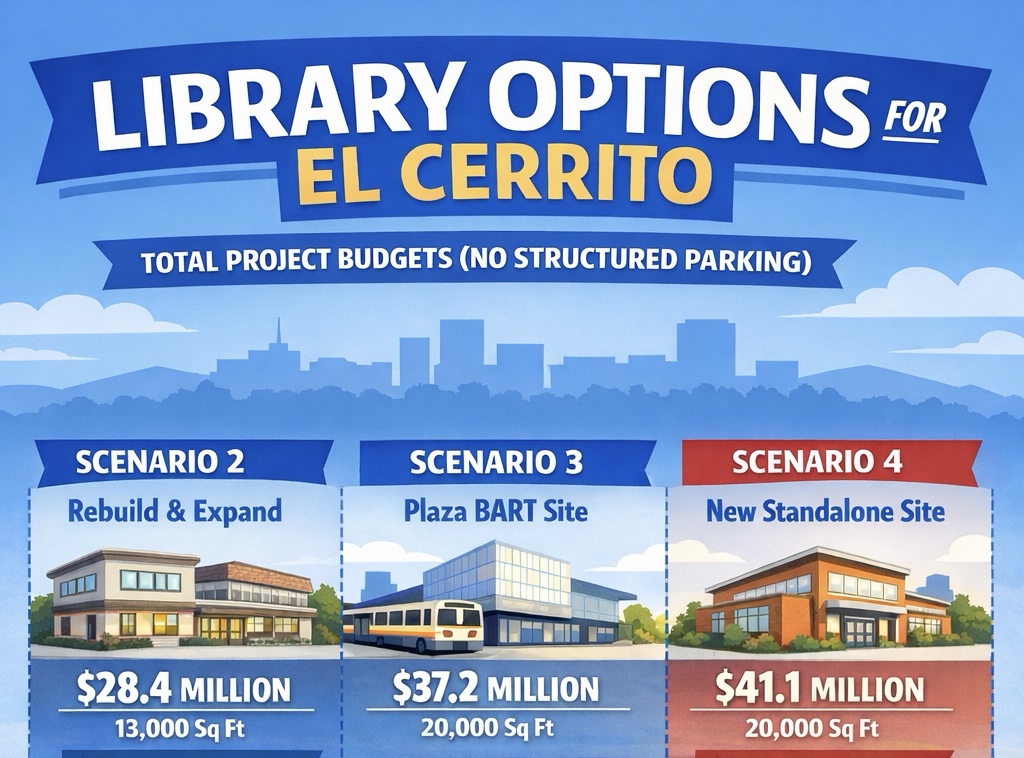
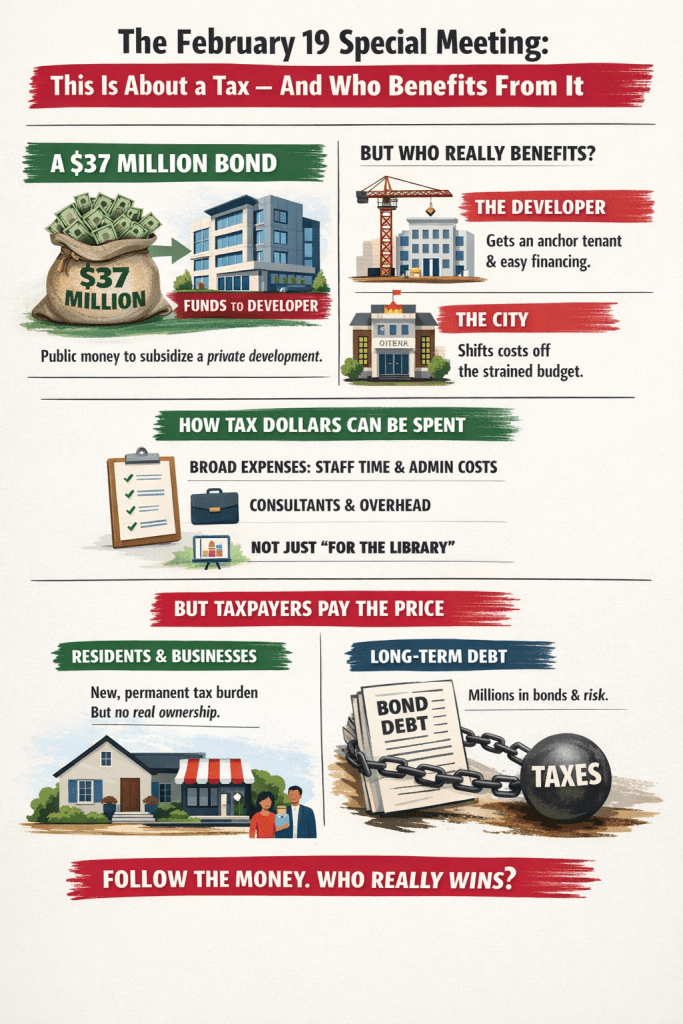
El Cerrito can modernize its library in a faster, more predictable, and far more affordable way — without taking on the financial risk of a $28 million construction project or locking residents into a 30-year parcel tax that escalates with multiple inflation factors.

The current El Cerrito Plaza proposal is the most expensive and least predictable option available. Meanwhile, practical alternatives exist that the City has not fully evaluated. Using existing buildings — such as the vacant Marshall’s or Barnes & Noble — combined with expanding the Stockton Avenue branch offers a lower-cost, lower-risk solution that does not require a parcel tax or provide a financial advantage to a developer.

It is time for the public to see the full picture.

A Practical Alternative: Use Existing Buildings and Expand Stockton

Two large, centrally located retail spaces — the old Marshall’s and the old Barnes & Noble — are currently empty. Both are:

  • 15,000–20,000 square feet
  • Easily accessible from major streets and transit
  • Surrounded by ample on-site parking
  • Available without relying on the Plaza developer’s timeline
  • Ready for quick conversion

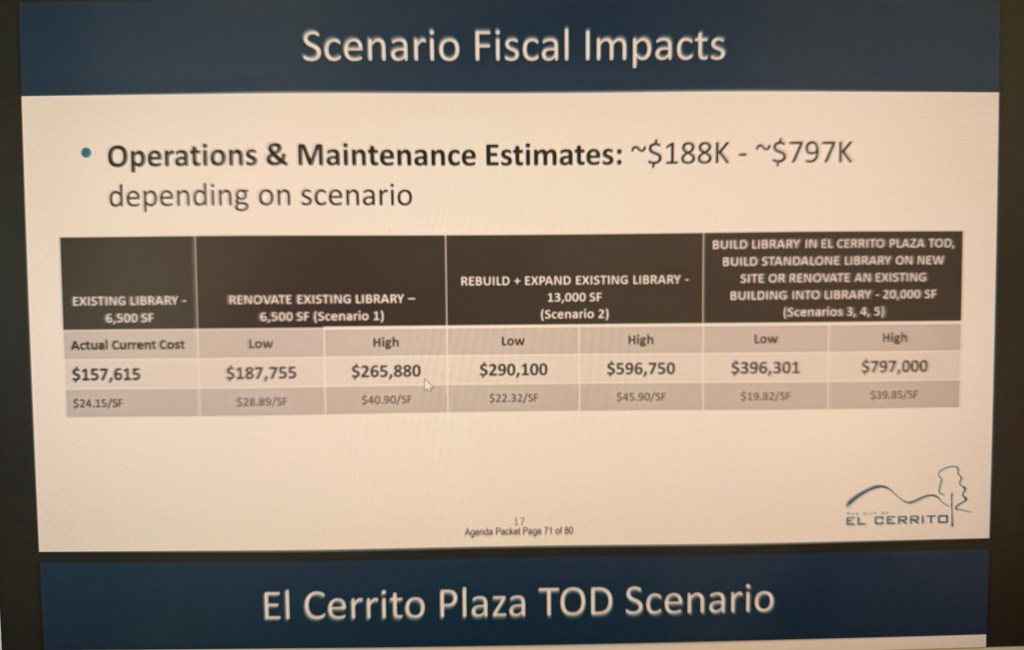
These buildings could serve as a temporary or even long-term library while the existing 6,500 sq ft Stockton Avenue library is expanded to 12,000–13,000 sq ft at a reasonable construction cost.

This combination offers:

  • Far lower total cost
  • Predictable timelines
  • Faster delivery of improved library services
  • Guaranteed parking
  • No need for a 30-year parcel tax
  • No developer handout
  • No dependency on delays or negotiations with a private developer

The City has not presented this option alongside the Plaza proposal.

How Much Would a Bridge Library Cost?

Using the City’s own rent and improvement assumptions from the October 2025 library newsletter:

  • Rent: $30/sq ft/year
  • Tenant improvements: $350/sq ft (high-end estimate used by the City)

Since this is only a 3–5 year lease during construction, the cost is straightforward.

20,000 sq ft option

  • Annual rent: $600,000
  • 3-year rent: $1,800,000
  • 5-year rent: $3,000,000
  • Improvements: $7,000,000

Total cost for 3–5 years: $8.8M–$10M

15,000 sq ft option

  • Annual rent: $450,000
  • 3-year rent: $1,350,000
  • 5-year rent: $2,250,000
  • Improvements: $5,250,000

Total cost for 3–5 years: $6.6M–$7.5M

Even using the City’s high-end improvement estimate, short-term leasing costs far less than the Plaza’s projected $28 million — and comes with guaranteed parking and minimal risk.

We could have paid for this option if the City Manager Pinkos had bothered to apply for a grant.   Instead, she’d much rather raise our taxes.

Is the Plaza the Most Expensive Option?

In almost every respect, yes.

Plaza Library (El Cerrito Plaza)

  • Cost estimate increased from $21 million to $28 million
  • No dedicated parking
  • No signed development agreement
  • No guaranteed timeline
  • Two inflation escalators (unprecedented locally)
  • Already years behind schedule
  • Financial structure benefits the developer
  • Requires a 30-year parcel tax to support uncertainty

Given El Cerrito’s fiscal constraints and history of underestimated project costs, the risks are substantial.

Twenty Years of Pursuit, But Conditions Have Changed

Former Councilmember Greg Lyman, City Manager Karen Pinkos, and a small group of insiders have advocated for a new, large library for nearly two decades – except when they had selective memory and cut the budget  ☹

 Their interest is clear, but the environment has changed significantly:

  • Digital access and online research tools have grown
  • Inter-library loan systems are robust
  • Library usage patterns have shifted
  • Construction and borrowing costs are far higher
  • The City’s financial position is weaker than in earlier years

Continuing to pursue a large, custom-designed project in today’s cost environment places significant pressure on taxpayers.

Where Is Our Road Tax Money Going?

Neighbors, we need to pay attention to what’s happening with our roads.

The latest data from the Metropolitan Transportation Commission shows El Cerrito’s pavement condition has fallen sharply—from a PCI score of 83 in 2018 to 66 in 2024, and now 65 as of July 2025. That’s a 17-point drop in just a few years, taking us from Very Good to Fair. Our three-year average PCI is now 68, which is below the median in the Bay Area.

Here’s what makes this even more troubling: this decline happened despite Measure T, our dedicated roads tax. The city raised taxes specifically to maintain and improve our streets, yet our pavement condition continues to deteriorate.

The estimated cost to return our roads to their 2018 condition (PCI 83) is now between $13 million and $27 million, as deferred maintenance becomes more expensive with each passing year.

Source: MTC Pavement Condition Report 2024
https://mtc.ca.gov/sites/default/files/documents/2025-11/%20PCI_table_2024_data_11-10-2025.pdf

So the question is simple: Where is the money going?


How did our PCI fall below the regional median even though we have a dedicated tax?


Why are the city’s stated goals lower than our historical performance—and still not being met?

If you want answers, write to your council members directly and ask why our roads are deteriorating while we are paying more.

Mayor Carolyn Wysinger — cwysinger@ci.el-cerrito.ca.us
Mayor Pro Tem Gabe Quinto — gquinto@ci.el-cerrito.ca.us
Councilmember Lisa Motoyama — lmotoyama@ci.el-cerrito.ca.us
Councilmember Rebecca Saltzman — rsaltzman@ci.el-cerrito.ca.us
Councilmember William Ktsanes — wktsanes@ci.el-cerrito.ca.us

We deserve transparency. We deserve accountability. And we deserve safe, well-maintained roads.

Correction: Clarifying Our Statement About the Library Tax Initiative

One of our readers questioned our earlier statement that the proposed ballot measure does not mention the word “library.” After re-reviewing the filed Notice of Intent and ballot materials, we confirm that the measure does reference funding for a library. Our prior statement was incorrect.


We are issuing this correction because it is the right thing to do. Accuracy matters—especially when discussing long-term taxes that will affect every property owner in El Cerrito.


We also call on the City of El Cerrito to correct its own public statements. For months, City representatives have insisted they are “not involved” in this initiative while simultaneously promoting a library tax at public meetings and funding surveys related to the library. These surveys are more about efficacy, and the city has already loaned the developer large sums of taxpayers’ money.

Residents deserve complete transparency, not selective information.

Why We Still Oppose the Library Tax Initiative

Even with the word “library” included in the text, the larger concerns remain, including:

1. Once the tax is approved, the funds will flow into the General Fund.

El Cerrito has a long pattern of presenting taxes as dedicated to a purpose—only for the revenue to be deposited into the General Fund without meaningful tracking or oversight. This has occurred with the Real Property Transfer Tax, the Utility Users Tax, the Pool Tax, and the 2008 Streets Tax. Promises of reviews, audits, and accountability have repeatedly gone unfulfilled.
On paper, the library initiative states the funds are for a library. In practice, the City’s history shows that those funds will not be segregated, audited, or protected.

2. The City is only at “Stage 1” of its capital project pipeline—but the library is Stage 6.

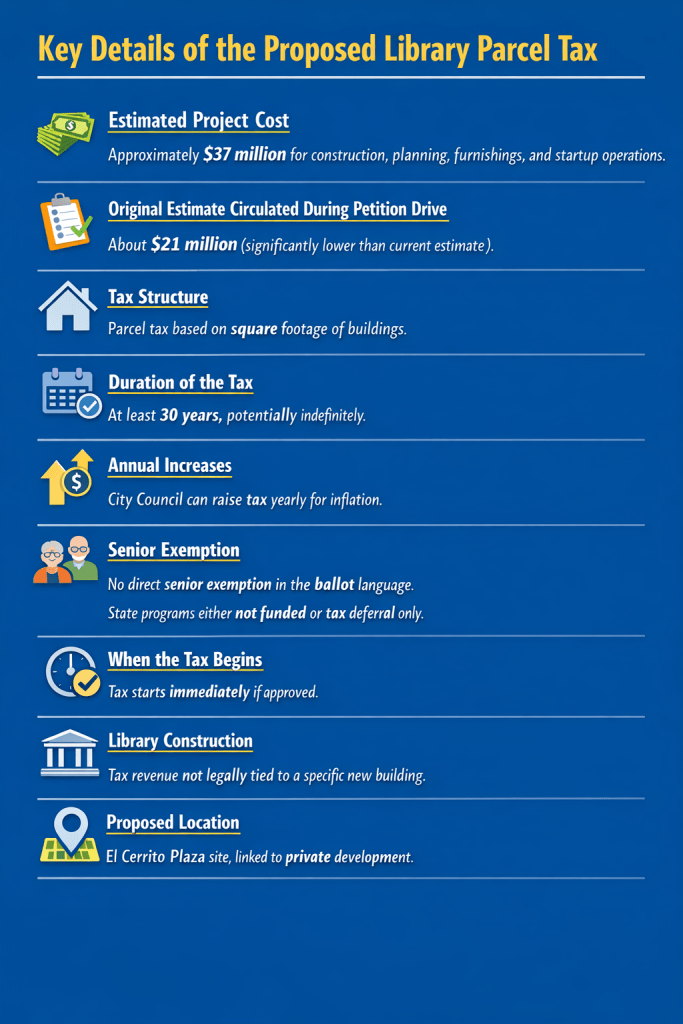
Under the City’s own adopted roadmap, a new library is far down the priority list. If the tax passes in June, property owners will begin paying in July—immediately and indefinitely—regardless of whether the library moves forward, stalls for years, or is never built. Taxation starts on Day 1. The project is years from readiness.

Our Commitment to Accuracy

We corrected this because facts and transparency matter. We appreciate the reader who raised the question—it made this review possible. Residents deserve honesty, clarity, and accountability from every source, including us.

Is the El Cerrito Library Tax a Community Initiative?

Supporters of a new tax to fund a future library have been quick to call their effort a “citizen initiative.” Legally, that’s correct — 10% of registered voters must sign a petition to qualify a measure for the ballot.

But let’s be honest about what actually happened:

Roughly 1,800 verified signatures — in a city of 18000 voters — does not represent a groundswell of civic engagement.


It represents the bare minimum needed to avoid the more challenging path: a City Council vote requiring at least 4 of 5 council members (66⅔%) to approve placing a special tax on the ballot.

And that’s the point.

This isn’t about citizen empowerment — it’s about political convenience

Greg Lyman — the author of the measure, former councilmember, and long-time Plaza Library promoter — clearly understands the math. He also understands that four City Council votes might not be guaranteed when the stakes involve a permanent tax without clear accountability.

So instead, the initiative route allows:

A simple majority vote of the Council to send it to the ballot
A special tax requiring only a simple majority of voters to pass

All while framing the campaign as “community-led.”
Smart politics? Sure.
Transparent democracy? Not so much.

How Small Is 1,780 Signatures?

El Cerrito has roughly 25,000 residents and 18,000 registered voters.

To qualify this measure, organizers only need about 1,780 valid signatures.

That means:

📌 Only ~7% of residents needed to sign
(1,780 ÷ 17800 ≈ 10%)

Put differently:
90% of the people who will be taxed did not sign the petition.

Yet this small percentage could trigger a forever tax that raises at least $2.7 million every year.

$2.7 Million a Year — Without Saying “Library” Even Once

Supporters call this a library tax. The campaign name includes the library. All messaging promotes the library.

But the initiative language itself:

Does not include the word “library.” Not even once.

Because without naming the purpose, the funding is unrestricted:

  • Pensions
  • Payroll
  • Consultants
  • Routine maintenance
  • Budget holes

The money can be used in any way the city chooses
Even if no new library is ever built.

And the tax:

📌 Has no expiration date

It is forever.

What Residents Are Being Told vs. What’s Actually Written

Here’s the reality in one quick snapshot:

📌 FACT BOX

“Library Initiative” — What the Campaign Says vs. What the Measure Actually Does

Campaign MessagingActual Initiative Language
“This is a library tax.”The word ‘library’ does not appear once.
“Funds will build a new library.”Tax revenue can be spent on anything the City chooses.
“Community-driven initiative.”Only ~10% of residents needed to sign to qualify.
“High level of community support.”“This is about the Plaza Library.”
“This is about a Plaza Library.”No site is required, no project is guaranteed.
“Investing in our future.”Tax lasts forever, even with no library built.
“Urgent need.”City has no project timeline, no cost cap.

Everyone Wants a Library — But We Deserve the Truth

El Cerrito deserves:

🔹 A real project
🔹 A clear location
🔹 Proper cost accountability
🔹 An end date when the purpose is complete
🔹 Funding tied to actual deliverables

Right now, residents are being asked to hand over a permanent revenue stream — with zero guarantees.

We’ve Been Through This Before

El Cerrito has a track record:

  • New taxes are sold for specific community benefits
  • Once passed, revenue sinks into the General Fund
  • Promised improvements never fully materialize

Residents have every reason to approach this measure with eyes wide open.

The Bottom Line

The City didn’t want to risk needing a supermajority of the Council.

So they’re using a technical workaround to create a forever tax — marketed as a library, but not legally required to fund one.

A citizen initiative in legal form? Yes.
A citizen mandate? Absolutely not.

Make Your Voice Heard — This Is Our City

El Cerrito residents are smart. We read the fine print.
And we know when we’re being sold a feel-good story to cover a forever tax.

If the City and political insiders want $2.7 million a year indefinitely,
then they should be honest about what the money is for —
and guarantee it funds a real library.

Until that happens…

📣 Show up and speak up at City Council meetings
📣 Ask direct questions about where the money will actually go
📣 Demand transparency before any tax goes to the ballot
📣 Let leaders know we see through the smoke screen
📣 And if this measure reaches the ballot… Vote NO

Because we all support better services.
We all want a library that serves every part of our community.
But a perpetual blank check is not the way to get it.

El Cerrito deserves real accountability —
not another tax with no guarantees.

Gabe Quinto’s Path to Re-Election: Promises vs. Reality

The city of El Cerrito is approaching a key moment: Gabe Quinto — now in his eleventh year on the City Council — has confirmed to Livable El Cerrito on October 31, 2025, that he plans to run for re-election in 2026. At the same time, he is slated to be selected as mayor in December 2025 and serve throughout 2026.
This blog takes a closer look at the promises and rhetoric he has advanced — and contrasts them with the public record and local commentary to date. If you’re a resident with an eye on accountability and outcomes, this is a meaningful conversation.
📧 Contact: gquinto@ci.el-cerrito.ca.us

His stated priorities and public narrative

According to his official bio:
Quinto was first elected in 2014; his current term ends in 2026.


He presents himself as a proponent of good governance, diversity, equity, and environmental stewardship.
He identifies publicly as El Cerrito’s first Filipino-American and LGBTQ Councilmember — and the city’s second Asian American elected official.


His stated priorities include “equity, fiscal responsibility, and public safety.”


In short, the public story is of a seasoned Councilmember who is a progressive voice committed to inclusion and responsible management.

Where the gaps between rhetoric and practice show up

  1. Fiscal responsibility vs. budget management
    Quinto often speaks about fiscal responsibility, yet under his tenure, El Cerrito has repeatedly faced structural deficits, depleted reserves, and heavy dependence on new tax measures. The city’s reserve position remains fragile, and the so-called “balanced budget” masks mid-year asks and long-term liabilities, including a pension debt exceeding $80 million.
  2. Equity and transparency vs. governance culture
    While Quinto’s messaging emphasizes inclusivity and transparency, city governance remains closed. The city reveals only years-required information and doesn’t allow remote comments, which impacts the elderly, mobility-challenged and those with children. El Cerrito is opaque and heavily staff-driven, with limited citizen oversight.
    During his last campaign, he claimed to be a college graduate but hadn’t graduated.
  3. Service delivery vs. resident experience
    Despite claims of supporting community safety and strong city services, residents report slower response times, aging infrastructure, and declining service quality. Key community facilities — such as the senior center and library — remain unfunded or delayed, even as new taxes are discussed.

New Taxes Initiated While Quinto Was in Office
Since Gabe Quinto first took office in 2014, the city of El Cerrito has approved several significant revenue measures. These include:

  • The real-estate transfer tax: according to the city’s official FAQ the rate is $12 for every $1,000 of the purchase price. Contra Costa Vote+3elcerrito.gov+3el-cerrito.org+3 The transfer tax is codified in the Municipal Code (Chapter 4.64) at that rate. elcerrito.gov+1
  • Layered parcel assessments and special taxes tied to landscaping, lighting, storm‐drains and general services have continued — even those pitched initially as temporary. Local commentary notes “every major measure since 2014… has become permanent and gone into the General Fund.”
    These new and continuing tax burdens, enacted under an agenda of “maintaining services,” raise questions about what further tax expansions residents might be asked to support when existing taxes remain in place indefinitely.

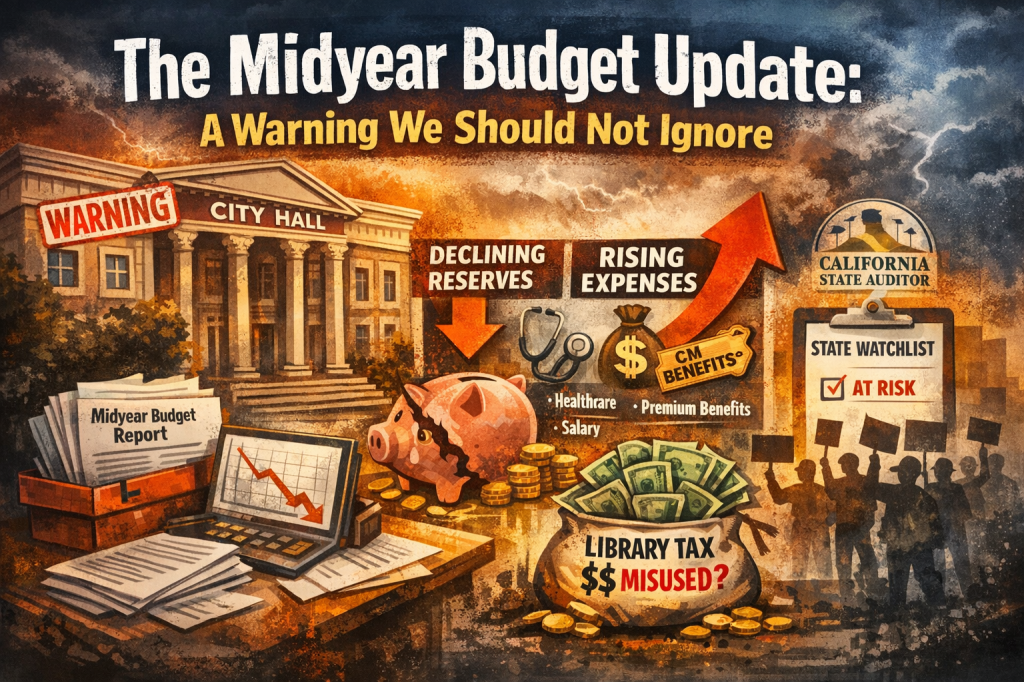
Financial Difficulties: Auditor Report, Bond Ratings and Depleting Reserves
While the city has raised new taxes and extended others, the financial backdrop shows notable stresses. According to the California State Auditor, in its audit report of the town, the city’s fiscal year 2020-21 audited statements reported a general fund reserve of only $7.1 million — or 19 % of the city’s general fund expenditures — with general fund revenues exceeding expenditures by about $6 million. California State Auditor

 The auditor noted that the increase in revenue was primarily driven by an unexpectedly robust real estate market (real estate transfer tax revenue $4 million in FY 20-21, 53 % more than expected) — revenue the city may not reliably count on going forward. California State Auditor On the bond rating front, while the city recently secured an upgrade from S&P Global Ratings in September 2025 (from “BBB” to “A-” then “A+” on particular debt) the upgrade came amid commentary that underlying finances remain in the bottom 20 % of 400 + California cities — meaning roughly 80 + cities are in worse shape, leaving about 320 + cities in better fiscal condition.  Taken together, the tax increases, deferred infrastructure and service needs, pension liabilities and historic reserve depletion mean the city’s claim of “balanced budget” must be scrutinised in light of longer-term liability and sustainability questions.

What this means for 2026
With Quinto slated to serve as mayor throughout 2026, his leadership record will face unprecedented scrutiny.

  • Visibility and accountability: Every policy decision will be seen as a reflection of his leadership.
  • Fiscal transparency: Residents deserve clear reporting on reserves, liabilities, and performance measures.
  • Community voice: True inclusivity means more than representation — it requires responsiveness and implementing public comment.
  • Measurable impact: Voters should expect progress reports tied to outcomes, not slogans.

Questions for residents to ask

  • How will Quinto define and measure “fiscal responsibility” going forward?
  • What steps will he take to ensure open data and genuine budget transparency?
  • How will he restore trust in city management and strengthen oversight?
  • What’s the concrete plan for essential community services — not just long-term aspirations?

Final thoughts
After more than a decade on the Council, Gabe Quinto enters a defining chapter of his political career. This year offers him a critical opportunity to demonstrate whether his leadership can bridge the gap between promises and measurable progress. For residents and stakeholders, now is the time to engage, ask questions, and hold city leadership accountable.

Why El Cerrito Residents Pay More — And Get Less

We reviewed the new Master Fee Schedule. The Council quietly approved the changes after about a decade of no changes. They could have explained the changes, but it’s hard to explain why El Cerrito residents are paying some of the highest costs in the region for basic city services. But it’s not because our services are better. It’s because the City of El Cerrito has built a costly, inefficient staffing and overhead structure — and residents are footing the bill every day.

The City’s own Master Fee Schedule shows what it really costs them to complete routine work. These fees are not market prices — they reflect the internal payroll and overhead required to get the job done.

That means every fee — every permit, every inspection, every small interaction — is a window into how expensively the City operates.

El Cerrito Is an Outlier in Payroll Costs

Compared to nearby cities performing the same public functions:

CityFully Burdened Staffing + OverheadCost Per ResidentPerformance Notes
El CerritoHighest in region$1,977Lower pavement condition, slower capital progress
AlbanyLower payroll cost$1,684Smaller city, more efficient
HerculesLower payroll and contract service mix$1,654Similar population and size as EC
PinoleCompetitive cost structure$1,772More conservative service delivery

Using the City’s own cost model, several standard permits illustrate this pattern.

The Cost of Bureaucracy — A Few Examples

These fees reflect the cost to City staff to perform the work, not what the City chooses to charge.

Source: El Cerrito Master Fee Schedule — fully burdened labor rates

2025-26 Master Fee Schedule – U…

ServiceEl Cerrito CostIf Albany Staff Did the Same WorkDifference
Tier 1 Project Review$3,027$2,573Residents pay 18% more
Tier 1 Temporary Sign Permit$122$104Residents pay 17% more
Building Re-Inspection$254$216Residents pay 18% more
Rental Housing Inspection (single-family)$334$284Residents pay 18% more

And these are just a few. There are hundreds of fees just like them.

The Core Problem

El Cerrito’s budget isn’t bloated because:

✗ Our services are larger
✗ We offer more programs
✗ Our infrastructure is world-class

The real reason:

Too many layers of staffing + too much overhead for the work performed.

And when those systems underperform — as we’ve seen with pool repair delays, lack of a library plan, and declining streets — residents pay again, this time through new taxes.

Residents Pay More — While Services Underperform

El Cerrito families are already hit with:

✔ Higher fees
✔ Higher taxes
✔ Slower project delivery
✔ Lower quality results

This isn’t sustainable.

We deserve a city government that:

  • Delivers more per dollar
  • Sets staff levels based on real need
  • Stops charging residents for inefficiency

What Needs to Change

A citywide operational assessment is long overdue. Priorities must include:

1️⃣ Right-sizing staffing to what is necessary
2️⃣ Aligning labor cost to service delivery
3️⃣ Eliminating redundant administrative layers
4️⃣ Transparent performance reporting
5️⃣ Long-term financial accountability

El Cerrito’s future depends on it.

Residents Can Drive Accountability

Demand clarity. Demand performance. Demand value.

Our community deserves a city that is:

Efficient. Responsible. And working for the people who pay the bills — us.

Leadership Isn’t Optics — It’s Obligation

Mayor Carolyn Wysinger and the Measure of True Inclusion

Mayor Carolyn Wysinger entered office with a powerful story — one rooted in representation, visibility, and inclusion. As the first openly Black lesbian mayor in California, her leadership carries symbolic weight and a promise of progress for a city still emerging from years of fiscal strain. Under her tenure, El Cerrito has been removed from the State Auditor’s “high-risk” list, celebrated for its diversity, and publicly branded as a welcoming, forward-looking community.

Those achievements matter. But headlines don’t measure leadership — it’s measured by follow-through.

The State Auditor’s “high-risk” list includes the bottom three percent of California cities. Getting off that list doesn’t mean financial stability; it simply means the city is no longer in bankruptcy freefall. El Cerrito’s unfunded pension liability still exceeds $80 million—the city hasn’t paid a dime against it; personnel costs consume roughly 73% of the General Fund; pension costs are 16% of the budget; and reserves remain at the bare minimum required by policy. These are not indicators of fiscal health. They are warning lights.

Passion and identity can inspire, but they cannot substitute for disciplined governance. The city still lacks a funded capital renewal plan for its infrastructure. Service levels remain inconsistent. And despite ambitious language about transformation, there is little published evidence of measurable improvement in basic functions — no clear data showing faster pothole repairs, restored library hours, or reduced reliance on reserves.

That gap between message and measurable outcome became painfully evident in the Richmond Street “Complete Streets” project.

When Leadership Forgets to Listen

Mayor Wysinger’s handling of the Richmond Street project reflects a troubling disregard for the people who are most vulnerable in this city — the elderly, the disabled, and multigenerational families — and a pattern of dismissiveness that runs counter to the basic principles of ethical leadership.

A just leader listens most carefully to those who will be most affected by change. When longtime residents raise concerns about access, safety, or being cut off from their homes, that isn’t privilege — that’s lived reality. Dismissing those concerns as “performative activism” or framing them as obstructionist doesn’t make you brave. It makes you careless with other people’s lives.

A truly just vision for the future never treats elders as disposable. It never builds policy on the assumption that walking farther, enduring more pain, or navigating inaccessible infrastructure is something people should simply “tough out.” The measure of any community isn’t how sleek its plans are — it’s how it treats those whose bodies, needs, and histories aren’t convenient.

The rhetoric used — suggesting you “can’t find empathy,” brushing off the loss of curb access as irrelevant, and implying that people in houses don’t represent the working class — shows a fundamental misunderstanding of the very residents you claim to represent. El Cerrito is full of homes where three and sometimes four generations share the same roof: caregivers coming home from double shifts, grandparents caring for grandchildren, and people living with chronic pain or disability. If they’re not part of your vision, then your vision isn’t one of equity — it’s one of exclusion.

The Real Test of Leadership

Leadership demands more than passion. It requires restraint, accountability, and the humility to serve those who are not politically advantageous.

Mayor Wysinger has elevated El Cerrito’s profile and restored a measure of civic pride — but progress must extend beyond image. The work now is to rebuild fiscal integrity, deliver reliable services, and prove that inclusion is more than a brand.

A city that claims compassion must show it in its budgets, its projects, and its tone. It must weigh every decision against one question: Who will this help — and who will it leave behind?

Mayor Wysinger has had several years to prove herself, and she has shown us little. It’s time to elect someone who not only has passion but also possesses financial expertise — something she has consistently lacked — and a strong dedication to services that directly enhance residents’ lives.

If you share these concerns, make your voice heard:
📧 cityclerk@ci.el-cerrito.ca.us
🌐 http://www.el-cerrito.org/CityCouncil

Why Are We Calling It a “Library Initiative”?

Understanding What’s Actually Being Proposed in El Cerrito

In recent months, El Cerrito residents have increasingly heard about a “library initiative.” The term sounds straightforward — a voter measure dedicated to building and supporting a new public library. But here’s the issue:

📌 There is no specific proposed legislation focused solely on library services currently in the public domain.

Instead, what is being discussed behind the scenes — and promoted publicly — is a parcel tax that could be used for a variety of purposes. A new library building may be one of those purposes… but it is not the only one. And no publicly available draft measure limits funds to the library exclusively.

So, why are we being asked to think of this as a library initiative?


What We Do Know: A Parcel Tax Is Under Consideration

One version of the proposal circulating suggests:

🔹 Tax structure

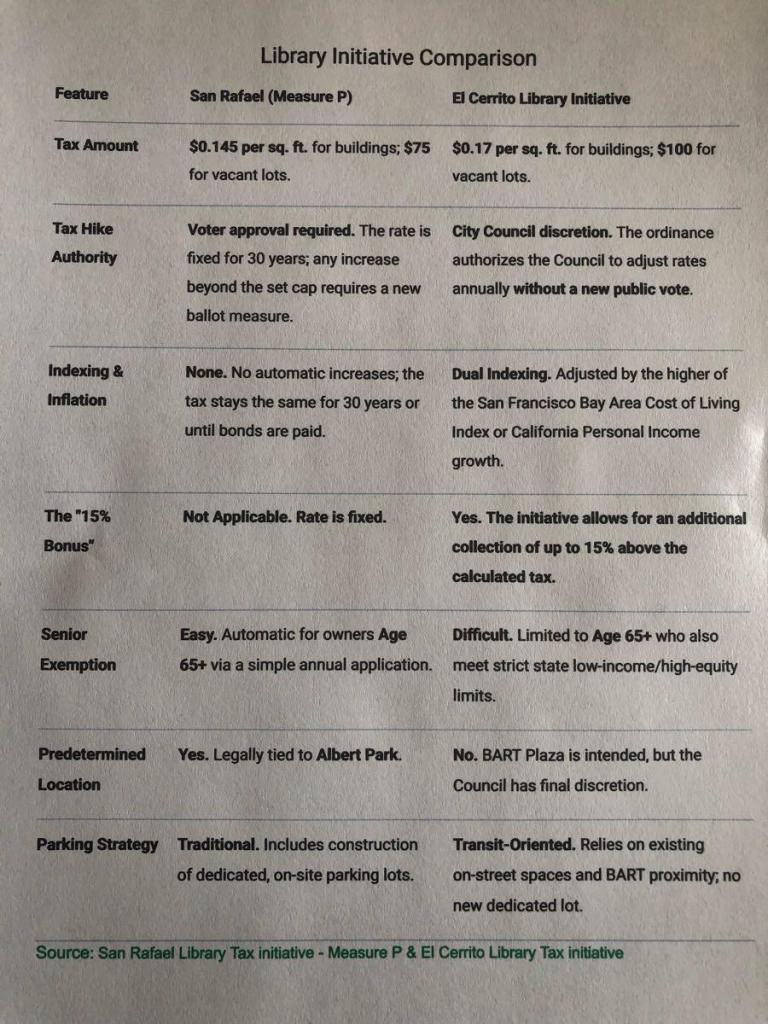
  • $0.17 per square foot of improved property
  • A special tax, meaning it is not based on property value
  • Administration by the Contra Costa County Treasurer-Tax Collector

🔹 Annual inflation increases

The City Council could raise the tax each year without voter approval.
This means costs will grow automatically year over year.

🔹 Estimated impact on homeowners

  • $288 per year for an average-sized home in Year 1
  • Significantly higher in later years due to inflation adjustments

🔹 Limited exemptions

Qualifying seniors may be exempt under:

  • Senior Citizens Homeowners and Renters Property Tax Assistance Law
  • Senior Citizens Property Tax Postponement Law

These exemptions are not automatic and require qualifications that not all seniors meet.


Where Would the Money Go?

That’s the biggest concern.

The City could designate the tax for:

  • A new library
  • Public safety
  • Infrastructure
  • Parks
  • BART-related housing or other development

In other words:
📌 The funding would benefit general city priorities — not necessarily the library.

Even the city’s own website states the project is “for City Council and voter consideration,” signaling that nothing is guaranteed.

Meanwhile…

  • The City loaned $350,000 of taxpayer funds to a developer connected with the project.
  • The project is actively advertised on the City’s website, despite claims that the City is not involved.

This contradiction raises a fair question:

If the City isn’t involved, why are taxpayer dollars and City resources supporting the effort?


Important Financial Considerations

ConcernWhat It Means for Residents
Annual Inflation IncreasesThe tax becomes more expensive every single year
Disproportionate ImpactOwners of modest or longtime homes may pay more relative to property value
Long-term CostTax burden could reach tens of thousands over the life of the measure
Bond SubsidiesFunds could potentially support developers rather than just public facilities

This isn’t about opposing investment in our community.
It’s about making sure voters get the whole picture before being asked to approve another tax.

Why This Matters

El Cerrito residents have already watched past tax measures shift direction after approval:

  • Streets not repaired as promised (PCI declining from 85 to 68)
  • Senior center permanently closed after promising continued services
  • Pool repairs delayed and costs skyrocketing
  • Public safety equipment still unfunded despite a public safety tax

Taxpayers deserve transparency. A true library initiative would clearly state:

✔ Precisely what it funds
✔ Total tax cost over time
✔ Legally binding restrictions so funds cannot be diverted
✔ Accountability for results

Today, none of that is guaranteed.

What You Can Do: Your Voice Matters

Major tax decisions shouldn’t move forward without clear, honest communication. Residents deserve a direct explanation — not branding that obscures the real purpose and impact of a new tax.

If you care about transparency and responsible spending, now is the time to speak up.

Attend City Council meetings and ask:

1️⃣ Why is the City claiming it is “not involved” — while:

  • Loaning $350,000 in public funds to a developer, and
  • Promoting the library concept on the official City website?

2️⃣ Why is this being called a “library tax” when there is no ballot language dedicating funds exclusively to library construction or services?

3️⃣ Why does the tax structure appear to funnel revenue into the General Fund — while being marketed to residents as a library measure?

These are direct, reasonable questions. And they deserve direct, truthful answers — not shifting language or vague assurances.

Show Up. Speak Up. Stay Engaged.

You don’t need to be an expert in tax law to ask for honesty.

📅 El Cerrito City Council Meetings
1st and 3rd Tuesdays monthly — 6:00 PM
City Hall, Council Chambers
10890 San Pablo Avenue

💻 Livestream and agenda available on the City website

When residents participate, decisions improve.
When we ask informed questions, transparency increases.
When we hold leaders accountable, public trust is strengthened.

Bottom Line

Calling this a “library initiative” may be a way to encourage support — libraries are popular, beloved community assets. But at this moment, the proposal appears to be:

📌 A new parcel tax with broad spending potential and automatically rising costs — not a dedicated library measure.

Before any vote moves forward, taxpayers should insist on:

🔍 Transparency
📊 Clear fiscal impacts
🧾 Binding legal protections
📣 Honest communication

Until then, the name doesn’t match the proposal.

El Cerrito First Quarter Financial Update: Key Takeaways

If you tuned into this week’s City Council meeting, you probably noticed something unusual — the financial presentation actually made sense. That’s thanks to Claire Coleman, who walked through the First Quarter General Fund update with calm confidence. No reading word-for-word from a script. No jargon marathon. Just a clear explanation of where we stand and what we should expect. That alone makes her stand out. In most departments, the department head presents directly to the Council. Finance works a little differently, and the contrast to the department head’s communication style is hard to miss.

First Quarter Results: “It’s Early” — but a Few Things Are Already Showing

Claire reminded everyone that first-quarter numbers don’t tell much of a story. Our revenues are notoriously cyclical, and Q1 is usually the quietest quarter of the year. Still, we’re tracking close to where we were last year — with one significant difference: salaries are up about 5%. The long-term impacts of negotiated raises are definitely starting to show.

Revenues: Timing, Cycles, and a Few Surprises

Property Tax

Almost no property tax money shows up until December. That’s just how the County schedules payments.

Sales Tax

Sales tax always arrives a couple months late because of state processing. So the “drop” we saw in Q1 isn’t a real drop at all — just a delayed payment.

Licenses & Permits

We’re on budget but lower than last year. That’s mostly because permit activity is unpredictable. One big project can completely reshape this category, and a large one may be coming soon.

Fines & Forfeitures

Higher than last year, mostly due to more police citation activity.

Use of Money & Property

Much higher because the Section 115 Pension Trust is now producing investment returns that didn’t show up in last year’s first quarter.

Charges for Services

Lower because Recreation only ran nine weeks of summer camp instead of ten. Fewer weeks = fewer fees, but also fewer staffing and supply costs.

Spending: Salary Growth Front and Center

Even though most spending is pacing close to last year, salary costs are up about 5%. This isn’t a one-time jump — it’s the ongoing effect of earlier contract increases. And because salaries influence overtime rates, pension contributions, and benefits, these increases compound over time. It’s one of the most significant budget pressures this year.

A Clarification the City Didn’t Make: Normal Cost vs. UAL

There was one moment in the discussion that deserves clarification.
Councilmember Motoyama asked whether the City had made payments toward the Unfunded Accrued Liability (UAL). Claire responded that the City made payments “in advance.” That sounds reassuring — but it’s not accurate in the way most people would interpret it.

El Cerrito has not made advance payments on the UAL.

What the City did instead was make advance payments on the “normal cost” — the portion of pension costs that funds the benefits employees earn this year. That’s standard, predictable, and ~$9 million of the annual budget.

But the UAL is something different entirely.

In CalPERS terms:

  • Normal Cost
    The yearly cost of benefits employees earn this year. It’s paid through employer and employee contributions.
  • Unfunded Accrued Liability (UAL)
    This is the long-term shortfall — the amount owed because past investment returns didn’t meet CalPERS’ assumptions. It’s driven heavily by safety employees (police and fire), but it includes all City staff. The UAL is the debt the City still needs to pay down over time.
  • The question was about the UAL, but the answer addressed only the normal cost.

We recognize that Claire may not have wanted to contradict the councilmember, but that is not the same thing—and residents deserve a clear explanation of the difference. Paying the normal cost early does not reduce the pension debt. It simply pays this year’s bill a little faster.

Why Q1 Doesn’t Tell the Whole Story

Q1 is always the calmest quarter, which is why it rarely gives us the whole picture. Significant revenue comes later, overtime is unpredictable, and program fees rise and fall with the seasons. Mid-year is when the numbers start telling the truth about how healthy — or strained — the City’s budget really is.

Why These Decisions Matter: Our Reserves Are the City’s Safety Net

One thing that’s easy to miss in all the financial talk is how little cushion the City has. El Cerrito’s unrestricted reserves — basically the portion of the General Fund we can actually use — are already pretty limited. According to the City’s own First Quarter Budget Update, the General Fund balance is projected at about $23.9 million. But that number doesn’t mean what it sounds like. Here’s the breakdown: $11 million of that is restricted or already committed (Emergency Disaster Relief Fund, Section 115 Pension Trust, non-spendable items, etc.). That leaves about $12.8 million in true discretionary reserves. And only $3.6 million above the City’s minimum reserve requirement.

That’s not much breathing room for a city of this size — mainly because none of the pool-related costs are included in that $3.6 million cushion. The pool project — with significant capital and long-term operating costs — sits completely outside the reserve calculation Claire presented. These are the same dollars that help El Cerrito: keep essential services running if the economy slows, respond to emergencies or disasters, cover cash flow gaps when revenues are delayed, and absorb unexpected costs without sliding back into financial trouble. Every time the City draws from what’s left of this cushion, we shrink our margin of safety — and with rising labor costs, volatile revenues, and significant projects looming, that margin matters more than ever.

Growing Concern: Pool Costs Keep Shifting

In recent meetings, the public was shown two possible approaches to fixing the aging Emery G. Weed, III Lap Pool: a straightforward “replaster-only” repair estimated at under $400,000, or a full rehabilitation costing around $3.5 million. Based on those figures, residents could reasonably expect a clear decision and a predictable path forward.

Instead, we’re now looking at a $970,000 estimated cost just for design-related services and preliminary work — more than double the amount discussed for the basic repair itself.

According to the staff report, the City proposes awarding a $220,000 contract to Rogers Stringer & McClelland, Inc. (RSM) for design services. But once accessibility upgrades, electric vehicle infrastructure, and other add-ons are included, the “initial phase” alone climbs to nearly $1 million with full rehabilitation at $3.5 million. This is a significant shift from what residents were told initially. It raises an obvious question:

What exactly is included in each cost estimate, and how do these new numbers relate to the earlier repair options?

At this point, it’s also important to note that the City has already gone out to bid for pool work. And given that the lower-cost repair option has now been widely publicized, it is unlikely that any bid will come in below the numbers the City itself has announced. Once a publicly established price floor is set, contractors rarely underbid it.

This only reinforces the need for a transparent, consistent explanation of what the City is trying to build — and how much it will ultimately cost.

What El Cerrito’s Reserves Really Look Like

Projected General Fund Balance: $23.9 million
But here’s what’s actually usable:
$11.0M – Restricted or already committed
$12.8M – True unrestricted reserves
$3.6M – Amount above the City’s minimum reserve requirement


And importantly:


Pool project costs are not included in this reserve cushion. What the reserves protect the City from:
• Economic downturns
• Cash-flow delays
• Unexpected cost spikes
• Future fiscal instability


Bottom line: Our actual safety net is far smaller than the headline number suggests — and major projects like the pool aren’t included in that cushion at all.

Clear Communication Matters — and Claire Set the Standard

What stood out more than any chart or table was how the information was shared. Claire explained everything in a way that regular residents could follow. She didn’t hide behind complex terminology. She didn’t read from a script. She didn’t talk in circles. For a city that has struggled with public trust — especially around finances — this level of clarity isn’t just nice to have; it’s essential. If El Cerrito wants residents to believe in its financial recovery, this is the kind of honest, straightforward communication we should expect every time.

Why Residents Should Stay Engaged

Even with limited Q1 data, a few things are already clear: salary costs are rising faster than other revenues, permit revenue may hinge on a single large project, citation activity is up, and the City still hasn’t shared its assumptions around vacancy savings. These are exactly the kinds of trends that deserve close attention as the year goes on.

A Model for How Financial Reporting Should Be Done

If the City wants to demonstrate transparency, this presentation is a strong example of making progress. Clear. No drama. Some confusion, but an improvement. Exactly what residents deserve — and precisely what builds trust in a city still working to stabilize its financial footing.

The Controversy of Library Foundation Donations in El Cerrito

A concerned El Cerrito resident’s perspective
The discussion surrounding El Cerrito’s library has become one of the most complicated and emotionally charged issues in our city. While residents debate the financial responsibility and structural soundness of the proposed Plaza Station Library plan, another issue also deserves attention: the funding of the campaign supporting this measure. Recent filings reveal that the El Cerrito Library Foundation has contributed $5,800 to the political committee advocating for the parcel tax, making it the largest single contributor. This fact alone should give residents reason to pause. Furthermore, library foundations in California are typically organized as 501(c)(3) nonprofits, which means federal law prohibits them from participating in political campaigns—especially those involving taxation or ballot decisions that directly impact the community.

What Library Foundations Cannot Do

Library foundations are typically 501(c)(3) nonprofit organizations. Under federal law:

🚫 They cannot donate to political campaigns

This includes any contributions to:

  • Candidates
  • Candidate committees
  • Political parties
  • PACs
  • Committees supporting or opposing candidates

🚫 They cannot intervene in political campaigns

They may not support or oppose any candidate for public office. Even the appearance of political involvement can jeopardize their tax-exempt status.

What Library Foundations Can Do

Library foundations do have some latitude:

✔ They may support a ballot measure

They can contribute to a separately formed ballot measure committee.

✔ They can educate the public

They may hold informational sessions and provide facts.

✔ They can advocate as individuals

Board members may advocate personally—but not with foundation resources.

✔ They may help establish a separate committee

This committee must be legally distinct and not funded by charitable donations intended for library operations or improvements.

Why This Donation Raises Concerns

The issue here is not whether residents want a new library; rather, it is whether they can afford one. Virtually everyone wants updated facilities, more space, and a community hub. The real issue is whether a charitable foundation—trusted to steward donor money responsibly—should be financing a political campaign aimed at imposing a permanent tax on residents. Donors give to the Library Foundation because they want to support programs, equity initiatives, better collections, children’s services, and literacy. They do not donate so their money can be used to influence political outcomes. Even if the Foundation’s donation is technically allowable under certain ballot-measure rules, it still undermines public confidence. In a small city like ours, trust is everything. And this action erodes that trust.

The Money: Who Is Funding the Campaign

According to official filings, the Committee for a Plaza Station Library has:

  • Received: $16,699.40 (first 9 months of 2025)
  • Spent: $24,465.23
  • Cash on hand: $5,939.73

Top contributors include:

  • El Cerrito Library Foundation — $5,800
  • Friends of the El Cerrito Library — $1,800
  • Tom Panas — $2,500
  • Paul Fadelli — $1,000
  • Gary Pokorny — $600
    The Library Foundation is the largest contributor to this political effort. When nonprofit foundations behave like political machines, donor trust collapses.

Why This Matters to Every Resident

This is not about being “for” or “against” the library. This is about transparency, ethics, and respect for community funds. When charitable organizations enter political campaigning:

  • Donor money is diverted away from its intended purpose
  • Political influence becomes uneven
  • The boundary between charity and politics is blurred
  • Residents lose confidence in institutions meant to serve them
    El Cerrito already struggles with transparency issues—remote meetings, limited recordings, and inconsistent public access. Allowing our library foundation to function as a political donor only deepens public concern.

A Better Path Forward

If the Foundation wants to support a future library, there are responsible options:

  • Raise capital funds
  • Support programs
  • Build reserves for a future facility
  • Strengthen partnerships
  • Support literacy and access initiatives
    None of these requires financing political campaigns.

Call to Action: Tell the Library Foundation to Rescind the Donation

If you believe charitable dollars should support the library—not political campaigns—you should make your voice heard. The Library Foundation’s $5,800 donation undermines the neutrality and credibility that nonprofits must maintain. Ask them to act responsibly and rescind the contribution.

Write to the El Cerrito Library Foundation

El Cerrito Library Foundation
6510 Stockton Avenue
El Cerrito, CA 94530
Email: info@eclibraryfoundation.org
Tell them:

  • Donor funds should support library programs and services, not politics
  • Using charitable funds to fund a campaign erodes community trust
  • The Foundation’s credibility depends on political neutrality
  • Rescinding the donation is the responsible and ethical path
    Your message does not have to be long. What matters is that the Foundation hears from the community it serves.

Final Thought

El Cerrito residents can get a modern library and a senior center funded from the budget—and it deserves ethical, transparent institutions. A charitable foundation’s role is to uplift the library, not influence the outcome of a political campaign. Restoring trust starts with a straightforward step: keeping politics out of charitable giving.

El Cerrito’s Transparency Crisis: Understanding SB 707

For years, El Cerrito residents have requested greater transparency, easier access to public meetings, and more opportunities to participate in local government. Instead of expanding access, our city has quietly moved backward—removing remote public comment, ending livestreams of critical boards and commissions, and limiting public visibility into the decisions that shape our community.

Now, with the passage of Senate Bill 707, the State of California is requiring a higher standard of accessibility and public engagement. And El Cerrito’s long-standing model of restrictive transparency is about to face serious pressure.

As residents, we should understand what SB 707 actually does, how El Cerrito currently operates, and why change is long overdue.

The City Has Been Moving Backward on Public Access

During the pandemic, cities across California adapted quickly. They livestreamed meetings, enabled remote comment, expanded video archives, and allowed working families and seniors to participate without being physically present.

Most cities kept these practices because they increased civic participation.

El Cerrito did the opposite.

What El Cerrito Eliminated:

  • Remote public comment at City Council meetings
  • All livestreaming and recordings of boards and commissions
  • Hybrid participation options
  • Archived video access for non-Council meetings

Today, if you want to speak, you must show up in person—no matter your schedule, disability, family obligations, or health concerns.

This is not just inconvenient.
It is exclusionary.

Boards and commissions—where policy ideas are formed, vetted, and shaped—now operate with virtually no visibility and no public comment unless you are physically in the room.

That’s not modern governance.
It’s a step back into the 1990s.

What SB 707 Actually Is—And Why It Matters Here

“SB 707” refers to two very different California laws. Only one impacts public transparency:

The Brown Act Reform Bill of 2025 (SB 707)

This bill modernizes and strengthens California’s Open Meeting Law. It expands teleconferencing rules, strengthens public-access protections, and requires certain government bodies to offer remote participation.

Key Requirements for Eligible Legislative Bodies (including City Councils):

  • Remote access must be provided (phone or audiovisual).
  • Remote public comment must be allowed.
  • If remote access fails, the meeting must recess until restored.
  • Agencies must provide language access and public outreach.

This is a floor, not a ceiling.
Cities can exceed these standards—but El Cerrito has shown no interest in doing so.

The Loophole El Cerrito Is Relying On

SB 707 does not require boards and commissions to offer livestreaming, remote access, or remote public comment. So, while the City Council will be forced to comply with these new standards, the city’s other public bodies will remain in the dark unless the City chooses to be transparent.

And so far, they have chosen not to.

City’s current stance:

  • City Council:
    Will have to restore remote public comment under SB 707—but only because it is required.
  • Boards & Commissions:
    • No livestreams
    • No recordings
    • No remote comment
    • No intention to restore any of these options

This is not an oversight.
It’s a decision.

A decision to keep early-stage policymaking out of the public eye.

Yet these bodies—such as the Financial Advisory Board, Arts & Culture Commission, Planning Commission, Environmental Quality Committee, and others—are where significant policy recommendations originate.

If you eliminate visibility there, you eliminate meaningful participation.

The Cost of a Closed Government

El Cerrito faces significant challenges:

  • A fragile budget
  • Major pension obligations
  • Aging infrastructure
  • Rising service needs
  • Large development decisions
  • Transportation and safety investments

Good decisions require a well-informed and actively engaged community.

When public access shrinks:

  • Trust erodes
  • Accountability weakens
  • Special interests gain influence
  • Public confidence in decisions collapses
  • Residents disengage or feel deliberately excluded

A city cannot claim to value transparency while constructing barriers that keep the public out.

We Deserve a Transparent City—Not the Minimum Required by Law

El Cerrito can choose transparency anytime.
However, it consistently chooses the bare minimum.

Nothing in SB 707 prevents the city from:

  • Livestreaming board and commission meetings
  • Allowing remote public comment for all bodies
  • Recording and archiving all public meetings
  • Providing hybrid participation options
  • Supporting remote participants with translation
  • Publishing materials earlier and more consistently

Many cities across the state already do all of this because they see transparency as a public right, not an administrative burden.

El Cerrito should be leading—not lagging.


Now Is the Time to Act

Transparency doesn’t happen unless residents demand it.

If you believe El Cerrito deserves open government, accessible meetings, and meaningful public input, here’s what you can do:

1. Email the City Council Today

Tell them you expect:

  • Remote public comment
  • Livestreaming of all public meetings
  • Archived recordings
  • Policies that encourage—not discourage—public participation

Write to your elected officials:

  • Mayor Carolyn Wysinger – cwysinger@ci.el-cerrito.ca.us
  • Mayor Pro Tem Gabe Quinto – gquinto@ci.el-cerrito.ca.us
  • Councilmember Lisa Motoyama – lmotoyama@ci.el-cerrito.ca.us
  • Councilmember Rebecca Saltzman – rsaltzman@ci.el-cerrito.ca.us
  • Councilmember William Ktsanes – wktsanes@ci.el-cerrito.ca.us

City Clerk (official correspondence):
cityclerk@ci.el-cerrito.ca.us

2. Speak at City Council Meetings

Use your voice—because the city needs to hear it.
Inform them that access, transparency, and trust are essential to you.

Show up. Speak up.
Bring neighbors with you.

3. Vote for Transparency

When leaders seek your vote, ask a straightforward question:

Do you support livestreaming and remote public comment for all public meetings?

If the answer is anything less than “yes,” that tells you everything you need to know.

Your vote is your leverage.
Use it.

**El Cerrito belongs to all of us.

It’s time for a government that behaves like it.**

Underground Power Lines: El Cerrito’s $2M+ Opportunity

El Cerrito has an estimated $2 million+ available from PG&E specifically for undergrounding local power lines — a once-in-a-generation opportunity to improve safety, reliability, neighborhood aesthetics, and property values. Despite this, the City Manager has shown no interest in pursuing the funds, even though PG&E is actively encouraging cities to partner on undergrounding as part of its statewide wildfire-prevention program.

PG&E is already undergrounding power lines across California to reduce fire ignition risks from wind, vegetation, and aging equipment. The goal is clear: bury 10,000 miles of overhead lines to ensure fewer sparks, fewer failures, and fewer disasters. As of late 2025, they have energized more than 1,000 miles and plan an additional 770 miles across 2025–2026.

For El Cerrito, the safety case is overwhelming. Overhead lines fail — underground lines don’t.
• High winds knock down poles or blow branches into wires, creating live-wire hazards.
• Aging transformers explode during heat waves, as residents have experienced firsthand.
• Vehicle collisions with poles cause outages, fires, and blocked emergency routes.
• During fire-weather events, overhead lines can spark dry vegetation on the city’s steep hillsides.
• Downed lines force police and fire to secure the scene before emergency response can begin, delaying lifesaving action.

Undergrounding removes these risks entirely — no poles to fall, no wires to spark, no equipment dangling above homes, streets, or evacuation routes. In a region defined by wildfire seasons, wind-events, and aging infrastructure, this is basic public safety.

But the benefits don’t stop at safety. Aesthetics matter in the Bay Area, especially in a city built on hills with sweeping views. El Cerrito residents pay a premium for views of:


• the Golden Gate Bridge
• Mount Tamalpais
• San Francisco skyline
• the Bay and Marin Headlands
• Richmond and Berkeley waterfront

Today, many of those views are sliced apart by poles, crossarms, sagging wires, and transformers. On hillside streets — Arlington, Terrace, Tamalpais, Shevlin, Belmont, and others — the difference between a clean, unobstructed view and a power-pole-centered view can be tens of thousands of dollars in home value. Realtors routinely cite undergrounded utilities as a “silent premium” that boosts curb appeal, reduces visual clutter, and increases buyer demand.

Undergrounding is not just a safety improvement — it is a value enhancement and a quality-of-life upgrade.

What Residents Can Do Now
If El Cerrito won’t pursue the $3 million available, residents must insist on it. Ask City leadership why these funds are being ignored, and demand a plan for undergrounding.
Mayor Carolyn Wysinger: cwysinger@ci.el-cerrito.ca.us
Mayor Pro Tem Gabe Quinto: gquinto@ci.el-cerrito.ca.us
Councilmember Lisa Motoyama: lmotoyama@ci.el-cerrito.ca.us
Councilmember Rebecca Saltzman: rsaltzman@ci.el-cerrito.ca.us
Councilmember William Ktsanes: wktsanes@ci.el-cerrito.ca.us

El Cerrito has the money. The safety need is obvious. The aesthetic and property-value benefits are undeniable. PG&E is ready.
Residents must now push the City to act — before this opportunity disappears.

Lost Productivity in El Cerrito: $3.2 Million Annually

Most working people know what a standard full-time schedule looks like: 40 hours a week—often more. That’s the reality for residents across El Cerrito who juggle jobs, commutes, family responsibilities, and rising costs of living. Yet when it comes to City Hall, the schedule looks very different.

According to the posted hours, El Cerrito City Hall operates just 37.5 hours a week. Offices close every other Friday, and the remaining weekdays follow reduced schedules compared to what residents work themselves. That’s 2.5 hours less per week per employee, or 6.25% fewer hours than a standard full-time schedule.

At the city’s current payroll levels—over $53 million per year, according to the latest Annual Comprehensive Financial Report (ACFR)—that reduction equates to roughly $3.2 million in lost productivity annually. In other words, taxpayers are paying for nearly a full week of work every month that isn’t being performed.

This isn’t just a matter of convenience—it’s a reflection of a deeper problem in how the city manages its operations, its finances, and ultimately, its priorities.

While City Hall’s doors are closing early, the city’s payroll and pension costs keep climbing. El Cerrito’s annual pension obligation sits around $8.5 million per year, and the number of employees per resident is among the highest compared to neighboring cities like Albany, San Pablo, and Hercules. That inflated headcount translates into higher payroll, more benefit costs, and growing long-term liabilities—all of which strain the budget.

Compare that to Albany, where employees only receive overtime after working more than 40 hours a week, not 37.5. Albany operates more efficiently—with a smaller workforce, lower payroll costs, and fewer service complaints or public safety concerns. Their crime rate is lower, and their budget more closely aligns with performance and accountability.

Meanwhile, in El Cerrito, residents are seeing reduced public services, rising property crimes, and shrinking reserves. The city continues to draw from its unrestricted General Fund balance, eroding financial stability and leaving fewer resources to invest in long-term priorities like public safety, infrastructure, and recreation.

El Cerrito residents deserve a city government that mirrors their own work ethic: disciplined, transparent, and committed to getting results. Aligning City Hall’s hours, staffing, and financial discipline with the standards of the people it serves isn’t too much to ask—it’s the least the community should expect.

Call to Action:
It’s time to elect leaders who will restore fiscal responsibility, strengthen accountability, and ensure that El Cerrito’s resources serve the public—not bureaucracy. Residents deserve leadership that works as hard as they do.

El Cerrito’s Pension Crisis: A Deeper Look at Causes

During the May 20, 2025 presentation to the El Cerrito City Council, NHA Advisors—serving as the city’s financial advisor—essentially blamed CalPERS for El Cerrito’s $80 million + Unfunded Accrued Liability (UAL), citing underperformance in investment returns.

But that explanation doesn’t hold up to scrutiny. The presenter indicated that many cities are experiencing $80 million pension liabilities, but that was a misrepresentation. Other cities of similar size who rely on CalPERS are not facing pension liabilities near this magnitude. In fact, many neighboring cities with similar populations and economic challenges are in far better shape. The real issue isn’t CalPERS—it’s El Cerrito’s staffing and financial strategy decisions.

How El Cerrito Compares

CityPopulationPension Liability (Approx.)Maintains Own Fire?Maintains Own Police?
El Cerrito25,000$89.2 millionYesYes
Hercules26,000$63 million*No (contracts with ConFire)Yes
San Pablo31,000$59.5 millionNo (contracts with ConFire)Yes
Albany20,000$48.7 millionNo (contracts with Alameda County Fire)Yes
*Estimate pending updated ACFR verification.

The data reveals a pattern: cities contracting out fire services—particularly with Contra Costa County Fire Protection District (ConFire)—carry significantly lower liabilities. El Cerrito, by contrast, retains both fire and police services internally, and 63% of its total UAL is tied to these two departments. Even more alarming, no other city of El Cerrito’s size owes more than $80 million in unfunded liability, and no other city its size spends 16% of its annual operating budget on pension payments.

That level of ongoing cost diverts money from essential services—everything from road maintenance and facility repairs to recreation programs and emergency preparedness. NHA also claimed that other cities have “similar” pension liabilities, but what they failed to mention is that those comparative cities are roughly twice El Cerrito’s size. Comparing raw liabilities without considering population or operating budget size is misleading at best and deceptive at worst.

The Pitfalls of Using the Same Firms Over and Over

El Cerrito’s financial narrative continues to be shaped by the same consulting firms—firms that have advised the city for years, sometimes decades. That repetition breeds comfort, not accountability. When the same advisors are hired to review, explain, and justify the very decisions they helped shape, the result isn’t transparency—it’s narrative control. Over time, that control turns into spin. The story becomes so polished, so selective, that it no longer resembles the truth.

This cycle undermines public trust and stifles honest assessment. Reports become exercises in validation rather than correction. The same voices repeat the same talking points—until distortion replaces data. Cities serious about fiscal health rotate their advisors, require independent peer review, and welcome fresh perspectives.

El Cerrito has done the opposite. It has relied on a closed circle of consultants whose familiarity has turned into complacency. The result: recycled analysis, missed red flags, and mounting liabilities hidden behind professional gloss.

Missed Financial Opportunity

NHA also noted that El Cerrito created a Section 115 Pension Trust several years ago to set aside funds for future obligations. While perhaps well-intentioned, the city’s choice of a highly conservative investment strategy has sharply limited its returns. Had the city instead sent the initial $1.4 million contribution directly to CalPERS, it would have realized roughly double the investment return over the same period. CalPERS’ pooled investments—though not risk-free—consistently generate stronger long-term returns than low-yield, bond-heavy portfolios. And because CalPERS charges 6.8% interest on outstanding pension debt, paying down that debt directly is one of the most effective ways to reduce long-term costs. By contrast, most other cities with Section 115 Trusts are in surplus positions, allowing them to invest more aggressively—often outperforming even CalPERS. El Cerrito’s delayed contributions and limited risk tolerance turned a valuable tool into a missed opportunity.

Conclusion: A Structural Problem, Not a Market One

Blaming CalPERS obscures the city’s responsibility for its financial posture. Structural choices – excess staffing, drive El Cerrito’s pension crisis: maintaining high-cost public safety managers- 4 batallion chiefs, layers of police management and internally; electing a conservative investment posture while underfunded; reusing the same financial advisors without demanding independent review; and delaying meaningful pension reform or regional collaboration.

Until these issues are addressed, residents will shoulder the burden—through higher taxes, reduced services, or continued instability. The time for honest, data-driven planning is long overdue.

Revitalizing El Cerrito: Lessons from Emeryville

El Cerrito’s most significant sources of business revenue come from Safeway, Lucky’s, Honda, Chevron, CVS, STIIIZY, and Trader Joe’s—solid employers and recognizable brands, but not the kind of economic anchors that transform a city. Yet year after year, City Hall turns to residents with another tax measure instead of turning outward with a real economic development strategy.

If El Cerrito truly wants a vibrant downtown and sustainable prosperity, it should look to Emeryville for inspiration—not to its taxpayers for bailouts.

Emeryville’s Blueprint for Growth

Just a few miles away, Emeryville has become a model for what forward-thinking leadership can achieve. Once a gritty industrial town, it’s now home to Pixar Animation Studios, Peet’s Coffee, the Center for Investigative Reporting, Alternative Tentacles, and Clif Bar. Tech and biotech firms like LeapFrog, Sendmail, MobiTV, Novartis, and BigFix (now part of HCL) also call it home.

Emeryville didn’t build its success by overtaxing residents—it built a business ecosystem. The city embraced innovation, streamlined development, and attracted employers that brought jobs, foot traffic, and investment.

Emeryville even boasts a Trader Joe’s and two major shopping centers, generating steady local tax revenue, jobs in the community and economic activity that El Cerrito can only envy. The difference isn’t geography—it’s vision.

El Cerrito’s Missed Opportunity

El Cerrito has every advantage it needs: freeway access, two BART stations, and a highly educated population. But instead of harnessing those strengths, the city has relied on short-term fiscal fixes and serial tax hikes.

High sales taxes drive shoppers to Albany and other cities. High property taxes discourage new families from moving in. And with no comprehensive economic development plan, our commercial corridors remain stagnant.

What El Cerrito needs now are visionaries and business-minded leaders—people who understand how to negotiate with developers, attract major employers, and craft deals that grow both the housing supply and the city’s economic base. We can create housing and financial success without endless taxation, but only if City Hall changes its mindset.

A Better Path Forward

To revitalize its economy, El Cerrito must:

  • Prioritize business attraction and retention over new taxes.
  • Streamline zoning and permitting to support mixed-use development and job creation.
  • Leverage its two BART stations as anchors for transit-oriented innovation.
  • Recruit visionary leaders who understand business, negotiation, and fiscal sustainability.
  • Develop a real economic plan that grows revenue through partnership, not pressure.

El Cerrito doesn’t need higher taxes—it needs higher expectations. The path to prosperity starts with leadership willing to build, not just bill.

El Cerrito Seniors Deserve a Dedicated Center

The main reason there’s no Senior Center is because the City Manager uses that funding for the multiple layers of management in Administrative, Police, and Fire Departments (see cited roles below).

For decades, El Cerrito was home to a vibrant senior center located behind the library on Stockton Avenue. The Open House Senior Center was a community hub where seniors could gather, take classes, enjoy meals, and access critical resources. However, in 2018, the West Contra Costa County School District reclaimed the building, forcing the city to move the senior center to two portable buildings next to the police department on San Pablo Avenue. Renamed the “El Cerrito Midtown Activity Center,” the center continued offering essential services—until 2020.

In March 2020, the senior center was closed due to the COVID-19 pandemic. But the pandemic was a red herring. City leadership never intended to reopen it. If they had, the city could have restored operations when when millions in ARPA funding or millions of new Real Property Transfer Tax revenue began flowing in following voter approval of the 2020 measure — a measure that, notably, promised to support city services, including recreation and senior programs. That promise was quietly forgotten.

If you’ve seen the “Senior Center” sign at Hana Gardens next to City Hall, you might be surprised to learn that it’s just an empty room.

Instead of reopening the senior center, the city eliminated one of the portable buildings, leased the other to the Kensington Police Department, and drastically reduced senior programming. What little remains is now hosted at the Community Center on Moeser Lane — but it pales in comparison to the offerings of a dedicated senior center.

El Cerrito’s seniors deserve better — and the city must prioritize reopening a permanent, fully funded senior center. It’s time for city leadership to act.

Cited management roles

  • City Manager’s Office: City Manager Karen Pinkos, Assistant City Manager, and Assistant to the City Manager.
  • Police Department: Two Lieutenants and a Detective Sergeant.
  • Fire Department: Four Battalion Chiefs.

We urge you to contact the City Manager and City Council members to demand action:

City Manager
📧 karenp@ci.el-cerrito.ca.us

City Council

City Clerk
📧 cityclerk@ci.el-cerrito.ca.us

Make your voice count.
Email the City Manager and Council today — and be sure to copy the City Clerk to request that your message be included in the public record for the next City Council meeting. Let them know that El Cerrito’s seniors matter, and that promises made should be promises kept.

Dramatic Fee Hikes in El Cerrito: A Breakdown

Fact Box: What Changed and by How Much

CategoryFee (Old → New)% Increase
Single-Family Home Design Review$959 → $2,320+142%
Typical Planning Project (Combined Fees)$3,198 → $5,939+86%
ADU Permit$367 → $950+159%
Tree Planting (DIY Permit)$59 → $533+803%
City Vegetation Removal$75 → $775+933%
Street Tree (City-Planted)$354 → $1,306+269%
Code Enforcement Citation$21 → $183+790%
New General Plan Update Fee2.4% on all building permits
Estimated Added Revenue$630,000 – $885,000 per year
Hourly Rates Used in Fee CalculationsCity Manager $244.77/hr, Police Chief $373.67/hr, Fire Chief $344.53/hr, CDD $309.47/hr

While the city’s attention (and ours) may have been focused on the library ballot measure, something else happened quietly but far more broadly: the City of El Cerrito Council approved a substantial set of fee increases—some rising by hundreds of percent—that will affect every homeowner, every housing project, and anyone who works on property here.


At last Tuesday’s council meeting, the public testimony included a concerned citizen who asked hard questions. In fact, another resident asked Claude AI to dig into the new Master Fee Schedule (effective July 1, 2025). Since the city did not provide a convenient comparison of the old vs. new line items, the citizen used AI to extract the changes. Below are the results. We have no expertise in the city’s fee structure and are just sharing what Claude wrote. Please point out any errors or omissions.

What Claude found

Housing costs exploded

  • Single-family home design review: +142% (from $959 → $2,320)
  • Combined planning fees for a typical project: +86% (from $3,198 → $5,939)
  • ADU permits: +159% (from $367 → $950)
  • New 2.4% General Plan Update Fee on all building permits

Tree fees are insane

  • Planting a tree yourself: +803% (from $59 → $533 just for the license)
  • City vegetation removal: +933% (from $75 → $775)
  • City planting a street tree: +269% (from $354 → $1,306)

Senior city manager costs (full overhead included)

  • Police Chief: $373.67 /hour
  • Fire Chief: $344.53 /hour
  • Community Development Director: $309.47 /hour
  • City Manager: $244.77 /hour

These fully-burdened rates (salary plus 23–51% overhead) are now used to calculate all permit fees.

Code enforcement citation fee: +790% (from $21 → $183)

Estimated total revenue increase: $630,000 – $885,000 per year

The city claims this is simply a cost recovery measure. Still, there are serious concerns: the methodology is opaque, the timing is terrible (during a housing affordability crisis), and we don’t know if Council members fully understood what they were voting for but they should ask tough questions.

This affects everyone — homeowners, renters (developers will pass along costs), and anyone who cares about housing and trees in El Cerrito.

References used

Important caveats & questions

Before we jump to conclusions, here are areas we should check or clarify:
Verification of line items:
While Claude pulled numbers, we suggest verifying each line item manually by looking up the exact fee tables in the two PDFs (FY 24-25 and FY 25-26) to ensure the starting and ending numbers are correct. The city’s website confirms that the new schedule is effective as of July 1, 2025.
Exact percentage increases:
Some of the very high percentages (e.g., +803%, +933%, +790%) may appear dramatic and could depend on small base amounts, where a modest absolute increase becomes a significant percentage. We should make sure the base and new amounts are in the same category and correctly matched.
New fees vs. existing fees:
The “new 2.4% General Plan Update Fee” on all building permits is a strong claim. We haven’t yet located a quick verification in the schedule summary that explicitly states “2.4% fee on all permits.” That may require digging deeper into the fee schedule or meeting minutes.
Use of fully-burdened hourly rates:
The rates cited for chiefs and the city manager seem to reflect “fully burdened” cost allocations used in the schedule. But it would be important to confirm that these exact hourly rates are indeed published in the fee schedule and applied as described (i.e., across all permit calculations).
Total revenue estimate:
The estimated increase of $630k–$885k per year is presumably derived from multiplying fee increases by projected volume. We haven’t found a cited official calculation from the city supporting that range. It seems to come from the citizen/AI analysis.
Housing crisis context:
Our framing that this comes “during a housing affordability crisis” is valid from a policy perspective, but if we want to bolster it we might link to regional housing cost data or city/county housing production shortfall numbers.
City process and timing:
The city website states that prior to July 1 each year, the Council considers and adopts the schedule of all fees as part of the annual budget process. If the schedule was adopted with little public discussion of the magnitude of increases, that’s worth highlighting—and we might check the agenda/bill for the Council meeting where this item was adopted (to see if it was on the consent calendar or if there was public comment).

Suggested calls to action

Encourage residents to review the fee schedule PDFs themselves.
Ask them to attend the next Council meeting and ask: “How did you calculate these fee increases? What is the expected revenue? How will these increases impact affordability and housing production?”


Suggest contacting Council members with questions or requests for the methodology behind cost recovery and fee increases.


Encourage sharing this information with friends and neighbors—because these changes will affect every property owner, renter, and resident.