At the August 27, 2024, Financial Advisory Board (FAB) meeting, an important financial policy recommendation was approved and will be sent to the City Council for consideration. This new policy specifies that the UNRESTRICTED General Fund (GF) reserves should be maintained at a minimum of 17% of the city’s GF expenditures. In comparison, the Emergency Disaster Relief Fund (EDRF) should be kept at no less than 13% of GF expenditures.
For a city like El Cerrito, where GF expenditures hover around $50 million, this policy means that:
• 17% of $50 million amounts to $8.5 million, which should be set aside for unrestricted purposes.
• 13% of $50 million comes to $6.5 million for the restricted EDRF, which cannot be used for other purposes.
The city’s current financial situation raises alarms. As of June 30, 2024, El Cerrito reported that its TOTAL General Fund balance was under $17 million. After subtracting the $9 million dedicated to the EDRF, the unrestricted General Fund balance is estimated to be just $8 million. This figure is already below the $8.5 million threshold recommended by the FAB policy.
However the situation worsened in July 2024. El Cerrito paid nearly $7 million to CalPERS to address its Unfunded Accrued Liability (UAL) debt. Additionally, a bond payment of several hundred thousand dollars was also due. At the same time, the city’s money market account saw a significant reduction of funds, further eroding any available reserves.
It’s evident that El Cerrito’s financial situation is precarious, and the unrestricted reserves may no longer meet the minimum thresholds recommended by the FAB. The city’s current financial management has left residents facing the possibility of a looming financial crisis.
Now more than ever, it’s critical to hold a town hall meeting to discuss these issues openly and transparently. Residents, city leadership, and financial experts need to come together to chart a path forward before the city’s financial health deteriorates even further. How El Cerrito will address its growing debt, shrinking reserves, and future expenditures must be part of this urgent conversation.
We need to prioritize planning for fiscal stability before it’s too late.
Call to Action:
Contact the City of El Cerrito and voice your concerns about the depleted General Fund reserves. Demand accountability and a clear plan for the city’s financial future. Your voice matters!
Contact Information:
• City Manager: Karen Pinkos
Email: kpinkos@ci.el-cerrito.ca.us Phone: (510) 215-4300 Address: El Cerrito City Hall, 10890 San Pablo Ave, El Cerrito, CA 94530
In the the June budget meeting, the City Manager presented the council with a balanced budget, expressing deep emotion and gratitude toward her finance team. Her voice wavered, almost to the point of tears, as she thanked them for their dedication and hard work. For many, this moment might have seemed like a triumph—a testament to the resilience and commitment of the city’s leadership. Yet, to those more attuned to the city’s long-term challenges, the scene was incredulous.
The City’s financial woes are not a secret. The State Auditor’s report painted a grim picture, highlighting deep-seated issues that have plagued El Cerrito for years. Given this context, it’s worth questioning whether maintaining the status quo is the right approach or if it’s time to consider moving on, particularly when it comes to leadership.
In June, a conversation took place between a concerned citizen and Council Member Motoyama. The citizen, a Certified Management Consultant, questioned why the city had not hired Steve Salomon, a renowned interim city manager known for turning around cities like Orinda, Albany, and Hercules during their financial crises. Motoyama’s response was straightforward: “We already have a City Manager.” But the citizen, drawing on her expertise, countered with a pointed observation: “The people who oversaw the actions that led to the State Auditor’s report are not the people to clean things up.”
This exchange underscores a fundamental principle in management: sometimes, the best way to achieve long-term goals is to make difficult decisions in the short term. In this case, that might mean recognizing when current leadership has reached the limits of its effectiveness. Financial mismanagement, no matter how well-intentioned, cannot be resolved by those who were at the helm when it occurred.
Motoyama also mentioned that the city didn’t have the money to bring in someone like Salomon. However, this perspective may be shortsighted. The cost of continuing with ineffective leadership can be far greater in the long run than the immediate expense of hiring a skilled turnaround expert. A seasoned interim city manager could make the tough decisions necessary to rightsize the budget, streamline operations, and implement sustainable financial practices—potentially saving the city millions in the long term.
The solution is clear: El Cerrito just needs to secure Steve Salomon or another experienced turnaround operative and choose not to renew the current City Manager’s contract. This strategic move would ensure that the city’s financial future is placed in the hands of someone with a proven track record of success in similar situations. By doing so, the city can avoid the pitfalls of continued mismanagement and take a significant step toward financial stability.
As El Cerrito grapples with its financial future, it’s crucial to weigh the benefits of moving on. Clinging to familiar faces may feel safe, but it could also hinder progress. Sometimes, the best way to honor the hard work of a team is to acknowledge when fresh leadership is needed to guide them toward the future they deserve.
The time to make these changes is now, before more damage is done. The city needs leaders who are not only willing but capable of making the difficult choices necessary to secure El Cerrito’s financial stability and future prosperity. The merits of moving on, in this case, are clear: it’s about ensuring that the city’s long-term goals are met with the right people leading the way.
Did you know that two years ago, the El Cerrito City Council renewed the City Manager’s contract a full year before it was set to expire? This premature decision not only ignored her ongoing poor performance but also missed a crucial opportunity to bring in new leadership capable of making the tough decisions that our city desperately needs.
Now, as we approach another critical juncture, it seems the City Council is poised to make the same mistake again. With new members set to join the council soon, it would be only fair—and in the best interest of the residents—for the decision to renew or terminate the City Manager’s contract to be made by the newly elected representatives. After all, they are the ones who will be working closely with the City Manager and will be responsible for guiding our city through its current challenges.
Unfortunately, the current council members seem biased and are rushing to extend the City Manager’s contract before the new members are seated. This is a move that smacks of self-interest, as they have nothing to lose by securing the City Manager’s position before stepping down. But what about the residents of El Cerrito? We are the ones who have suffered from the City Manager’s ongoing poor performance.
One of the most glaring failures under her leadership has been the chronic financial mismanagement that has left El Cerrito teetering on the brink of insolvency. Despite years of warnings and the city’s designation as one of the most financially distressed municipalities in California, there has been little to no effective action taken to reverse course. The City Manager has presided over mounting deficits, the depletion of reserves, and an increasing reliance on short-term fixes like sales tax hikes rather than addressing the root causes of our financial woes.
Additionally, her handling of the city’s unfunded pension liabilities has been woefully inadequate. With over $85 million in unfunded liabilities, El Cerrito is facing a fiscal time bomb, yet the City Manager has done little to mitigate this looming crisis. Instead, she has continued to support bloated administrative salaries and failed to implement meaningful cost containment measures.
Her lack of transparency has also been a major concern. Critical financial information is often obfuscated or delayed, leaving residents in the dark about the true state of the city’s finances. This lack of openness not only erodes trust but also hinders any real progress toward fiscal stability.
But it doesn’t stop there. The City Manager’s tenure has also been marred by ethical and professional lapses that should have disqualified her from holding such a critical position. The city recently had to settle a $544,000 sexual harassment claim, a situation that occurred under her watch, reflecting a severe lack of oversight and leadership. Moreover, she was caught on a hot mic yelling an expletive at a subordinate—a public display of unprofessionalism that further erodes confidence in her ability to lead effectively.
Extending her contract now, before the new council members can weigh in, is not just shortsighted—it’s irresponsible. This would have been the perfect time to part ways with a leader who has consistently failed to meet the needs of our community. Instead, we could have brought in someone new, someone with the vision and courage to make the difficult decisions required to turn things around.
Our city deserves better than a hasty decision made by a council that’s on its way out. We deserve leadership that is accountable to the people it serves, not leadership that is more concerned with protecting its own interests. It’s time for the El Cerrito City Council to put the needs of the residents first and allow the newly elected members to have a say in this important decision. Let’s not repeat the mistakes of the past. Let’s choose a path that leads to real change and a better future for El Cerrito.
El Cerrito’s City Council is returning, pleading for more tax revenue from its residents. In 2022, it was the parcel transfer tax. Now, they want to pass Measure G, which means our sales tax will be 10.25%—and make it permanent. Yes, you read that right. Despite the voter mandate to sunset this tax in March 2027 and return it to 9.25%, the City Council wants to make this higher tax rate a permanent fixture. They aren’t asking for a vote to extend it for another 10 or 12 years; they want it to last forever.
This “beggar thy neighbor” policy is not just a bad look for our city but alienates us from neighboring cities, which lose revenue while El Cerrito benefits at their expense. Our share of property taxes is already staggering, comparable to a spoiled juvenile who keeps hitting up their parents for more money without even bothering to get a part-time job. Richmond, El Cerrito, and Pinole already pay the highest property taxes in Contra Costa County. How much more do they expect from us?
Look at San Pablo Avenue—it’s a wasteland. Our city can’t seem to get any development approved. Our slow permit department and lackluster city services are reaping what they’ve sown. The best way to increase tax revenue isn’t by squeezing every last penny out of residents and businesses who are already struggling. It’s by making our city a place where businesses want to operate.
El Cerrito Has the Highest Sales Tax in Contra Costa County
To put things into perspective, take a look at the current sales tax rates across Contra Costa County:
City
Sales Tax Rate
County
Type
Antioch
9.750%
Contra Costa
City
Brentwood
8.750%
Contra Costa
City
Clayton
8.750%
Contra Costa
City
Concord
9.750%
Contra Costa
City
Contra Costa County
8.750%
Contra Costa
County
Danville
8.750%
Contra Costa
City
El Cerrito
10.250%
Contra Costa
City
Hercules
9.250%
Contra Costa
City
Lafayette
8.750%
Contra Costa
City
Martinez
9.750%
Contra Costa
City
Moraga
9.750%
Contra Costa
City
Oakley
8.750%
Contra Costa
City
Orinda
9.750%
Contra Costa
City
Pinole
9.750%
Contra Costa
City
Pittsburg
9.250%
Contra Costa
City
Pleasant Hill
9.250%
Contra Costa
City
Richmond
9.750%
Contra Costa
City
San Pablo
9.500%
Contra Costa
City
San Ramon
8.750%
Contra Costa
City
Walnut Creek
9.250%
Contra Costa
City
As you can see, El Cerrito already has the highest sales tax in the county. Voting YES on Measure G means giving up any chance of rolling back taxes in the future. It means saying yes to more of the same slow, ineffective city services and lack of development that has plagued our city for years. It means letting the City Council continue to dig deeper into our pockets without addressing the root causes of our financial woes.
We need to send a message to the City Council: No more permanent taxes. Vote NO on any tax measure without a sunset. We deserve a city that works for us, not against us.
The City of El Cerrito recently secured $39.1 million in funding to build the first of six affordable housing structures near BART, marking a significant investment in the city’s future. This news, while positive on the surface, raises an important question: Is the proposed $300 forever tax truly necessary?
The $39.1 million from the state is a considerable sum, indicating that El Cerrito can attract substantial funding for critical projects. The city’s leadership has celebrated this achievement, highlighting its positive impact on the community. But as we delve deeper, it’s essential to scrutinize the financial decisions that are being made alongside such victories.
The proposed $300 forever tax has been presented as a necessary measure to maintain and improve city services. However, with the recent influx of state funds, we must ask ourselves whether the city has explored all possible avenues to fund its operations without imposing additional financial burdens on residents.
It’s easy to argue that more funding is always better, but what is often overlooked is the efficiency and accountability of how these funds are managed. If El Cerrito can secure $39.1 million for housing, could similar efforts be made to address other financial shortfalls? Could the city, instead of relying on a perpetual tax, implement better fiscal management practices to reduce the need for such measures?
Moreover, the timing of the tax proposal feels questionable. It comes after securing substantial funds, which should, in theory, alleviate some financial pressures. The residents deserve transparency about how these funds will be allocated and whether they can offset the need for a permanent tax.
The $300 tax, if implemented, will be a forever burden on residents—one that doesn’t disappear even as the city’s financial landscape changes. It’s crucial for the city to provide a clear, detailed explanation of why this tax remains necessary in light of the new funding. What guarantees do we have that this tax won’t simply become another revenue stream, rather than a temporary measure to address specific challenges?
As El Cerrito moves forward with its housing plans, residents should demand a full accounting of how the $39.1 million will be used and whether additional taxation is genuinely needed. The city has an opportunity to prove that it can manage its finances responsibly and transparently. The $300 forever tax should not be a default solution—it should be a last resort, only after all other options have been thoroughly explored and exhausted.
In conclusion, while the new funding is a victory, it also serves as a reminder to carefully scrutinize financial decisions that have long-term impacts on residents. The city must answer the tough question: Is the $300 forever tax truly necessary, or can we achieve fiscal stability without placing an additional burden on our community?
In recent years, El Cerrito’s City Council has faced numerous challenges, particularly when it comes to the city’s finances. Yet, despite the gravity of these issues, we continue to see a troubling pattern in council meetings: the 5-0 vote. Time and again, council members unanimously support decisions that, to many, seem fundamentally flawed—especially when it comes to managing our city’s finances.
One might wonder, how can a unanimous vote be problematic? Isn’t it a sign of strong leadership and unity? In theory, yes. But in practice, especially in the context of municipal governance, it can also signal something far more concerning: a reluctance to challenge the status quo and a discomfort with dissent.
In El Cerrito, our financial health has been teetering on the edge for years. We’ve seen budgetary decisions that many of us question, yet the council votes as one. This pattern suggests a council that is either unwilling or unable to voice dissent, even when dissent is desperately needed.
What’s even more disheartening is that, during discussions, council members like Lisa and Paul often express thoughtful, rational, and empathetic concerns. They ask the right questions, highlight potential risks, and acknowledge the complexities of the issues at hand. But when it comes time to vote, those concerns seem to evaporate, and the vote ends up being a unanimous 5-0 in favor of decisions that are, at best, questionable.
This is not the hallmark of effective governance. A healthy democracy thrives on debate and the airing of diverse opinions. Dissenting votes are not a sign of discord; they are a sign of a functioning, dynamic council where every voice is heard and considered. It’s time for our city council to recognize that unity should not come at the expense of good decision-making.
As we look ahead to the next city council, we need leaders who are not just comfortable asking tough questions but who are also courageous enough to vote in line with their convictions—even if it means casting a dissenting vote. We need council members who understand that their role is not to simply go along to get along but to represent the best interests of the people of El Cerrito, even when it means standing alone.
Let’s hope that in the coming years, we see fewer 5-0 votes and more votes that reflect the true diversity of thought and opinion in our community. Because when it comes to the future of El Cerrito, we need leadership that is not afraid to challenge the norm and push for decisions that truly serve the public good.
Greg Lyman’s tenure on the El Cerrito City Council during the economic downturn of 2008 which led to the financial crisis that nearly bankrupted our city between 2012 and 2020 should be a stark reminder of the consequences of poor leadership. Despite these historical failures, it’s more than disappointing—it’s outright irresponsible—that Greg Lyman continues to wield so much influence over the El Cerrito Democratic Club.
Recently, the El Cerrito Democratic Club endorsed two well-connected insiders: Lisa Motoyama and Rebecca Saltzman. Rebecca has led her agency toward a fiscal cliff, yet both candidates received the club’s backing, with William Ktsanes finishing third in the endorsement process. Courtney Helion, the third insider and endorsed by both Lisa Motoyama and Greg Lyman, came in fourth.
With three seats up for grabs in November 2024, the choices before us are clear. El Cerrito’s government has consistently lacked financial transparency, as evidenced by the city’s $6 million deficit in FY 2024, a slashed general fund reserves goal (down from 17% to just 10% of expenditures), and an $85 million unfunded pension liability. To add insult to injury, city management refuses to disclose the current amount in the general fund reserves. This is a strong indication that the general fund balance has decreased.
Given these alarming fiscal realities, let’s highlight William Ktsanes. William teaches finance and ethics at the University of San Francisco, bringing the exact skill set that El Cerrito desperately needs right now. While Lisa and Rebecca will almost certainly be elected, the race for the third seat is a critical decision between William Ktsanes and Courtney Helion.
Courtney, though seemingly a nice person, submitted a candidate statement to the city clerk that failed to mention city finances altogether. Her performance at the Democratic Forum only heightened concerns—when questioned about city spending, she appeared out of her depth. Her endorsements from Greg Lyman, who was part of the council during the financial debacles, and Lisa Motoyama, who was mayor when the $6 million deficit budget passed, suggest that Courtney might not be the independent and financially savvy voice El Cerrito needs.
For the future of our city, we must prioritize competence and independence. The race for the third city council seat is between William Ktsanes and Courtney Helion. Given William’s background in finance and his commitment to ethical leadership, the choice is clear.
Let’s not repeat the mistakes of the past. Let’s vote for someone who can guide El Cerrito through these challenging times with the financial acumen and integrity we so desperately need.
For more details about the November 2024 candidates and the El Cerrito Democratic Club, visit the official websites.
When it comes to planning for the future, one would expect a city to have a clear and coherent capital improvement plan, especially for major infrastructure projects. Unfortunately, the reality in El Cerrito is far from ideal. Around 2010, budget documents pointed to three significant projects: a new senior center, a new library, and a new public safety building. Fast forward to today, and what do we have? A series of half-baked proposals, a lot of money spent, and little to show for it.
The voters made their voices clear when they defeated the 2016 library measure. Despite this, the city council persisted in trying to sell various library proposals to the public, most of which lacked substance and failed to address the real needs of the community. The senior center, once deemed a necessity, has now been all but erased from the city’s priorities. This decision was made without meaningful public input, and it leaves one to wonder: what happened to the promises made to our seniors?
More recently, the city decided to purchase a piece of property at a significantly inflated price—$1.5 million, to be exact, despite an appraisal valuing it at $1.29 million. The purchase was justified by council member Lisa Motoyama, who argued that it was a strategic acquisition for the city’s portfolio. Yet, in the same breath, Lisa voted to rent out the portables that were once used as a senior center. How does this align with the city’s long-term strategy, if there even is one?
The reality is that capital improvements have been put on hold because the city simply cannot afford them. Despite spending a considerable amount of money last fiscal year to purchase the property, the current budget document projects a declining unrestricted general fund for the next few years. Moreover, the city is burdened with an $85 million Unfunded Actuarial Liability (UAL) pension liability, a financial strain that further complicates the city’s ability to invest in meaningful infrastructure.
It’s also worth noting that the purpose of the newly acquired site remains unclear. During a recent meeting, council member Quinto suggested that it might be a good site for a future public safety building. However, without a clear plan or timeline, this suggestion feels more like wishful thinking than strategic planning.
Addressing these items on a case-by-case basis is neither strategic nor in the best interest of the community. A piecemeal approach to major decisions like these only adds to the confusion and uncertainty, preventing us from achieving the cohesive and forward-looking vision that El Cerrito desperately needs.
One more thing: during the meeting, it was curious to observe how public participation was managed. While the El Cerrito Booster was called upon with a mere wave of his hand, one might wonder if the average citizen would receive the same treatment. Do they need to fill out a form to speak, or is there a different standard for certain individuals? Transparency and fairness in public meetings should not be optional—they should be the norm.
As we move forward, it’s crucial for the city to articulate a clear and realistic capital improvement plan that aligns with the community’s needs and financial realities. Half-baked proposals and unclear priorities will only lead us further down a path of fiscal instability and unmet promises.
It’s a common refrain these days that there’s “no money” for essential services in El Cerrito, especially when it comes to our senior community. Yet, just this past January, the City made a substantial purchase, paying $1.5 million for the Life in Christ property on San Pablo Avenue. This site is located between the parking lot that previously housed bungalows/modules, which temporarily replaced the Open House Senior Center, and the El Cerrito Fire Department building.
What’s even more perplexing is that this centrally located property, with easy access via AC Transit, is sitting unused. Despite its size—5,698 square feet on a 20,000 square foot lot—the property remains idle, with no clear plan for its future.
The Life in Christ building is quite substantial, featuring a well-equipped kitchen, a cafeteria, an auditorium with a capacity for 225 people, two classrooms, and an office. Outside, there’s a paved and inviting courtyard, perfect for community gatherings. City staff have informed us that the building needs repairs, such as addressing holes in the floor under the carpeting. However, with some modifications and repairs, this space could potentially be transformed into a vibrant senior center.
Imagine a senior center operating five days a week in a space that large, centrally located, and fully equipped. It could serve as a hub for social, educational, and wellness activities for our older residents—something that our city sorely needs.
However, when we inquired about the intended use for this property, the answer we received was vague at best: a public safety complex. But with the city consistently pleading poverty, it’s hard to believe that this vision will come to fruition any time soon. The likely reality? The San Pablo Avenue property will sit idle for years, a missed opportunity for a community desperately in need of accessible services for its seniors.
This situation raises significant questions about the city’s priorities. There seems to be a recurring theme of financial resources being available—or not—depending on what the city deems important. While essential services, like a senior center, are delayed or dismissed due to “lack of funds,” significant amounts are spent on properties that may not be utilized effectively or efficiently for years, if ever.
The potential for this site is enormous, yet it appears destined to languish unused while our seniors continue to lack a dedicated space. This is not just a matter of resources but of prioritization. It’s high time the city reassessed its priorities and considered how this property could be used to better serve our community.
Let’s not allow this valuable asset to go to waste. The Life in Christ property represents a tangible opportunity to provide something of real value to the citizens of El Cerrito, particularly our seniors, who have contributed so much to the fabric of this city. If the city is truly strapped for cash, then it should at least ensure that its investments serve the immediate and pressing needs of its residents. The alternative is an empty building, a wasted opportunity, and a community that continues to wait for the services it deserves.
Let’s demand that this property be put to good use—for the benefit of all.
If you believe the Life in Christ property should be repurposed as a senior center, make your voice heard. Contact the city council, attend meetings, and share this message with your neighbors. Together, we can ensure that this property doesn’t sit idle and instead serves a valuable purpose for our community.
Write to the El Cerrito City Council to express your support for this cause. The City Clerk’s email address, which can forward your message to the council members, is cityclerk@ci.el-cerrito.ca.us. You can also reach the City Clerk’s office by phone at (510) 215-4305. The office is 10890 San Pablo Ave., El Cerrito, CA 94530.
Let’s take action now to create a senior center that truly benefits our community.
For the past two decades, our city has done little more than tax us. Despite these taxes, we’ve seen a bloated pension plan, an increase in crime and drugs, and businesses leaving our community—except for liquor stores, massage parlors, and dispensaries. Do we feel safer? We don’t, yet the city continues to demand more and more of our hard-earned money.
El Cerrito’s Measure G is a prime example of this. Measure G seeks to extend the current 1% Measure R sales tax hike, set to expire in March 2027, into perpetuity. A permanent sales tax hike would create significant obstacles for citizens wanting to repeal it later on. There would be no straightforward way for voters to demand city officials place a repeal on the ballot. In other words, approving this tax now is not urgent, as the current Measure R won’t expire until March 31, 2027.
Consider this: with a sales tax rate of 10.25%, El Cerrito already has the highest rate in Contra Costa County and is among the top ten state-wide. Despite this excess revenue, city leaders have failed to manage the city’s finances effectively. This is why the State Auditor designated El Cerrito as a high-risk local government. The City Council has shown no inclination, desire, or ability to tighten the budget and roll back some of the bloated bureaucracy. For a city of just 26,000 people, we have some 14 commissions and committees, all staffed with city employees.
Before placing this permanent tax extension on the ballot, the City spent $36,500 of our tax dollars on a feasibility study conducted by Godbe Research to test how far voters would be willing to extend the sales tax. According to city officials, market research showed that voters preferred “until voters end it.” But here’s the kicker—the city won’t allow the public to review this research. Council members have discounted concerns that poll participants did not understand that “until voters end it” likely means the tax could become permanent. Most citizens are unaware of the significant process required to end the tax once it’s in place.
This situation is nothing short of a scare tactic designed to coerce support for the Measure G forever tax. Voting No on Measure G will force the city to add a sunset date, ensuring that this tax doesn’t become a permanent fixture in our lives without a proper review.
Don’t let the city scare us into supporting this measure. Protect our wallets and vote No on Measure G.
For more information, visit the official site here.
On Saturday, August 17, 2024, the El Cerrito Democratic Club hosted a forum featuring four candidates vying for seats on the City Council. As the forum unfolded, it became clear that the issues facing our city are both urgent and complex. If you missed the live discussion, I strongly encourage you to view the recorded conversation, which will soon be available on the club’s website and other platforms. Being an informed voter is essential, especially given the financial challenges our city currently faces.
The forum showcased a range of perspectives, but it was William Ktsanes who stood out as the most candid and insightful on the critical issue of El Cerrito’s finances. Ktsanes, who teaches finance and ethics at the University of San Francisco, brings a unique blend of expertise and experience to the table. His background includes service in the Peace Corps and volunteering for various causes that have positively impacted communities. It is this combination of financial acumen and a deep commitment to public service that positions Ktsanes as a candidate capable of tackling El Cerrito’s pressing financial issues.
Ktsanes made it clear that his campaign will focus on financial transparency and fostering genuine engagement between the government and the public. His understanding of the city’s financial woes, coupled with his willingness to confront these issues head-on, distinguishes him from the other candidates.
While Lisa Motoyama expressed a desire to address the city’s finances, her track record and approach left some questions unanswered. We’ve written extensively about Motoyama in the past. While it was encouraging to hear her acknowledge the financial situation, specifics on her plan to resolve these issues were not fully articulated, but Ktsanes, should he get a seat, can assist in those efforts.
Rebecca Saltzman, another candidate, highlighted her experience with BART and housing, areas where she has undoubtedly made contributions. However, her failure to address the financial challenges facing El Cerrito during the forum was notable. Despite her repeated references to her tenure at BART and claims that transit has improved, she did not acknowledge the broader issues plaguing BART, particularly in the realm of finances, which mirror some of the challenges El Cerrito faces. The community’s reluctance to return to BART, despite her assurances, speaks to the deeper, unresolved problems that need addressing.
The forum provided a valuable opportunity for voters to hear directly from the candidates, but it also underscored the importance of financial transparency and accountability in our local government. As we move closer to the election, it is crucial for voters to critically evaluate each candidate’s ability to address the financial health of El Cerrito.
You can watch the forum and form your own opinions by visiting the El Cerrito Democratic Club’s website at https://ecdclub.org.
Stay informed, stay engaged, and let’s work together to ensure a brighter future for El Cerrito.
As concerned residents of El Cerrito, it is alarming to witness the city inching once again toward financial insolvency. The federal bailout, which temporarily provided relief by paying off the TRANs loans, did little more than put a band-aid on a festering wound. Despite the state auditor’s clear warnings, the city seems determined to ignore the advice and continue down a perilous path.
In the wake of the state auditor’s findings, one would expect responsible leadership to take decisive action to reduce costs and stabilize the city’s finances. Instead, the City Manager chose a different route: raising the salaries of her management team by double digits. This decision is not only fiscally irresponsible but also deeply unjust. The individuals in these positions now earn upwards of $275,000, considerably more than the majority of El Cerrito’s population. Yet, it is these same residents—many of whom are struggling with stagnant wages and rising living costs—who are expected to shoulder the tax burden to support these exorbitant salaries.
Assistant City Manager: From $241,834 to $330,863, a 36.8% increase.
Finance Director: $282,482 (latest figure).
Public Works Director: From $269,537 to $331,407, a 23.0% increase.
Community Development Director: From $264,396 to $300,921, a 13.8% increase.
Recreation Director: From $260,745 to $299,816, a 15.0% increase.
City Clerk: From $203,716 to $276,276, a 35.6% increase.
The city’s financial situation is dire. Last year alone, El Cerrito drained $6 million from its reserves. Revenue remains flat, but expenses continue to rise, leaving the city with a mere $6.3 million in unrestricted reserves. Any reasonable and informed person would be gravely concerned about this trajectory. The reserves that once served as a safety net are nearly depleted, and without significant changes, the city is heading toward a financial crisis.
For those new to this issue and interested in understanding the city’s initial response to the state auditor, I recommend watching the following videos:
Financial Advisory Board (FAB) Meeting on April 13, 2021 (start at 58:40): Watch here
City Council Meeting on April 20, 2021 (start at 1:17): Watch here
Our City Council members must be held accountable. With the upcoming elections, it is time for a change in city management. Before the state auditor’s findings, “going concern” letters were issued to the city, indicating serious doubts about its ability to continue functioning financially. Yet, the city did nothing. The current City Manager has shown that she cannot or will not address these critical issues, and it is clear that new leadership is desperately needed—leadership that will take the state auditor’s findings seriously and make the tough decisions required to steer El Cerrito back to financial health.
As the election approaches, it is up to us, the residents of El Cerrito, to demand accountability and ensure that those in power are working in the best interests of the community. It is time for a leadership change that prioritizes fiscal responsibility and the long-term sustainability of our city.
Allegations of sexual harassment within the El Cerrito Police Department continue to raise serious concerns about the safety and well-being of employees. Five years ago, former police officer Sarah Perez filed a lawsuit on August 20, 2019, accusing the department of sexual harassment, sex discrimination, and retaliation. Despite the passage of time and the seriousness of these allegations, the city has not reported any policy or procedural implementations to protect employees, particularly in departments like police and fire, where female employee headcount is considerably lower. This lack of action demands attention from city leadership to ensure a safe working environment for all employees.
Allegations of a Toxic Workplace
Sarah Perez, one of only four female officers in the department, alleged that she was subjected to a hostile work environment, where male officers engaged in inappropriate behavior, such as changing clothes near her desk and making crude comments about her body. The harassment reportedly began as soon as Perez started her job and escalated over five years. Her direct supervisor, Sgt. David Wentworth, was accused of becoming “obsessed with her,” with the department not only tolerating but condoning such behavior.
The Cost of Silence
The lawsuit, filed in Contra Costa County Superior Court, accused the police department of failing to protect Perez from harassment by colleagues and supervisors. Her experience was not an isolated incident but a reflection of systemic issues within the department. With no admission of liability, the $544,341 settlement paid to Perez raised questions about the city’s handling of such claims. With three city council members (Fadelli, Quinto, and Abelson) present during the settlement approval, the city’s accountability was under scrutiny.
Financial Implications and Accountability
The financial implications of this settlement were alarming, especially considering El Cerrito’s ongoing fiscal challenges. While the city manager had recently proposed budget cuts affecting library hours, a significant payout was made to settle this case. The settlement specified that Sgt. Wentworth would not contribute financially, leaving taxpayers to bear the burden. This raised concerns about potential future claims and the lack of accountability within the department.
A Call for Transparency and Action
Given the seriousness of these allegations, the City Manager and Police Chief Paul Keith must address the public on what steps are being taken to prevent such incidents in the future. As of now, the city has not reported any systems in place to prevent recurrence. Transparency is crucial in rebuilding trust in the community. The following actions are essential:
Implementation of Clear Policies: The city must establish and enforce clear policies against sexual harassment, ensuring that all employees understand their rights and responsibilities.
Training and Education: Mandatory training sessions on sexual harassment prevention and response should be conducted for all city employees, with a focus on creating a respectful and inclusive workplace.
Independent Investigations: Harassment allegations must be investigated independently and transparently, with accountability for those found responsible.
Support for Victims: Providing support and protection for harassment victims is essential. Employees should feel safe reporting incidents without fear of retaliation.
Diversity and Inclusion Efforts: The department should actively work towards increasing diversity among its ranks, ensuring that female officers and other minority groups are represented and protected.
A Dysfunctional System
This case highlights the dysfunction within El Cerrito’s leadership and the urgent need for reform. The allegations against the police department and the city’s handling of the situation reflect a larger issue of mismanagement and lack of accountability. The community deserves better, and it is time for city leaders to take responsibility and enact meaningful change.
The City Manager is urged to update the community on the measures being implemented to prevent such occurrences in the future. Another $500,000 payment is not something El Cerrito can afford.
In her State of the City address on December 19, 2023, Councilmember Lisa Motoyama presented an optimistic picture of El Cerrito’s financial health. Her words, however, warrant closer examination.
Lisa has long been recognized as the most fiscally responsible member of our City Council. Her efforts to steer El Cerrito through challenging financial times have been commendable. Yet, in her latest address, the message was one of unwavering positivity: “How are we doing? We are doing great.” But is this the full truth?
Lisa’s assertion that there is “a lot of misinformation out in the community about our financial condition” suggests a disconnect between the Council’s narrative and the reality that many residents experience. While it’s true that the state audit pointed out areas where improvements were needed, and the city has taken steps to address these issues, the question remains: are we being fully transparent about the city’s ongoing financial challenges?
A Closer Look at the Claims
1. Bond Rating Improvements
Lisa mentioned that the city’s bond rating has gone up. When this administration took over, the bond rating was at a low A-. It did indeed fall to BBB- before a recent increase to BBB. While this is an improvement, it’s essential to recognize that we are still not back to the original rating, and the city continues to face significant financial hurdles.
2. General Fund Reserves: Lisa proudly stated, “We are well above the 17% that we are supposed to have as a general fund.” However, the current budget paints a different picture, with reserves showing a declining trend. The goal has now shifted to 10%, a reduction that, while perhaps necessary in the short term, does not reflect a robust financial position. Yet, City policy is just 10%—well below the GFOA recommended amount. Additionally, the large graph of reserves conveniently omits the substantial loss of approximately $6 million during fiscal year 2024.
3. Future Projections: She confidently noted, “After 2026, this will be even better.” Yet, the projections in the current budget do not support this optimism. While we all hope for financial stability, it is crucial to base these projections on realistic assessments rather than wishful thinking.
The City Manager’s Track Record
The City Council should not accept the City Manager’s word for fiscal stability without scrutiny. The City Manager has been wrong many times before. She ignored the going concern letters that warned of financial instability. She went as far as criticizing the state auditor, attempting to discredit their findings by claiming they were wrong. Despite these warnings, she proclaimed fiscal stability back in 2020—only to have the city’s financial condition decline after the federal bailout.
Years of dependency on reserves should make our Council members much more skeptical about the financial information they are provided. It is not enough to accept positive projections at face value; our city’s leadership must demand rigorous, transparent, and honest evaluations of our fiscal health.
A Call for Honest Dialogue
Lisa Motoyama has shown a commitment to fiscal responsibility, and her role on the City Council has been vital. However, as she stands for re-election, the residents of El Cerrito must ask themselves: does she deserve another term if the full truth is not being presented?
Fiscal responsibility is crucial, but so is honesty about where we stand. The residents deserve a transparent and accurate assessment of our city’s financial condition. We can only move forward together if we are all working from the same set of facts. Lisa’s leadership has been instrumental, but as we look to the future, we must demand both responsibility and transparency from our elected officials.
The city has some exciting projects on the horizon, such as the El Cerrito Plaza Transit Oriented Development and Library. These initiatives have the potential to benefit the community greatly, but they must be built on a foundation of financial stability—not just optimistic projections.
It’s time for a candid conversation about where El Cerrito truly stands. The residents deserve nothing less.
The Government Finance Officers Association (GFOA) Budget Award is considered a benchmark of excellence in public budgeting. Receiving this award signifies that a local government’s budget document is comprehensive and transparent and serves as an effective policy document, financial plan, operations guide, and communication device.
GFOA Budget Award Criteria
To achieve this prestigious award, a local government must meet several stringent criteria:
Policy Document: The budget should articulate how it supports policy priorities and goals, providing a clear link between the community’s strategic vision and its financial planning.
Financial Plan: A comprehensive financial plan must be presented, showcasing both short-term and long-term financial strategies and the ability to meet community service delivery needs and priorities.
Operations Guide: The budget should effectively guide operational practices, ensuring resources are allocated efficiently and programs are managed effectively.
Communications Device: It should serve as a key communication tool, enhancing transparency and accountability by providing the community with a clear understanding of how public funds are utilized.
Recent Recipients
In recent years, many municipalities across the country have received the prestigious GFOA Budget Award, demonstrating their commitment to excellence in financial governance and accountability. These cities have demonstrated outstanding fiscal responsibility and innovative budgeting techniques that meet the GFOA’s high standards. You can see the list of recent recipients here.
Unfortunately, El Cerrito was not among the recipients in either 2023 or 2024. Despite the city manager’s declaration that securing a GFOA budget award was the singular goal for this year’s budget, it appears that more work is needed to align the city’s financial practices with the award criteria. This goal, while admirable, must be complemented by comprehensive strategies that address underlying fiscal challenges, including deficit spending and unfunded pension liabilities.
As we move forward, it’s crucial for El Cerrito to not only aim for recognition through awards but to fundamentally strengthen its financial management processes. The GFOA Budget Award should be viewed as a byproduct of effective governance and sound fiscal planning, rather than the sole objective.
In a surprising turn of events, the $20 billion Bay Area housing bond proposal has been pulled from the November ballot. The Bay Area Housing Finance Authority made this decision in light of dwindling support for new taxes, according to recent polls. This development raises significant questions for residents of El Cerrito, a city that has consistently supported tax increases, often promising improved services but delivering less.
NO NEW TAXES
El Cerrito has a history of being an outlier when it comes to tax policies. The city’s leadership frequently leans on increasing taxes as a solution to its financial woes, but residents have seen little return in the form of enhanced public services. The recent controversy surrounding the 55% tax proposal, which aimed to change the threshold for certain tax measures, further illustrates the city’s tendency to move the goalposts in ways that are often viewed as misleading.
The 55% proposal, although ultimately considered misleading and not pursued, highlights a troubling pattern. The city appears willing to adjust the rules to secure more revenue, even when such changes may not align with the best interests of its residents. This approach fosters a growing skepticism among taxpayers, who are expected to bear the burden of these decisions while receiving diminishing returns in services.
With the removal of the housing bond measure from the ballot, one must wonder if this signals a shift in public sentiment across the region. Will El Cerrito continue to push for higher taxes despite offering fewer services, or will this be a wake-up call for the city to reevaluate its approach? As other cities in the Bay Area reconsider their tax strategies in response to voter fatigue, El Cerrito’s leadership faces a critical decision: continue down the path of taxing without tangible improvements, or listen to its residents and chart a new course.
It’s time for the city to reflect on its priorities and consider whether its current trajectory is sustainable or if it’s time to align more closely with the broader regional sentiment. The future of El Cerrito’s financial health, and the satisfaction of its residents, may very well depend on this crucial decision.
In the realm of public finance, the goalposts seem to shift whenever it suits those in power. In El Cerrito, we’ve seen this play out with how the city measures the health of its General Fund reserves. When the City meets the Government Finance Officers Association (GFOA) guidelines, it’s cause for celebration. But when the numbers don’t add up, new, less robust guidelines are quickly adopted. This practice of “moving the goal line” raises serious concerns about transparency and accountability in city management.
The GFOA Guidelines: A Moving Target
Let’s start with the GFOA guidelines, which recommend that municipalities maintain a General Fund unrestricted reserve of at least 17% of their annual expenditures. This standard is designed to ensure that cities have enough of a financial cushion to weather economic downturns or unexpected expenses.
On June 20, 2023, city management proudly announced that, “as a result of these significant strategies, coupled with a robust real estate market and funding from the Federal Government, the City continues to maintain a positive General Fund balance that well exceeds the Government Finance Officers Association (GFOA) recommended standard of 17% of General Fund expenditures.”
But as the real estate market cooled and federal assistance was used to balance the budget rather than to invest in the community, the city found itself falling short of the GFOA’s 17% guideline. Now, the city management is claiming victory by a different measure: “As a result of these significant strategies, the City continues to maintain a positive General Fund balance well above the City’s 10% reserve level policy.”
The problem is clear. When the city can’t meet the GFOA’s 17% guideline, it simply lowers the bar to 10%, declaring success based on its own, more lenient standard. This isn’t just moving the goal line; it’s redefining the game to guarantee a win.
The Ongoing Financial Strain
This pattern of behavior is especially troubling given the city’s current financial situation. According to city management, the total budget for FY 2025 tells a story of continued financial strain.
On June 18, 2024, the city revealed that “with all funds combined, the Proposed FY 2024-25 Budget recommends total expenditures of $71,613,889 and provides funding for all City services, including Police, Fire, Recreation, Community Development, Public Works, and City Management. At this time, total revenues are projected to be $68,057,453. These funds will continue to be monitored and updated as the lingering impacts of inflation, rising interest rates, and uncertain economic conditions continue.”
In other words, the city is once again planning to spend more than it takes in. While the General Fund budget for FY 2024-25 projects a small surplus of $33,952, this is a drop in the bucket compared to the overall budget gap. And yet, the city is already hinting that deficits are likely to continue.
The Implications of Moving the Goal Line
So, what does this all mean for the residents of El Cerrito? By continually adjusting the benchmarks for financial success, city management obscures the true state of the city’s finances. This lack of transparency prevents meaningful public discourse about the city’s fiscal health and hinders accountability.
Moreover, by lowering the reserve target, the city is taking on greater financial risk. A 10% reserve might be enough to get by in the short term, but it leaves the city vulnerable to future economic shocks. And as the city’s financial challenges persist, the temptation to move the goal line even further will only grow.
Call to Action
It’s time to hold our city leaders accountable. We need to demand that El Cerrito adhere to the established GFOA guidelines and resist the urge to move the goal line whenever it’s convenient. Transparency and accountability are non-negotiable if we want to secure a stable financial future for our community. Let your voice be heard—attend city council meetings, ask tough questions, and advocate for responsible financial management. Our city deserves leadership that plays by the rules, not one that changes them when it suits their agenda.
Let’s work together to ensure that the goal line stays where it belongs.
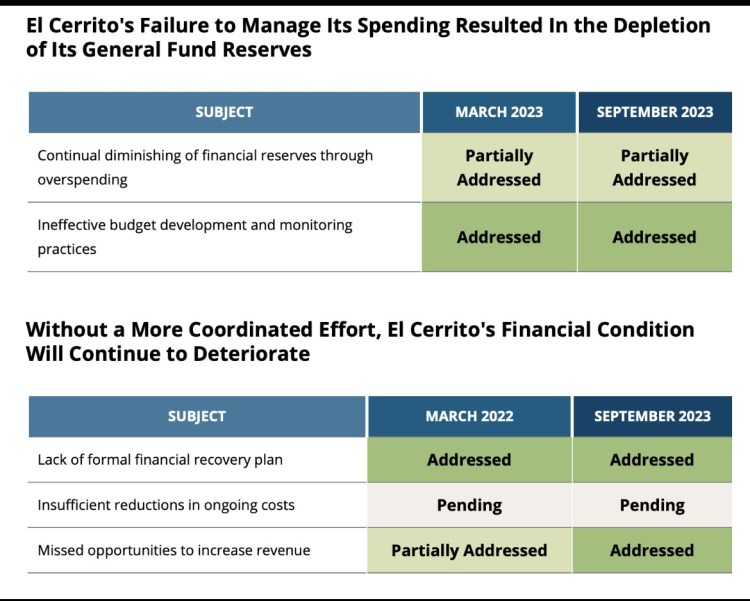
El Cerrito, CA – August 13, 2024 – Four years after the State Auditor’s report highlighted the severe financial mismanagement and fiscal irresponsibility plaguing El Cerrito, the City Council remains conspicuously negligent in addressing the crisis. The consequences of their inaction are stark, with the city teetering on the brink of bankruptcy, driven by a chronic reliance on reserves, unfunded pension liabilities, and a failure to implement meaningful reforms.
El Cerrito’s fiscal crisis has, unfortunately, become a norm rather than a wake-up call for its leadership. Instead of taking decisive action to rectify the financial chaos, the City Council has chosen to sidestep the recommendations of the State Auditor, allowing the situation to deteriorate further..
The State Auditor’s 2020 report painted a grim picture of El Cerrito’s finances, ranking it among the top 6 cities in California most likely to face bankruptcy. The warning signs were clear: excessive reliance on dwindling reserves, ballooning pension liabilities exceeding $85 million, and a glaring absence of sustainable revenue streams. Yet, four years later, the City Council has failed to take substantive measures to address these critical issues.
Instead of enacting necessary budget cuts, streamlining operations, or renegotiating contracts, El Cerrito’s leaders have allowed the city’s financial woes to fester. The FY25 budget, once again likely be balanced on the back of depleted reserves, will leave the city’s savings well below the Government Finance Officers Association’s recommended levels. The city however touts strong reserves but $10 million of the $16 million are restricted reserves.
The city’s top-heavy leadership structure remains untouched, and despite the State Auditor’s warnings, a classification and compensation study was implemented, further straining the city’s finances.
The City Council’s approach to public communication has been riddled with obfuscation, half-truths, and outright lies. In a recent presentation, the City Manager downplayed the severity of El Cerrito’s financial situation, glossing over the $85 million in unfunded pension liabilities—a substantial economic burden, even if it doesn’t appear on the balance sheet. She also claimed that the City was never close to bankruptcy, despite the issuance of the State Auditor’s going concern letters and the 2020 designation of El Cerrito as the 6th most likely city in California to go bankrupt. With the city now ranked 13th most likely to become bankrupt, it is clear that El Cerrito remains dangerously close to financial collapse. The City Manager’s misleading statements, combined with the Council’s ongoing refusal to address the fiscal realities, have severely eroded public trust and intensified concerns about the city’s long-term viability.
El Cerrito’s leadership claims that the city’s financial woes are out of their control, attributing the crisis to external factors like increased non labor related costs. However, this narrative falls apart under scrutiny. Exorbitant wages for most of the city’s leadership, excessive staffing levels, and an increased reliance on consultants are fully within their power to address. Instead of taking steps to contain costs, El Cerrito continues to grow its budget, a stark contrast to other cities in Contra Costa County that have successfully recovered from pandemic-related challenges through prudent fiscal management.
Additionally, the use of “scare tactics” has become a rather successful operating model for the City Manager. By waiting until the budget adoption day to address critical issues, the City Manager creates a sense of crisis, which in turn creates confusion and demands immediate action by the City Council—irrespective of cost and common sense. This approach provides cover for accepting irrational decisions under the threat that services will be decimated if cuts are made. While this claim isn’t necessarily true, it becomes a self-fulfilling prophecy when the City Manager refuses to engage in advance planning to address the city’s inflated expense budget.
The situation in El Cerrito is emblematic of a broader failure in governance. When leadership prioritizes short-term optics over long-term solutions, it is the residents who suffer. The city’s financial instability is not just a number on a ledger; it impacts essential services, public safety, and the quality of life for all residents. The continuation of this fiscal mismanagement threatens the very fabric of the community.
El Cerrito voters should reject any new tax or bailout measure until the fiscal crisis is addressed without additional support from taxpayers. The future of El Cerrito depends on it.
To avoid a fiscal catastrophe, El Cerrito needs robust crisis management led by independent experts who can conduct a thorough analysis of the city’s operations, identify cost-saving opportunities, and develop a sustainable financial plan. This process must include renegotiating labor and vendor contracts, consolidating redundant functions, and making hard choices about service levels.
Moreover, the residents of El Cerrito must demand greater accountability and transparency from their elected officials. It is no longer acceptable for the City Council to ignore the glaring issues at hand. The community deserves leaders who are willing to make the tough decisions necessary to steer the city back on course. This includes not only addressing the immediate fiscal challenges but also laying the groundwork for a more sustainable and resilient financial future.
The upcoming elections offer an opportunity for voters to elect representatives who are committed to fiscal responsibility and transparency. It is crucial that candidates running for City Council are held to a high standard, with clear plans for addressing the fiscal crisis and restoring trust in local government.
El Cerrito’s fiscal crisis is not an inevitability; it is the result of years of neglect and poor governance. The community must come together to demand change, starting with the rejection of any new tax measures until the City Council takes meaningful steps to resolve the underlying issues. The path to recovery will not be easy, but with strong leadership and a commitment to accountability, El Cerrito can emerge from this crisis stronger and more resilient.
As we approach the 2024 election, El Cerrito’s City Council race is heating up. With two current council members—Paul Fadelli and Tessa Rudnick—not running for re-election, the landscape is set to change. This blog provides a brief overview of the candidates on the ballot and what their election could mean for the future of El Cerrito.
Who’s Not Running?
Two incumbents, Paul Fadelli and Tessa Rudnick, have decided not to seek re-election. Their departure opens up opportunities for fresh faces on the council. Lisa Motoyama, the only incumbent running for re-election, will be looking to retain her seat amid a competitive field.
Candidates on the Ballot
This election is particularly significant because there are three seats up for grabs on the El Cerrito City Council. With two incumbents stepping down, the race is wide open for new leadership.
Lisa Motoyama As a current council member, Lisa Motoyama brings experience and a record of service to the table. Her re-election campaign will likely focus on continuing the work she’s done during her term, particularly in areas like fiscal responsibility and community development.
Rebecca Saltzman Rebecca Saltzman, currently serving as a BART Board member, is stepping into the local political arena. With her background in public transit and regional planning, Saltzman could bring a unique perspective to the council, especially on issues like transportation and sustainability. However, Saltzman’s tenure at BART has not been without challenges. She has faced criticism for struggles with fiscal management, as BART has dealt with budget deficits, rising costs, and an ongoing pension liability crisis. Additionally, despite efforts to improve passenger service, issues such as service reliability and safety concerns have persisted, leaving some riders dissatisfied.
Courtney Helion Another contender, Courtney Helion, is vying for a seat on the council. Though less is known about her campaign platform at this stage, her participation in the race adds to the diversity of choices available to El Cerrito voters.
Lauren Dodge Lauren Dodge is also in the running, bringing her perspectives and ideas to the forefront of the election. Voters will be keen to hear more about her plans for the city as the campaign progresses.
David Hatton David Hatton has shown interest in running but has not yet submitted the required documents. If he officially enters the race, it will be interesting to see how his platform compares with those of the other candidates.
William Ktsanes Similar to Hatton, William Ktsanes has yet to submit his paperwork but may still join the race. His participation would further broaden the field of candidates.
Important Dates
With two incumbents not filing for re-election, the deadline for submitting candidacy documents has been extended to Wednesday, August 14. This gives potential candidates additional time to declare their intentions and get their campaigns up and running.
What’s at Stake?
The 2024 election is a crucial one for El Cerrito, as the newly elected council members will have significant influence over the city’s future. Key issues like fiscal management, public safety, and community services are likely to dominate the discussions in the coming months. The candidates’ positions on these matters will play a pivotal role in shaping El Cerrito’s direction in the years to come.
As the campaign season unfolds, we’ll be watching closely to see how the candidates differentiate themselves and what they propose to tackle the challenges facing El Cerrito. Stay tuned for more updates as we get closer to election day.
For more details on the candidates and their campaign disclosures, you can visit the official El Cerrito election pages.
El Cerrito recognize that employee compensation is one of the largest expenses for any organization, including our city. Often, this area goes unmanaged, leading to significant issues such as inconsistent pay for performance and disparities in compensation. Given the pivotal role of the City Manager in El Cerrito’s administration, it’s crucial to have a clear, transparent, and effective evaluation mechanism.
Mayor Tessa Rudnick, no longer running for reelection and who claims to be data-driven has dismissed any public recommendations for service delivery or performance metrics.
A compensation scorecard is a comprehensive tool that collects and displays key metrics to monitor and evaluate performance. This tool helps identify problems, improve decision-making transparency, and enhance the overall quality of service delivery and financial decisions. For El Cerrito, using a compensation scorecard can significantly increase the effectiveness of managing the City’s performance. .
Goals and Objectives for the El Cerrito City Manager
The role of the City Manager in El Cerrito is multifaceted and crucial for the effective administration and progress of the city. Here are key goals and objectives for the City Manager:
Economic Development:
Foster economic growth by attracting new businesses and supporting existing ones.
Promote job creation and workforce development initiatives.
Enhance the city’s financial health through strategic planning and efficient resource management.
Public Safety:
Ensure the safety and security of residents by supporting police, fire, and emergency services.
Implement programs to reduce crime and improve community policing.
Enhance disaster preparedness and response capabilities.
Infrastructure and Urban Planning:
Oversee the maintenance and development of city infrastructure, including roads, public transportation, and utilities.
Promote sustainable urban development and smart growth strategies.
Ensure effective land use planning and zoning regulations.
Community Engagement and Public Relations:
Foster transparent communication and strong relationships with residents, businesses, and community organizations.
Promote citizen participation in city governance through public meetings and forums.
Manage the city’s public relations and ensure timely dissemination of information.
Environmental Sustainability:
Implement policies and programs to protect and enhance the city’s natural environment.
Promote renewable energy, waste reduction, and conservation initiatives.
Ensure compliance with environmental regulations and standards.
Budget and Financial Management:
Develop and manage the city’s budget, ensuring fiscal responsibility and transparency.
Optimize revenue generation while maintaining efficient expenditure practices.
Oversee financial reporting and ensure compliance with financial regulations.
Operational Efficiency:
Improve the efficiency and effectiveness of city services and operations.
Implement performance measurement systems to monitor and enhance service delivery.
Foster a culture of continuous improvement and innovation within city departments.
Housing and Community Development:
Support affordable housing initiatives and programs to reduce homelessness.
Promote neighborhood revitalization and community development projects.
Ensure equitable access to housing and community resources.
Human Resources and Workforce Development:
Oversee the recruitment, development, and retention of city staff.
Promote diversity, equity, and inclusion within the city’s workforce.
Implement training and professional development programs for employees.
Legal and Regulatory Compliance:
Ensure the city’s compliance with all local, state, and federal laws and regulations.
Oversee the management of legal matters, including contracts and litigation.
Develop and implement policies to mitigate legal risks.
Questions for Residents
Economic Development:
How effectively has the City Manager fostered economic growth and supported local businesses?
Have you noticed any significant improvements in job creation and workforce development initiatives?
Public Safety:
Do you feel safer with the current measures in place for police, fire, and emergency services?
Are there noticeable improvements in crime reduction and community policing?
Infrastructure and Urban Planning:
How would you rate the maintenance and development of city infrastructure such as roads and public transportation?
Are the urban development and land use planning strategies meeting the needs of our community?
Community Engagement and Public Relations:
Is there transparent communication and strong relationship-building between the city administration and residents?
How well is the city managing public relations and disseminating information?
Environmental Sustainability:
Are you satisfied with the policies and programs aimed at protecting our natural environment?
How effective are the renewable energy, waste reduction, and conservation initiatives?
Budget and Financial Management:
How transparent and responsible has the city been in managing its budget?
Are revenue generation and expenditure practices optimized effectively?
Operational Efficiency:
Have you observed improvements in the efficiency and effectiveness of city services?
Is there a noticeable culture of continuous improvement and innovation within city departments?
Housing and Community Development:
How well is the city supporting affordable housing initiatives and reducing homelessness?
Are there significant efforts towards neighborhood revitalization and equitable access to resources?
Human Resources and Workforce Development:
How effective has the city been in recruiting, developing, and retaining staff?
Are diversity, equity, and inclusion promoted within the city’s workforce?
Legal and Regulatory Compliance:
Is the city adhering to all local, state, and federal laws and regulations?
How well are legal matters such as contracts and litigation managed?
Conclusion
A compensation scorecard is a powerful tool that can transform how El Cerrito manages and evaluates the City Manager’s performance. By focusing on transparent, strategic metrics, the city can ensure that its compensation strategy aligns with its broader goals, leading to better management of one of its most critical roles.
Your feedback is vital in ensuring our city’s leadership is held accountable and is continuously striving to improve. Please share your thoughts on how the City Manager and City Council have performed against these metrics and goals.











 El Cerrito Committee for Responsible Government (ECCRG)