Featured

10 Reasons Many Residents Do Not Support the 2026 Library Tax

Worried about rising taxes? Concerned neighbors on Nextdoor have been cautioning others on the real reasons they will vote NO on this proposed tax increase.

1. The true price tag is far higher than advertised.

While the city touts a $21 million library, taxpayers will end up paying around $75 million to $100 million over 30 years—mostly in interest, not construction.

2. The “$1-per-year lease” narrative is misleading.

The city frames the lease as nearly free, but in practice, taxpayers are essentially prepaying $21 million to support the developer upfront—about $2.5 million a year.

3. It puts a heavy burden on homeowners.

A 17¢-per-square-foot parcel tax translates to roughly $288 the first year for an average homeowner—and about $7,650 over 30 years, and escalates from there.

4. Annual tax increases are built into the proposal.

The measure permits the city council to raise the tax each year to account for inflation—meaning costs won’t stay level.

5. Longtime homeowners and seniors pay disproportionately more.

Because parcel taxes are not based on property value, seniors who’ve lived here for decades could see their tax bills climb by 12% or more.

6. The cost per use is unsustainable.

The combined $75 million tax plus existing operating costs mean the library will cost around $3.3 million a year—that’s about $28.50 for every book checked out, with usage reportedly declining.

7. It functions as a hidden subsidy for the BART housing project.

The city mandates below-market-rate housing units in the Plaza BART development, making the project financially shaky—and the library tax serves as a bailout.

8. It attempts to circumvent higher voter approval thresholds. The city’s representative Greg Lyman has a petition to make this a citizens initiative Rather than a ⅔ supermajority for tax increases, the city labels this measure a “citizens’ initiative,” lowering the requirement to just 50% + 1 vote.

9. Taxpayer dollars are funding the campaign.

The city has already spent about $100,000 on message-testing polls to support this tax—funding that should come from independent PACs, not public coffers.

10. Renters will pay too.

Even if they don’t own homes, renters will bear the cost: landlords are likely to pass on the tax increase via higher rents, making housing less affordable.

These concerns come from Nextdoor threads, community blogs, and citizen watchdog efforts demanding transparency and fiscal prudence.

If you’re skeptical about the city’s financial stewardship—and you don’t want homeowners and renters stuck with this burden—please join your neighbors – don’t sign Lyman’s citizen initiative petition and vote NO on the 2026 library tax.

If you agree, like and share on your social media outlets. If you disagree, please tell us why.

El Cerrito’s General Fund Update Is Late — Again

A resident-focused review of the Q1 General Fund Update presented November 18, 2025

El Cerrito residents deserve financial reporting that is timely, comparable, and designed for real oversight—especially in a city where taxes are already high, and the margin for error is shrinking. But the General Fund First Quarter Update presented on November 18, 2025, covers only the first quarter of the fiscal year, July 1 through September 30, 2025. That’s nearly seven weeks after the quarter ended—49 days late—meaning residents and Council are evaluating the City’s fiscal condition with information that is already outdated, while the City is well into the second quarter. When the City warns about reserves and long-term sustainability, a lag like that isn’t a minor inconvenience; it undermines meaningful oversight because the public is always looking in the rearview mirror.

The way the City frames the numbers makes the problem worse. The update repeatedly compares year-to-date revenues and spending to the full annual budget—for example, describing quarterly revenues and expenditures as a percentage of the year’s total budget. Staff also notes that revenues and expenditures are highly cyclical and timing can vary, but that is exactly why residents should be shown budget versus actual for the same period: year-to-date actuals compared to a year-to-date (phased) budget, with clear variances. That matching-principle approach is how you distinguish normal timing differences from real over-spending, under-performance, or emerging structural gaps. Without it, the public is left with percentages that sound precise but don’t tell you whether the City is tracking as expected for this point in the year or drifting off course.

This isn’t academic—it goes straight to reserves, which are the City’s safety net. The City’s minimum General Fund reserve policy is 17% of expenditures, and the City’s own table shows that the discretionary cushion above that minimum is only a few million dollars. In plain terms, the truly flexible cushion is not a massive pool of money; it is the portion most vulnerable to being chipped away through one-time appropriations from unassigned fund balance. Once that discretionary layer is reduced, the City has fewer options to absorb shocks without cutting services or turning to new taxes.

Which brings us to the second issue residents should connect directly to the quarterly update: Council spending approvals, and where the money comes from. In this agenda cycle, Council is asked to approve audio-visual upgrades for the Council Chambers funded by a one-time appropriation from unassigned balances, including a substantial amount from the General Fund unassigned balance. That is a direct draw on reserves—plain and simple. Other authorizations may be described as budgeted or offset by savings, but residents should not lump all spending items together; what matters is whether an action is truly funded within the operating budget or is paid for by draining the unassigned balance.

Since El Cerrito expects residents to accept premium taxation, residents should require premium governance in return: faster quarterly reporting while it still informs decisions; budget-versus-actual comparisons for the same period with clear variances; and plain-language explanations every time reserves are used. Trust doesn’t come from reassuring slides or percentages—it comes from timely information, apples-to-apples reporting, and honest reserve accounting.

What residents should ask for (and expect)

  • Quarter updates are delivered quickly enough to influence decisions, not months after the fact.
  • Budget vs. actual reporting for the same period (YTD actual vs. YTD budget) with clear variances.
  • Clear identification of every action that uses reserves, including the exact fund source (e.g., unassigned General Fund balance).
  • A simple reserve dashboard that distinguishes the policy minimum from the discretionary cushion.

Contact City leadership

City Manager: Karen Pinkos — kpinkos@elcerrito.gov

City Council:

• Carolyn Wysinger — cwysinger@elcerrito.gov

• Gabe Quinto — gquinto@elcerrito.gov

• Rebecca Saltzman — rsaltzman@elcerrito.gov

• Lisa Motoyama — lmotoyama@elcerrito.gov

• William Ktsanes — wktsanes@elcerrito.gov

City Clerk: cityclerk@elcerrito.gov | 510-215-4305

Assessing El Cerrito’s City Services: A Call for Improvement

Residents do not pay taxes for a subpar City Hall . Taxpayers pay for services we can access and rely on: permits and plan checks that move on time, inspections that get scheduled, code enforcement follow-up, timely answers from the clerk and the front counter, and a City Hall that is available when people need to get things done.

El Cerrito has been clear about how it operates. The issue is whether the City’s availability matches the level of service residents are funding.

Full-time in El Cerrito is 37.5 hours

El Cerrito’s Personnel Rules define regular full-time as employees who work a minimum of 37.5 hours per week.

That is a legitimate policy choice. But it also means the City’s baseline capacity is smaller than what many residents assume when they hear full-time.

Winter break: City Hall closes for most of the stretch between Christmas and New Year’s

The City’s posted administrative holiday schedule lists a December Winter Holiday Closure from Friday December 19 through Friday, January 2, 2026, with City Hall reopening Monday, January 5, 2026.

When City Hall is closed, residents lose service days on the calendar. That has real consequences: fewer days to resolve time-sensitive issues, fewer counter hours, fewer opportunities to get a live answer, and more delays that spill into January.

How El Cerrito’s closure compares to neighbors

Nearby cities also close for the holidays, but not all do it the same way:

  • Pinole: City Hall and Community Services facilities closed to the public Dec 24 – Jan 2, reopening Jan 5, 2026.
  • San Pablo: non-emergency City offices closed Dec 24, 2025 – Jan 4, 2026, reopening Jan 5, 2026.
  • Albany: City offices closed Dec 25, 2025 and Jan 1, 2026.

This is not about whether anyone deserves time off. People do. It is about the combined service impact when a shorter baseline workweek and a long winter shutdown stack together.

Fact Box: El Cerrito workweek + winter closure vs. neighbors

ItemDetails
El Cerrito baselineFull-time is 37.5 hours per week.
El Cerrito winter closureDec 22, 2025 – Jan 2, 2026 | Reopens Jan 5, 2026.
Pinole winter closureDec 24, 2025 – Jan 2, 2026 | Reopens Jan 5, 2026.
San Pablo winter closureDec 24, 2025 – Jan 4, 2026 | Reopens Jan 5, 2026.
Albany winter closuresDec 25, 2025 and Jan 1, 2026.
Why it mattersTaxes fund services. Fewer open days means less access and more delay for routine City business.

And it affects public access to City Council, too

Residents reasonably expect the first City Council meeting of the year to occur on the first Tuesday. Yet the adopted 2026 City Council meeting schedule does not include a Council meeting on Tuesday, January 6, 2026. The first January meeting shown is Tuesday, January 20, 2026.

Whether by design or because the holiday closure limits the ability to post required public notice, the practical effect is the same: residents lose the first early-January chance to show up, speak, and be heard. Residents are robbed, once again, of access and urgency at the exact moment the year should be getting started.

Call to action

If this bothers you, do something with it this week:

  • Email City leadership and ask for service standards that match what we pay for: City Manager Karen Pinkos (kpinkos@elcerrito.gov) and the City Manager’s Office (citymanager@elcerrito.gov).
  • Email the full City Council and request action, not explanations: Carolyn Wysinger (cwysinger@elcerrito.gov), Mayor Gabe Quinto (gquinto@elcerrito.gov), Councilmember Lisa Motoyama (lmotoyama@elcerrito.gov), Mayor Pro Tem Rebecca (rsaltzman@elcerrito.gov), Councilmember William Ktsanes (wktsanes@elcerrito.gov).
  • Ask for a simple service-access plan for the December to January period: what is closed, what is open, what is staffed, and what residents should expect.
  • Share this with neighbors. Service expectations only change when residents insist they should.

The Swearing-In Wasn’t Just a Celebration. It Was a Soft Launch for a 2026 Tax Campaign

At the El Cerrito City Council meeting on Tuesday, December 16, 2025, regional and state elected officials joined Gabe Quinto as he was selected as mayor for next year. Attorney General Rob Bonta administered the oath, underscoring Quinto’s rising profile and the political attention El Cerrito continues to draw.

But as the congratulations rolled in, it became clear the night wasn’t just about leadership. It was also about messaging—specifically, the library tax measure expected to qualify for the 2026 ballot.

Former Mayor Greg Lyman, who serves as treasurer of the Committee for a Plaza Station Library, congratulated Quinto and Councilmember Rebecca Saltzman and said he looked forward to their support to move the library forward. County Supervisor John Gioia echoed the praise, noting he hopes voters recognize Quinto has taken on extra responsibility and extra work by serving as president of Cal Cities and as El Cerrito mayor. Gioia added that he is looking forward to the library.

Quinto also mentioned the library proposal several times—both directly and through personal story—reinforcing what many residents should pay attention to now: the library tax campaign is already underway in tone, alliances, and public narrative.

The City has repeatedly positioned itself as impartial and not involved in the library initiative. Residents should hold that claim up against what they’re seeing in real time: a ballot measure being normalized through official platforms, celebrated through coordinated remarks, and framed as inevitable. Impartiality isn’t a label—it’s a standard of conduct, and the public deserves clarity about where City Hall actually stands.

Why residents should not accept the framing

Supporters keep presenting this as a library measure. That framing is emotionally effective—but it is incomplete.

This is not simply a vote to build a library. It is permission for the City of El Cerrito to levy a long-term parcel tax and then decide how to deploy that revenue within a broader development strategy—even if a library is delayed, reshaped, or never built as residents imagine it today.

If you’re a voter, that distinction matters. Because once a tax is approved, the city has the revenue stream. The public is left negotiating details after the fact—often when leverage is gone and the we already passed it argument becomes the default response to legitimate questions.

The Plaza Station Library connection is the point

The library concept being promoted is not happening in a vacuum. It is tied to the Plaza Station development vision. That is why the same voices keep repeating the same phrase: move the library forward.

That language sounds like progress. But residents should ask: forward into what, exactly? A tax measure can move forward faster than a building. A narrative can move forward faster than accountability.

When civic leaders speak as if the library is inevitable, they compress uncertainty into certainty. That’s how communities end up paying now for promises that may not materialize for years—if at all.

The latchkey story: heartfelt, real—and out of date as a policy argument

Quinto shared a personal memory that landed with many people:

Let the real truth come out starting in 2026, Quinto said. The library is where I was as a latchkey child until 3:30 every day when my mom could pick me up.

Many of us recognize that era. For kids growing up in the 50s and 60s, the library truly was a safe landing place after school—an informal community hub in a different time.

But El Cerrito is not living in that time anymore.

But the term latchkey itself is a reminder: the social and family structures that made libraries the default after-school shelter have shifted. Today, kids’ afternoons are shaped by aftercare programs, transportation realities, digital life, school policies, safety expectations, and entirely different community patterns. A story from the 1960s can be meaningful without being a blueprint for fiscal policy in 2025.

Nostalgia is not a plan. And personal memories—no matter how sincere—should never replace a clear explanation of outcomes, timelines, cost controls, and accountability.

What residents should demand before 2026

If city leaders and outside electeds want voters to approve a new long-term tax, residents deserve more than applause lines and soft endorsements. Before any ballot is finalized, El Cerrito should be pressed to provide:

  • A clear timeline that matches real-world project sequencing, not best-case projections
  • A plain explanation of what is guaranteed if the tax passes—and what is not
  • Transparent cost estimates, escalation risks, and what happens if funds fall short
  • Accountability mechanisms with real enforcement, not just symbolic oversight language
  • A clear description of how the tax revenue could be used if the library is delayed or the development changes

The bottom line

Tuesday night made something clear: the 2026 library tax measure is being positioned as a feel-good inevitability, reinforced by political validation and familiar storytelling.

But residents should not confuse a ceremonial moment with a sound financial plan.

El Cerrito voters deserve straight answers, not just inspiring memories. What worked in the 50s and 60s no longer serves us well in 2025—and the city should not ask residents to fund the future using arguments anchored in the past.

El Cerrito’s Long-Term Tax Measure: Hidden Costs Explained

Influenced by Concerned Citizens’ Social Media Posts

Residents deserve transparency before voting on a tax that won’t deliver what’s being promised


El Cerrito is once again being asked to approve a long-term tax measure — this time advertised as an initiative for a new library. But before anyone votes, residents deserve to understand what this measure actually does, what risks it creates, and what it will cost long before a single shovel hits the ground. If you care about responsible spending, transparent governance, and fiscal accountability, now is the time to dig deeper. This measure is not what its supporters claim — and El Cerrito taxpayers deserve the whole story. If you want to stay informed, sign up for updates at www.nomoreforevertax.org. Be informed. Be engaged. Be part of defeating this bad tax.

You Start Paying in 2027. Construction Doesn’t Start Until 2028 or 2029 — At Best

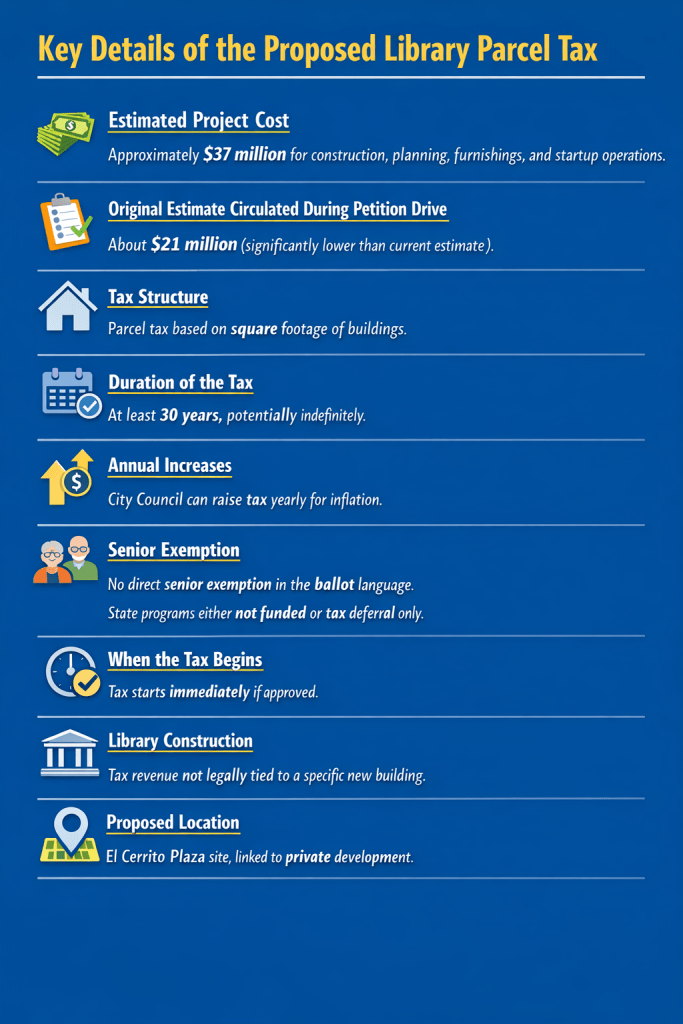
One of the most misleading elements of the June 2026 library ballot measure is the timeline. The City begins collecting the tax in December 2027, but construction for the library won’t start for 2–3+ years after that, and only if the project secures competitive state funding. For a typical 1,700 sq ft home, that means paying $136–$289 per year, beginning in 2027 — years before the project is even viable.

Real Timeline Based on City Statements

• June 2026: Voters decide the measure
December 2027: First tax bill arrives
• Spring 2027: City applies for state AHSC grant funding
• Late 2027–Early 2028: State decides whether El Cerrito wins
• If approved: 6–12 months for financing to close
Earliest groundbreaking: Late 2028 or 2029
Earliest opening: 2031–2032
By the time anyone sees construction activity, the average homeowner will have already paid $400–$850+ in taxes. That is not responsible funding. It’s taxation on speculation.

The Project Might Not Even Be Funded — And There Are No Refunds

Supporters insist the library will be built once voters approve the tax. But the truth is far more uncertain. The City is depending on winning state Affordable Housing and Sustainable Communities (AHSC) funding — a competitive, unpredictable grant program. Just last year, Parcel C East scored 85 points (a competitive score) and was still rejected by the state in December 2025. Parcel C West — the proposed library site — faces the same risks. If the grant is denied, the project stalls indefinitely; the library cannot be built as designed; and the city keeps all the tax money. There is no refund mechanism in this measure. Not one dollar would go back to residents. This is a huge risk shifted onto taxpayers, while the city faces no penalty for failure.

The Measure Allows the City to Double the Tax with No New Vote

The ballot language is crafted to sound modest. Supporters promote a tax “around eight cents per square foot,” translating to roughly $136 per year for the average home. What they do not emphasize is that the measure allows the City Council to raise the tax to the maximum17 cents per square foot — without voter approval. That means your bill can jump from $136 to $289 overnight.

What the measure really allows:

• Start the tax low to gain voter support
• Raise it to the maximum after bonds are issued
• Do all of this with zero additional voter input
This is not transparency. It’s rate manipulation.

This Isn’t a 30-Year Tax. It Actually Runs 32 Years or forever

Supporters call this a 30-year measure. It is not. The tax begins collection in 2027, but the 30-year clock starts once bonds are issued — likely in 2029. That means residents will be paying this tax until 2059. Two extra years of taxes. No added value. No voter disclosure. More importantly, the city has extended every tax that initially had a sunset.

Residents Deserve Better Than Misleading Messaging

A tax of this magnitude — running more than three decades — should be built on facts, not marketing. Yet this measure:
✗ Collects taxes for 2–3 years before construction
✗ Allows the city to keep your tax dollars even if the project fails
✗ Allows tax rates to double without voter approval
✗ Runs 32 years or more, not the stated 30

El Cerrito deserves a library solution that is honest, financially sound, and built on reliable funding — not one that shifts every risk to homeowners and disguises the actual costs.

Be informed. Be engaged. Be part of defeating this bad tax.

Stay updated at www.nomoreforevertax.org. If we want a library, we deserve a proposal that is transparent, financially responsible, and built on certainty — not a forever tax built on hope and wishful thinking.

Overstaffing in El Cerrito: Impacts on Expenses and Services

El Cerrito stands out among its neighboring cities for its unusually high concentration of fire services, considering its population and geographic size. More than five years ago, the California State Auditor recommended that the city conduct a staffing analysis to determine the appropriate levels for each classification. While El Cerrito is finally conducting a staffing study, it comes five years later than recommended, and its scope and depth remain unclear.

Residents still don’t know whether the study will lead to any actionable recommendations—and if it does, they will likely be implemented incrementally, resulting in no meaningful reductions or additional years of delay in achieving cost savings.

As the data show, El Cerrito’s staffing levels appear to be significantly inflated compared to those of its neighbors, raising legitimate questions about the efficiency of its resource allocation and the burden on taxpayers. Overstaffing not only creates upward pressure on expenses, but it also significantly increases the city’s CalPERS retirement costs, further inflating the unfunded liability.

That liability now exceeds $80 million, and pension costs alone consume nearly 20% of the city’s budget—about $9 million annually. The city’s four Battalion Chiefs are among the most expensive positions in local government, and they do not contribute to front-line staffing. No other city of comparable size in Northern California employs more than one Battalion Chief, making El Cerrito an outlier.

These upper-management positions add heavily to the city’s long-term pension liability while diverting resources that could fund critical community services—such as restoring operations at the Senior Center, expanding library hours, or improving infrastructure maintenance.

With a population of roughly 26,000 served by three fire stations, El Cerrito 4.66 square miles, averages just 8,700 residents per station—far fewer than most of its peers. By comparison:

  • Lafayette: 8,349 residents per station (3 stations, population 25,048, covering 15.20 sq. mi.)
  • Martinez: 12,132 residents per station (3 stations, population 36,395, covering 12.47 sq. mi.)
  • Richmond: 16,105 residents per station (7 stations, population 112,735)
  • Berkeley: 16,745 residents per station (7 stations, population 117,214)
  • Pleasant Hill: 16,901 residents per station (2 stations, population 33,802)

Despite covering only 4.66 square miles, El Cerrito maintains a far higher ratio of fire resources per capita than much larger cities such as Antioch (29,274 residents per station) or Concord (40,772 residents per station).

To ensure taxpayer dollars are spent efficiently and responsibly, El Cerrito must commission an independent, comprehensive staffing analysis—one that evaluates the appropriate levels for fire services and other departments and includes clear, actionable recommendations. Such a study would provide the data needed to align staffing with community needs, reduce unnecessary expenses, and begin addressing the city’s escalating pension burden.

Fiscal sustainability requires courage, transparency, and a willingness to make data-driven decisions—not merely maintaining the status quo at the expense of taxpayers.

Residents should urge the City Council to make the full staffing study public once completed and to commit to implementing its recommendations—not shelving them. Meaningful reform begins with transparency, accountability, and a shared commitment to using our limited resources wisely.

#ElCerrito #FireDepartment #TaxDollars #PublicSafety #StaffingAnalysis #PensionLiability #FiscalResponsibility #LocalGovernment #Accountability

Transforming El Cerrito’s Policing: Strategies for Safer Communities

El Cerrito residents deserve a public safety strategy that matches the realities on the ground. Yet at a recent meeting, the Chief of Police proudly highlighted the additional revenue the department generated from citations — while saying nothing about the rise in property crime across our neighborhoods. That contrast tells you everything.
When leadership celebrates ticket revenue but stays silent on crime trends, it raises a fundamental question: City Manager — what exactly is our patrol strategy?


Because patrol isn’t about “visibility” or driving around aimlessly. It isn’t about writing tickets to parked cars or padding the city’s general fund with citation dollars. Patrol is your frontline operational strategy — the engine that drives safety, trust, and accountability. But too often, cities (ours included) still treat it like random circulation rather than intentional deployment.
Here’s what residents should expect — and what every city manager should be demanding.

1. Clear Zones Aligned to Actual Risk

Patrol zones shouldn’t be based on outdated maps, officer habits, or convenience. They should reflect calls for service, real-time crime trends, hot-spot activity, and community expectations. When property crimes rise, but deployment doesn’t shift, that’s not a resource issue — it’s a strategy issue.

2. Purposeful Time Allocation

How much of patrol time is spent on proactive engagement versus reactive response? If the answer is “it depends,” or if no one can clearly break it down, El Cerrito has a problem. Patrol time should be planned and monitored, not guessed.

3. Defined Outcomes — Not Activities

Patrol is not just writing citations, hunting for expired tags, or driving in circles. Patrol is reducing response times, preventing repeat calls, creating predictable and reliable presence, building trust block by block, and identifying problems before they escalate. If leadership talks more about tickets than outcomes, the priorities are upside down.

4. Field Supervision With Intent

Sergeants should actively manage deployments, monitor gaps, and coach officers to carry out a strategic plan — not just run paperwork and shift schedules. Supervision sets the tone and the culture.

5. Analysts Providing Real-Time Insight

Patrol strategy should evolve daily based on data, not wait for a monthly report that tells us what already went wrong. Without real-time analysis, you’re not doing strategic policing — you’re doing post-incident accounting.

The Single Most Important Question

Suppose El Cerrito wants safer neighborhoods and a more confident community. In that case, leadership must begin by asking the Police Chief one simple, revealing question: “What is our patrol strategy — and how do we know it’s working?” Because when patrol is intentional, aligned, and zone-based, you get more than visibility. You get impact.


Right now, residents aren’t seeing impact — they’re seeing rising property crime and a department touting ticket revenue. The City Manager owes the community more than that.


Speak Up. The next chance is Monday, December 16, at 6:00 PM at City Hall — and if you want to hear directly from the City Manager, attend the State of the City presentation at 5:00 PM the same evening. Your voice matters, and public safety deserves real accountability.

El Cerrito’s Leadership Crisis: Time for New Voices

El Cerrito is long overdue for a change in leadership.

Despite over a decade of warning signs—financial mismanagement, escalating liabilities, and a deeply troubled General Fund—City Hall has continued to cling to the same failing playbook and the same enabling cast of characters. And now, residents are being asked to fund a $75 million library project, which is being supported through a parcel tax scheme designed more to replenish city coffers than to serve library users.

Let’s be clear: no city with 25,000 residents needs a 20,000 square foot, $75 million library. This isn’t about community literacy or safe infrastructure. This is about political legacy projects and using public sentiment as cover for financial gamesmanship.

The current plan directs parcel tax revenue into the General Fund—money the city can then spend with fewer restrictions, thereby propping up a structurally imbalanced budget.

We’re not fooled.

A History of Ignoring the Red Flags

More than a decade ago, El Cerrito’s financial warning lights were flashing bright red. While city officials touted “fiscal sustainability,” the numbers told a different story—of empty reserves, mounting risk, and financial free fall.

The 2013 Comprehensive Annual Financial Report (CAFR), discussed during a May 6, 2014 council meeting, was unambiguous:

  • The General Fund was already spending nearly $1 million more than it was taking in.
  • Unrestricted cash? Less than five days of operating expenses—an extraordinarily dangerous position for any city.
  • The unassigned fund balance—the real emergency cushion—was down to just 16 days of coverage.

Maze & Associates, the City’s independent auditor, flagged a material weakness in financial management and warned that continued deficit spending could threaten the city’s ability to operate as a “going concern.”

That is not routine language. It’s the financial equivalent of pulling the fire alarm.

And yet, the city pressed on, business as usual.

Leadership That Looked Away

At the helm during this crisis? Then‑Mayor Greg Lyman, current council member Gabe Quinto, Assistant City Manager Karen Pinkos, and City Manager Scott Hanin. Despite the audit and clear warnings, the response from City Hall was silence—or worse, denial.

This wasn’t just negligence. It was a strategic choice to ignore risk, mislead the public, and reward loyalty over competence.

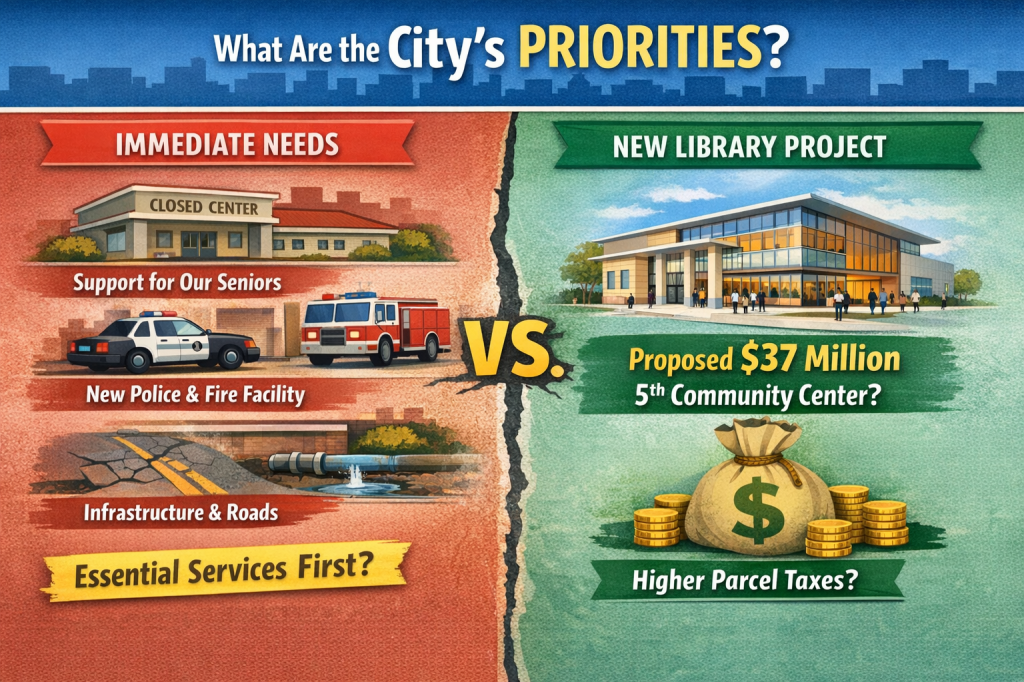
Fast-forward to today: many of the same individuals—directly or by proxy—remain in power, continuing to dismiss public input, reward underperformance, and prioritize vanity projects over essential services like roads, public safety, and support for seniors.

We appreciate Councilmember William Ktsanes for asking hard questions and pushing for accountability. But one new voice isn’t enough to break this entrenched pattern.

Fast-Forward to 2025: History Repeating

Fast-forward to 2025, and the bond rating has improved but we’re back in familiar territory: the City continues to rely on General Fund unrestricted reserves to balance the budget. According to city projections, we are once again on track to fall below the Government Finance Officers Association (GFOA) recommended reserve levels as well as below the city’s stated policy.

That’s right—we’re headed back to the precarious financial position we were in during 2014. If this trend continues, El Cerrito could once again attract scrutiny from the California State Auditor.

Less than One Year Left to Choose

We are now less than one year away from the June 2, 2026 primary election and the November 3, 2026 general municipal election—the next opportunity to overhaul the City Council el-cerrito.org+8en.wikipedia.org+8ci.richmond.ca.us+8.

Enough Is Enough

We’re tired of asking questions.
We’re tired of being ignored.
We’re tired of watching the City Manager and several long‑time council members treat residents as obstacles instead of stakeholders.

It’s time to elect new leadership.

New voices. New priorities. A new path forward.
El Cerrito can’t afford more of the same because you can’t recover with the same leadership that created the problems.

#ElCerritoDeservesBetter #NewLeadershipNow #ResponsibleGovernment #TimeForChange

A Legacy of Neglect

For nearly twenty years, El Cerrito residents have shouldered the consequences of City Hall’s fiscal negligence. The City’s pension costs now exceed $8.5 million every year—roughly 16 percent of the city’s entire General Fund budget. Those costs keep rising, even as service levels fall, and public safety concerns grow.

This didn’t happen by chance. It’s the result of long-standing patterns of mismanagement—decisions made by both elected and appointed leaders that expanded payroll, increased pension obligations, and routinely allowed expenses to exceed revenues year after year.

A History of Warnings—and Inaction

El Cerrito’s fiscal troubles began in earnest during the 2008 recession, when cities across California took aggressive steps to reduce costs, renegotiate contracts, and build long-term financial resilience. El Cerrito did the opposite.

While other municipalities restructured debt, cut nonessential spending, and rebuilt reserves, El Cerrito continued to expand payroll, add positions, and defer necessary reforms. Temporary revenues masked structural problems, and repeated internal warnings about unsustainable spending were ignored.

By 2018, the California State Auditor had taken formal notice—designating El Cerrito a “going concern” because its ability to continue operating independently was in serious doubt. That designation was reaffirmed multiple times between 2018 and 2021, as the Auditor cited the same pattern of declining reserves, mounting debt, and ballooning pension costs.

In 2020, the Auditor ranked El Cerrito in the bottom 3 percent of all California cities for fiscal health—one of the least financially responsible municipalities among more than 400 statewide. The report described “severe fiscal distress,” pointing to shrinking reserves and overreliance on one-time fixes.

Still, City Hall did not act decisively. Budgets continued to draw on reserves to stay balanced. Payroll and pension obligations kept rising. And temporary grant funding or deferred payments were touted as signs of recovery.

Although El Cerrito has since moved out of the bottom 3 percent, it remains ranked among the worst-run cities in California, burdened by the same structural weaknesses that prompted the Auditor’s intervention.

During the pandemic, $6.1 million ARPA funding and the $3+ million of real property transfer tax provided El Cerrito with sorely needed influx of revenue which led to the increase in reserves. However, the city will not get more ARPA funding, and the real property transfer tax has been absorbed into the General fund rather than its intended purposes and the city continues to drain reserves.

Leadership at the Helm

Accountability starts at the top. The following City Managers presided over El Cerrito’s a decline:

  • Scott Hanin, City Manager until 2018
  • Karen Pinkos, Assistant City Manager under Hanin and current City Manager (2018 – present)

Scott Hanin retired in 2018 with a substantial public pension, funded by the same taxpayers now paying more for fewer services. His departure coincided with the City’s worsening fiscal outlook and the State Auditor’s “going concern” classification.

His successor, Karen Pinkos, has continued that pattern. After stepping into the top post, she negotiated a pension formula and compensation package more favorable than those offered to other employees, ensuring long-term benefits at taxpayer expense.

Her five-year employment contract, approved by the City Council and later extended, included no performance-based evaluation clause, meaning she would not normally be held accountable for measurable fiscal outcomes. However the city council has the power to implement such requirements.

Her package includes:

  • A base salary exceeding $230,000 per year, with automatic cost-of-living increases
  • Extended her contract for five additional years
  • Full CalPERS pension participation at the highest available tier
  • Deferred-compensation contributions and executive-leave cash-outs
  • Vehicle allowance and professional-association stipends

The Council approved this arrangement without linking pay to performance or financial reform.

The Current Narrative vs. Reality

City Hall now insists that El Cerrito is “fiscally healthy”—pointing to an improved bond rating as proof of progress. But an upgraded credit score doesn’t erase the facts. The City still relies on reserves every year to balance its budget, a clear sign of structural imbalance. Those reserves are finite, steadily shrinking, and unsupported by any long-term capital plan.

At the same time, the City continues to over-tax residents under the guise of earmarking funds for specific purposes. Yet prominent examples—like the Pool Tax and the Real Property Transfer Tax—show a pattern of broken promises. The funds have not been used as initially pledged, and neither tax has been subject to a public audit or independent oversight, even though El Cerrito now carries at least 10 separate taxes on its books.

Fiscal health requires integrity—not just new taxes and a higher bond rating.

Meanwhile, El Cerrito faces an unfunded pension liability of more than $80 million—a burden City Hall continues to ignore in public discussions. There is no transparent repayment plan, no honest accounting of its long-term impact, and no credible strategy to stop the debt from growing.

To make matters worse, the City bundles all of its general fund reserves together and presents the combined total as evidence of fiscal strength. That practice masks the weakness of individual funds, particularly unrestricted reserves and misleads residents about the City’s actual financial position.

Claiming fiscal health while relying on savings and creative accounting to stay afloat isn’t management—it’s manipulation. And manipulation doesn’t pay the bills.

 Officials Who Approved the Budgets and Contracts

To understand how the crisis deepened, here’s a breakdown of City Council members by period of service—and the one leader who tried to do better.

Note: Former Mayor and longtime Councilmember Janet Abelson, who passed away in 2024, served during much of this period. Her decades of civic involvement are recognized, but her leadership choices—particularly around fiscal management—remain central to understanding the City’s ongoing instability.

2008 – 2012 | Post-Recession Expansion

  • Janet Abelson
  • Letitia Moore
  • Bill Jones III
  • Sandi Potter
  • Ann Cheng
  • Greg Lyman

➡️ Context: After the 2008 recession, most cities tightened their belts. El Cerrito expanded payroll, added management layers, and ignored sustainability.

2012 – 2016 | Mounting Costs and Growing Liabilities

  • Janet Abelson
  • Greg Lyman
  • Mark Friedman
  • Jan Bridges
  • Rebecca Benassini

➡️ Context: Pension and benefit costs ballooned, but spending continued unchecked, draining reserves further.

2016 – 2020 | State Auditor Intervention and Denial

  • Janet Abelson
  • Greg Lyman
  • Gabe Quinto
  • Paul Fadelli
  • Rochelle Pardue-Okimoto

➡️ Context: When the State Auditor declared El Cerrito a fiscal “going concern,” most of the Council and City Manager downplayed the warning.
Councilmember Rochelle Pardue-Okimoto was the only member who demonstrated true fiscal responsibility, questioning spending, demanding transparency, and calling for oversight when others refused to act.

2020 – 2022 | Public Awareness, Minimal Reform

  • Lisa Motoyama
  • Tessa Rudnick
  • Gabe Quinto
  • Paul Fadelli
  • Janet Abelson

➡️ Context: Despite the Auditor’s findings and public frustration, reforms were superficial. Payroll and pension costs continued to rise, while essential services lagged.

2022 – Present | Continuing the Pattern

  • Lisa Motoyama
  • Tessa Rudnick
  • Gabe Quinto
  • Rebecca Saltzman (elected 2022)
  • Carolyn Wysinger (elected 2022)

➡️ Context: Despite claims of “fiscal health,” El Cerrito continues to rely on reserves to balance its budget and has no transparent plan to address its $80+ million pension liability.

Of all these councils, Rochelle Pardue-Okimoto stood alone in advocating fiscal discipline and transparency. Her leadership showed what responsible governance could have looked like—had others followed her example.

The Cost of Inaction

Even more troubling, overtime pay begins after 37.5 hours—not 40, as in neighboring Albany. This means taxpayers shoulder overtime costs sooner and more often, inflating payroll expenses by hundreds of thousands of dollars annually.

While most residents work 40 hours a week or more to make ends meet, El Cerrito City Hall operates just 37.5 hours per week, closing every other Friday.

Despite shorter hours and higher expenses, service quality continues to erode. Nearby cities—Albany, San Pablo, and Hercules—maintain more substantial reserves and deliver better results.

The Path Forward

Now, newly elected officials like Rebecca Saltzman (2024) have shown little appetite for reform. Despite years of warnings and growing frustration, City Hall continues to ignore fiscal fundamentals.

El Cerrito needs leaders who face facts, respect data, and put residents first. The next generation must be fiscally responsible, transparent, and willing to rebuild reserves, reduce liabilities, and restore public trust.

Our future depends on it.
It’s time to stop mortgaging tomorrow to pay for yesterday’s mistakes.

📊 The Numbers Behind the Crisis

CategoryAmount / StatisticNotes
Annual Pension Cost$8.5 million≈ 16 % of General Fund spending
Total Payroll (FY 2023)$51.2 millionManagement, Police, Fire, Public Works
State Auditor “Going Concern” Alerts2018 – 2021Repeated warnings were ignored by leadership
Fiscal Health Ranking (2020)Bottom 3 % statewideAmong California’s least responsible cities
Current Status (2024)No longer the bottom 3 %, but still among the worst-runStructural imbalances persist
Unfunded Pension Liability≈ $80 millionNo clear plan for repayment
Karen Pinkos Compensation$230 K + perksFive-year contract, no performance clause; currently serving
Overtime ThresholdEl Cerrito: 37.5 hrsAlbany: 40 hrs – earlier overtime increases costs
City Hall Work Week37.5 hrs (bi-weekly Friday closure)Reduced hours vs. 40-hour standard
Crime Trend (2020 – 2024)↑ Property and auto theftLinked to reduced police staffing
Nearby City ComparisonAlbany • San Pablo • HerculesLower payrolls, healthier reserves

Call to Action – Demand Accountability

El Cerrito can’t fix what it refuses to face. Residents deserve transparency, fiscal honesty, and a plan that prioritizes stability over spin.

  • Attend City Council meetings.
  • Ask why the City still relies on reserves to balance its budget.
  • Demand a plan to reduce the $80 million pension liability.
  • Question why overtime starts after 37.5 hours — costing taxpayers more.
  • Hold leaders accountable for self-serving contracts and fiscal mismanagement.
  • Vote for representatives who will protect El Cerrito’s future — not their own comfort.

El Cerrito’s recovery begins with informed residents.

We can do better.

El Cerrito’s Conflict of Interest in City Manager Expenses

Shame on the Mayor for shirking their responsibilities

In municipal government, transparency and accountability start with something simple: who approves the expenses of the top executive. In nearly every California city, that responsibility rests squarely with the Mayor or City Council, not a subordinate employee. It’s a small but essential safeguard that ensures no one approves their own boss’s reimbursements or travel costs.

Recently, we conducted interviews with 10 California cities similar in size and structure to El Cerrito. Each confirmed the same policy:

The City Manager’s expense account must be reviewed and signed off by the Mayor or a designated member of the City Council.

This approach is standard across municipalities because it removes any appearance of conflict and preserves the integrity of financial oversight.

Yet in El Cerrito, the Assistant City Manager is reportedly the one who signs off on the City Manager’s expense reports. That’s a serious conflict of interest. Subordinates should never be responsible for approving expenses incurred by their supervisor — particularly when those expenses involve public funds.

Even more concerning is that Mayor Carolyn Wysinger has allowed this practice to continue. The responsibility for oversight of the City Manager lies with the Mayor and the City Council — not with staff. By failing to enforce basic accountability, the Mayor is shirking one of her most fundamental duties: ensuring the proper use of taxpayer dollars.

The issue isn’t about personalities or titles. It’s about checks and balances. A city that prides itself on fiscal responsibility should ensure that every transaction, from small reimbursements to large purchases, follows best practices for internal control.

When senior leaders can approve each other’s spending — or worse, their own — public confidence erodes. The correction is simple:

  • City Council must adopt a clear policy requiring that the Mayor or Mayor Pro Tem review and approve the City Manager’s expenses.
  • The Finance Department can verify documentation but should never authorize payment.

El Cerrito deserves the same level of accountability practiced by its peers. Shame on the Mayor for failing to uphold it.


I Fact Box: How Other Cities Handle It

CityPopulationWho Approves City Manager Expenses
Albany20,000Mayor
Emeryville13,000Mayor
San Pablo32,000Mayor or City Council Subcommittee
Lafayette26,000Mayor
Orinda20,000Mayor
Piedmont12,000Mayor
San Carlos31,000Mayor
Clayton12,000Mayor
Los Altos Hills25,000Mayor or Council Designee
Belmont28,000Mayor

In each of these cities, the City Manager’s expenses are reviewed by the Mayor or Council — not a subordinate.


Take Action

El Cerrito residents deserve the same accountability standards as their neighboring cities.
If you agree that the City Council — not staff — should review the City Manager’s expenses, contact your elected officials and ask them to adopt a transparent, conflict-free policy.

📧 Contact the El Cerrito City Council:

In municipal government, transparency and accountability start with something simple: who approves the expenses of the top executive. In most California cities, that responsibility rests squarely with the Mayor or City Council, not a subordinate employee. It’s a small but essential safeguard that ensures no one approves their own boss’s reimbursements or travel costs.

Recently, we conducted interviews with 10 California cities similar in size and structure to El Cerrito. Each confirmed the same policy:

The City Manager’s expense account must be reviewed and signed off by the Mayor or a designated member of the City Council.

This approach is standard practice across municipalities because it removes any appearance of conflict and preserves the integrity of financial oversight.

Yet in El Cerrito, the Assistant City Manager is reportedly the one who signs off on the City Manager’s expense reports. That’s a serious conflict of interest. Subordinates should never be responsible for approving expenses incurred by their supervisor — particularly when those expenses involve public funds.

The issue isn’t about personalities or titles. It’s about checks and balances. A city that prides itself on fiscal responsibility should ensure that every transaction, from small reimbursements to large purchases, follows best practices for internal control.

When senior leaders can approve each other’s spending — or worse, their own — public confidence erodes. The correction is simple:

  • City Council should adopt a clear policy stating that the Mayor or Mayor Pro Tem reviews and approves the City Manager’s expenses.
  • The Finance Department can verify compliance and documentation but should not authorize payment.

El Cerrito deserves the same level of accountability practiced by its peers. This isn’t about politics — it’s about public trust.


Fact Box: How Other Cities Handle It

CityPopulationWho Approves City Manager Expenses
Albany20,000Mayor
Emeryville13,000Mayor
San Pablo32,000Mayor or City Council Subcommittee
Lafayette26,000Mayor
Orinda20,000Mayor
Piedmont12,000Mayor
San Carlos31,000Mayor
Clayton12,000Mayor
Los Altos Hills25,000Mayor or Council Designee
Belmont28,000Mayor

In each of these cities, the City Manager’s expenses are reviewed by the Mayor or Council — not a subordinate.


Take Action

El Cerrito residents deserve the same accountability standards as their neighboring cities.
If you agree that the City Council — not staff — should review the City Manager’s expenses, reach out to your elected officials and ask them to adopt a clear, transparent policy.

📧 Contact the El Cerrito City Council:

California’s Housing Funding Setbacks: The Plaza Library Challenge

The State of California’s Strategic Growth Council (SGC) has released staff recommendations for its latest round of affordable housing awards—funding essential for moving major transit-oriented development projects forward. El Cerrito Plaza’s Parcel C East did not receive an award, representing an early and important setback for the proposed Plaza Library, which is tied to Parcel C West.

The SGC’s full vote is scheduled for Wednesday, but staff recommendations usually indicate the final direction. And that direction underscores a deeper truth: the Plaza Library project faces real obstacles, long timelines, and substantial uncertainty.

A Competitive Funding Environment With Structural Challenges

Affordable housing projects in California rely on a complex stack of competitive funding sources:

  • AHSC (Affordable Housing & Sustainable Communities) grants
  • 4% tax credits
  • 9% tax credits

Three Plaza-related projects are currently in play:

  1. Parcel A South
  2. Parcel C East
  3. Parcel C West (affordable housing + proposed library)

Parcel A South appears to have secured key awards—pre-development fencing is already visible.

Parcel C East, however, just lost out on AHSC funds. And because El Cerrito is not categorized as a low-income area, its applications are at a competitive disadvantage compared with surrounding communities.

To date, there is no visible indication that funding has been secured—or even actively pursued—for Parcel C West, the parcel that includes the library. If Parcel C East later secures funding, it could reduce the odds for Parcel C West, as state agencies typically aim to spread resources across multiple projects and regions.

Complicating matters further, other major transit-oriented developments—such as the North Berkeley BART TOD—are competing for the same limited pool of grants.

In short, the Plaza Library parcel is in a competitive race with no clear path to the front.

Why This Is a Setback for the Library

Years ago, one of the City’s own consultants warned that the Plaza would face “significant issues beyond the city’s control.” Today, those issues are on full display.

Meanwhile, the regional market tells the same story: housing development across the Bay Area is slowing or stalling due to high construction costs, tightened financing, and economic uncertainty. Large, complex mixed-use projects tied to multiple funding streams are the most difficult to advance.

And yet:

**The proposed tax is guaranteed.

The library itself remains highly uncertain.**

Residents are being asked to approve 30 years of new taxing authority—starting immediately—despite the project having no building plans, no secured timeline, no environmental certainty, and no funding commitments from the State.

A Financial Reality Check: The True Cost of Affordable Housing

Examining other developments illustrates the scale of the challenge.

The Mayfair project in El Cerrito averaged $964,000 per affordable unit—nearly one million dollars per apartment under the current financing model.

This matters because it highlights the broader fiscal landscape:

El Cerrito can save—if spending is reprioritized around core service delivery.

But even with reprioritized spending, the library project is still dependent on competitive State funding that is not guaranteed and has not yet materialized.

The issue is not the City’s ability to save.
The issue is whether this particular project is realistically positioned to advance in the current competitive environment.

If the measure passes, taxpayers would authorize:

  • Immediate tax collection
  • 30 years of new taxing authority
  • A library project with no secured funding timeline
  • Potential multi-year delays due to competitive grants
  • Escalating construction costs during those delays
  • The possibility that the library may not move forward at all

Supporters often assume the project is shovel-ready. The State’s funding decisions reveal the opposite.

Equity Concerns: Who Would Bear the Cost?

Comparing this proposal to the WCCUSD parcel tax shows meaningful differences in taxpayer protections:

  • WCCUSD offers a simple, accessible senior exemption.
  • The proposed library tax has a senior exemption that is extremely difficult to qualify for.
  • Disabled and low-income residents fare significantly better under the WCCUSD model.

As written, the library tax would fall disproportionately on seniors, disabled residents, and low-income homeowners—those least able to absorb long-term tax increases.

Bottom Line: A Setback That Should Influence the City’s Approach

The Strategic Growth Council’s decision represents a notable setback for the library project and should prompt serious reflection:

  • Funding is not secured.
  • Timelines are uncertain.
  • Competing regional projects are stronger.
  • Costs continue to rise.
  • The project’s viability is tied to factors outside the City’s control.

What Taxpayers Are Being Asked to Commit To

With so many unknowns, the tax is the only certain component—and it begins immediately.

Call to Action: Ask El Cerrito to Return With an Affordable, Tax-Free Option

El Cerrito residents need a library plan that is financially responsible, transparent, and achievable without new taxes. The City can save—if it reprioritizes spending based on service delivery and core community needs—and does not need to pursue the most expensive and uncertain path.

Before asking residents to shoulder 30 years of new taxing authority, the City should return with an option that:

  • Fits within existing resources
  • Focuses on service delivery rather than costly, speculative development
  • Reduces long-term financial risk to taxpayers
  • Reflects realistic funding timelines
  • Ensures equity for vulnerable residents

Now is the time for residents to speak up.

Tell the City Council you support a library plan that is achievable, affordable, and tax-free—not one that relies on decades of new taxes and uncertain promises.

Your voice matters.
Your participation matters.
El Cerrito deserves a responsible path forward.

____________________________________________________________________

A Routine Consent Calendar Item Revealed a Much Bigger Problem

On December 2, 2025, the El Cerrito City Council received two simple, unanimous recommendations from the Financial Advisory Board (FAB). These came from the October 28 meeting and were memorialized in the email included on page 28 of the agenda packet.

Chair David Carvel appeared remotely to address the recommendation.   There were no questions from the City Council.

The recommendations were not controversial. They were not costly. They were not political. They were standard elements of sound fiscal governance:

FAB Recommendation #1

Take action in the next budget cycle (FY 26/27–27/28) to meet the City’s 17% unassigned reserve target.
This is consistent with the City’s long-standing policy and the Comprehensive Financial Policies Council’s adopted policies.

FAB Recommendation #2

Before Council takes action on the forthcoming Service Delivery Study, allow FAB the opportunity to evaluate the recommendations and provide financial analysis.

This is precisely what FAB exists to do. The Municipal Code charges FAB with reviewing major expenditures, long-term financial planning, and revenue impacts. Asking to review a study about service delivery and potential savings is not only appropriate—it is expected.

Both recommendations passed unanimously. There was no opposition, no dissent, and no ambiguity.

And yet, when these recommendations reached the City Council, something very telling happened.

Council Could Have Pulled the Item for Discussion— They Didn’t

The FAB recommendations were placed on the Consent Calendar, meaning they were slated for a simple receive-and-file. Any councilmember could have pulled the item to discuss it.

None did.

Instead, during Council comments, Councilmember Lisa Motoyama took the now-predictable path: lecturing the Financial Advisory Board about how they need to do more. She requested specific recommendations on cuts.

This was not the first time. It is part of a pattern.
Instead of addressing the substance of the recommendations or giving guidance to staff, she often publicly reprimands volunteers who don’t have access to City data and only meet once a month – as decided by city staff.

Let’s be clear on the facts:

  • FAB meets once per month.
  • FAB does not supervise City staff.
  • FAB has no direct access to internal operational data or systems.
  • City staff report to the City Manager. The City Manager reports to the City Council.

If a councilmember wants a detailed financial analysis or operational evaluation, the process is simple:

Council directs the City Manager to provide the data.

Without that direction, FAB cannot produce the depth of analysis Councilmember Motoyama claims to want.

A Service Delivery Study Is Already Underway — So Why the Finger-Pointing?

The irony here is stark.

The City is already conducting a Service Delivery Study—the very study designed to identify savings, efficiency opportunities, and operational improvements. It is being led by consultants who do have access to staff, data, and systems.

Yet instead of:

  • preparing for the recommendations, or
  • directing the City Manager to empower FAB to engage meaningfully, or
  • directing the Manager to make a recommendation on the necessary reductions without severely impacting service delivery

Councilmember Motoyama again chose performance over governance.

So, we are left with only two possible explanations:

1. She does not understand her authority as an elected official, including that

the City Manager reports to the City Council, not the reverse.

or

2. She understands her authority — but is unwilling to exercise it, particularly when it involves directing the City Manager to make the necessary cuts.

Neither explanation reflects well on her leadership.

When a council liaison routinely criticizes volunteers while failing to request the data needed for those volunteers to succeed, the issue is not FAB’s performance.
The issue is a refusal to lead.

FAB Did Its Job. Now It’s Time for the City Council to Do Theirs.

The December 2 recommendations were simple. Reasonable. Necessary.

  • Stabilize reserves.
  • Review the Service Delivery Study before taking action.
  • Allow the City’s only fiscally qualified advisory board to do the job it was created to do.

Instead of supporting that work, the liaison chose to deflect responsibility and scold volunteers for failing to complete tasks the City has never empowered them to perform.

El Cerrito deserves a City Council that understands the basics of governance:

  • If you want analysis, you authorize access to data.
  • If you want recommendations, you empower your advisory bodies.
  • If you want accountability, you direct the City Manager accordingly.

Councilmember Motoyama’s continued reliance on public lectures—rather than leadership—does not move the City forward. It simply erodes trust and avoids the responsibility voters entrusted to her.

The Bottom Line

The FAB recommendations should have been the least controversial part of the evening.
Instead, they exposed a deeper issue: a council liaison who places expectations on volunteers that the City has never enabled them to meet.

That is not governance.
That is not oversight.
And it is certainly not leadership.

El Cerrito deserves leaders who empower accountability, not ones who deflect it.  There’s an election in less than a year.  

Let’s vote for council members who understand good governance and are willing to work effectively in their role.

A Better Alternative: Building a Library at Stockton Avenue

El Cerrito could have a modern library. But the Plaza library proposal is not the responsible path to get there. After months of shifting numbers, incomplete statements, and conflicting assumptions, one thing has become clear. This project is not financially sound, not transparent, and not in the long-term interest of residents. Voters should reject it.

Supporters of the measure are now saying the City would receive a 99-year lease for the Plaza site. Even with that detail included, the fundamental issue remains: El Cerrito would spend tens of millions of taxpayer dollars to construct a public building on land the City will never own. Ownership matters. It determines long-term control, cost, and community value. A lease—regardless of length—cannot provide the same protection or security as building on public land that the community already owns.

The financial inconsistency is impossible to ignore. The pro-Plaza campaign advertises a $28 million library but simultaneously claims the City will receive $2.7 million per year from Plaza redevelopment. Over 30 years, that revenue totals more than $81 million. If the project truly costs only $28 million, why is the city asking homeowners to pay triple the cost? The numbers simply do not add up.

Residents must also understand that the City Council has the authority to raise the parcel tax rate by up to 5 percent every single year. That means homeowners and renters could face escalating taxes year after year, with no guarantee of cost containment or long-term stability at the Plaza location.

Meanwhile, the City already owns a viable, centrally located site at Stockton Avenue. Rebuilding the library is a practical, cost-effective alternative that has been largely excluded from public discussion. A modernized facility at the existing site would cost less, even after accounting for design, construction, and temporary relocation. A short-term temporary library—estimated at $500,000 to $750,000—would ensure uninterrupted service. And at the end of the process, El Cerrito would have a library it wholly owns, on land it fully controls.

The Plaza proposal asks residents to shoulder a significant tax burden, accept unclear long-term risk, and invest in a building located on private property. That is neither transparent governance nor sound financial planning.

This measure is not the best path for El Cerrito. It prioritizes a location the City does not own, relies on inconsistent math, and exposes residents to rising taxes for decades. We can support a new library without accepting a flawed plan that fails to protect the community’s financial future.

For these reasons, residents should vote No.

You can read the pro-Plaza group’s statements here:
https://c4psl.org/

El Cerrito Residents Reject Library Tax Proposal

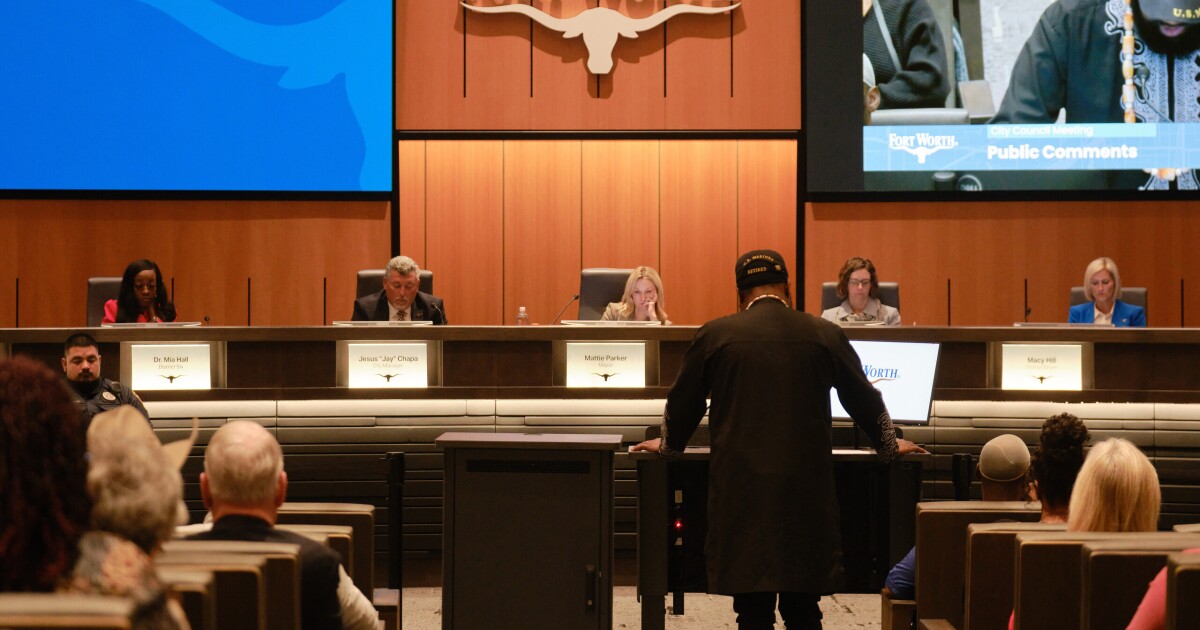
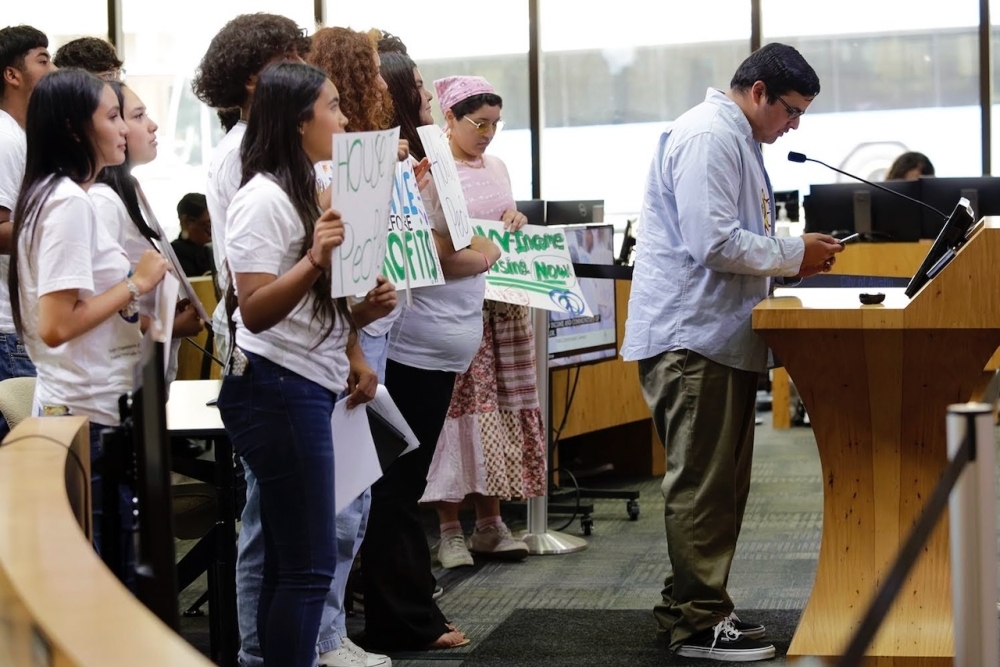
At the December 2 City Council meeting, El Cerrito residents showed up in force — and they were overwhelmingly opposed to yet another long-term tax for a library the city would not own. Six residents spoke against the proposal, raising concerns about the initiative’s structure, its lack of transparency, and the long-term financial impact on taxpayers. Although their perspectives varied, their message was unmistakably aligned: this plan is not ready, not transparent, and not in the best interest of El Cerrito.

A central theme of the evening was the absence of basic financial information. Multiple speakers questioned why the initiative contains no project cost estimate, no revenue target, and no explanation for why taxpayers should begin paying in 2026 for a project that has neither a design nor an approved budget. As several pointed out, the public is being asked to commit to a tax rate before leaders have disclosed what the project will cost, who set the timeline, and whether the proposed amount will be anywhere near sufficient. Residents made it clear that they see this as backward: numbers should come first, not after the tax is already in place.

Another concern centered on the strategy used to place this measure on the ballot. Because the initiative is being brought forward by a citizen group rather than the city, it requires only a simple majority — 50% plus one vote — instead of the 67% threshold necessary for a city-sponsored tax. Speakers noted that past research has shown there is not enough public support to meet a two-thirds requirement. Several warned that this approach appears designed to push through a 30-year tax that might not pass under a higher, more appropriate standard.

Residents also objected strongly to the proposed BART Plaza location and the long-term implications of committing taxpayers to a facility the city will never own. They highlighted congestion, limited paid parking, and the reality that the initiative would lock El Cerrito into a 99-year lease arrangement that could ultimately cost $75 million or more. Others questioned why the city would effectively subsidize a developer by building out a 20,000-square-foot space that might remain vacant if El Cerrito didn’t agree to lease twice the amount of space the city actually needs.

Speakers also asked why more reasonable alternatives have been pushed aside. Several reminded the council that El Cerrito already owns its existing library and that renovation or expansion plans were developed and costed years ago. These options should be revisited.

Others noted the city has several vacant commercial spaces with ample parking that have not been meaningfully evaluated. These residents were not opposed to improving library services; they were opposed to ignoring less expensive, more logical options that would allow the city to own its own facility.

The potential tax burden was another major concern. One resident detailed how the allowable annual increases would affect a typical 1,500-square-foot home: roughly $255 in year one, more than $1,300 within five years, nearly $3,000 by year 15, and more than $6,500 annually after two decades. With no true end date and the ability for future councils to raise the tax without voter approval, residents described this as a financial commitment far too large and far too open-ended.

Finally, several residents noted declining library usage. Speakers who visit regularly described seeing fewer patrons today compared to a decade ago, questioning the need to triple the library’s size at a moment when digital access has changed how people seek information. They emphasized that being pro-library does not mean supporting a poorly conceived plan.

Across all six speakers, the underlying message was consistent: El Cerrito deserves a transparent, financially responsible, well-designed plan — not a rushed initiative with unanswered questions and a price tag that could burden residents for decades. The comments made clear that residents are not anti-library; they are anti-blank-check. They expect alternatives to be evaluated, financial details to be disclosed, and taxpayer interests to be prioritized.

The December 2 meeting demonstrated something important: El Cerrito residents are paying attention, they are informed, and they are unwilling to support another “forever” tax without accountability and a credible path forward.

Speak up. The next chance to be heard is Monday, December 16, at 6:00 PM at City Hall — and if you want to hear directly from the City Manager, attend the State of the City presentation at 5:00 PM the same evening.

Your voice matters. Show up and make sure the decisions being made reflect the community — not just the proponents of another long-term tax.

Are Seniors Really Exempt from El Cerrito’s Library Tax?

El Cerrito neighbors and friends,
you’ve probably heard one line over and over from supporters of the new library tax:

“Seniors are exempt.”

Not “low-income seniors under a strict state program.”
Not “a few seniors who qualify after paperwork and audits.”
Just a blanket “seniors are exempt.”

That isn’t just misleading. It’s false.
And the people leading this effort—City Manager Karen Pinkos and Pro Library Head and former councilmember Greg Lyman—keep using that line even after the facts have been pointed out.

What the ballot language really says

The ballot measure only exempts parcels where an owner qualifies for one of two state programs:

  • The Gonzales-Deukmejian-Petris Senior Citizen Property Tax Assistance Law
  • The Senior Citizen Property Tax Postponement Law

That’s it. No broad city exemption.
No automatic relief.
No “all seniors are exempt.”

What they don’t tell you

The first program has been inactive since 2009.

It has not accepted applications for 15 years, yet it’s still listed in the ballot text as if it were a real option.

The second program has an income cap of $55,181.

In the Bay Area, that excludes most seniors immediately.

And even for the small number who might qualify, this is not a free pass. The state program is a loan against the property—with interest. Seniors must:

  • apply to the state (not the city),
  • submit tax returns and other documents, and
  • meet conditions set by the State Controller’s Office.

That is very different from the simple “senior exemption” being advertised.

A charade built on repetition, not honesty

At this point, the continued use of the “seniors are exempt” claim is not an honest mistake—it is a tactic.

Karen Pinkos and Greg Lyman know:

  • one of the two cited programs no longer operates,
  • the other is extremely narrow,
  • and almost no seniors in El Cerrito will actually see relief.

Yet they keep repeating the talking point anyway. That’s not public service.
It’s a charade designed to calm seniors with something that simply isn’t true.

This tax is bad for every parcel owner

This measure hits every parcel owner:

  • homeowners
  • condo owners
  • small landlords
  • apartment buildings
  • businesses
  • nonprofits that own property

There is no broad, local exemption for seniors.
There is no city-run relief program.
And the City Council can raise the amount by about 5% every year, compounding over time.

So when you hear “Don’t worry, seniors are exempt,” remember:

  • one program is defunct,
  • the other is a hard-to-access state loan,
  • and most seniors will still be paying this tax.

El Cerrito deserves better

Neighbors and friends, we deserve:

  • clear, honest explanations
  • accurate descriptions of who pays and who doesn’t
  • and leaders who don’t rely on half-truths to pass long-term taxes

When a measure depends on misleading voters—especially seniors—it’s a warning sign.

We can support libraries without being misled.
We can demand both a strong library and an honest government.

El Cerrito Is Kicking the Can Again — And Residents Deserve Better

El Cerrito’s Swim Center lap pool needs attention. No one disputes that. The replastering project is a basic, overdue maintenance task, and residents want facilities that are safe, functional, and well-maintained.


What’s at issue is how the City plans to pay for it — and what that decision reveals about the ongoing pattern of pushing financial problems into the next fiscal year instead of addressing them head-on.

This Tuesday, December 2, at City Hall, the City Council will vote on awarding a contract for the Swim Center Lap Pool Replastering Project, City Project No. C3050.9. Staff is recommending that the contract be awarded to Burkett’s Pool Plastering Inc. for $228,103, with an additional $34,215 authorized for potential change orders. That part is straightforward.

The problem is the funding plan. Staff is proposing a one-time allocation from the General Fund for $183,300 — but not this year. They’re pushing it into Fiscal Year 2025–26.

On paper, that might look tidy. In reality, it is yet another example of fiscal sleight of hand that keeps El Cerrito from ever achieving proper financial stability.

Here’s the context residents deserve to know.

The City labor budget is already about 5 percent over budget this year because it did not adequately account for salary and pension costs. These are not random or unpredictable costs. They are the largest drivers of the City’s financial obligations, and they are known in advance. When those numbers are underestimated, the entire financial plan becomes shaky.

Next year, labor costs — including management salaries — will increase even more. The City knows this. The unions know this. Staff know this. The council knows this. These increases are already baked into negotiations and market pressures.

So instead of first fixing the structural problem and adjusting the forecast to reflect real labor and pension costs, the City is committing future General Fund dollars to cover a project today. That means future money — money that should be used to stabilize core services — is being spent before next year’s budget is even built.

That is the textbook definition of kicking the can down the road.

And there’s an additional layer residents should not ignore.

For years, El Cerrito collected a voter-approved pool tax specifically meant to support the Swim Center. Residents were told those dollars would maintain, repair, and improve the pools. Yet much of that revenue quietly went to cover unrelated operating costs instead of the facilities it was meant to protect. As a result, the pools deteriorated while dedicated revenue was diverted to backfill other budget holes. The City is now turning to future General Fund dollars to do work that should have been paid for with the revenue voters had already provided.

This matters. When revenue intended for the pool isn’t used for the pool, residents end up paying twice — once through the special tax, and again through cuts, reallocations, or future-year General Fund obligations.

The General Fund is not play money. It pays for police, fire, streets, parks, recreation, and basic services residents depend on every day. When the City dips into future-year General Fund capacity, it is making tradeoffs — often without saying what those tradeoffs are.

If El Cerrito were on stable footing, with accurate budgeting and healthy reserves, this discussion would look different. But that is not the reality. Instead, we are watching a familiar pattern:

Underestimate labor and pension costs.
Overspend the current year.
Divert dedicated revenue to unrelated uses.
Push new spending into the next year.
Hope future revenues or future councils absorb the impact.
Repeat.

The community has seen this movie before. It’s how El Cerrito ended up on the State Auditor’s High-Risk list for years, burnt through reserves, and keeps returning to taxpayers for more revenue.

The lap pool absolutely needs replastering. But residents also deserve honest budgeting, full transparency, and a commitment to stop pre-committing future dollars — especially when dedicated revenue was already available and spent elsewhere.

And that is why this Tuesday matters.

The City Council will vote on this item on Tuesday, December 2, at City Hall. Residents who care about fiscal responsibility, transparency, and long-term stability should attend.

Show up.
Ask questions.
Express your concerns.

Cities course-correct when residents are paying attention — and El Cerrito needs that now more than ever.

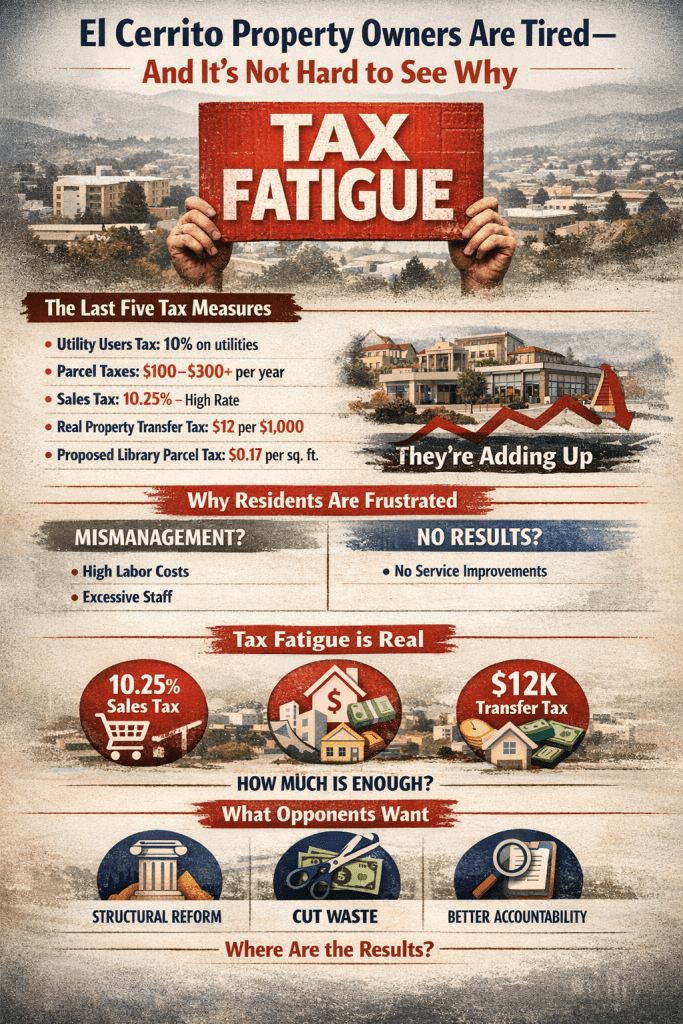
El Cerrito’s Rising Taxes: Decline in Services

For decades, El Cerrito has responded to fiscal pressures with one familiar tool: more taxes. From parcel taxes and storm drain assessments to multiple sales tax hikes and the 1.2% real property transfer tax, voters have repeatedly been asked to approve new revenue streams to “preserve city services” and “prevent cuts.”

Yet today, service levels are declining, crime is increasing, and the city is signaling that additional taxes may be on the horizon.

A History of Rising Taxes — With Little to Show for It

The record is clear:

  • Four separate sales tax measures since 2008 have brought El Cerrito’s local rate to 1%, and in 2024, that tax was made permanent.
  • Layered parcel assessments for storm drains, landscaping, lighting, and parks continue indefinitely.
  • A real property transfer tax was added in 2018, creating a major new revenue stream on home sales.
  • Residents still pay an 8% Utility Users Tax on essential services like gas, water, and telecom.

Despite these layers of taxation, El Cerrito continues to struggle with basic service delivery. Streets and sidewalks remain in disrepair. The Swim Center requires major renovation. Library access is uncertain. The senior center remains closed. The city has no established service delivery standards — and police efforts have not kept pace with community safety needs.

Recent crime trends, including auto burglaries and theft, underscore that higher taxes haven’t translated into stronger public safety or better quality of life.

Time for Fiscal Responsibility

The city must learn to live within its means and focus on improving service delivery — not expanding bureaucracy or chasing new initiatives. Instead of continually turning to taxpayers for more, leaders should focus on:

  • Getting spending under control
  • Prioritizing core services over new programs
  • Improving financial management and accountability
  • Building trust through transparency and measurable results

Residents have shown extraordinary willingness to support the city financially. But after nearly a dozen tax increases, tax fatigue is real. It’s time for City Hall to demonstrate that it can manage existing resources effectively before asking for more.


📊 El Cerrito Tax Measures Since 1993

YearMeasure / DescriptionTypeKey Details
1993Storm Drain AssessmentProperty AssessmentFunds storm drain improvements; ongoing
1996Landscape & Lighting Assessment District (LLAD)Property AssessmentSupports landscaping and streetlights; ongoing
2000Measure HParcel TaxParks & Recreation facilities improvement
2008Measure ASales Tax (0.5%)Street repair and improvement
2010Measure RSales Tax (0.5%)7-year general tax
2014Measure R (Extension)Sales Tax (1.0%)12-year general tax, raised to 1%
2018Measure VReal Property Transfer Tax (1.2%)Charter city conversion; major new revenue
2019Measure H (Extension)Parcel TaxExtended parks tax indefinitely, no increase
2024Measure GSales Tax (1.0%)Reauthorized existing 1% tax permanently
2004Utility Users Tax (Reaffirmed)Utility Tax8% on utilities including telecom, gas, water

🗣 Call to Action: Hold City Hall Accountable

El Cerrito residents have stepped up time and again to keep the city afloat. Now, City Hall must do the same. Before asking for another tax, city leaders should:

  1. Show where the money goes. Publish clear, accessible reports on how each tax dollar is used.
  2. Measure what matters. Establish service delivery standards and report progress publicly.
  3. Rebuild public trust. Make transparency and fiscal discipline the priority — not an afterthought.

📩 Write to the City Council and ask them to focus on results — not new revenue.
Taxpayers have done their part. It’s time for the city to do theirs.


Published by the El Cerrito Committee for Responsible Government (ECCRG)
Working for transparency and accountability since 2020.

Happy Thanksgiving, El Cerrito

As we gather with family, friends, and neighbors this Thanksgiving, I’m reminded of what makes our community so special. El Cerrito is full of people who care deeply—about our neighborhoods, our parks, our local businesses, and most of all, about one another. That spirit of connection is what gives our city its heart.

Over the past year, many residents have stepped forward to ask tough questions, attend meetings, read reports, monitor decisions, and stay engaged in shaping our city’s future. That kind of civic participation is not just admirable—it’s essential.

Thank you for supporting responsible governance.

Thank you for reading the documents.
Thank you for asking the questions.
Thank you for showing up—consistently, thoughtfully, and respectfully.
Thank you for holding our city accountable to the standards that residents deserve.

Our community is stronger because so many people refuse to accept “good enough” when it comes to transparency, financial stewardship, or long-term planning. El Cerrito’s future depends on residents who care enough to understand the details and speak up when things don’t align with common-sense expectations.

This year, your engagement made a difference.
Your vigilance protected your neighbors.
Your voices ensured that important issues didn’t slip quietly into the background.

And your commitment to responsible governance continues to shape a better future for all of us.

As we enjoy this season of Thanksgiving, I hope we all remember the power we have when we stay informed and involved. Our city is at its best when residents participate—not just during election cycles, but all year long.

Wishing you and your loved ones a peaceful, warm, and joyful Thanksgiving.


Thank you again for your dedication to a transparent, accountable, and community-centered El Cerrito.

Happy Thanksgiving, El Cerrito.

El Cerrito Library: Another Case Against the Plaza Project

Why the City Should Pause the Plaza Project, Scrap the Parcel Tax, and Use Existing Buildings Instead

El Cerrito can modernize its library in a faster, more predictable, and far more affordable way — without taking on the financial risk of a $28 million construction project or locking residents into a 30-year parcel tax that escalates with multiple inflation factors.

The current El Cerrito Plaza proposal is the most expensive and least predictable option available. Meanwhile, practical alternatives exist that the City has not fully evaluated. Using existing buildings — such as the vacant Marshall’s or Barnes & Noble — combined with expanding the Stockton Avenue branch offers a lower-cost, lower-risk solution that does not require a parcel tax or provide a financial advantage to a developer.

It is time for the public to see the full picture.

A Practical Alternative: Use Existing Buildings and Expand Stockton

Two large, centrally located retail spaces — the old Marshall’s and the old Barnes & Noble — are currently empty. Both are:

  • 15,000–20,000 square feet
  • Easily accessible from major streets and transit
  • Surrounded by ample on-site parking
  • Available without relying on the Plaza developer’s timeline
  • Ready for quick conversion

These buildings could serve as a temporary or even long-term library while the existing 6,500 sq ft Stockton Avenue library is expanded to 12,000–13,000 sq ft at a reasonable construction cost.

This combination offers:

  • Far lower total cost
  • Predictable timelines
  • Faster delivery of improved library services
  • Guaranteed parking
  • No need for a 30-year parcel tax
  • No developer handout
  • No dependency on delays or negotiations with a private developer

The City has not presented this option alongside the Plaza proposal.

How Much Would a Bridge Library Cost?

Using the City’s own rent and improvement assumptions from the October 2025 library newsletter:

  • Rent: $30/sq ft/year
  • Tenant improvements: $350/sq ft (high-end estimate used by the City)

Since this is only a 3–5 year lease during construction, the cost is straightforward.

20,000 sq ft option

  • Annual rent: $600,000
  • 3-year rent: $1,800,000
  • 5-year rent: $3,000,000
  • Improvements: $7,000,000

Total cost for 3–5 years: $8.8M–$10M

15,000 sq ft option

  • Annual rent: $450,000
  • 3-year rent: $1,350,000
  • 5-year rent: $2,250,000
  • Improvements: $5,250,000

Total cost for 3–5 years: $6.6M–$7.5M

Even using the City’s high-end improvement estimate, short-term leasing costs far less than the Plaza’s projected $28 million — and comes with guaranteed parking and minimal risk.

We could have paid for this option if the City Manager Pinkos had bothered to apply for a grant.   Instead, she’d much rather raise our taxes.

Is the Plaza the Most Expensive Option?

In almost every respect, yes.

Plaza Library (El Cerrito Plaza)

  • Cost estimate increased from $21 million to $28 million
  • No dedicated parking
  • No signed development agreement
  • No guaranteed timeline
  • Two inflation escalators (unprecedented locally)
  • Already years behind schedule
  • Financial structure benefits the developer
  • Requires a 30-year parcel tax to support uncertainty

Given El Cerrito’s fiscal constraints and history of underestimated project costs, the risks are substantial.

Twenty Years of Pursuit, But Conditions Have Changed

Former Councilmember Greg Lyman, City Manager Karen Pinkos, and a small group of insiders have advocated for a new, large library for nearly two decades – except when they had selective memory and cut the budget  ☹

 Their interest is clear, but the environment has changed significantly:

  • Digital access and online research tools have grown
  • Inter-library loan systems are robust
  • Library usage patterns have shifted
  • Construction and borrowing costs are far higher
  • The City’s financial position is weaker than in earlier years

Continuing to pursue a large, custom-designed project in today’s cost environment places significant pressure on taxpayers.

Where Is Our Road Tax Money Going?

Neighbors, we need to pay attention to what’s happening with our roads.

The latest data from the Metropolitan Transportation Commission shows El Cerrito’s pavement condition has fallen sharply—from a PCI score of 83 in 2018 to 66 in 2024, and now 65 as of July 2025. That’s a 17-point drop in just a few years, taking us from Very Good to Fair. Our three-year average PCI is now 68, which is below the median in the Bay Area.

Here’s what makes this even more troubling: this decline happened despite Measure T, our dedicated roads tax. The city raised taxes specifically to maintain and improve our streets, yet our pavement condition continues to deteriorate.

The estimated cost to return our roads to their 2018 condition (PCI 83) is now between $13 million and $27 million, as deferred maintenance becomes more expensive with each passing year.

Source: MTC Pavement Condition Report 2024
https://mtc.ca.gov/sites/default/files/documents/2025-11/%20PCI_table_2024_data_11-10-2025.pdf

So the question is simple: Where is the money going?


How did our PCI fall below the regional median even though we have a dedicated tax?


Why are the city’s stated goals lower than our historical performance—and still not being met?

If you want answers, write to your council members directly and ask why our roads are deteriorating while we are paying more.

Mayor Carolyn Wysinger — cwysinger@ci.el-cerrito.ca.us
Mayor Pro Tem Gabe Quinto — gquinto@ci.el-cerrito.ca.us
Councilmember Lisa Motoyama — lmotoyama@ci.el-cerrito.ca.us
Councilmember Rebecca Saltzman — rsaltzman@ci.el-cerrito.ca.us
Councilmember William Ktsanes — wktsanes@ci.el-cerrito.ca.us

We deserve transparency. We deserve accountability. And we deserve safe, well-maintained roads.

Correction: Clarifying Our Statement About the Library Tax Initiative

One of our readers questioned our earlier statement that the proposed ballot measure does not mention the word “library.” After re-reviewing the filed Notice of Intent and ballot materials, we confirm that the measure does reference funding for a library. Our prior statement was incorrect.


We are issuing this correction because it is the right thing to do. Accuracy matters—especially when discussing long-term taxes that will affect every property owner in El Cerrito.


We also call on the City of El Cerrito to correct its own public statements. For months, City representatives have insisted they are “not involved” in this initiative while simultaneously promoting a library tax at public meetings and funding surveys related to the library. These surveys are more about efficacy, and the city has already loaned the developer large sums of taxpayers’ money.

Residents deserve complete transparency, not selective information.

Why We Still Oppose the Library Tax Initiative

Even with the word “library” included in the text, the larger concerns remain, including:

1. Once the tax is approved, the funds will flow into the General Fund.

El Cerrito has a long pattern of presenting taxes as dedicated to a purpose—only for the revenue to be deposited into the General Fund without meaningful tracking or oversight. This has occurred with the Real Property Transfer Tax, the Utility Users Tax, the Pool Tax, and the 2008 Streets Tax. Promises of reviews, audits, and accountability have repeatedly gone unfulfilled.
On paper, the library initiative states the funds are for a library. In practice, the City’s history shows that those funds will not be segregated, audited, or protected.

2. The City is only at “Stage 1” of its capital project pipeline—but the library is Stage 6.

Under the City’s own adopted roadmap, a new library is far down the priority list. If the tax passes in June, property owners will begin paying in July—immediately and indefinitely—regardless of whether the library moves forward, stalls for years, or is never built. Taxation starts on Day 1. The project is years from readiness.

Our Commitment to Accuracy

We corrected this because facts and transparency matter. We appreciate the reader who raised the question—it made this review possible. Residents deserve honesty, clarity, and accountability from every source, including us.

Is the El Cerrito Library Tax a Community Initiative?

Supporters of a new tax to fund a future library have been quick to call their effort a “citizen initiative.” Legally, that’s correct — 10% of registered voters must sign a petition to qualify a measure for the ballot.

But let’s be honest about what actually happened:

Roughly 1,800 verified signatures — in a city of 18000 voters — does not represent a groundswell of civic engagement.


It represents the bare minimum needed to avoid the more challenging path: a City Council vote requiring at least 4 of 5 council members (66⅔%) to approve placing a special tax on the ballot.

And that’s the point.

This isn’t about citizen empowerment — it’s about political convenience

Greg Lyman — the author of the measure, former councilmember, and long-time Plaza Library promoter — clearly understands the math. He also understands that four City Council votes might not be guaranteed when the stakes involve a permanent tax without clear accountability.

So instead, the initiative route allows:

A simple majority vote of the Council to send it to the ballot
A special tax requiring only a simple majority of voters to pass

All while framing the campaign as “community-led.”
Smart politics? Sure.
Transparent democracy? Not so much.

How Small Is 1,780 Signatures?

El Cerrito has roughly 25,000 residents and 18,000 registered voters.

To qualify this measure, organizers only need about 1,780 valid signatures.

That means:

📌 Only ~7% of residents needed to sign
(1,780 ÷ 17800 ≈ 10%)

Put differently:
90% of the people who will be taxed did not sign the petition.

Yet this small percentage could trigger a forever tax that raises at least $2.7 million every year.

$2.7 Million a Year — Without Saying “Library” Even Once

Supporters call this a library tax. The campaign name includes the library. All messaging promotes the library.

But the initiative language itself:

Does not include the word “library.” Not even once.

Because without naming the purpose, the funding is unrestricted:

  • Pensions
  • Payroll
  • Consultants
  • Routine maintenance
  • Budget holes

The money can be used in any way the city chooses
Even if no new library is ever built.

And the tax:

📌 Has no expiration date

It is forever.

What Residents Are Being Told vs. What’s Actually Written

Here’s the reality in one quick snapshot:

📌 FACT BOX

“Library Initiative” — What the Campaign Says vs. What the Measure Actually Does

Campaign MessagingActual Initiative Language
“This is a library tax.”The word ‘library’ does not appear once.
“Funds will build a new library.”Tax revenue can be spent on anything the City chooses.
“Community-driven initiative.”Only ~10% of residents needed to sign to qualify.
“High level of community support.”“This is about the Plaza Library.”
“This is about a Plaza Library.”No site is required, no project is guaranteed.
“Investing in our future.”Tax lasts forever, even with no library built.
“Urgent need.”City has no project timeline, no cost cap.

Everyone Wants a Library — But We Deserve the Truth

El Cerrito deserves:

🔹 A real project
🔹 A clear location
🔹 Proper cost accountability
🔹 An end date when the purpose is complete
🔹 Funding tied to actual deliverables

Right now, residents are being asked to hand over a permanent revenue stream — with zero guarantees.

We’ve Been Through This Before

El Cerrito has a track record:

  • New taxes are sold for specific community benefits
  • Once passed, revenue sinks into the General Fund
  • Promised improvements never fully materialize

Residents have every reason to approach this measure with eyes wide open.

The Bottom Line

The City didn’t want to risk needing a supermajority of the Council.

So they’re using a technical workaround to create a forever tax — marketed as a library, but not legally required to fund one.

A citizen initiative in legal form? Yes.
A citizen mandate? Absolutely not.

Make Your Voice Heard — This Is Our City

El Cerrito residents are smart. We read the fine print.
And we know when we’re being sold a feel-good story to cover a forever tax.

If the City and political insiders want $2.7 million a year indefinitely,
then they should be honest about what the money is for —
and guarantee it funds a real library.

Until that happens…

📣 Show up and speak up at City Council meetings
📣 Ask direct questions about where the money will actually go
📣 Demand transparency before any tax goes to the ballot
📣 Let leaders know we see through the smoke screen
📣 And if this measure reaches the ballot… Vote NO

Because we all support better services.
We all want a library that serves every part of our community.
But a perpetual blank check is not the way to get it.

El Cerrito deserves real accountability —
not another tax with no guarantees.